A failing supply line and a fixed envelope
An OEM came to us because the supply line for their old forward-curved blower had turned unreliable. The replacement math pointed at low-volume tooling: a bespoke stamping die for a part they buy about 150 times a year.
The old unit was a European-sourced blower whose drawings the customer sent us. Meanwhile, everything around it in their product was already built.
The inherited envelope
- First, 250 m3/h at 2450 RPM, from a 125mm impeller with 50mm blade width.
- Next, 170mm total depth and 180mm height, with a 72 by 77mm exhaust flange.
- Meanwhile a mounting pattern of exactly 86 by 88mm with 5mm holes, into existing bulkheads.
- Finally, 230 V 50 Hz, 80 W and 0.35 A, with Class B insulation and IP44.
Why the dimensions could not move
A 128mm inlet ring and a 94mm motor stick-out sound like details, until you recall they mate with sheet metal the customer has already tooled and stocked.
So one millimetre of drift anywhere and the replacement stops being a replacement. The whole value of the project lives inside those tolerances.
The arithmetic behind low-volume tooling
Here the engineering was faithful copying; the interesting decision was economic. When does a custom die make sense for 150 units a year?
What the customer was actually buying
Not a cheaper fan. Rather, they were buying a secure supply for a product line whose source had failed them, and a steady state for an assembly line that cannot absorb change.
Priced against that, the comparison is not die cost versus unit cost. Instead, it is die cost versus the cost of a product redesign around the closest standard part, then proving it all over again.
The arithmetic, honestly
Low-volume tooling pays itself off slowly. Across 150 units a year, a stamping die adds real cost per fan for several years, and anyone quoting otherwise has hidden the die somewhere in the price.
Even so, it wins here. The other path carries larger, less visible numbers: hours to change the chassis, proving the assembly again, the risk window while both run side by side, and a parts-list change across every product that shares the fan.
Reproducing a part from its drawings
We digitized the customer 2D drawings into 3D CAD and checked the airflow path before cutting anything. After all, a housing can match every dimension and still behave differently if someone reads an internal radius wrongly.
We matched the 125mm impeller and scroll geometry to hit 250 m3/h at 2450 RPM, on a single-phase external rotor motor wound for the 230 V grid directly.
Where we did not upsell
An EC motor would cut the 80 W draw, and we set it aside without ceremony. It would need changes to the customer control circuitry, which contradicts the whole objective of a zero-modification replacement.
In short, a replacement project succeeds by disappearing into the product. Efficiency upgrades belong in the next design, not in this part number. Dimensional conventions follow ISO tolerance practice.
Technical Specifications
Every dimension below is inherited rather than chosen. That inheritance is what the tooling money buys.
| Parameter | Value |
|---|---|
| Airflow | 250 m³/h |
| Input Power | 80 W |
| Speed | 2450 RPM |
| Voltage | 230 V |
| Frequency | 50 Hz |
| Current | 0.35 A |
| Dimensions (WxHxD) | 170 x 180 x 94 mm |
| Exhaust Flange (Outer) | 72 x 77 mm |
| Exhaust Opening (Inner) | 62 x 66 mm |
| Protection Class | IP44 |
| Insulation Class | Class B |
Technical Documentation

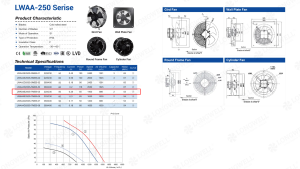
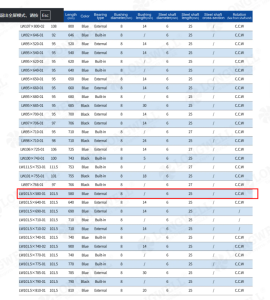
Dimensions table detailing the required flange and housing mounting measurements for the custom tooling process.

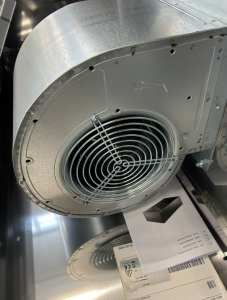
Reference photo of the target forward-curved centrifugal blower showing the required black metal scroll housing and wire mesh inlet guard.

Mechanical drawing specifying the precise physical layout, including the 170 mm by 180 mm overall footprint necessary for direct OEM integration.

Original motor nameplate confirming the 230V, 50Hz, 80W electrical parameters and the critical 250 m³/h airflow performance target.
Deciding your own tooling case
Low-volume tooling is neither folly nor a default. In the end, four questions decide each case.
- Price the alternative, not just the die. The honest comparison for low-volume tooling is against redesign, requalification and parallel-running risk. If those are small, buy the closest standard part. If they are large, the die is the cheap option wearing a costly label.
- Count every product that shares the part. A die paid off across one SKU at 150 units looks thin. The same die feeding three product variants, or a ten-year service duty, changes the math entirely.
- Settle die ownership and lifespan in the quote. At low volume the die outlives many orders. So agree who owns it, where it lives, what its upkeep costs, and what happens if either party walks away.
- Demand a measured first article against the inherited drawing. The whole premise is getting the numbers right, so the proof is a measured first article, not a visual match. Every interface dimension, on paper, before the batch runs.
See our centrifugal fans range, the forward-curved fans section, or centrifugal blowers.
Questions about small-batch tooling
Is there a volume below which tooling never makes sense?
There is no fixed line, because the comparison runs against the cost of not tooling at all. For instance, a deeply integrated part can justify a die at a few dozen units a year, while a generic part with good standard substitutes cannot justify one at thousands.
Why not 3D print or fabricate the housing instead?
For prototypes and very small counts, fabrication works. However, at 150 units a year for years, per-unit fabrication labor overtakes the die cost surprisingly fast, and stamped consistency wins where every interface dimension carries the project value.
What should a low-volume tooling quotation contain?
The die cost split out from the unit price, the die life in strokes, ownership terms, storage and upkeep duty, and the first-article measuring plan. A quote that blends the die into the unit price hides exactly the numbers you need.
Could the customer not just hold more stock of the old part?
Stockpiling buys time, not a solution. The supply line stays broken behind the buffer, and capital sits in aging inventory. So it is the right bridge while tooling gets cut, which is how it was used here, and the wrong destination.
Working on something similar?
Send us the duty point, the envelope and the supply, and our engineers come back with a shortlist rather than a catalog. Meanwhile custom spec sheets and samples run to 90 days. Since 1990 we have built fans for HVAC, cold chain, data center and industrial OEMs.
Browse Related Products:
🏆 ISO 9001 / ISO 14001 / ISO 45001 | CE (TÜV) | UL/ETL | ATEX Zone 21/22 | AMCA 210/211 / ISO 5801 tested
Choose the right centrifugal fan
Longwell manufactures 1,130 centrifugal fans in-house. Send airflow, static pressure and voltage — an engineer replies with a matching model, performance curve and price within one working day.