What the convector maker needed
A European HVAC OEM needed documentation for a cross-flow fan with a segmented impeller, going into a new line of trench convectors.
The envelope was 1113mm long by 70mm wide by 70mm high. In other words, a meter of fan in a channel narrower than a hand.
The constraints
- First, native operation on a 24 VDC bus, with no inverter.
- Next, airflow above 550 m3/h with low static pressure.
- Meanwhile under 45 dB(A), since these go into offices and hotel lobbies.
- A 0-10V input, so the building management system can modulate against thermal load.
- Finally, CE compliance for the European market.
They had already identified a model and wanted 3D and 2D data quickly, because their design was on a fast track.
Why the segmented impeller works
Here the model matched the constraints directly. However, one detail deserves explaining, since it is why a fan this long works at all.
What happens to a long rotor
A cross-flow impeller is a long, slender cylinder. Over 1055mm of active length at 1800 RPM, two things go wrong with a single continuous rotor.
First it sags under its own weight between the bearings, which changes the clearance to the housing along its length. Second, a long slender rotor has bending modes at frequencies that a fan can easily excite, and once it resonates the noise and the wear both climb.
Three sections instead of one
Instead the design uses a segmented impeller: three aluminum sections along the active length rather than one continuous piece.
Consequently each segment is short enough to stay stiff, and the assembly does not behave like a single long beam. That moves the bending modes well away from the operating speed, and it keeps clearance consistent from end to end.
Furthermore a segmented impeller tolerates manufacturing variation better. Holding straightness over one meter is far harder than over a third of it.
Why EC was already settled
Their system is DC-native. An AC motor would need an inverter, which means cost, a failure point, and heat to manage inside a 70mm channel that has nowhere to put it.
The EC motor connects straight to the rail, takes the 0-10V signal directly, and provides a tachometer output so the building management system can see whether the fan is turning.
The rest of the structure
A steel frame with aluminum housing gives rigidity across the span at sensible weight. Meanwhile aluminum carries heat away from the motor.
Meanwhile the finished fan delivers 574 m3/h at 42 Pa, measuring 44 dB(A), across a -25C to +60C range that covers both heating and cooling cycles.
What it cost
Assembly complexity. A segmented impeller has more parts than one rotor, and every joint must be concentric or the balance suffers.
That is a manufacturing cost rather than a customer-facing one, and it buys a fan that stays quiet over a meter. A single-piece rotor at this length would be cheaper to make and worse to live with.
Technical Specifications
Note the length against the height and width below. In effect that aspect ratio is what makes a segmented impeller necessary.
| Parameter | Value |
|---|---|
| Model | LWCD-501055MN-06 |
| Voltage (VDC) | 24 |
| Current (A) | 0.6 ±10% |
| Speed (RPM) | 1800 ±10% |
| Maximum Airflow | 574 m³/h / 337 CFM |
| Maximum Static Pressure (Pa) | 42 |
| Noise [dB(A)] | 44 |
| Speed Control | 0-10V / PWM |
| Signal Output | FG (Tachometer) |
| Overall Dimensions (L x W x H) | 1113 x 70 x 70 mm |
| Mounting Centers (Length) | 1065 mm |
| Bearings | Ball Bearing |
| Insulation Class | B |
| Operating Temperature | -25°C to +60°C |
Technical Documentation
The following documents were provided to the customer to support their system design and integration process.
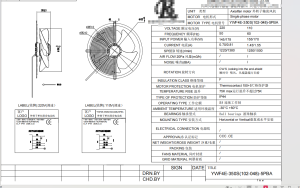
LWCD-501055MN-06 Technical Drawing & Specification Sheet (PDF)
The document provides OEM design engineers with all critical mechanical dimensions, mounting points, electrical specifications, and material details required for CAD integration.
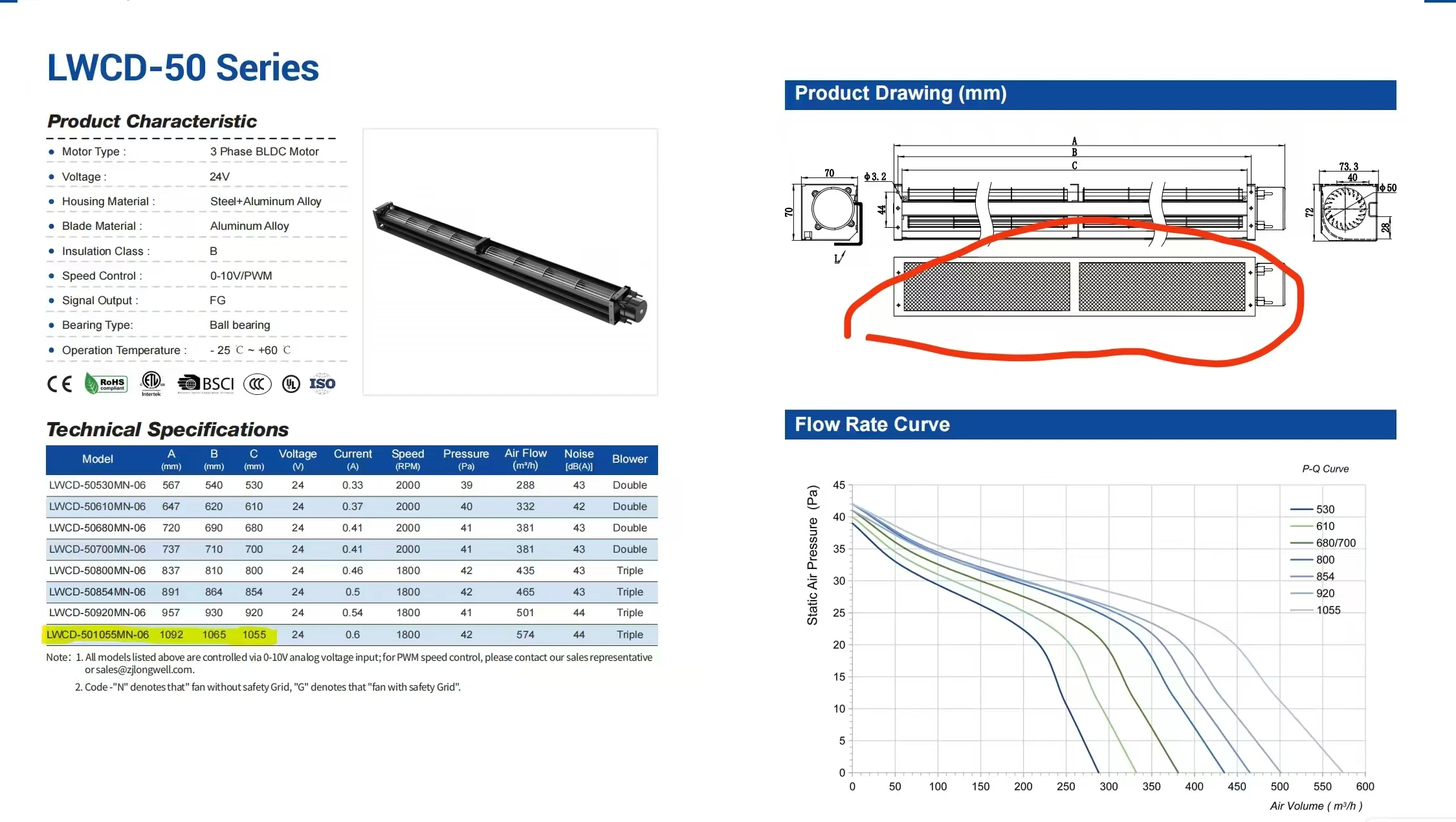
Here the product image shows the complete assembly of the LWCD-501055MN-06 cross-flow fan, including the EC motor, housing, and triple-impeller configuration.
If you are specifying a long-span fan
Long, narrow fans behave differently from short ones. So these matter once the span passes roughly half a meter.
- Ask how the rotor is constructed over long spans. A single continuous rotor past about 600mm is a warning sign rather than a simplification. So ask about segmentation, bearing support and the bending mode margin against operating speed.
- Match the active length to the opening, not the housing. Overall length includes the motor and end supports. The active impeller length is what actually produces air, and that is the figure that has to cover your outlet.
- Watch the clearance tolerance along the length. Cross-flow fans depend on close clearance to the housing vortex wall. A rotor that sags gives inconsistent clearance, which shows up as uneven airflow and localised noise.
- Take the tachometer output. A trench convector fan is buried in a floor channel. If it stops, nobody sees it. A speed signal to the building system turns a hidden failure into a work order.
See our cross flow fan range, the cross flow impeller section, or DC cross flow fans. Balance grades follow ISO 21940.
Questions about long impellers
Why not simply make one long impeller?
Because a slender rotor over a meter sags between its bearings and resonates at frequencies the fan can excite. Both effects grow quickly with length. Segmenting keeps each section stiff, moves the bending modes away from operating speed, and makes the straightness tolerance achievable in production.
Do the joints between segments cause vibration?
Not when they are concentric, which is what the assembly process controls. Each joint is aligned and the whole rotor is balanced as a unit. Admittedly a poorly made segmented impeller would be worse than a single piece. Consequently the manufacturing method matters as much as the design.
What airflow does the active length actually give?
This fan delivers 574 m3/h at up to 42 Pa across 1055mm of active impeller. Airflow scales roughly with active length at a given diameter and speed, so a shorter version of the same design produces proportionally less. Specify the opening you need to cover and we will work back from it.
Is 44 dB(A) quiet enough for a hotel lobby?
Generally yes, since it sits close to typical background level in an occupied public space. That figure is at full speed, and the 0-10V control lets the system run slower most of the time. Ask for the noise at your expected duty point rather than at maximum.
Technical Documentation & Resources
Have a fan requirement like this one?
Send the datasheet you are working against, or simply the duty point. Then our engineers tell you what fits and what does not. Meanwhile custom spec sheets and samples take up to 90 days. Since 1990 we have been building fans for OEMs worldwide.
Browse Related Products:
🏆 ISO 9001 / ISO 14001 / ISO 45001 | CE (TÜV) | UL/ETL | ATEX Zone 21/22 | AMCA 210/211 / ISO 5801 tested
Choose the right fan impeller
Longwell manufactures 10 fan impellers in-house. Send airflow, static pressure and voltage — an engineer replies with a matching model, performance curve and price within one working day.