What the OEM wanted to change
An OEM had our LWFE3G180-092SS-02 EC centrifugal fan inside an air handling unit, giving 927 m3/h. However, a new product generation needed far more air.
The request was two words long in the original. Increase airflow. However, the constraints around it were anything but loose.
- A drop-in fit inside 301.9 by 262.3 by 180mm, since any change means retooling their sheet metal.
- A 230 VAC supply, likewise unchanged.
- 0-10VDC analogue control, so their board stays as it is.
- Finally, performance verified to AMCA 210/211 rather than estimated.
- Safety compliance with EN 60335-1 for European markets.
That first point is the whole project. A larger fan would solve the airflow problem at once. Equally, it would cost the customer an enclosure redesign, new tooling and a fresh round of validation. In practice that is not an upgrade at all.
Finding a bigger EC centrifugal fan that still fits
Analysis confirmed the obvious first. The existing 220W motor at 2200 RPM had reached its ceiling, so spinning it faster would not deliver the gain required.
Keeping the forward-curved impeller
We settled one decision early and deliberately. The forward-curved design stays.
Forward-curved wheels excel at high flow against the moderate pressure an air handler presents. Switching to backward-curved would change the character of the fan entirely. Moreover, at these pressures it would not have helped.
Same housing, different motor
So the search became specific. Namely a model in our range sharing the housing and mounting geometry, with a stronger motor and a retuned impeller.
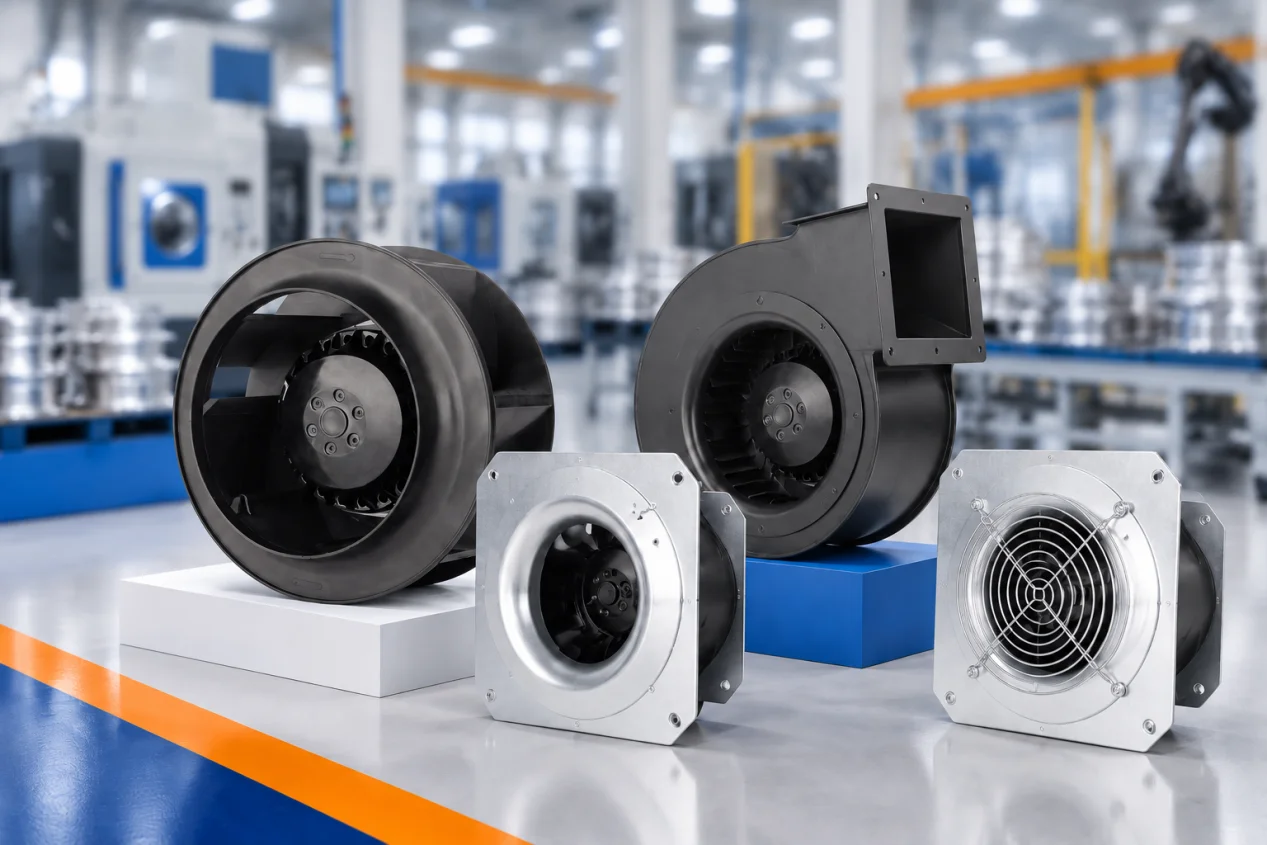
Here the answer was the LWFE3G180-102SS-03-00. Identical outside dimensions, identical mounting points, and a 500W motor in place of the 220W unit. At 2400 RPM this EC centrifugal fan reaches 1380 m3/h, close to 50% more air from the same envelope.
The three honest trade-offs
None of that comes free. Consequently the customer heard all three before deciding.
- Noise rises from 68 to 78 dB(A). Ten decibels is a lot. Even so, the customer confirmed it was fine in their application.
- Protection drops from IP55 to IP44. That was accepted too, since the fan runs indoors in a clean space.
- Insulation improves from Class B to Class F. Consequently there is a wider heat margin for the bigger motor.
One extra benefit came with the newer platform. Its SmartEC controller keeps the existing 0-10V and PWM signal, and it adds RS485 Modbus. Consequently the customer can move to digital control later without changing supplier.
Technical Specifications
Compare the noise and IP rows against the airflow row. Those are the trade-offs the customer accepted in exchange for the extra air from this EC centrifugal fan.
| Parameter | LWFE3G180-092SS-02 (Baseline) | LWFE3G180-102SS-03-00 (Solution) |
|---|---|---|
| Model Type | EC Forward Centrifugal Fan | EC Forward Centrifugal Fan |
| Nominal Voltage | 230 VAC | 230 VAC |
| Air Flow (Max) | 927 m³/h / 545 CFM | 1380 m³/h / 812 CFM |
| Static Pressure (Max) | 824 Pa | 937 Pa |
| Speed | 2200 RPM | 2400 RPM |
| Maximum Input Power | 220 W | 500 W |
| Maximum Input Current | 1.6 A | 2.5 A |
| Noise Level (LpA) | 68 dB(A) | 78 dB(A) |
| Operating Temp. Range | -25°C to +60°C | -25°C to +60°C |
| Protection Type | IP55 | IP44 |
| Insulation Class | Class B | Class F |
| Dimensions (H x W x D) | 301.9 x 262.3 x 180 mm | 301.9 x 262.3 x 180 mm |
| Control Interface | 0-10VDC / PWM | 0-10VDC / PWM / RS485 |
| Certifications | CE, RoHS, Reach, UL/CSA | CE, RoHS, Reach |
Technical Documentation
Baseline Specification (LWFE3G180-092SS-02)
The document details the performance and specifications of the original fan, serving as the baseline for the upgrade project.
Final Specification (LWFE3G180-102SS-03-00)
Meanwhile the final approved specification sheet for the new fan, containing detailed performance curves, electrical data, and control interface protocols for system integrators.

The final LWFE3G180-102SS-03-00 solution with a 500W EC motor, engineered for higher airflow output.
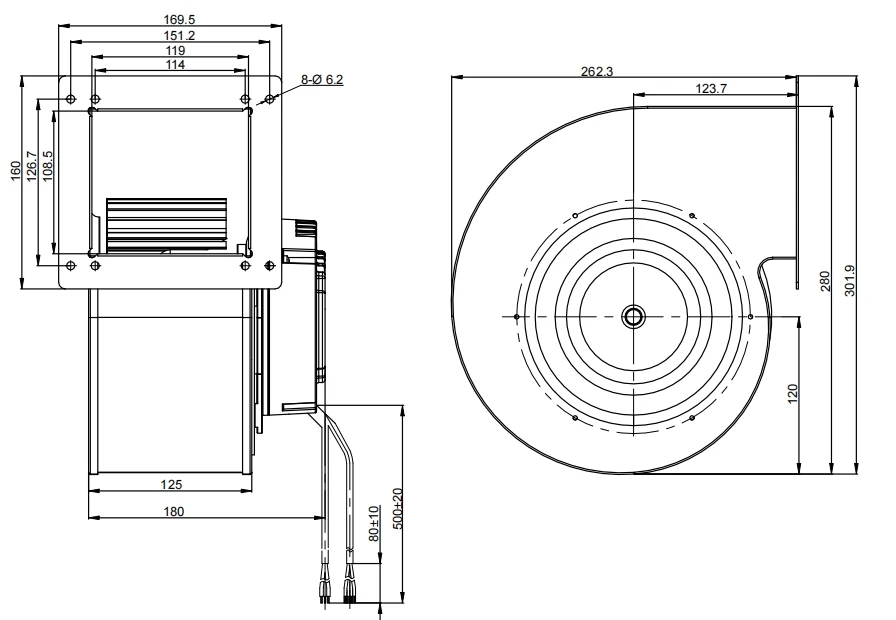
Here the dimensional drawing confirms the identical mounting pattern and external geometry, validating the unit as a true drop-in replacement.
Why the upgrade stayed with us
This was more than a part swap. In the end, four things made it work.
- An existing model beat a custom one. Rather than open a 12 to 18 month NPI cycle, our engineers found a model that fits and performs better, already in the range. The whole job ran as light development and finished in weeks.
- Nearly 50% more air, zero mechanical change. Identical housing and mounting points meant no retooling and no revalidation. Consequently, for the customer, that saving dwarfs the price of the EC centrifugal fan.
- A performance uplift at a sensible price. The customer avoided a custom development premium and a European equivalent alike. Consequently the finished EC centrifugal fan lands materially below comparable models.
- A control platform with somewhere to go. RS485 Modbus sits beside the old 0-10V input. Therefore the next product can move to digital control and fault reporting without a supplier change.
Browse our EC forward-curved centrifugal fan range, or the centrifugal fan section generally. Test methods are published by AMCA International.
Questions before you swap one in
What L10 life applies at maximum temperature?
Here the datasheet quotes 40,000 hours L10 at 40C and 15 to 65% humidity, on maintenance-free ball bearings, with the fan rated to +60C ambient. Running continuously at the top of that range shortens the figure. Send us your duty cycle for a specific calculation.
Is it truly a drop-in replacement?
Mechanically yes, since the outside dimensions and mounting pattern are identical. Electrically, however, check two things. Maximum input power rises from 220W to 500W, so verify your power budget. Protection falls from IP55 to IP44, so verify the environment is genuinely controlled.
Does RS485 need a different harness?
Only if you use it. RS485 sits on pins U3 and U4 of the L2 control connector, while the 0-10VDC and PWM control stays on pin U5. Existing wiring works unchanged for analogue or PWM control, and Modbus simply needs the two extra bus wires connected.
Why does a 50% airflow gain cost 10 dB(A)?
Because fan noise rises steeply with tip speed and with the air velocity leaving the wheel. Getting much more air from the same diameter means turning faster, and nobody does that quietly. Had the noise been unacceptable, the answer would have been a bigger fan and a redesigned enclosure.
Technical Documentation & Resources
Got a duty point you need matched?
Tell us the airflow, the pressure and the space you have. Then we mark your duty point on a tested curve and send the drawing back. Meanwhile samples and custom spec sheets take up to 90 days. Since 1990 we have supplied OEMs across HVAC, refrigeration and industry.
Browse Related Products:
🏆 ISO 9001 / ISO 14001 / ISO 45001 | CE (TÜV) | UL/ETL | ATEX Zone 21/22 | AMCA 210/211 / ISO 5801 tested
Choose the right centrifugal fan
Longwell manufactures 1,130 centrifugal fans in-house. Send airflow, static pressure and voltage — an engineer replies with a matching model, performance curve and price within one working day.