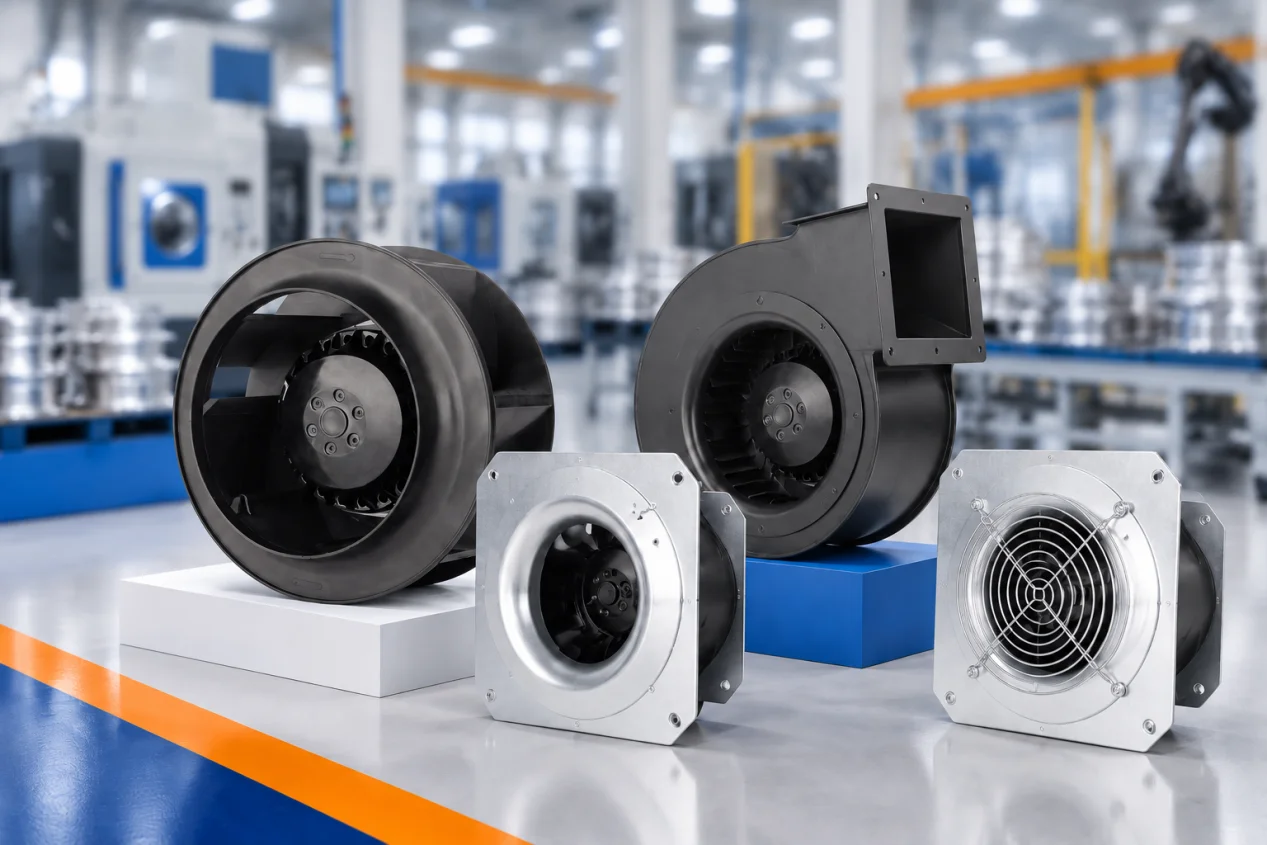
What the OEM needed
A maker of compact HVAC systems asked for 1700 m3/h from a 180mm double-inlet AC centrifugal fan. That is a specific request with an awkward answer.
They named one of our existing models as the baseline, which set a hard limit at once. Consequently the new fan had to drop into a finished chassis, with no change to the enclosure.
Meanwhile volume was forecast at 4,000 units a year, against a firm per-unit budget ceiling.
Why this was not straightforward
The reference AC centrifugal fan gives 1205 m3/h from a 200W motor at 1250 RPM. So the request meant 41% more airflow inside the same 180mm housing.
Notably, no impeller profile or volute tweak recovers a gap that size. It needs shaft power the existing motor simply does not have.
- First, supply was a standard 220-230 VAC at 50Hz.
- Second, the physical envelope could not change at all.
- Next, expected service life was 30,000 hours or better on an L10 basis.
- Finally, EN 60335 safety and ISO 5801 performance verification were both implied by the European market.
Three routes for the AC centrifugal fan
We looked at three routes to close a 495 m3/h gap. However, two of them failed on inspection.
Route one: spin the existing motor faster
Rejected at once. Driving a 200W motor hard enough to reach the target pushes it past its thermal and mechanical limits.
It would pass on a test bench, then fail in the field well short of 30,000 hours. In short, that is the worst kind of answer, since the problem only shows up after shipping.
Route two: move to an EC motor
Certainly an EC fan reaches the airflow, with better efficiency and SmartEC speed control included.
However, at this performance class an EC motor would have broken the customer budget ceiling. Furthermore the application does not need variable speed at all, so the drive platform would be paid for and never used.
Route three: a bigger AC motor in the same frame
This is the route we took. Our engineers found a stronger four-pole AC induction motor in the library that fits the identical frame.
It is rated 325W at 1400 RPM, against the original 200W at 1250 RPM. Consequently the extra shaft power lifts impeller speed enough to reach the duty point and beat system resistance.
What it cost
Noise rose from 63 dB(A) to 66 dB(A). We put that in front of the customer rather than in a footnote. Ultimately they judged 3 dB(A) a fair price for 41% more air.
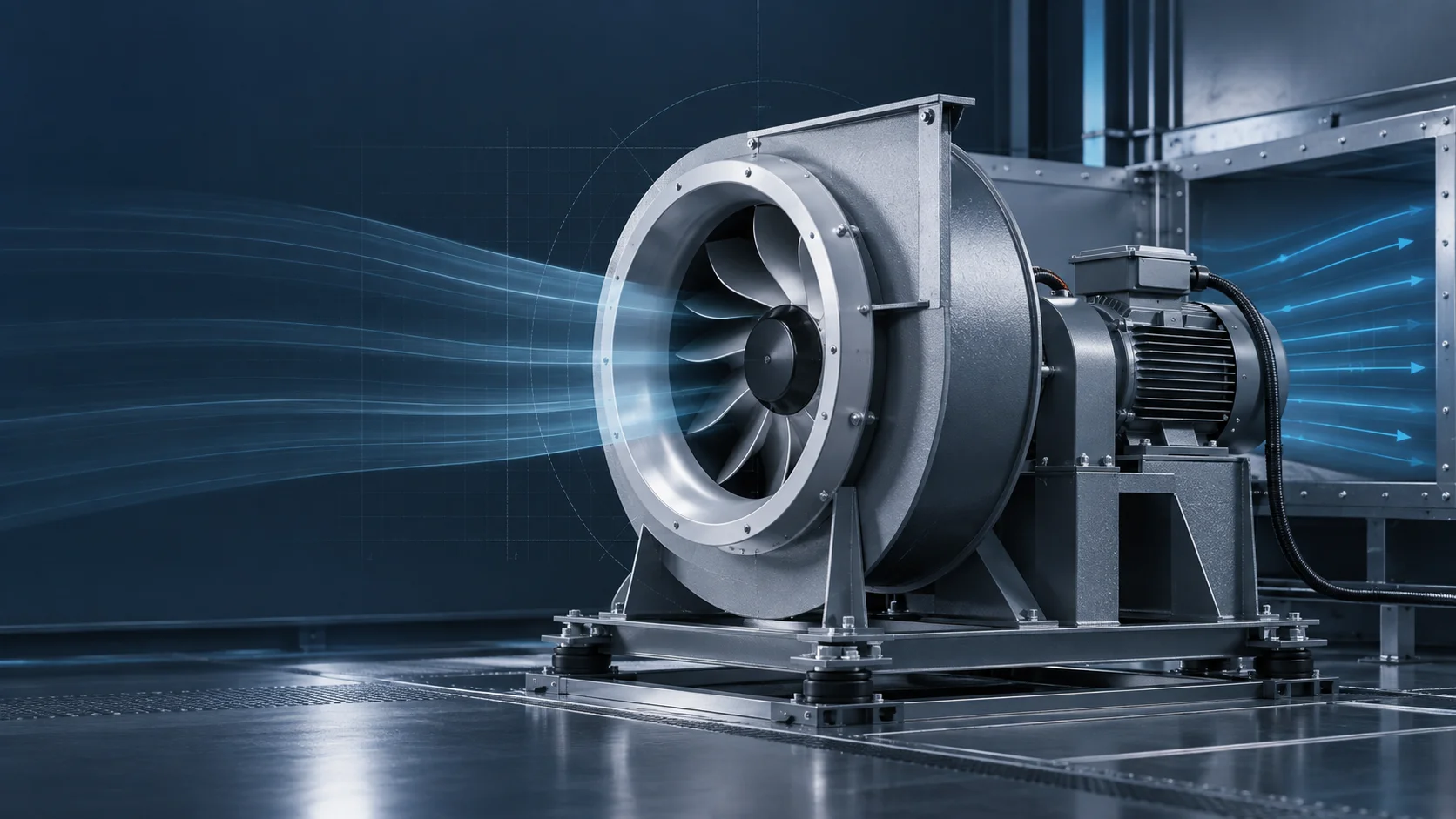
Here the finished AC centrifugal fan reaches 2163 m3/h, clearing the 1700 m3/h duty point easily. Meanwhile it keeps IP54 protection, Class F insulation and the -40C to +60C range from our ThermoFlex work.
Technical Specifications
The finished AC centrifugal fan specification is below. Compare its power and speed against the model it replaced.
| Parameter | Value |
|---|---|
| Model Number | LWFA4E180-092DS-07-00 |
| Nominal Voltage [VAC] | 220 |
| Voltage Range [VAC] | 198~242 |
| Frequency [Hz] | 50 |
| Speed [RPM] | 1400 |
| Current [A] | 1.45 |
| Power Input [W] | 325 |
| Air Flow (Max) [m³/h] | 2163 |
| Air Flow (Max) [CFM] | 1272 |
| Static Pressure (Max) [Pa] | 227 |
| Noise Level [dB(A)] | 66 |
| Capacitor [μF] | 8 |
| Ambient Temperature Range [°C] | -40 to +60 |
| Insulation Class | Class F |
| Protection Type | IP54 |
| Work System | S1 (Continuous Duty) |
| Life Expectancy | 30,000 Hours (L10) @ 40°C |
| Bearing Type | Maintenance-free deep groove ball bearings |
| Certifications | CE, RoHS, Reach |
Technical Documentation
Final Specification Sheet (LWFA4E180-092DS-07-00)
The final specification sheet provides complete performance data, the P-Q curve, mechanical drawings, and electrical diagrams for system integration.

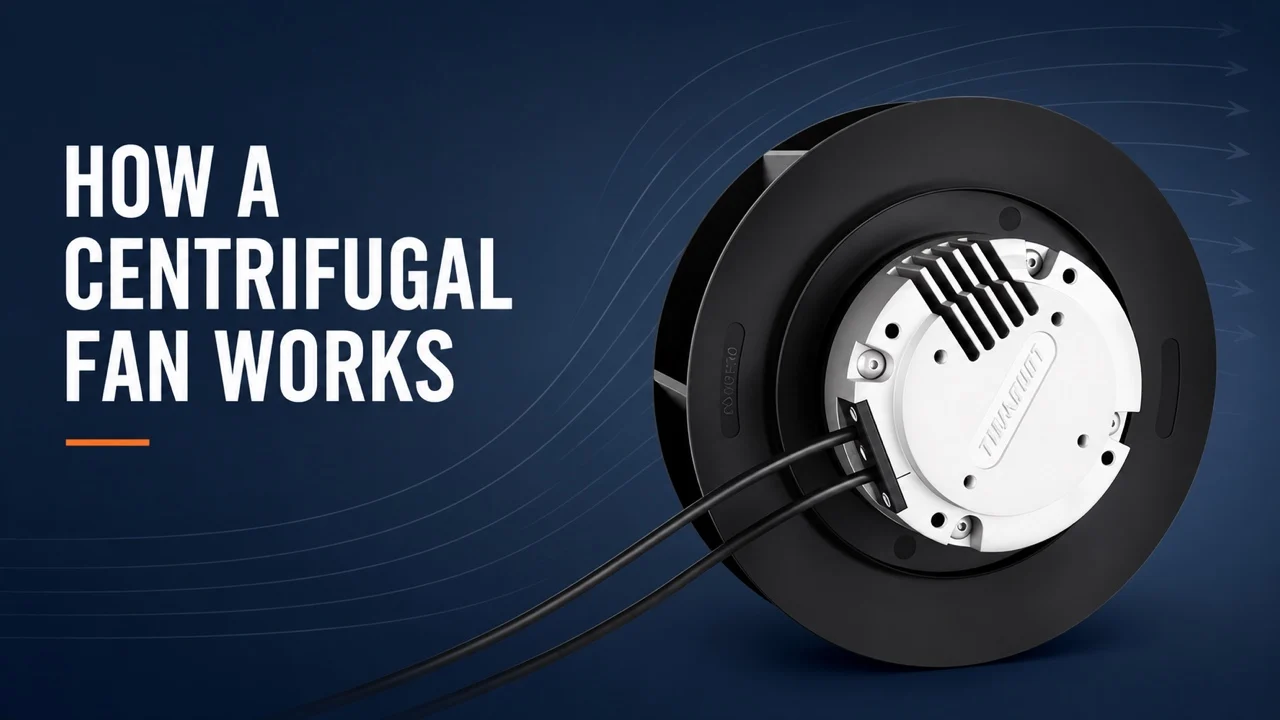
Here the image, provided by the customer, shows the original reference model LWFA4E180-092DS-01 that formed the dimensional baseline for the customization request.
Source Document: LWFA2E180-092DS-06-00.docx
This internal project document contains source data for a related project variant, used as a reference during the development process.
Source Document: LWFA4E180-092DS-07-00.docx
Above, the document contains the source data and revision history for the final approved engineering deliverable.
Why the OEM brought it to us
Meanwhile the project turned on three things. Notably, none of them was aerodynamics.
- A modification, not a redesign. The customer needed more performance without waiting for a new product. Our light customization route produced a costed, specified solution with a new part number and documents in weeks, against the 12 to 18 months imported European brands quote for new introductions.
- Depth of motor catalog. Hitting the airflow target inside the budget was the whole problem. Solving it meant finding the right motor from a deep AC catalog rather than developing one, which is what kept the price materially below a comparable European fan.
- Capacity behind the forecast. Four thousand units a year needs proven output. Our Ningbo facility builds over 120,000 data center fans and 30,000 cold chain units annually, so a blanket order of this size is routine scheduling.
See our centrifugal fan range, or the forward curved fan section. Appliance safety follows IEC 60335-1.
Questions about this fan
Does the new fan really drop into the old chassis?
Yes. The housing, mounting and inlet dimensions are unchanged, which was the whole point. Only the motor differs. However, check your electrical supply, since this AC centrifugal fan draws 1.45A rather than the original figure.
Why does 3 dB(A) more noise matter enough to mention?
Because 3 dB(A) is roughly a doubling of sound power, even though most people hear it as a modest increase. On a compact HVAC unit installed indoors, that can be the difference between acceptable and complained about. It is worth checking against your own product limit before committing.
Could a better impeller have closed the gap instead?
Not this gap. Impeller work typically buys a few percent, or ten in a badly matched design. By contrast, recovering 41% means adding shaft power, and shaft power comes from the motor. So anyone promising that much from blade geometry alone is worth questioning.
What is the lead time at 4,000 units a year?
A volume like that runs as a blanket order with scheduled releases rather than one shipment. First production typically takes 30 to 45 days after drawing sign-off. Afterwards, scheduled deliveries against a rolling forecast run 15 to 25 days.
Technical Documentation & Resources
Sizing something comparable?
Share the airflow, pressure, voltage and control interface, and we come back with a tested curve and a drawing. Meanwhile custom work runs to 90 days for spec sheets and samples. Since 1990 Longwell has supplied fans to HVAC and industrial OEMs.
Browse Related Products:
🏆 ISO 9001 / ISO 14001 / ISO 45001 | CE (TÜV) | UL/ETL | ATEX Zone 21/22 | AMCA 210/211 / ISO 5801 tested
Choose the right centrifugal fan
Longwell manufactures 1,130 centrifugal fans in-house. Send airflow, static pressure and voltage — an engineer replies with a matching model, performance curve and price within one working day.