What the OEM needed documented
An industrial equipment OEM asked for a formal specification sheet on a 250mm 380V 60Hz axial fan.
They had already identified our LWAA-250 series as a likely fit. Consequently the job was to validate that choice and issue the official documentation for their technical file and bill of materials.
The constraints
- First, a three-phase 380V supply at 60Hz.
- Next, continuous S1 duty across an ambient range of -30C to +60C.
- Meanwhile the 250mm frame had to fit inside 263 by 263 by 80 mm.
- IP44 protection was the minimum, covering solid objects over 1mm and splashed water.
- Finally, CE marking and conformity with EN 60335-1 for the European market.
The target was roughly 1854 m3/h free air, with the real operating point set by their own system resistance.
That temperature range says something about where the fan goes. A -30C to +60C span points at unconditioned industrial space: control cabinets, power distribution units or localized process cooling.
Confirming the 380V 60Hz axial fan
Here the customer choice checked out. So the work was picking the exact 380V 60Hz axial fan variant and formalizing its data.
Why AC rather than EC
An EC version would offer variable speed and better efficiency. However, the request pointed at a standard AC motor, and that reading was sound.
An AC fan drops into a simple existing control system with no 0-10V or PWM wiring to add. Consequently it avoids cost and complexity the application never asked for.
Five blades or seven
The series comes with different blade counts, and the choice matters more than it sounds.
We selected the five-blade impeller. Across the family P-Q curves, that layout is tuned for high airflow at low to medium static pressure. In short, exactly this duty, and it delivers the 1854 m3/h target.
A seven-blade version would build more static pressure. However, this application does not need it, and seven blades would also be noticeably louder than the 67 dB(A) the chosen model gives. Paying in noise for pressure you will not use is a poor trade.
The reliability details
Meanwhile the impeller is cold-rolled steel, which holds its shape in industrial duty. Meanwhile Class F insulation is rated to 155C, leaving a wide margin above the +60C limit.
Furthermore, maintenance-free deep groove ball bearings deliver the 30,000-hour L10 life under continuous S1 running.
Technical Specifications
The full specification is below. Note the current draw, since 130W on three-phase is light for this airflow.
| Parameter | Value |
|---|---|
| Model Number | LWAA2D250S-5MKW-47-00 |
| Nominal Voltage | 380 VAC |
| Voltage Range | 342 ~ 418 VAC |
| Frequency | 60 Hz |
| Input Power | 130 W |
| Current | 0.22 A |
| Speed | 2600 RPM |
| Max Air Flow | 1854 m³/h / 1091 CFM |
| Noise Level (LpA) | 67 dB(A) |
| Operating Temperature | -30°C to +60°C |
| Insulation Class | Class F |
| Protection Class | IP44 |
| Life Expectancy (L10) | 30,000 Hours @ 40°C |
| Impeller Material | Cold-rolled steel |
| Work System | S1 (Continuous) |
| Certifications | CE, RoHS, Reach |
Technical Documentation
Here the following documents provide the full technical details for system design engineers and procurement managers.
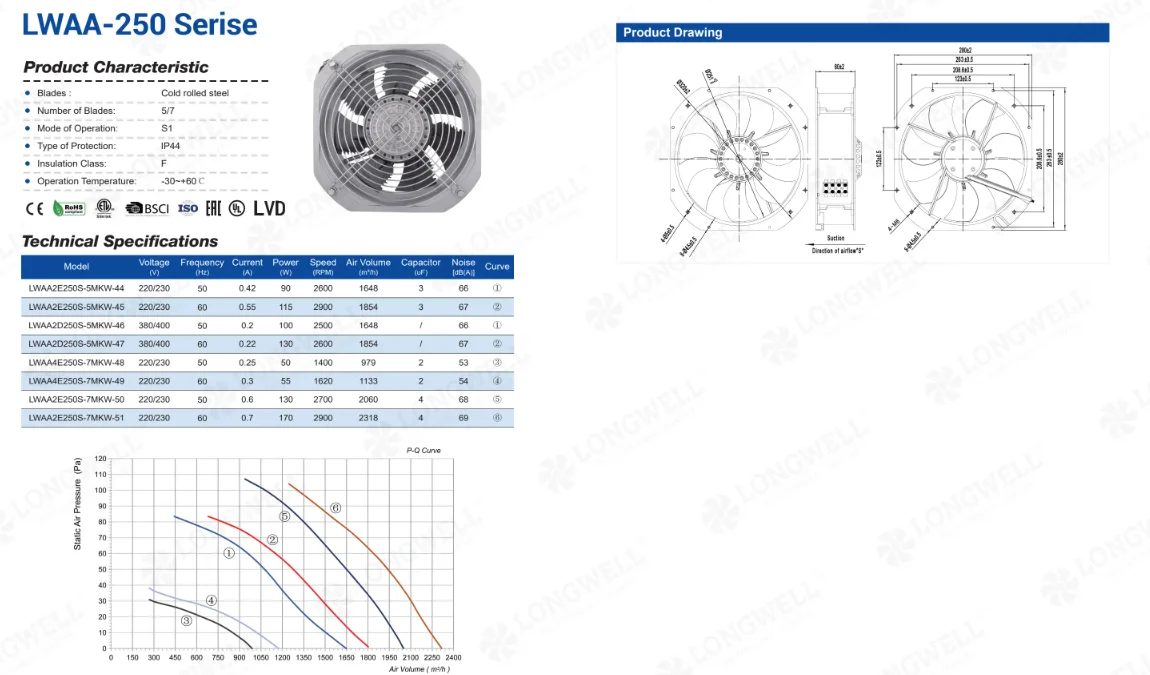
An overview of the LWAA-250 series, showing performance curves and key product characteristics for initial evaluation by application engineers.
For complete engineering data, download the final approved specification sheet: Technical Specification: LWAA2D250S-5MKW-47-00.
The final approved technical specification sheet contains all dimensional drawings, electrical data, and performance curves required by design engineers for system integration and by procurement for order confirmation.
Why the OEM sourced it here
Even a standard 380V 60Hz axial fan request says something about a supplier.
- Documentation without the wait. The request moved from enquiry to confirmed specification through an efficient internal workflow. OEM engineers get validated data for their technical file straight away, rather than waiting weeks.
- Specification kept intact. This 380V 60Hz axial fan offers S1 continuous duty and Class F insulation, and neither was traded away to manage cost. On a fan expected to run continuously, those are the two lines worth protecting.
- Data you can simulate with. The P-Q curve comes from testing to ISO 5801 and AMCA 210/211 methods. Consequently engineers can use it in system design and CFD work with confidence rather than caution.
See our axial fan range, or the industrial axial fan section. Ingress ratings come from IEC 60529.
Questions about this fan
What changes between the 50Hz and 60Hz versions?
Motor speed, and therefore everything downstream. On 60Hz the fan turns faster, so airflow and pressure both rise. Meanwhile noise rises with them. If your equipment sells into both markets, ask for both datasheets rather than scaling one by hand.
Is IP44 enough for an industrial site?
It depends where the fan sits. IP44 handles dust particles over 1mm and splashing water from any direction, which covers most cabinet and indoor process duty. However, for fine dust, washdown areas or outdoor mounting you want IP54 or higher. Tell us the environment and we will confirm the right rating.
Can this run on a variable frequency drive?
Yes, within limits. This 380V 60Hz axial fan uses a three-phase induction motor, so a correctly sized drive works. However, sustained running at low frequency reduces motor cooling. Where a wide speed range is the real goal, an EC fan holds efficiency at part load instead of losing it.
How much difference does blade count really make?
More than most specifications suggest. More blades build more pressure at a given diameter and speed, and they cost you noise and power doing it. Fewer blades favor open airflow. Neither is better in the abstract, so the choice follows the system curve rather than a preference.
Technical Documentation & Resources
Working on something similar?
Send us the duty point, the envelope and the supply, and our engineers come back with a shortlist rather than a catalog. Meanwhile custom spec sheets and samples run to 90 days. Since 1990 we have built fans for HVAC, cold chain, data center and industrial OEMs.
Browse Related Products:
🏆 ISO 9001 / ISO 14001 / ISO 45001 | CE (TÜV) | UL/ETL | ATEX Zone 21/22 | AMCA 210/211 / ISO 5801 tested
Choose the right axial fan
Longwell manufactures 1,086 axial fans in-house. Send airflow, static pressure and voltage — an engineer replies with a matching model, performance curve and price within one working day.