What the OEM needed
An OEM needed more airflow from two existing cross-flow fans, without changing anything the chassis touches. That meant a fan speed increase.
Their previous units delivered 168 and 203 m3/h. The upgraded system carries a higher thermal load and needs more than that.
The constraint that ruled out the easy answers
Both fans had to remain drop-in replacements, inside 336mm and 404mm mounting lengths. Any dimensional change triggers a chassis redesign and re-tooling on their side.
- A 24 VDC rail, native to their equipment.
- Next, 0-10V control for variable speed against real-time demand.
- Meanwhile a production run of 2,000 units, so the answer had to be manufacturable.
- Finally, performance validated against AMCA 210/211.
What a fan speed increase costs
Getting more air from an identical volume leaves very few options. Two were ruled out immediately.
What we could not change
Enlarging the 50mm impeller or the 70 by 70mm housing would give airflow easily. However, both break the drop-in requirement, which was the whole point.
An AC motor was also dismissed. Their architecture is 24 VDC, so an inverter would add cost, loss and a failure point.
So the speed goes up
So the fan speed increase had to come from the motor. New windings and revised control parameters took one model from 2000 to 2600 RPM, and the other to 2400 RPM.
Current rose from roughly 0.25A to 0.6A, because more torque is what holds the higher speed under load.
What a fan speed increase actually costs
This is the part worth being explicit about, since it is rarely mentioned when someone asks for more airflow.
Noise rises steeply with speed. So does bearing wear, because the bearings are turning more revolutions per hour and carrying higher dynamic loads while they do it.
Consequently the design specified high-precision ball bearings rather than keeping the originals. That is not an upgrade for its own sake. It is what keeps the L10 life target intact after the speed went up.
Anyone raising fan speed without revisiting the bearings is buying airflow now and paying for it in field failures later.
What it cost
Power, noise and bearing specification. A fan speed increase touches all three.
The customer accepted them because the alternative was redesigning their chassis. That is usually the right trade when sheet metal is already tooled, and it stops being right if the speed increase needed is much larger than this one.
Technical Specifications
Two models sit below. Both went up in speed, and both went up in current to pay for it.
| Parameter | LWCD-50290MN-10-00 | LWCD-50350MN-08-00 |
|---|---|---|
| Voltage (VDC) | 24 | 24 |
| Control Signal | 0-10V | 0-10V |
| Current (A) | 0.6±10% | 0.6±10% |
| Max Speed (RPM) | 2600±10% | 2400±10% |
| Air Volume (m³/h) | ≥220 | ≥240 |
| Overall Length (mm) | 336 | 404 |
| Impeller Length (mm) | 290 | 358 |
| Housing Dimensions (mm) | 70 x 70 | 70 x 70 |
| Bearings | Ball Bearing | Ball Bearing |
Technical Documentation
The following documents were the final approved deliverables for this project, containing all necessary data for integration.
LWCD-50290MN-10-00 Engineering Drawing (.pdf)
The document provides detailed mechanical dimensions, electrical specifications, and material callouts for the 336mm high-performance model, essential for mechanical engineers and quality control.
LWCD-50350MN-08-00 Engineering Drawing (.pdf)
Here the drawing contains all critical specifications for the 404mm upgraded fan, allowing system integrators to confirm fit and electrical compatibility.

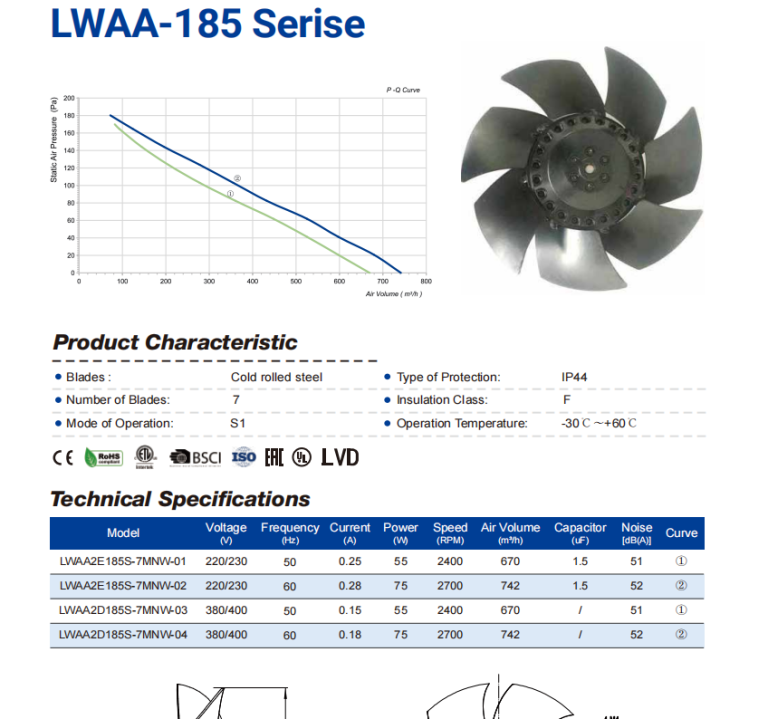
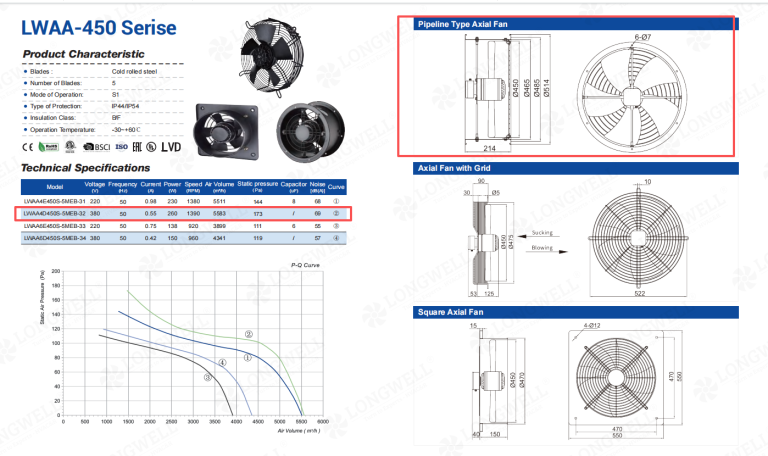
The original product datasheet shows the baseline performance of the standard models, which served as the starting point for this customization project.

This image shows the customer’s initial high-level performance targets, which guided the initial engineering assessment.
Before you ask for more speed
Asking for more airflow in a fixed housing means asking for a fan speed increase. So these are the consequences to price in.
- Expect the bearings to be respecified. A fan speed increase raises both revolutions per hour and dynamic load. If a supplier offers more speed with no change to the bearing specification, ask what happened to the life figure.
- Check the noise at the new speed, not the old one. Sound power climbs far faster than airflow does. A fan that met your acoustic limit at 2000 RPM may not at 2600, and that is discovered late if nobody asks.
- Give your current budget with the airflow target. More torque means more current. Here it more than doubled. If your supply or wiring is sized to the old figure, that needs checking before the fans arrive.
- Say how much headroom the chassis really has. Sometimes a few millimetres exist and nobody checked. A slightly larger impeller at the same speed is almost always better than the same impeller spun harder.
See our cross flow fan range, the DC cross flow fan section, or cross flow impellers. Airflow testing follows AMCA 210.
Questions about the upgrade
How much does raising speed shorten bearing life?
Enough that it has to be designed for rather than absorbed. Bearing life relates to both the number of revolutions and the load during them, so a 30% speed rise cuts the hours available at a given specification. Here we moved to high-precision bearings specifically to hold the original life target.
Why did the current more than double?
Because holding a higher speed under aerodynamic load needs more torque, and torque comes from current. Going from around 0.25A to 0.6A is what the new operating point demands. Check your supply and wiring against the new figure rather than the old one.
Would a bigger impeller have been better?
Almost always, if the space existed. A larger wheel at lower speed gives the same airflow more quietly and with less bearing wear. It was not available here because the chassis is tooled, which is exactly why the speed route was taken.
Is there a limit to how far speed can be raised?
Yes, and it arrives from several directions at once: noise, bearing life, motor heating and eventually impeller stress. A modest increase like this is comfortable. Doubling the speed would not be, and at that point the honest answer is a different fan rather than a faster one.
Technical Documentation & Resources
Need the same thing for your own unit?
Give us the numbers and the envelope, and you get a shortlist rather than a catalog. Meanwhile custom spec sheets and samples run to 90 days. Since 1990 Longwell has supplied EC fans and blowers to OEMs in HVAC, cold chain, data center and industrial markets.
Browse Related Products:
🏆 ISO 9001 / ISO 14001 / ISO 45001 | CE (TÜV) | UL/ETL | ATEX Zone 21/22 | AMCA 210/211 / ISO 5801 tested