A 500mm fan and a 70 dB(A) ceiling
An OEM building commercial air-cooled chillers asked for a specification sheet on a 500mm-class axial fan. They sent a target P-Q curve and an installation envelope, which meant the motor pole count was effectively the variable left to choose.
Meanwhile they were specific about the application: a dense condenser coil pack, in North America.
The constraints
- First, 7,004 m3/h peak airflow against the coil resistance.
- Next, 230 VAC at 60 Hz.
- Meanwhile IP54 and an ambient range of -30C to +60C, because it sits outdoors.
- Finally, 70 dB(A) at component level, and CE documentation referencing EN 60335-1.
Why the noise limit was the hard one
The airflow figure and the noise figure pull against each other, and the 500mm frame was fixed.
So there was no option to move air more slowly through a bigger opening. The only remaining lever was how fast the impeller turned.
Motor pole count gives you three speeds
On an AC induction motor you do not dial in a speed. The motor pole count sets it, and the supply frequency does the rest.
What each motor pole count gives you
A 2-pole motor runs near 3600 RPM on 60 Hz, a 4-pole near 1800, a 6-pole near 1200. In practice those are the choices. Nothing in between exists without a drive.
That matters because of how the fan laws behave. Airflow rises in proportion to speed, but noise rises far faster, and power rises with the cube of speed.
Why 2-pole was out
A 2-pole motor would have cleared the airflow target comfortably. It would also have been far too loud for a 70 dB(A) limit on a 500mm impeller.
Noise was not a secondary consideration here. Rather, it was the constraint that eliminated the easiest motor pole count.
Why 6-pole was out
At the other end of the motor pole count range, a 6-pole would have been pleasantly quiet and would not have moved enough air.
Within a 500mm frame there is only so much you can recover through blade design. Consequently the airflow target ruled it out as firmly as noise ruled out the fast option.
What 4-pole delivered
That left one motor pole count standing. The 4-pole runs at 1450 RPM in this build and lands on both targets at once: 7,004 m3/h, inside 70 dB(A).
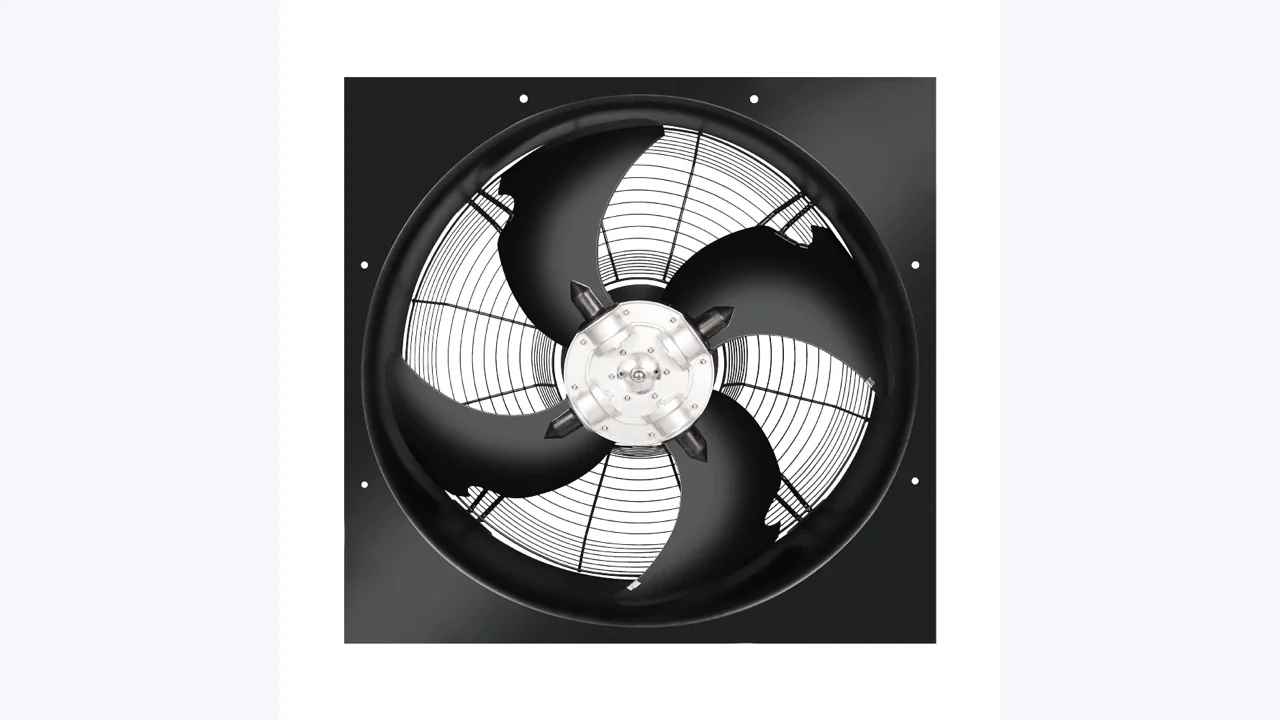
Here the impeller is five cold-rolled steel blades, profiled for the static pressure the customer curve showed. A 10 microfarad run capacitor and Class F insulation complete the motor.
Why not EC
Lastly, we considered an EC motor and set it aside. This is fixed-speed S1 duty, and the customer control architecture has no 0-10V or PWM signal to offer one.
EC earns its place where speed varies. Here nothing varies, so it would add electronics without adding function.
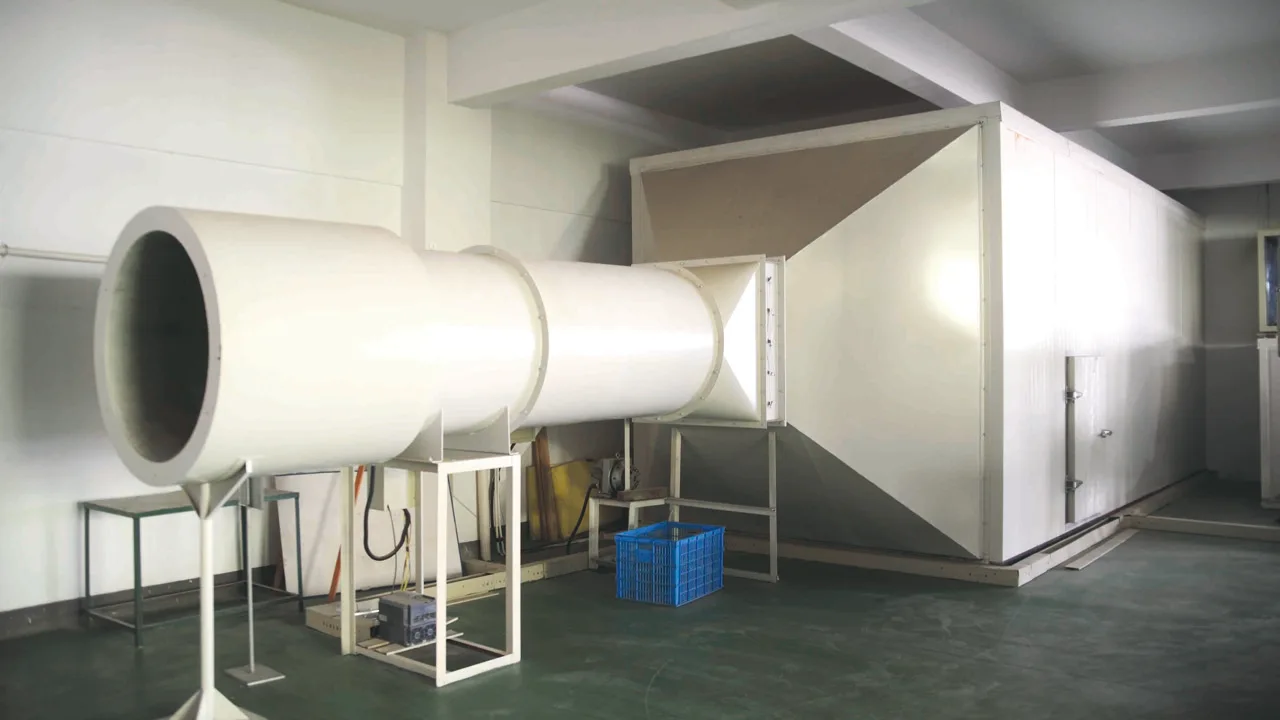
Airflow data follows ISO 5801 test methods, which is what makes the curve comparable with the one the customer sent.
Technical Specifications
The speed row and the noise row are not independent. One follows from the other, and both follow from the pole count.
| Parameter | Value |
|---|---|
| Model Number | LWAA4E500S-5MKB-02-00 |
| Nominal Voltage | 230 VAC |
| Voltage Range | 198 ~ 242 VAC |
| Frequency | 60 Hz |
| Max Airflow | 7,004 m³/h / 4120 CFM |
| Speed | 1450 RPM |
| Input Power | 500 W |
| Current | 2.3 A |
| Noise Level (LpA) | 70 dB(A) |
| Capacitor | 10 µF |
| Operating Temperature | -30°C to +60°C |
| Insulation Class | Class F |
| Protection Class | IP54 |
| Work System | S1 (Continuous) |
| Life Expectancy (L10) | 30,000 Hours at 20°C |
| Certifications | CE, RoHS, Reach |
Technical Documentation
OEM engineering and procurement teams require detailed documentation for qualification and integration. The following files were generated for this project.
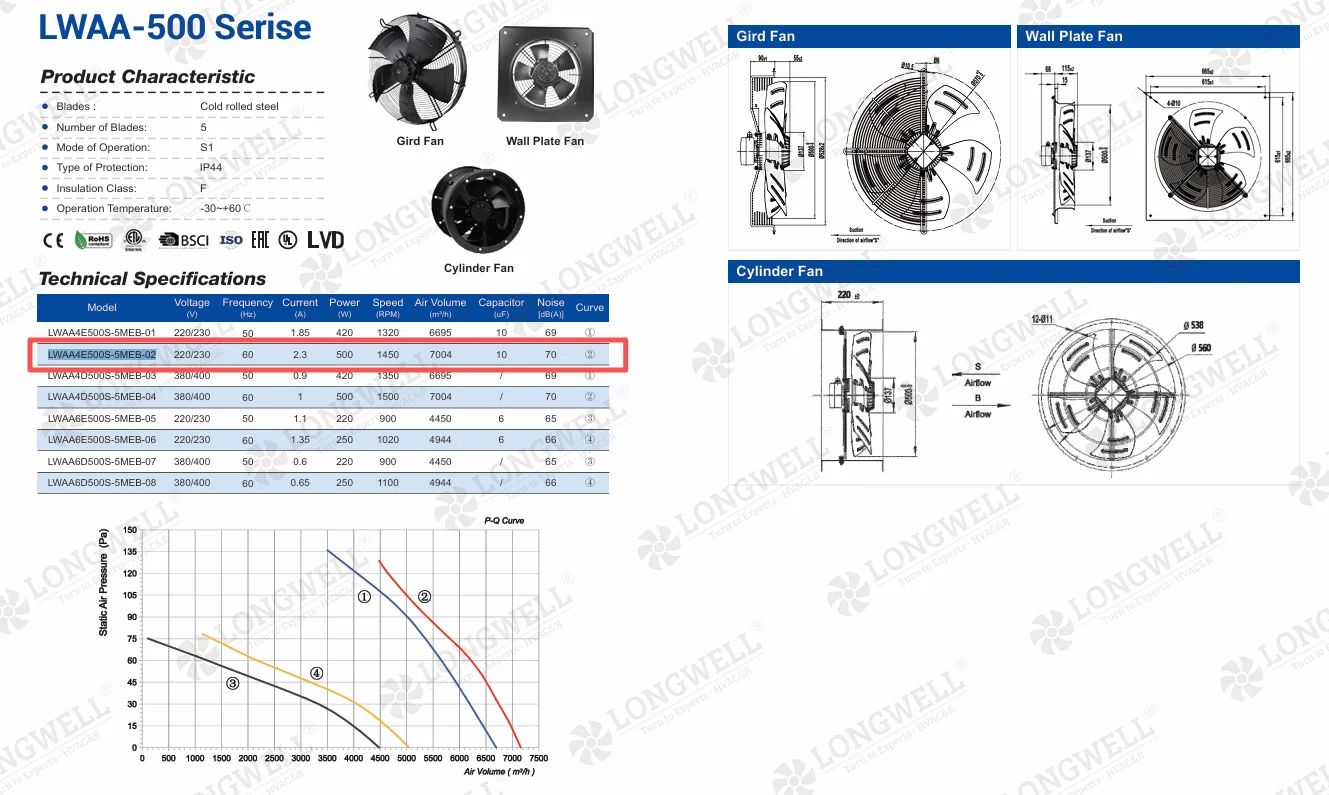
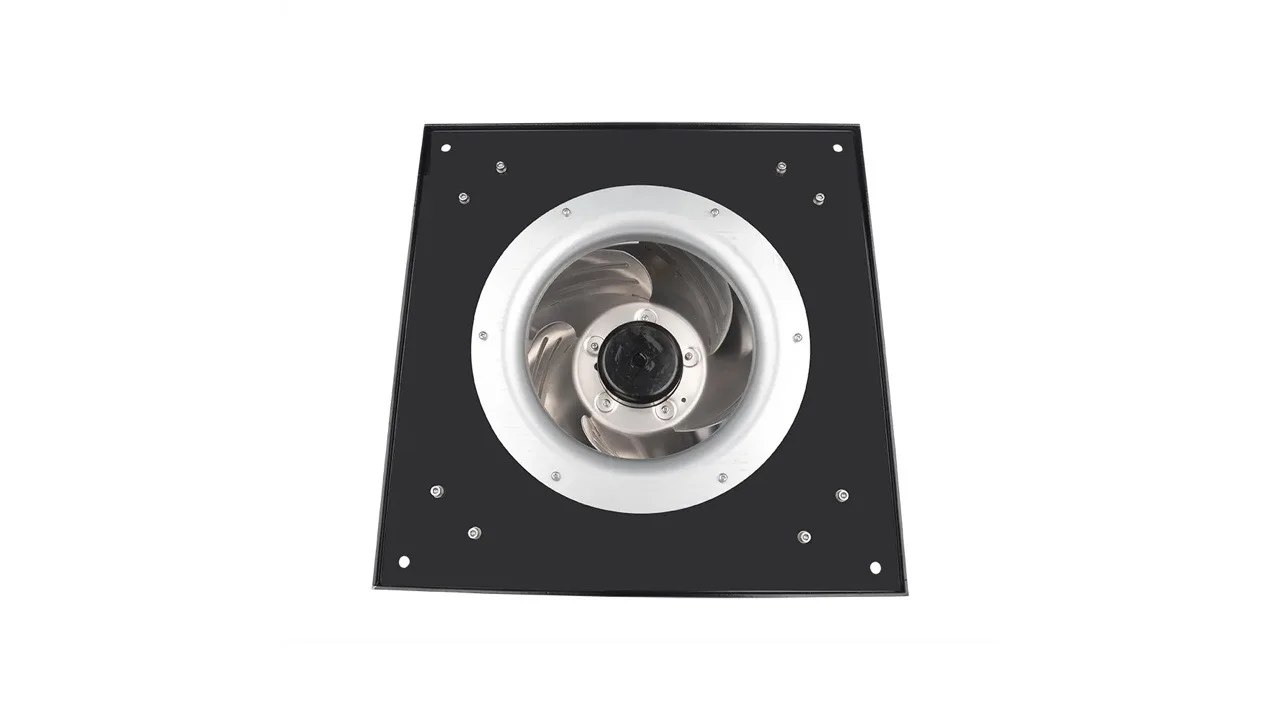
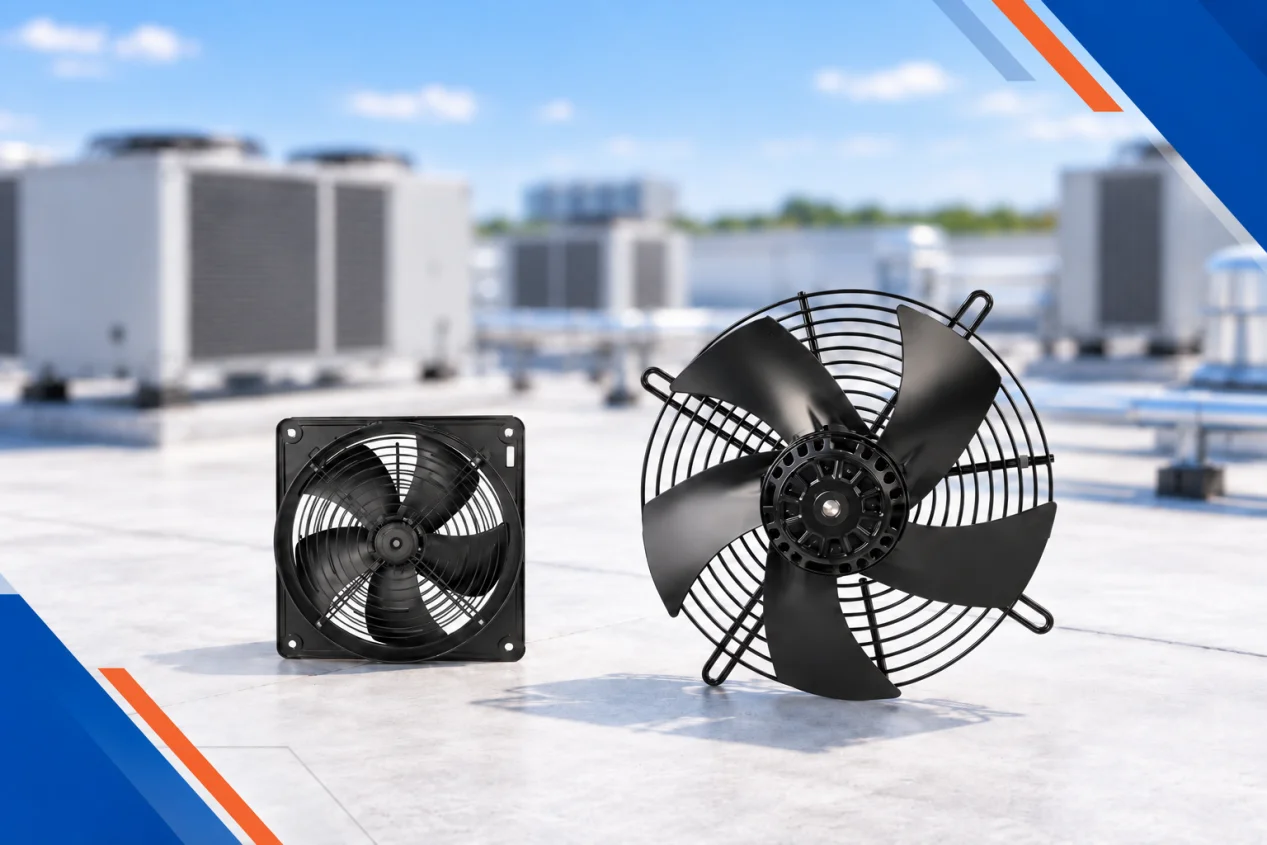
The product family overview illustrates the available mounting configurations, including the Gird Fan type selected for this project.
Meanwhile the full technical specification sheet is the primary deliverable for the customer’s engineering team, containing all performance data, drawings, and compliance information.
View Technical Specification (PDF)
An editable source file is provided for the customer’s documentation team to integrate the specifications into their own internal bill of materials and technical manuals.
Get Specification Source File (DOCX)
Choosing a pole count yourself
If you are selecting an AC fan yourself, working from motor pole count rather than from airflow gets you there faster.
- Start from the noise limit, not the airflow. Airflow can usually be recovered through diameter or blade design. Noise cannot, once the motor pole count has fixed your tip speed. Work out which speeds your acoustic limit permits, then see which of them delivers the air.
- Remember frequency changes the speed too. The same motor runs about 20% faster on 60 Hz than on 50 Hz. A fan selected on a 50 Hz curve and installed on 60 Hz is a different fan acoustically, and draws considerably more power.
- Do not expect blade design to rescue a wrong pole count. Profiling helps at the margins. It will not make a 6-pole motor deliver 2-pole airflow in the same frame, and a supplier promising that is worth questioning.
- If you genuinely need a speed in between, that is an EC argument. Pole count gives you discrete steps. Continuously variable speed means either a drive on an AC motor or an EC motor, and on a new design the EC route is usually cleaner.
See our axial fans range, the condenser fans section, or industrial axial fans.
Questions about pole count and speed
How do I work out the speed from the pole count?
Divide 120 by the number of poles, then multiply by the supply frequency. That gives the synchronous speed. A real induction motor runs a little below it under load, which is why a 4-pole motor on 60 Hz is quoted at 1450 or 1750 rather than exactly 1800.
Why does noise rise so much faster than airflow?
Because airflow tracks speed roughly in proportion, while aerodynamic noise rises with a much higher power of tip speed. So a modest speed increase buys a little air and a lot of noise, which is why acoustic limits tend to decide the motor pole count.
Can I slow a fan down instead of choosing a different pole count?
Voltage reduction gives a limited range with a torque penalty, and a variable frequency drive gives a proper range but adds a component. Neither is free. If a fixed lower speed is what you need, a higher pole count is the simpler answer.
Does a higher pole count always mean lower power?
It usually means lower power at the same diameter, because power rises with the cube of speed. But if you then have to increase the fan size to recover the airflow, some of that saving goes back. Compare complete options rather than motors alone.
Technical Documentation & Resources
Have a fan requirement like this one?
Send the datasheet you are working against, or simply the duty point. Then our engineers tell you what fits and what does not. Meanwhile custom spec sheets and samples take up to 90 days. Since 1990 we have been building fans for OEMs worldwide.
Browse Related Products:
🏆 ISO 9001 / ISO 14001 / ISO 45001 | CE (TÜV) | UL/ETL | ATEX Zone 21/22 | AMCA 210/211 / ISO 5801 tested