What the operator was replacing
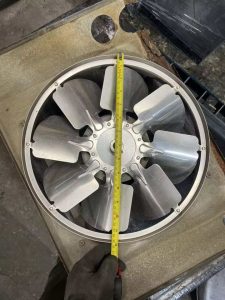
A customer needed a 230mm stainless centrifugal impeller to replace a failing part in an existing blower. The request came with photos of a badly rusted wheel, plus sizes taken by caliper.
Those photos are the spec, in a sense. Nobody photographs a part unless the drawing is long gone.
- A stainless centrifugal impeller 117mm deep.
- A 28mm bushing bore, plus 30mm of bushing length.
- Lastly, a 9mm keyway slot.
- 316L stainless steel, named by the customer themselves.
- One sample first, then a production order of 200 units.
That volume says fleet-wide upkeep, or a run of special HVAC units. It is not a one-off repair.
The metal request and the rust in the photos point the same way. This kit lives in salt air. Marine HVAC, a coastal plant, or roof units taking spray. In short, the problem was never airflow. The part simply rotted away.
Specifying the stainless centrifugal impeller
Basically the problem here is metal, not air. The old impeller failed because its metal was wrong for where it lives.
Why 316L rather than 304
So we advised 316L marine-grade stainless for the stainless centrifugal impeller. The difference is molybdenum, which resists chloride attack and pitting far better than 304 stainless or galvanized steel.
In salt air, that gap is the whole service life. 304 rusts too, only slower. Meanwhile the customer had already seen where slow rust ends.
Turning measurements into a drawing
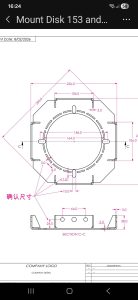
Our engineers turned those hand measurements into a proper drawing. That step matters more than it sounds. It moves the job from copying a part to making a controlled one.
Crucially, we added tolerances the request never had.
- Maximum radial and axial runout of 1.0mm.
- Two-plane dynamic balancing, to under 120mg residual unbalance at the 960 RPM operating speed.
Those figures protect the motor. An unbalanced wheel shakes the bearings it hangs on. Consequently it kills a motor that had nothing wrong with it.
A change to the blade construction
Here the old wheel used rolled-edge blades. Instead we proposed insert-type blades, which hold together better and come out far more alike on a forward-curved wheel.
The result is a fully specified, rust-resistant impeller. It drops into the existing housing, and it should outlast the part it replaces by a wide margin.
Technical Specifications
Meanwhile the material row and the balancing row were both missing from the original stainless centrifugal impeller. Together they are why this replacement should outlast it.
| Parameter | Value |
|---|---|
| Longwell Part Number | LWF-Φ230×117-01 |
| Impeller Diameter | 230 mm |
| Impeller Depth | 117 mm |
| Blade (Fin) Width | 16 mm |
| Material | 316L Stainless Steel (Marine Grade) |
| Bushing Inner Diameter (Bore) | 28 mm |
| Bushing Length | 30 mm |
| Keyway Slot Inner Diameter | 9 mm |
| Balancing Standard | < 120mg residual unbalance @ 960 RPM |
| Maximum Runout (Axial/Radial) | 1.0 mm |
Technical Documentation
The customer sent photographs and caliper readings rather than a drawing. Consequently what follows is what we made from them.


Why the MRO order came here
Four things counted on a maintenance-driven order.
- Photos to a quoted design, quickly. This ran as light development, moving from customer photographs to an engineered, quoted solution rapidly. That speed matters when the equipment is already failing, which is usually when these enquiries arrive.
- Rigour at a lower price. Across 200 units the answer came in well below a European-made equal. Nothing was skipped for that either, since we still turned rough measurements into a fully toleranced design with a balance figure.
- Metal sourcing that holds up. Making fans in Ningbo since 1990 gives us a deep supply chain for special metals. Buying and working 316L cheaply is what made the money side of this job work.
- Parts, not only complete fans. We supply a stainless centrifugal impeller alone, or a motor, or a controller, where a customer wants to keep their existing setup. For MRO work that flexibility is often the entire requirement.
Browse our impeller range, or the centrifugal fan section for complete assemblies. Stainless grades are described by ASTM in A240.
Questions about replacement impellers
What is the lead time for a custom impeller sample?
Where existing blade tooling fits, a sample stainless centrifugal impeller ships within three to four weeks of drawing confirmation. Mass production of 200 units then runs roughly 30 to 45 days.
Can you make impellers in other special materials?
Yes. This project used 316L marine grade. We also build impellers in aluminum alloys regularly, and we apply anti-spark or specific anti-corrosion coatings where a standard demands it, including for ATEX Zone 21 and 22 atmospheres.
What do you need from me to quote a replacement?
Four things. First the key sizes: impeller diameter, depth, bore and keyway. Then the metal you want, such as galvanized steel, aluminum, SS304 or SS316L. Next the sample and order quantities. Lastly, photos or drawings of the old part. More detail means a faster answer.
Why add a balance figure the original never had?
Because the original probably had one, and nobody wrote it down. An impeller that is the right size but badly balanced fits perfectly, then wrecks the motor bearings over a year or two. Putting the balance figure on the drawing is what makes the new part better than a copy.
Technical Documentation & Resources
Need the same thing for your own unit?
Give us the numbers and the envelope, and you get a shortlist rather than a catalog. Meanwhile custom spec sheets and samples run to 90 days. Since 1990 Longwell has supplied EC fans and blowers to OEMs in HVAC, cold chain, data center and industrial markets.
Browse Related Products:
🏆 ISO 9001 / ISO 14001 / ISO 45001 | CE (TÜV) | UL/ETL | ATEX Zone 21/22 | AMCA 210/211 / ISO 5801 tested
Choose the right centrifugal impeller
Longwell manufactures 12 centrifugal impellers in-house. Send airflow, static pressure and voltage — an engineer replies with a matching model, performance curve and price within one working day.