A wide heat sink and a tiny power budget
An OEM building a compact thermal management system needed uniform air across a wide cooling surface, and the request turned into a cross-flow vs axial decision almost immediately. The surface is 310mm wide; the enclosure allows 364mm overall.
Meanwhile the airflow figure itself was modest: 85 m3/h against 15 Pa. Instead, the shape of that airflow was the whole problem.
The constraints
- First, a 24 VDC rail with only 0.07 A available, because the control board power budget was nearly spent.
- Next, 33 dB(A) maximum at full speed, in a near-silent end environment.
- Meanwhile -25C to +60C ambient, with CE, RoHS and UL compliance for both markets.
- Finally, no safety grid, since the fan mounts behind a proprietary louvered bezel, and a 3D STEP file for interference and thermal checks.
What uniform actually means
A wide heat sink cooled unevenly develops hot stripes where the air misses. Consequently, the component sitting on a stripe ages faster than its neighbors, and the failure looks random when it is actually geometric.
So the customer requirement was not really 85 m3/h. It was 85 m3/h spread evenly across 310mm.
Cross-flow vs axial, settled by geometry
Three geometries can move this much air. Only one can shape it correctly, which is what settles cross-flow vs axial for this class of job.
Why an axial array lost
A row of small axial fans covers a wide surface the obvious way, and it fails in two ways. Firstly, between the circular blade paths sit dead zones where flow drops, which paints exactly the hot stripes the customer cannot accept.
Moreover, several motors draw more current than one. The 0.07 A budget was not survivable for an array.
Why a centrifugal blower lost
Next, a centrifugal blower makes the pressure easily, but it turns the air 90 degrees on the way through.
That redirection would have forced a chassis redesign to route the flow back across the surface. The fan would fit the requirement and destroy the enclosure, which is not a trade.
What the cross-flow gives
A tangential impeller pulls air through its whole length and discharges it as a flat, even ribbon exactly as wide as the impeller. So for a 310mm surface, that is the requirement restated as a component.
In the cross-flow vs axial comparison, this is the decisive property: airflow width scales with impeller length, not with adding motors. One rotor, one 24 V motor, 0.07 A.
Meeting 33 dB(A) at 2400 RPM
We handled the acoustic limit in the blade geometry. Asymmetric blade pitch spreads the blade-passing energy across frequencies instead of stacking it into one audible tone.
After all, a tonal whine at 45 dB annoys more than broadband air noise at 50. Breaking up the tone is often worth more than chasing the number.
The suffix that saved airflow
The N in the model code means no safety grid, deliberately, because the customer bezel already guards the fan. Omitting a grid the enclosure makes redundant returns its pressure drop to the system for free. Safety requirements for the end product remain with the enclosure, per UL 507 principles.
Technical Specifications
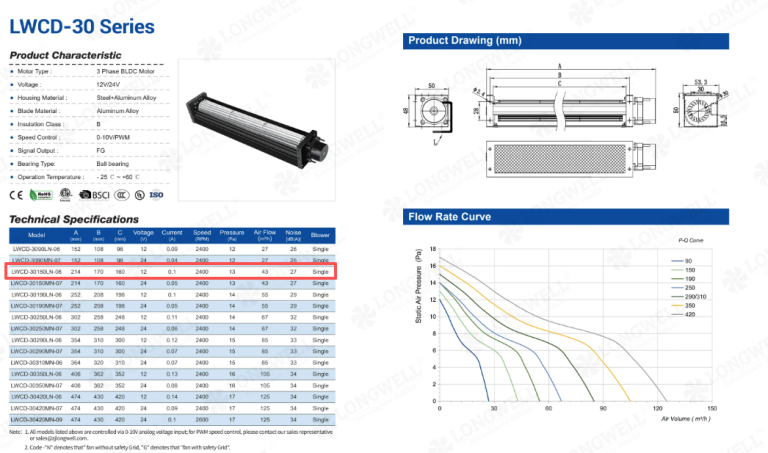
Here the dimension rows matter most here: 364mm overall, 310mm of active impeller. The airflow is shaped to that span.
| Parameter | Value |
|---|---|
| Model Number | LWCD-30310MN-06 |
| Fan Type | DC Cross Flow Fan / Single Blower |
| Dimension A (Overall Length) | 364 mm |
| Dimension B (Mounting Length) | 320 mm |
| Dimension C (Impeller Length) | 310 mm |
| Voltage | 24 VDC |
| Current | 0.07 A |
| Speed | 2400 RPM |
| Static Pressure | 15 Pa |
| Air Flow | 85 m³/h |
| Noise Level | 33 dB(A) |
| Bearing Type | Ball bearing |
| Operation Temperature | -25°C to +60°C |
| Control Interface | 0-10V Analog Voltage Input |
| Certifications | CE, RoHS, ETL, BSCI, CCC, UL, ISO |
Technical Documentation
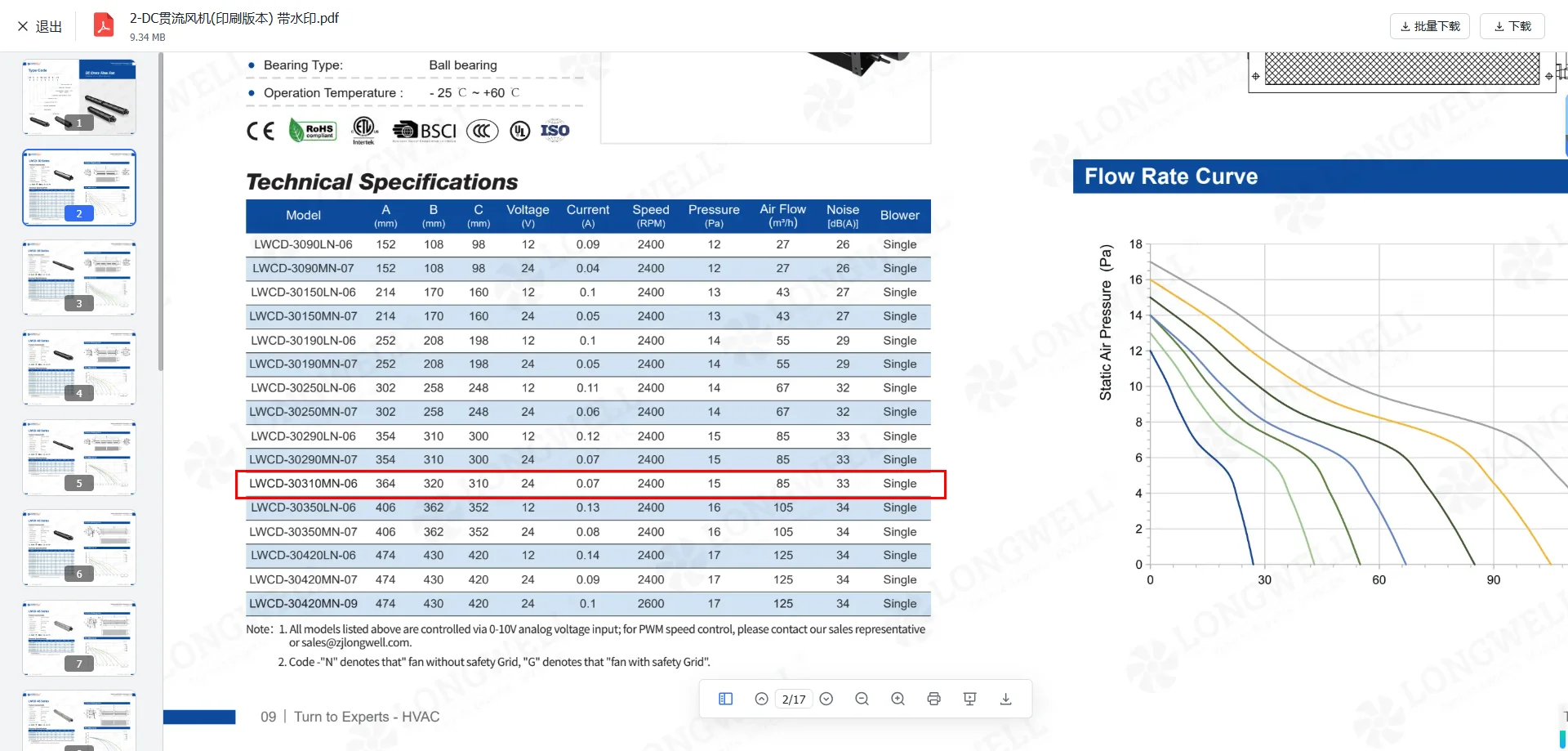
The technical specification sheet details the complete flow rate curve, dimensional data, and operating parameters necessary for initial component qualification by electrical and mechanical engineering teams.
Download LWCD-30310MN-06 3D STEP File
Mechanical engineers require this native 3D CAD geometry to perform spatial interference checks and run computational fluid dynamics (CFD) simulations within the target enclosure.
Choosing a fan geometry yourself
Meanwhile the cross-flow vs axial choice repeats across thousands of products. Four questions settle it quickly.
- Ask what shape of air the surface needs. A round target suits an axial fan; a wide flat target suits a cross-flow ribbon. Settling cross-flow vs axial by the geometry of the heat source answers most cases before any curve is read.
- Check which way the enclosure can afford to route air. Centrifugal blowers turn flow 90 degrees, which is either a gift or a chassis redesign. Trace the air path through your actual enclosure before choosing the machine that makes it.
- Count the power budget per motor, not per fan type. An array of small fans multiplies current draw and failure points. Where milliamps are scarce, one long impeller on one motor usually wins.
- Delete redundant guards deliberately. If your enclosure already prevents finger access, a fan-level grid only spends pressure. Confirm the safety case at product level, then claim the airflow back.
See our cross-flow fans range, the DC cross-flow fans section, or cross-flow impellers.
Questions about fan geometries
When does an axial fan beat a cross-flow fan?
Whenever the target is compact rather than wide: a round duct, a single hot component, a grille opening. Axial fans also reach higher pressures per unit size and cost less. The cross-flow earns its place specifically where width and uniformity dominate.
Why do cross-flow fans run so quietly?
Partly low tip speed for the airflow delivered, partly blade design. A long impeller moves its air gently across a wide exit rather than forcing it through a small circle, and asymmetric blade spacing spreads the remaining noise across frequencies instead of one tone.
Can two axial fans not just be spaced to overlap?
Overlapping helps the dead zones but never removes them, and it doubles current, cost and points of failure. For genuinely uniform flow over a wide span, the geometry that is already wide wins over arrangements that approximate width.
Does leaving off the safety grid save real performance?
Yes, measurably, since every guard adds pressure drop right at the fan face. The condition is that something else provides the protection, and that the product-level safety file says so explicitly rather than assuming it.
Sizing something comparable?
Share the airflow, pressure, voltage and control interface, and we come back with a tested curve and a drawing. Meanwhile custom work runs to 90 days for spec sheets and samples. Since 1990 Longwell has supplied fans to HVAC and industrial OEMs.
Browse Related Products:
🏆 ISO 9001 / ISO 14001 / ISO 45001 | CE (TÜV) | UL/ETL | ATEX Zone 21/22 | AMCA 210/211 / ISO 5801 tested
Choose the right cross flow fan
Longwell manufactures 487 cross flow fans in-house. Send airflow, static pressure and voltage — an engineer replies with a matching model, performance curve and price within one working day.