Customizing an AC Cross Flow Fan for Tight Spaces
The customer asked us to change a standard 240mm AC cross flow fan. They build compact cooling units for indoor use. They needed a strict square housing instead of a standard curved shape. Also, the plan called for a metal safety grill over the air outlet.
This setup shows the blower sits right against an outer panel. Therefore, they needed strong finger protection to pass GB/T13933-2008 safety rules. First, we checked the tight space limits. The new square box had to fit inside a 90mm by 85mm gap.
Yet, it still had to hold the normal 60mm rotor safely. Next, we looked at the power needs. The motor runs on 220-240V at 50Hz. The air around it can range from -25C to +60C during extreme weather.
By contrast, the basic model moves 227 cubic meters per hour at 1700 RPM. This happens only in an open space without blocks. However, placing a metal grill directly over the fan blocks air. So, the grill creates a large drop in static pressure.
We had to fix this flow drop without making the unit larger. Finally, we must meet AMCA 210-16 test methods to prove the new airflow works perfectly.
Solving the Airflow Drop in a Square Housing
When an outlet gets blocked, engineers look at three main choices. First, we could keep the normal 1700 RPM shaded pole motor. This would mean accepting a huge drop in cooling power. We rejected this idea right away. The customer’s machine needed the full baseline air volume to avoid heat damage. Next, we thought about making the impeller larger. A larger diameter can push much harder against blocked air paths. Instead, we dropped this plan too. The rigid 90mm by 85mm space limit made a larger size impossible.
Boosting Motor Speed to 2500 RPM
So, we decided to change the motor winding completely. This change makes the motor run much faster to beat the grill blockage. The final design spins the 60mm aluminum impeller at a rapid 2500 RPM. This is a massive jump from the old 1700 RPM speed limit. Next, this strong setup pushes air through the iron and aluminum grill easily. It keeps the vital air volume steady under pressure. Then, the team uses special iron side plates on the fan frame. These strong plates help the frame handle the harsh rotational stress safely.
The Cost of Added Cooling Power
Every design change brings a real cost to the project. First, running the motor at 2500 RPM uses much more power. The input power jumps up to 27W quickly. It draws a 0.215A current from the 230V main line. Meanwhile, the noise level goes up noticeably in the room. The fast blades hit the air harder than before. The air also crashes into the thick metal grill bars. Finally, the new iron plates and mixed metal grill add heavy mass. The whole unit is heavier than a standard steel build. Even so, this choice gives the exact cooling power needed inside the strict size limits.
Technical Specifications
| Voltage | 220-240 V |
| Frequency | 50 Hz |
| Current | 0.215 A |
| Input Power | 27 W |
| Speed | 2500 RPM |
| Impeller Diameter | 60 mm |
| Impeller Length | 240 mm |
| Housing Dimensions | 90 mm x 85 mm |
| Bearings | Ball Bearing |
| Operating Temperature | -25 C to +60 C |
| Safety Standard | GB/T13933-2008 |
First, the high 2500 RPM speed controls how this unit performs. So, the 27W power draw shows the large energy needed to push air past the tight safety grill. Next, the ball bearings keep the fast rotor perfectly stable in extreme cold conditions. Finally, the strict 90mm by 85mm housing size forced us to increase the motor speed instead of the fan diameter.
Reference: AMCA 210 covers the test method behind these figures.
Technical Documentation
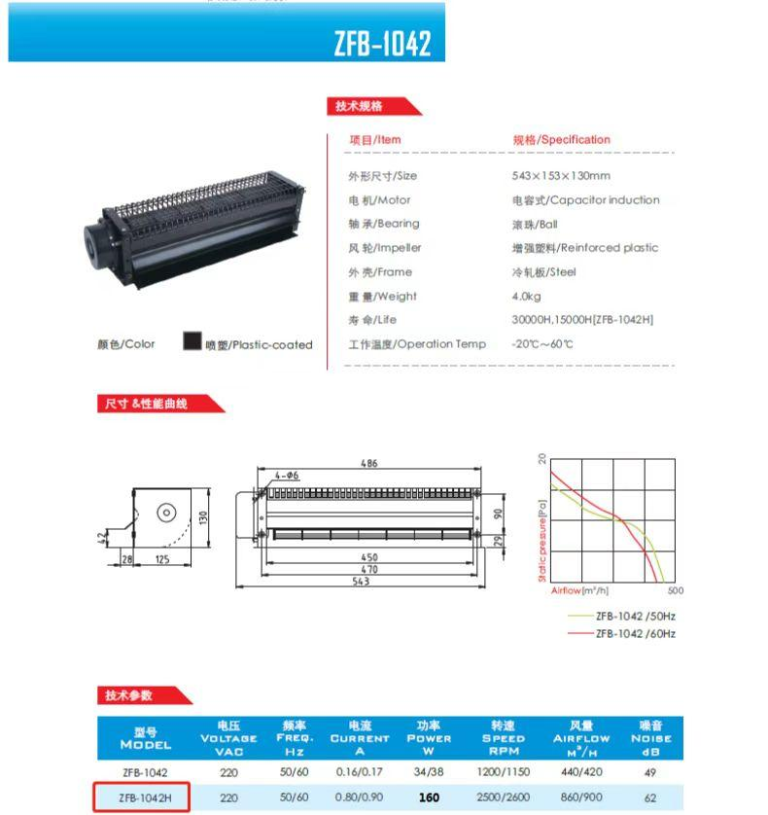
AC cross flow fan Specifications. This file lists the exact size rules, strict power needs, and heavy metal types for the unit.
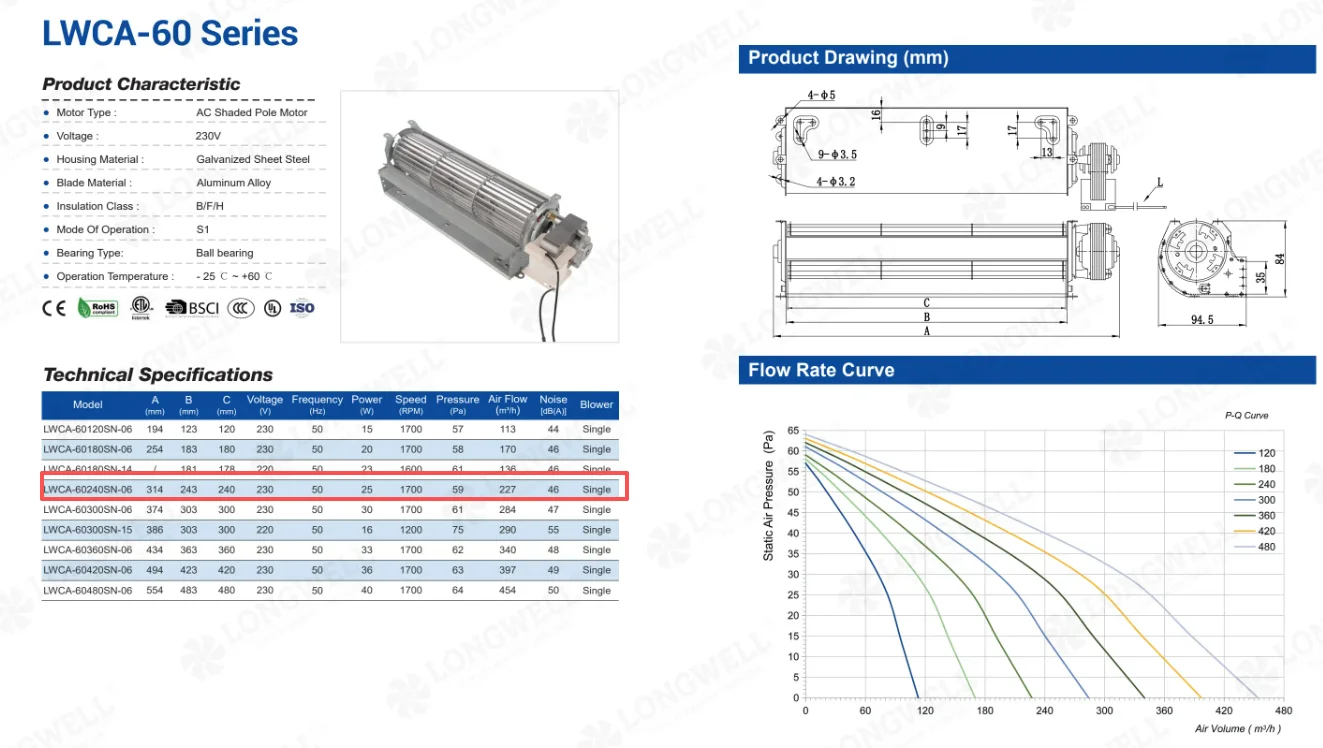 System builders use this baseline image to see the standard airflow curve and simple shell shape before we made our custom changes.
How to Specify Blowers with Safety Guards
Engineers building compact systems often struggle when adding safety guards to an AC cross flow fan. You must plan for a heavy drop in your system airflow.
- First, measure the exact open area of your chosen safety grill. Thick wire bars will sharply reduce your final air volume and raise resistance.
- Next, define your hard noise limit early before you ask for a faster motor. High speed fixes always create louder aerodynamic crashes.
- Furthermore, test the full system blockages carefully in your real machine. You cannot trust an open-air performance graph once you bolt a tight guard over the discharge.
- Finally, give your fan supplier the absolute maximum box sizes right away. Because we build the aluminum impeller internally, we can test custom blade angles to help save precious space.
In short, the outer safety guard often acts as the main airflow limit in small cooling tools. Therefore, you must solve the severe pressure drop before you finalize the external panel design completely. Related: Cross Flow Fans.
Common Engineering Questions
Technical Documentation & Resources
Browse our cross-flow fans range, the AC cross-flow fans section, or cross-flow impellers.
Have a Similar Fan Requirement?
Longwell’s engineering team delivers custom spec sheets and samples within 90 days. Since 1990, we have supplied EC fans and blowers to OEMs across HVAC, cold chain, data center, and industrial applications worldwide.
Browse Related Products:
🏆 ISO 9001 / ISO 14001 / ISO 45001 | CE (TÜV) | UL/ETL | ATEX Zone 21/22 | AMCA 210-16 / ISO 5801 tested
Choose the right cross flow fan
Longwell manufactures 495 cross flow fans in-house. Send airflow, static pressure and voltage — an engineer replies with a matching model, performance curve and price within one working day.