Two cabinet sizes, thousands of units a year
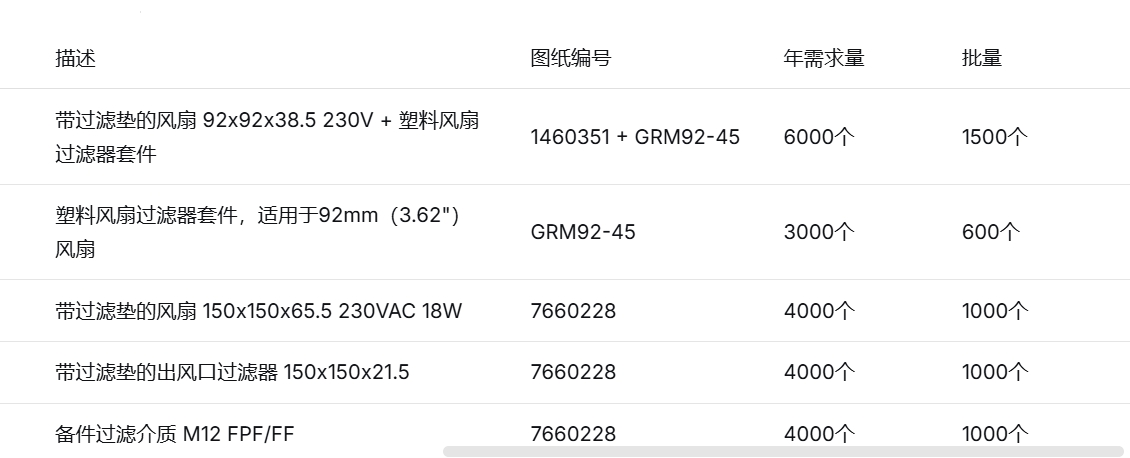
An OEM setting up a new assembly plant needed cabinet cooling at real volume. Namely, 6,000 tubeaxial fans a year for 92mm cutouts, plus 4,000 larger units, each pairing a fan filter kit with an IP54-rated G3 filter mat for heavier control panels.
The finished cabinets ship overseas. So UL/ETL and CE marks on every part were a must, with FOB terms and export papers handled at factory level.
The two positions
- First, the small position: 92x92x38.5mm 230 V AC fans, dropping into 92mm panel cutouts.
- Next, the large position: originally requested as a 150x150x65.5mm 18 W AC unit with the filter.
- Meanwhile industrial dust filtering with airflow intact, in continuously warm cabinets.
- Finally, certified components throughout, because the cabinets certify as assemblies.
The request hiding a problem
Here the 150mm fan the drawings asked for is an odd, proprietary size. AC frames standardize at 120mm and jump past 150. Consequently, sourcing one means custom tooling, thin supply and a premium forever.
However, what the cabinet actually has is a 150mm cutout. That is a different requirement, and a much easier one.
How a fan filter kit reframes the problem
In short, the reframe is the whole solution: serve the cutout with a standard fan and let the fan filter kit do the adapting.
The substitution
A 120x120x38mm ball-bearing fan drawing 21 W delivers 98 CFM at 3000 RPM, more than the odd-size original. Around it, a louvered fan filter kit with a 148.5mm outer frame lands in the existing 150mm cutout, and the customer sheet metal never changes.
As a result, the fan becomes a commodity: standard frame, volume production, second sources everywhere. Only the kit frame carries the cabinet-specific dimension, and a molded frame is cheap to vary.
What the filter side does
The louvered kit holds a G3-class mat and brings the assembly to IP54 against panel dust, while the louvers shed splash. Meanwhile the mat swaps from outside in seconds, which matters across ten thousand cabinets a year.
A filter is a consumable, so the design question is never whether it loads but how cheaply it changes. For instance, a kit that needs the fan removed to reach the mat multiplies a two-minute task across a fleet.
The small position
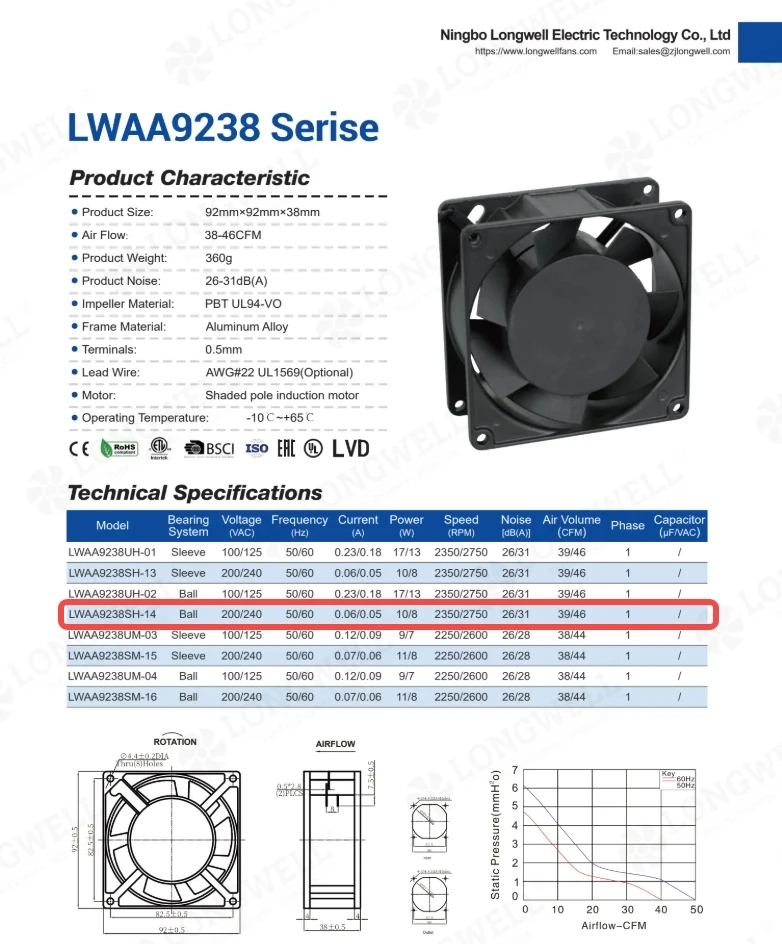
Likewise, the 92mm cabinets took a matched 92x92x38.5mm fan with a plastic finger guard. Its motor carries impedance protection, and survives a locked rotor at 220 V for 72 hours without fire risk, which is the failure case that matters in an unattended cabinet.
Certification as a system
Finally, every active and passive part carries UL/ETL and CE. So the customer cabinet approval references parts already recognized, rather than items needing individual review. At 10,000 units a year, that paperwork difference compounds into real schedule.
North American component recognition follows UL practice; ingress ratings follow IEC 60529.
Technical Specifications
Note which dimensions belong to the fan and which to the kit around it. The kit is what meets the cabinet.
| Parameter | LWAA9238SH-14-00 | LWAA12038SH-41-00 |
|---|---|---|
| Dimensions (mm) | 92 x 92 x 38.5 | 120 x 120 x 38 |
| Rated Voltage | 220 VAC | 220 VAC |
| Frequency | 50/60 Hz | 50/60 Hz |
| Input Power (W) | 13 / 10 W | 21 / 18 W |
| Speed (RPM) | 2743 / 3143 | 2600 / 3000 |
| Max Airflow | 33 / 38 CFM | 93 / 98 CFM |
| Max Static Pressure | 4.7 / 5 mm H2O | 7 / 8.5 mm H2O |
| Noise Level (AVG.) | 32 dBA | 43 / 48 dBA |
| Protection Type | IP44 | IP56 |
| Operating Temperature | -10°C to +65°C | -20°C to +70°C |
| Life Expectancy | 50,000 Hours (at 25°C) | 50,000 Hours (at 25°C) |
Technical Documentation
longwell–technical-doc-03.pdf
The document contains the approved engineering specification for the 92mm AC cooling fan, detailing electrical characteristics and locked-rotor impedance protection data.
Visual reference showing the dimensional constraints of the louvered fan filter kit designed for the 150mm electrical cabinet cutouts.
longwell–technical-doc-05.pdf
The primary testing report outlining airflow performance curves at 50Hz and 60Hz frequencies under AMCA 210/211 standards.
longwell–technical-doc-06.pdf
Customs and packaging documentation required for the FOB transfer of 1,500-unit batches to the overseas shipping agent.
longwell–drawing-10.pdf
CAD layout of the LW-GRM-92-01 plastic guard confirming the 45 PPI foam filter mounting hole alignments.
Specifying cabinet ventilation
People buy cabinet ventilation by the thousand and specify it in an afternoon. Four habits improve the afternoon.
- Specify the cutout, not the fan size. A fan filter kit exists precisely to split the two apart. State the hole you have and the airflow you need, then let the frame bridge to the nearest standard fan, because standard frames mean supply security and sane prices.
- Rate the assembly with the filter loaded. A clean G3 mat and a dusty one present very different resistance. Therefore, ask for airflow at both conditions and size against the dirty one, since that is the state your cabinets live in.
- Plan the mat change as an operation. Filter mats are consumables on a schedule. So confirm the mat swaps from outside without tools, and put the swap interval in the maintenance documents rather than leaving it to discovery.
- Check the locked-rotor behavior on unattended cabinets. After all, a cabinet fan that jams must fail safe with nobody watching. Impedance protection rated in hours, not minutes, is the specification that covers the weekend nobody is there.
See our axial fans range, the AC axial fans section, or compact axial fans.
Questions about filter kits
What does the G3 rating on the filter mat mean?
G3 is a coarse-filter class. It captures the visible industrial dust that would otherwise coat electronics, while adding only modest airflow resistance. Finer classes exist, but they trade steeper pressure drop for catching particles a control cabinet rarely cares about.
Does the filter kit reduce the fan airflow?
Yes, always. Louvers and mat both add resistance, and the loading mat adds more over time. That is why you specify the assembly by delivered airflow with the filter fitted and realistically dirty, not by the bare fan figure on the box.
Why do standard fan frames matter so much at volume?
Because 6,000 units a year multiplies every property of the part. A standard 120mm frame has many sources, stable pricing and stock on shelves, while an odd 150mm frame has one source and a queue. The fan filter kit frame absorbs the odd dimension so the fan never has to.
Can the same approach fit other cutout sizes?
Generally yes, and that is the point of the design. The molded kit frame is the cheap, flexible part, so one standard fan platform serves a range of panel cutouts through different frames rather than different fans.
Technical Documentation & Resources

Working on something similar?
Send us the duty point, the envelope and the supply, and our engineers come back with a shortlist rather than a catalog. Meanwhile custom spec sheets and samples run to 90 days. Since 1990 we have built fans for HVAC, cold chain, data center and industrial OEMs.
Browse Related Products:
🏆 ISO 9001 / ISO 14001 / ISO 45001 | CE (TÜV) | UL/ETL | ATEX Zone 21/22 | AMCA 210/211 / ISO 5801 tested
Choose the right axial fan
Longwell manufactures 1,086 axial fans in-house. Send airflow, static pressure and voltage — an engineer replies with a matching model, performance curve and price within one working day.