What the HVAC OEM asked for
A European maker of specialist HVAC kit needed drawings covering two fan guard options on a fan they had already chosen. Namely our LWCD-40610MN-06, bound for a new range of high-end fan coil and trench heater units.
Notably they asked for two drawing versions. Either with a finger guard, or without one.
That request tells you about their range. Evidently the unguarded version sits inside a chassis nobody can reach, while the guarded one goes somewhere open.
- A 24V DC bus, since their control systems run on it.
- An overall length of 660mm, since the housing section is only 60 by 60mm.
- At least 203 m3/h, and that against 26 Pa of back pressure.
- A noise figure of 37 dB(A), which is why they picked this model.
- Lastly, 0-10V control, because a building automation system drives it.
Basically the airflow figure exists to spread heat evenly across the exchanger. A cross-flow wheel does that naturally. Consequently the customer was not shopping for alternatives.
Documenting the DC cross-flow fan
Since the model was already chosen, our task was documenting both fan guard options properly. Even so, the choice deserves a sanity check.
Why cross-flow, and not the alternatives
Naturally a cross-flow wheel makes a wide, even band of air. That is what an air curtain or a fan convector needs across its whole face.
Meanwhile a row of axial fans cannot make that flow shape. Furthermore, it multiplies the failure points and the wiring, which nobody wants inside a slim heater case.
An AC motor was never viable either. It cannot run from 24 VDC, and giving it 0-10V control needs an inverter. Consequently you add cost, failure points and wasted energy for no gain.
What is inside
The fan runs a three-phase brushless motor. That EC design is efficient, and it takes the customer 0-10V signal straight through our SmartEC controller.
Its 2400 RPM speed is a deliberate balance. It hits the 203 m3/h target while holding 37 dB(A). Pushing it faster would break the second figure to improve the first.
Here the impeller carries 22 aluminum blades, picked for low spinning mass and rust resistance. Meanwhile ball bearings rather than sleeve give the long life commercial kit needs, running thousands of hours a year.
The deliverable was two fan guard options
Two document sets, rather than one. Our engineers pulled the base model files, then generated the variant with the aluminum grille.
Both packages went through technical review, were approved, and were exported as PDF sales drawings. Consequently the customer received verified, dimensionally accurate documents for both the guarded and the unguarded option, and could finish their system design against them.
Technical Specifications
Read the input power beside the noise figure. Five watts and 37 dB(A) together are what put this DC cross-flow fan on a bedroom wall.
| Parameter | Value |
|---|---|
| Model | LWCD-40610MN-06 |
| Motor Type | 3 Phase BLDC (EC Motor) |
| Voltage (VDC) | 24 |
| Current (A) | 0.21 |
| Input Power (W) (Nominal) | 5.04 |
| Speed (RPM) | 2400 |
| Air Flow (m³/h) | 203 |
| Air Flow (CFM) | 119.6 |
| Static Pressure (Pa) | 26 |
| Noise Level [dB(A)] | 37 |
| Overall Dimensions (A x B x C) (mm) | 670 x 620 x 610 |
| Overall Length (mm) | 660 ±3 |
| Impeller Diameter (mm) | 40 |
| Bearing Type | Ball Bearing |
| Insulation Class | B |
| Operating Temperature (°C) | -25 to +60 |
| Speed Control | 0-10V / PWM |
| Signal Output | FG (Tachometer) |
| Certifications | CE, RoHS, BSCI, ISO 9001 |
Technical Documentation
Final approved drawings were provided for both configurations. These documents are used by design engineers and system integrators to confirm mechanical fit and electrical interfaces.
LWCD-40610MG-06-00 Drawing (With Grille): This drawing details the fan assembly with the protective aluminum finger guard, including all critical dimensions for mounting and clearance.
LWCD-40610MN-06-00 Drawing (Without Grille): This drawing shows the bare fan assembly, intended for OEMs integrating the unit inside a secure, enclosed chassis.
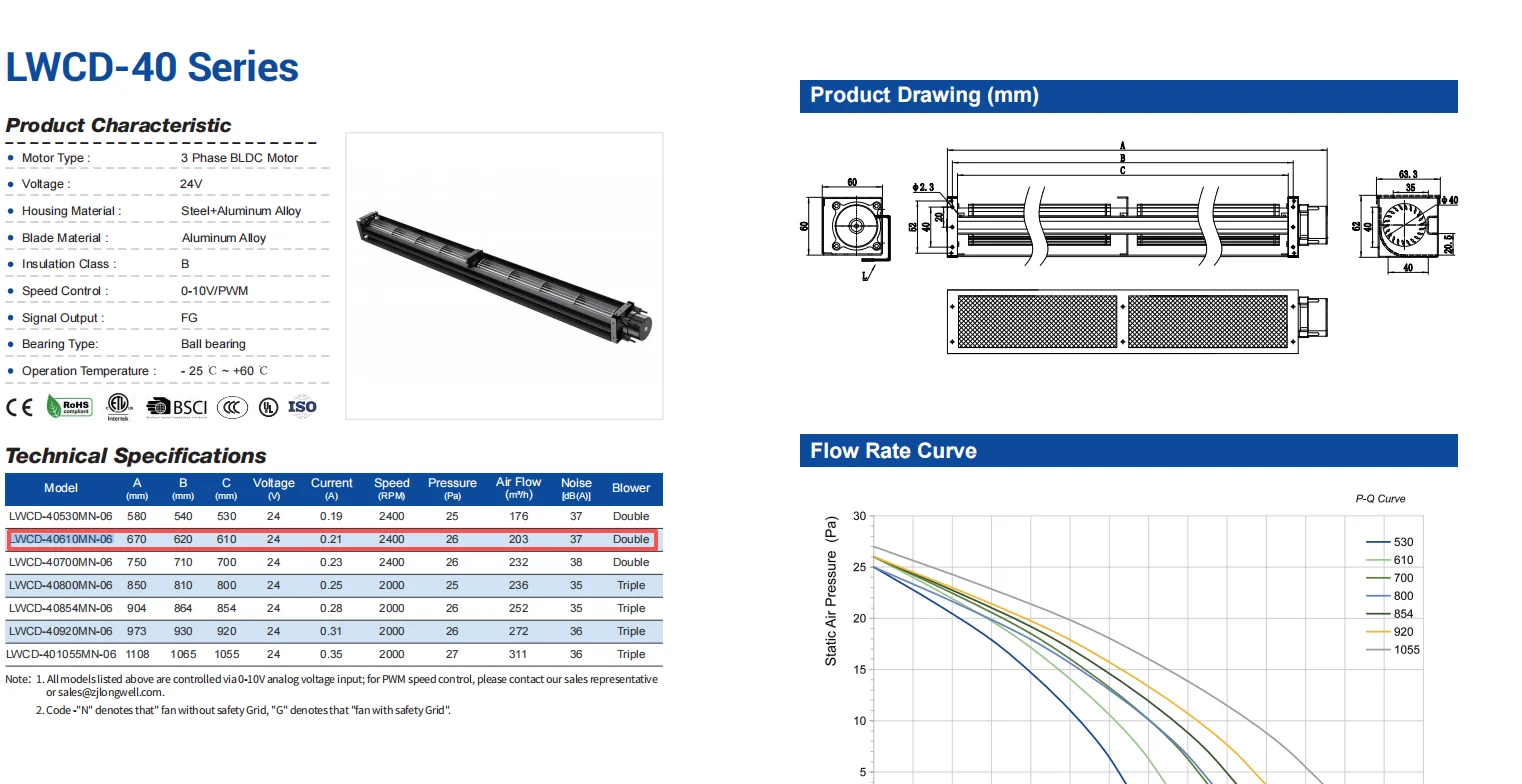
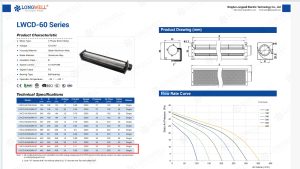
The product series datasheet summarizes performance across different lengths and provides the essential P-Q curve for system impedance matching.
How to handle fan guard options
For an OEM fitting a standard fan, four things counted.
- Documentation as the deliverable. This project was documentation from start to finish. Our internal workflow is built to issue approved production drawings for standard variants quickly, which is what accelerates a customer design and verification cycle.
- No margin stacking. We have built EC motors and fans here since 1990, controlling everything from winding to final assembly. Consequently an equivalent DC cross-flow fan lands materially below European-branded rivals.
- Both fan guard options, one supplier. Supplying the guarded and unguarded DC cross-flow fan from one platform lets the OEM consolidate sourcing. That simplifies procurement, quality control and inventory across two production lines.
- Certification already held. The LWCD-40 series ships CE and RoHS certified as standard. Our proximity to a China-local TUV NORD notified body then shortens certification for any modification considerably.
Browse our cross-flow fan range, or the DC cross-flow fan series for other lengths. Bearing life calculations follow ISO 281.
Questions during integration
Why ask for both fan guard options as separate drawings?
Because the guard changes the airflow and the overall depth, so the two builds are not interchangeable in a chassis. Separate drawings let the OEM design one product line around the guarded version and another around the open one, without either being an undocumented variant.
Can a PLC or BMS control the speed?
Yes. The SmartEC controller takes a standard 0-10V analogue input, which is a common output from both PLCs and BMS controllers. PWM works too. That gives smooth variable speed matched to heating or cooling demand rather than fixed steps.
What life do the ball bearings give?
Based on accelerated life testing to ISO 281, the L10 life calculates to 60,000 hours at a 40C ambient. In commercial HVAC, where a fan may run continuously, that is the difference between a service visit and no service visit.
Is it suitable for North America? Is it UL listed?
Meanwhile the standard LWCD-40 series carries CE for Europe. We hold UL 507 certification for many fan families, though this particular model is not UL-listed as standard. A UL-compliant version can be engineered and certified through our 90-day NPI process where volume justifies it.
Why supply an unguarded version at all?
Because a guard costs airflow and money, and inside a sealed chassis it protects nobody. Where the fan is truly unreachable in service, the unguarded version is the better choice. Conversely, where anyone can touch it, only the guarded version will do.
Technical Documentation & Resources
Need the same thing for your own unit?
Give us the numbers and the envelope, and you get a shortlist rather than a catalog. Meanwhile custom spec sheets and samples run to 90 days. Since 1990 Longwell has supplied EC fans and blowers to OEMs in HVAC, cold chain, data center and industrial markets.
Browse Related Products:
🏆 ISO 9001 / ISO 14001 / ISO 45001 | CE (TÜV) | UL/ETL | ATEX Zone 21/22 | AMCA 210/211 / ISO 5801 tested