What the electronics OEM needed
An OEM building compact industrial electronics needed spot cooling for a dense processing board. Specifically, a 12V DC blower making 176.81 Pa of maximum static pressure.
Meanwhile the envelope was severe. No larger than 62 by 62mm, and no thicker than 18mm.
- A 12 VDC rail, since supply may wander from 7.0 to 13.8 VDC.
- Enough pressure to force air past dense components, and past a tight exhaust path.
- At least 50,000 hours L10 life, on ball bearings.
- No more than 43 dBA, measured at one meter.
- PWM speed control, so the board manages heat itself.
- Lastly, CE, UL and RoHS compliance, since the product sells worldwide.
The unit error worth catching
One detail in the paperwork mattered more than any of the above. Namely, the draft specification and the final series datasheet disagreed.
Maximum static pressure appeared as 0.71 mmH2O in one place, and 0.71 inch-H2O in the other. Those are roughly 7 Pa and 177 Pa respectively. In short, a factor of twenty-five apart.
So our engineers stopped and settled it against the P-Q curve, which confirmed 177 Pa. Otherwise, quoting against 7 Pa would have delivered a fan that moved air nowhere near the board.
Selecting the DC blower
Three constraints drove the selection. Namely high pressure, very little space, and DC power.
Why not axial, and why not AC
We ruled out an axial fan at once. It simply cannot make 177 Pa in this frame size, so a centrifugal DC blower was the only route.
Adapting an existing AC blower was the next idea, and it went nowhere. The application is natively 12 VDC, so an AC unit would need an inverter. Consequently you add cost, bulk and another failure point to a design with room for none of them.
Bearings, and what the customer paid for
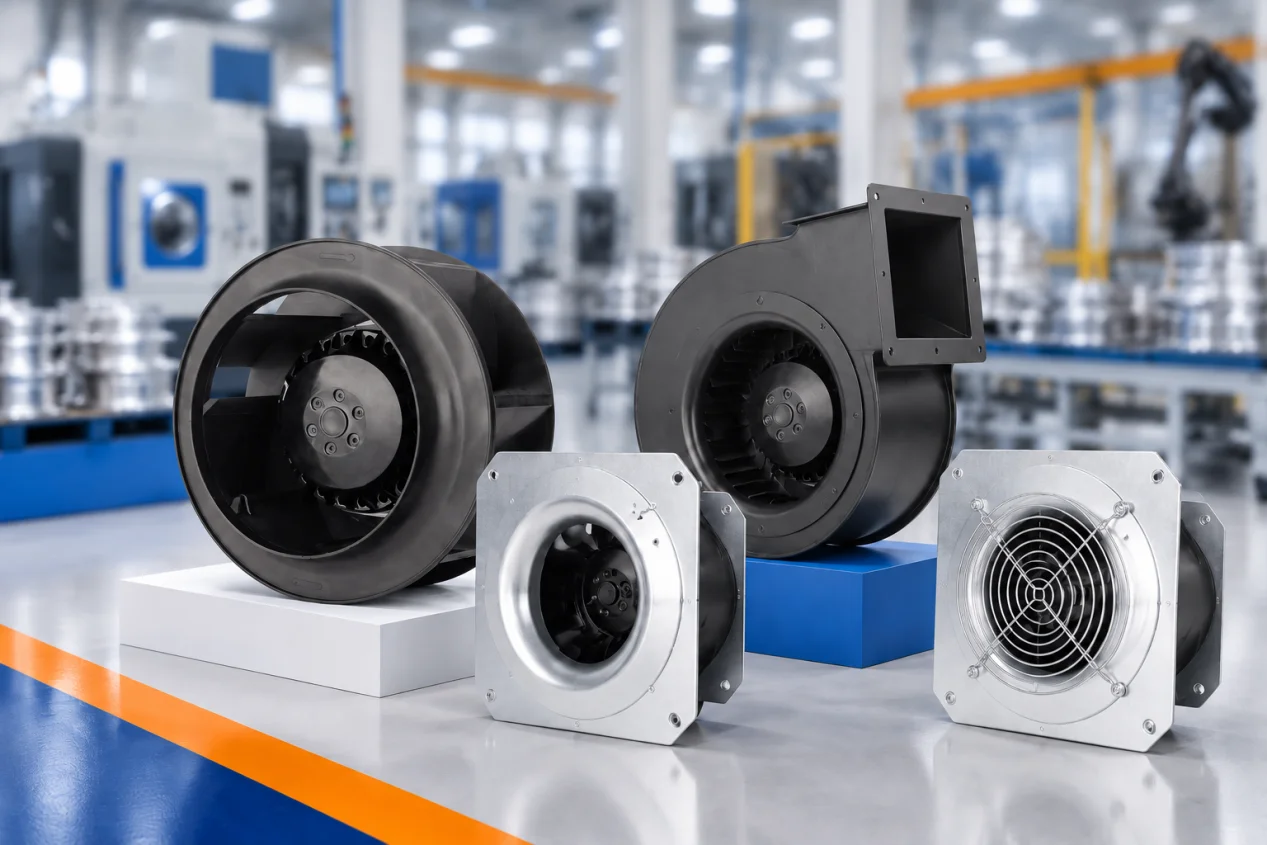
Our LWFD6018 series was the right platform on frame size. Within it, however, the real decision was bearings.
A sleeve bearing option existed at lower cost, offering 30,000 hours L10. Instead we specified dual ball bearings, which take L10 past 50,000 hours at 40C. For industrial electronics that difference is worth the money, and the customer had asked for it explicitly.
Impeller and motor
Impeller and scroll housing are both UL 94V-0 rated PBT plastic. Furthermore, we refined their geometry through CFD simulation until the pressure target was met.
A Longwell brushless external rotor motor was then matched to that impeller, reaching 5500 RPM on just 3.6 watts. Getting 177 Pa for under four watts is the genuinely difficult part of this specification.
Finally, the LWFD6018LH-01 carries PWM control on a 4-wire interface that connects straight to the customer mainboard. Consequently the board can vary fan speed with thermal load rather than running flat out continuously.
Technical Specifications
Read the maximum static pressure row carefully, including its unit. That single line is where this DC blower project nearly went wrong.
| Parameter | Value |
|---|---|
| Model Number | LWFD6018LH-01 |
| Rated Voltage | 12 VDC |
| Operating Voltage | 7.0 – 13.8 VDC |
| Input Current | 0.30 A |
| Input Power | 3.60 W |
| Speed | 5500 RPM |
| Maximum Air Flow | 5.89 CFM / 10.0 m³/h |
| Maximum Static Pressure | 176.81 Pa / 0.71 inch-H₂O |
| Noise Level | 43.0 dB(A) |
| Dimensions (LxWxH) | 61.8 x 61.3 x 18 mm |
| Weight | 41 g |
| Bearing Type | Two Ball Bearings |
| L10 Life Expectancy (@ 40°C) | 50,000 hours |
| Frame / Impeller Material | PBT Plastic (UL 94V-0) |
| Operating Temperature | -10°C to +70°C |
| Certifications | CE, UL, RoHS, ISO, EAC |
Technical Documentation
The PDF specification sheet contains detailed performance data, mechanical drawings, and wiring diagrams for the LWFD6018LH-01, essential for design engineers integrating the blower.
Download LWFD6018LH-01 Specification Sheet
Here the product series table allows engineers to compare the LWFD6018LH-01 against other models in the LWFD6018 family with different voltage and performance ratings. 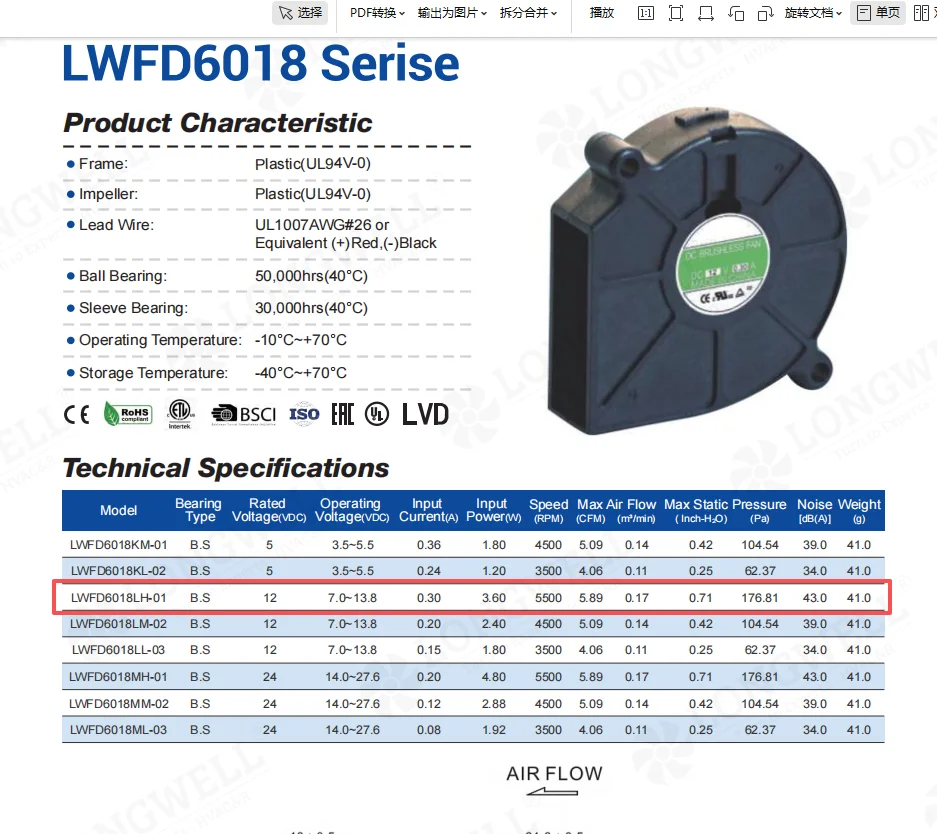
The project source file provides original design inputs and can be requested by OEM partners under an NDA for deep integration projects.
Download Project Source File
Why the OEM sourced here
In the end, four things counted here.
- Everything made in one place. The brushless DC motor, the PBT impeller and the housing are all produced in our Ningbo facility. That vertical integration puts the price materially below equivalent European blowers, without giving anything up on engineering.
- Samples quickly. An OEM on a tight schedule cannot wait months for parts to test. Even for a standard DC blower like this, qualification samples go out fast enough to keep validation moving.
- CE and UL handled. Our long-standing relationship with a China-local TUV NORD notified body shortens the certification timeline considerably, which removes a common bottleneck for products aimed at both Europe and North America.
- Curves from a verified lab. Every performance curve for this model comes from our test lab, independently verified to AMCA 210/211 and ISO 5801 methods. Engineers can design to those numbers rather than de-rating them defensively.
Browse our DC blower range, or the electronics cooling fan section. Flammability ratings for plastics come from UL Solutions in UL 94.
Questions about life and control
What L10 life applies at 60C rather than 40C?
Meanwhile the rated 50,000 hours applies to continuous running at 40C. Raising ambient to 60C stresses the bearing lubricant, and a general estimate for that 20C rise is roughly 25,000 to 30,000 hours. Send us your duty cycle and we will calculate it properly using the Arrhenius model.
How is the speed controlled?
Through PWM on the brown wire of the 4-wire harness. It accepts a standard logic-level signal, typically between 20 and 30 kHz, adjusting speed from a minimum up to the rated 5500 RPM. A yellow wire also carries a tachometer output at two pulses per revolution, so your controller can read actual speed back.
Is it available in other voltages?
Yes. The LWFD6018 series covers 5V, 12V and 24V, including the LWFD6018KM-01 for 5V systems and the LWFD6018MH-01 for 24V. Each has its own performance point, so ask us for the full series datasheet and pick the combination that suits your rail.
Why does a small blower make so much more pressure than a small fan?
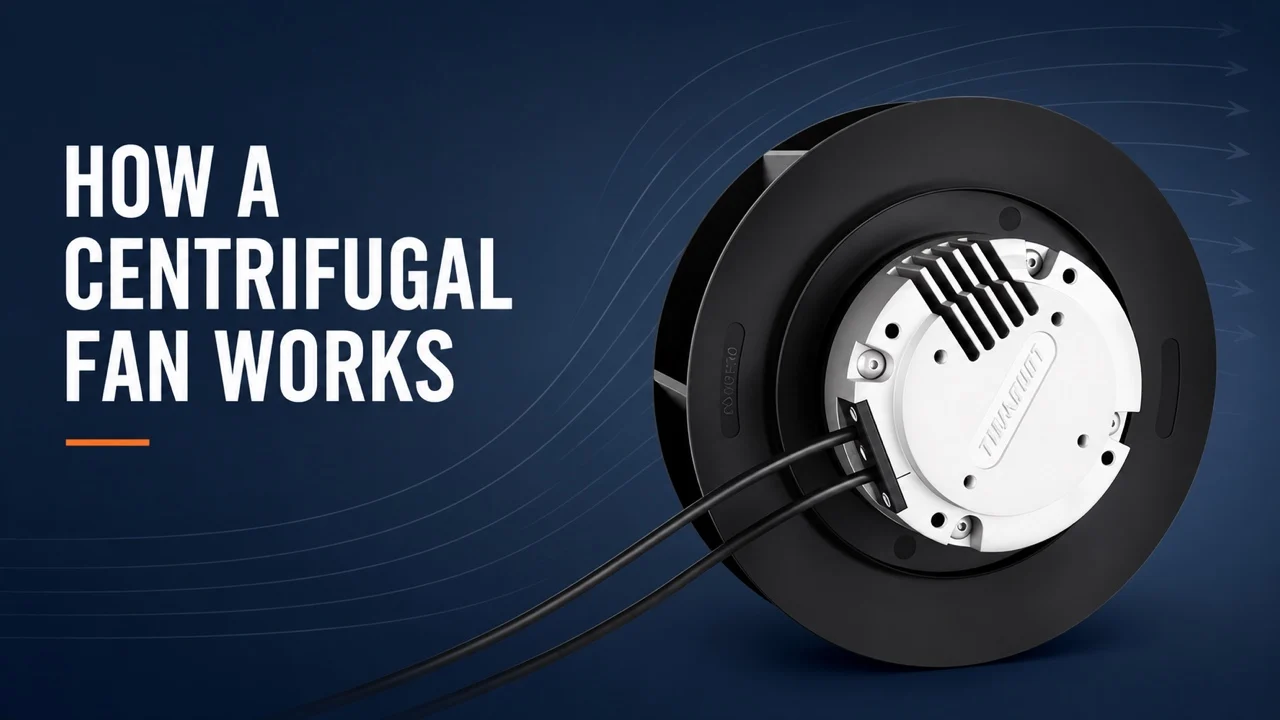
Because of how the air turns. A centrifugal impeller flings air outward, then the scroll converts that speed into pressure. An axial fan simply pushes air along its axis, which moves volume efficiently and builds pressure poorly. In a tight enclosure, pressure is what actually gets air to the components.
Technical Documentation & Resources
Got a duty point you need matched?
Tell us the airflow, the pressure and the space you have. Then we mark your duty point on a tested curve and send the drawing back. Meanwhile samples and custom spec sheets take up to 90 days. Since 1990 we have supplied OEMs across HVAC, refrigeration and industry.
Browse Related Products:
🏆 ISO 9001 / ISO 14001 / ISO 45001 | CE (TÜV) | UL/ETL | ATEX Zone 21/22 | AMCA 210/211 / ISO 5801 tested
Choose the right blower
Longwell manufactures 247 blowers in-house. Send airflow, static pressure and voltage — an engineer replies with a matching model, performance curve and price within one working day.