A pre-selected fan and a wide ambient range
An HVAC OEM had already chosen a 250mm axial fan for a commercial condenser and asked us to validate it and issue the data sheet. Among the figures they needed confirmed was an L10 bearing life of 30,000 hours.
In short, the selection was theirs. Our job was to check it held up and then say so on paper.
The operating envelope
- First, 230 VAC at 50 Hz, delivering about 979 m3/h in free air.
- Next, under 55 dB(A), because commercial building limits apply.
- Meanwhile a 280 by 280mm frame, maximum depth 80mm.
- Finally, -30C to +60C ambient, with CE marking against EN 60335-1.
The requirement that reaches the bearings
Above all, a 90 degree spread between coldest and hottest ambient is the demanding part of this specification.
The motor has to start at one end of it and run continuously at the other. Consequently the bearing and its grease see two quite different problems in the same year.
What L10 bearing life assumes
Here the 4-pole motor at 1400 RPM matched to a 7-blade steel impeller delivers the airflow. That part was straightforward. Meanwhile the L10 bearing life claim needed more care.
What L10 actually states
L10 is a statistical figure from ISO 281. It says that under stated conditions, 90% of a large population of these bearings will still be running at that hour count.
So 10% are expected to have failed by then. It is not an average, and it is not a minimum. Reading it as a guarantee for your individual fan is the mistake almost everyone makes.
It is also conditional. The figure assumes a load, a speed and a temperature. Change any of those and the number is no longer the number.
Why the grease decides more than the bearing
In practice, deep groove ball bearings are the easy part of this specification. The lubricant inside them is where the ambient range actually bites.
At -30C an ordinary grease stiffens. Starting torque rises, the motor has to break through it on every cold start, and a shaded or weak motor may not.
At +60C the opposite failure appears. Grease thins, bleeds and oxidises, and once it has migrated out of the raceway the bearing runs increasingly dry.
So a wide-range fan needs a grease formulated for both ends. That choice is what supports the L10 bearing life figure, rather than the bearing selection alone.
The thermal protector behind it
Meanwhile Class F insulation rated to 155C gives thermal headroom, and an integrated protector disconnects the motor between 150 and 160C.
That protects against a stalled rotor and against high-ambient overload. It does not extend L10 bearing life, which is a separate mechanism entirely.
Why not EC
We considered an EC variant and set it aside. This is fixed-speed duty with no control signal available, so EC would add electronics and no function.
That answer changes on a condenser with head pressure control. Here nothing varies.
Technical Specifications
The temperature range and the life figure belong together. Quoted apart, neither one means very much.
| Model Number | LWAA4E250S-7MKW-48 |
| Voltage | 230 VAC |
| Frequency | 50 Hz |
| Input Power | 50 W |
| Current | 0.25 A |
| Speed | 1400 RPM |
| Max Airflow | 979 m³/h (576 CFM) |
| Noise Level | 53 dB(A) |
| Operating Temperature | -30°C to +60°C |
| Protection Class | IP44 |
| Insulation Class | Class F |
| Bearing Type | Maintenance-free ball bearings |
| Impeller Material | Cold-rolled steel |
| Life Expectancy (L10) | 30,000 hours at 20°C |
| Frame Dimensions | 280 x 280 x 80 mm |
| Certifications | CE, RoHS, Reach |
| Work System | S1 (Continuous Duty) |
Technical Documentation
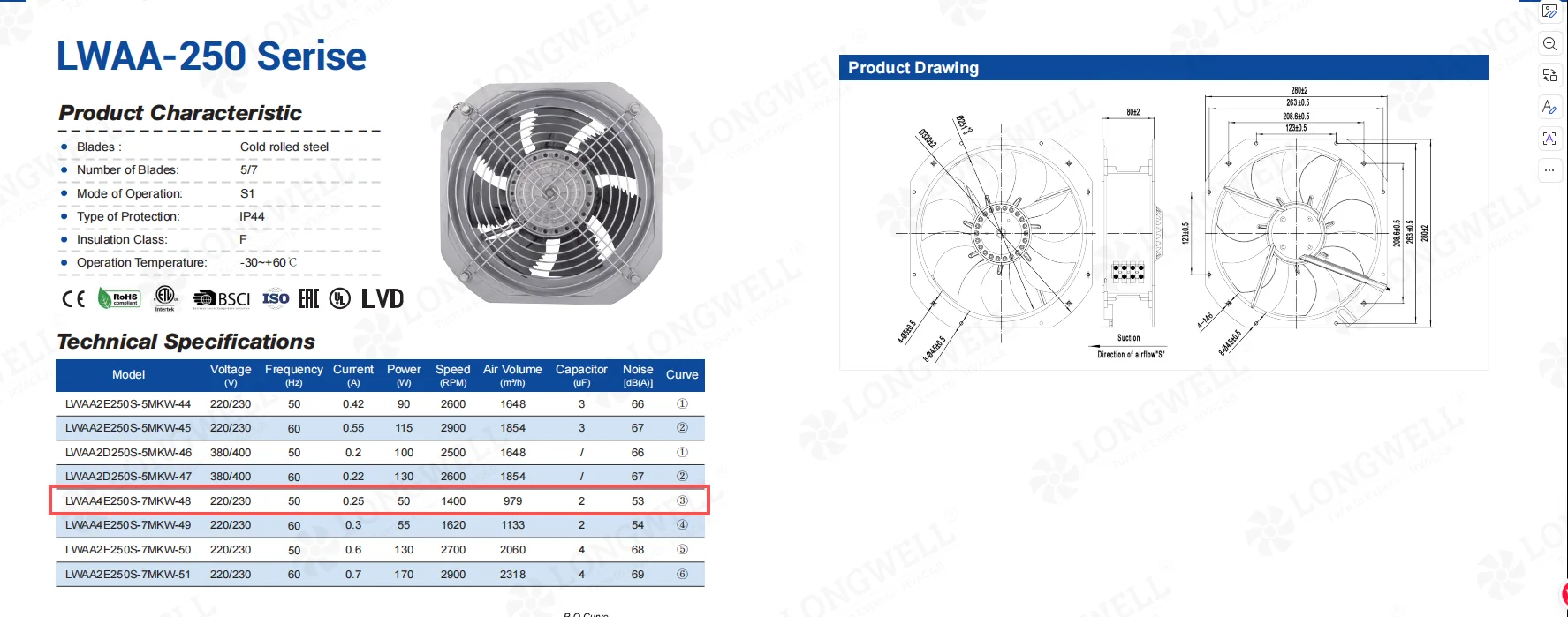
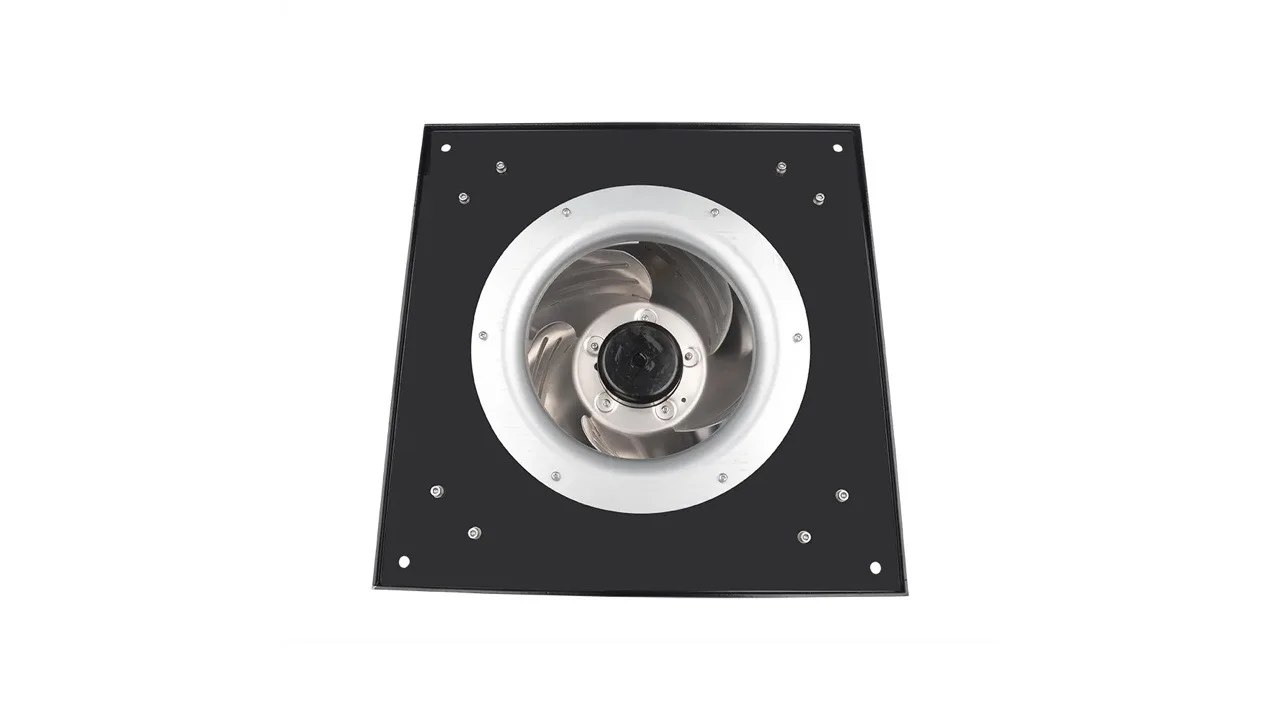
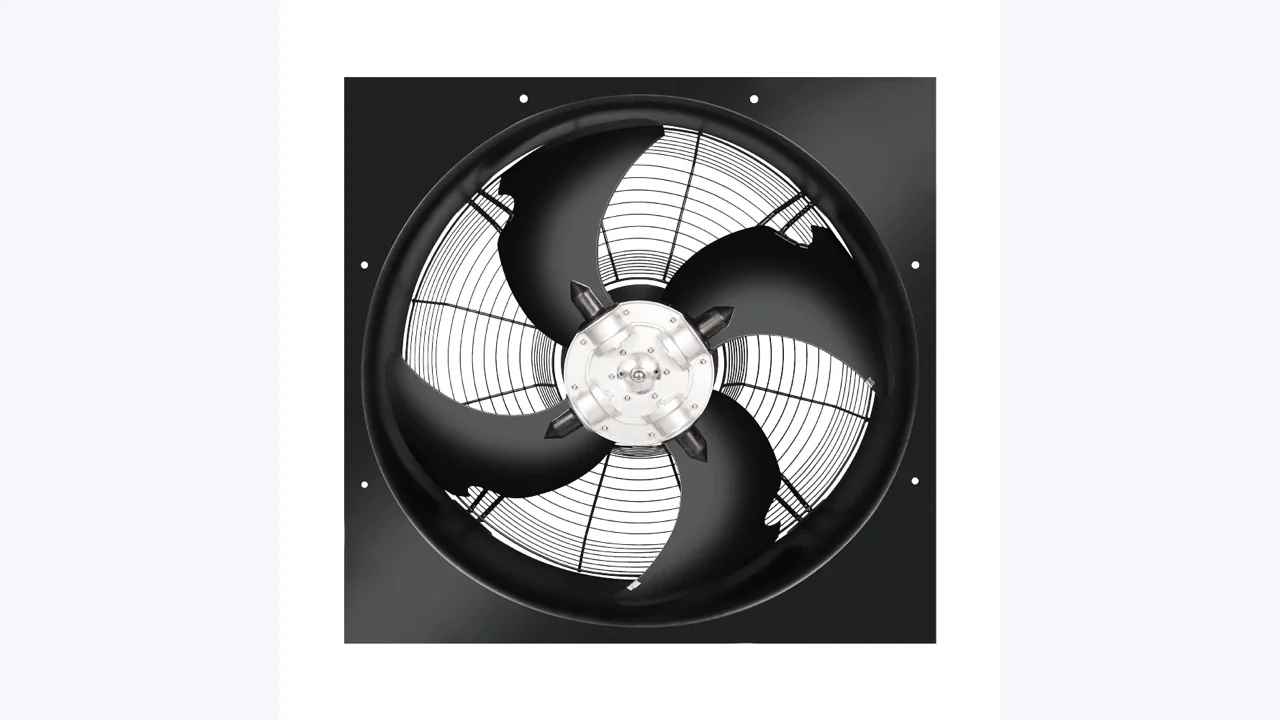
Meanwhile the product image allows for quick visual identification of the 7-blade fan and its square mounting frame for integration into assembly drawings.
Download PDF Specification Sheet
Here the final PDF document contains all approved electrical, mechanical, and performance data for system integrators and quality assurance teams.
This source Word document is provided for design engineers who need to copy technical data into their own project documentation or compliance files.
Reading a life figure properly
An L10 bearing life figure is quoted more often than it is checked. Four things make it meaningful.
- Ask what temperature the L10 bearing life was calculated at. A figure computed at 25C and one computed at 60C are not comparable, and suppliers do not always say which they quoted. Without the temperature, the hours are decoration.
- Read it as a population statistic. L10 bearing life means 10% are expected to have failed by that point. If you are shipping thousands of units, plan your spares and warranty around that tenth rather than around the headline.
- Check the grease against your cold end, not just your hot end. Low-temperature starting torque is the failure people forget. If your equipment sits unpowered through winter and has to start at -30C, say so during selection.
- Separate thermal protection from life expectancy. A thermal protector stops a motor burning out. It does nothing about bearing wear, so a fan with excellent protection can still reach end of life on its bearings exactly on schedule.
See our axial fans range, the condenser fans section, or AC axial fans.
Questions about bearing life
Does 30,000 hours mean the fan will run for 30,000 hours?
No. It means 90% of a large sample is expected to still be running at that point under the stated conditions. Your individual fan may run considerably longer or fail earlier. Treat it as a planning figure for a fleet, not a promise for one unit.
How much does temperature change bearing life?
Substantially, mostly through the grease rather than the steel. Higher temperatures accelerate oxidation and oil bleed, so the lubricant reaches the end of its useful life well before the bearing does. That is why the quoted ambient matters as much as the hour count.
Why does cold weather matter if the fan is not running?
Because it has to start. Grease stiffens as temperature falls, which raises breakaway torque at the exact moment the motor has least help. A fan that starts happily at 20C can stall at -30C on the same supply.
Can I extend bearing life by running the fan slower?
Usually yes, since lower speed means lower load and less heat. But on an AC motor you cannot simply choose a speed, and slowing the fan reduces airflow. It is a real lever, and it costs cooling capacity, so decide it deliberately.
Technical Documentation & Resources
Working on something similar?
Send us the duty point, the envelope and the supply, and our engineers come back with a shortlist rather than a catalog. Meanwhile custom spec sheets and samples run to 90 days. Since 1990 we have built fans for HVAC, cold chain, data center and industrial OEMs.
Browse Related Products:
🏆 ISO 9001 / ISO 14001 / ISO 45001 | CE (TÜV) | UL/ETL | ATEX Zone 21/22 | AMCA 210/211 / ISO 5801 tested