What the OEM needed
An OEM developing compact fan coil units needed a compact fan coil blower fitting inside 194mm of overall length.
That shallow, linear enclosure is the defining constraint. It rules out most fan types before performance is even discussed.
The constraints
- First, at least 113 m3/h for effective room circulation.
- Next, 45 dB(A) maximum, since these run in residential and light commercial rooms.
- Meanwhile a 230V supply at 50Hz.
- Finally, CE compliance for the European market.
The noise limit is the requirement that does the real work here. A fan coil unit sits in an occupied room, often above a window or in a ceiling, and people notice it long before they notice the airflow.
Building a compact fan coil blower
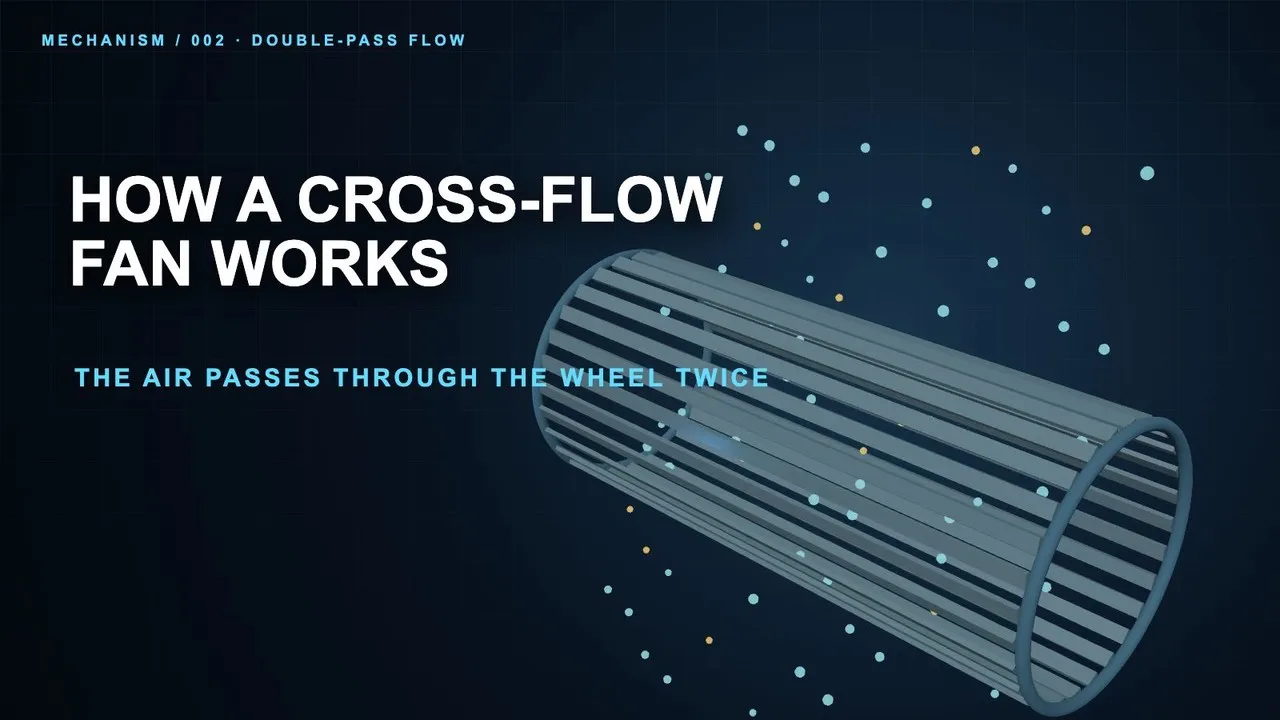
A cross-flow layout was right for a compact fan coil blower, and the customer had already reached that conclusion. It produces a wide, even sheet of air, which is what a fan coil, trench heater or air curtain needs. Distribution matters far more here than pressure.
Why not EC
An EC version with our SmartEC controller would give variable speed and better peak efficiency.
However, the specification called for simple on-off, single-speed operation. Adding an EC motor and its electronics would raise cost and complexity for capability the product never uses. So an AC shaded-pole motor at 1700 RPM was the correct answer.
Aluminum over steel, and why
Here the impeller is aluminum alloy rather than steel, and this is the choice that produces the 44 dB(A) figure.
A lighter rotor has less start-up inertia, so the motor accelerates it without straining. More importantly, lower mass means less energy stored in any residual imbalance, which translates directly into less vibration.
Consequently this compact fan coil blower lands a decibel under its target rather than on it. That is margin the customer can spend on installation variation.
The housing and bearings
The housing is galvanized SGCC steel, chosen for rigidity and corrosion resistance. Rigidity matters acoustically too: a flexible housing amplifies whatever the impeller produces.
Bearings are maintenance-free ball rather than sleeve. Sleeve bearings are cheaper and quieter when new, though they wear and get noisy, and in a ceiling-mounted unit nobody is going to service them.
What it cost
Pressure and control. At 57 Pa maximum this compact fan coil blower moves air across a coil and no further.
It also runs at one speed forever. If the room needs less air at night, the only options are switching it off or accepting the noise. That was the right trade for the price point, though it is a limitation worth knowing before the product ships.
Technical Specifications
Meanwhile the power and noise rows below are the ones worth reading together. Fifteen watts at 44 dB(A) is what a matched selection looks like.
| Parameter | Value |
|---|---|
| Model | LWCA-60120SN-06 |
| Voltage | 230 V |
| Frequency | 50 Hz |
| Input Power | 15 W |
| Speed | 1700 RPM |
| Max. Airflow | 113 m³/h |
| Max. Static Pressure | 57 Pa |
| Noise | 44 dB(A) |
| Overall Length (A) | 194 mm |
| Mounting Length (B) | 123 mm |
| Impeller Length (C) | 120 mm |
| Motor Type | AC Shaded Pole Motor |
| Bearings | Ball Bearing |
| Housing Material | Galvanized Steel |
| Impeller Material | Aluminum Alloy |
| Insulation Class | Class B/F/H |
| Operating Temperature | -25°C to +60°C |
| Certifications | CE, RoHS, BSCI, ISO |
Technical Documentation
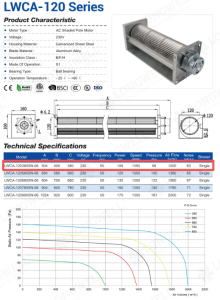
The product datasheet provides procurement managers and system integrators with a complete overview of the LWCA-60 series performance specifications.

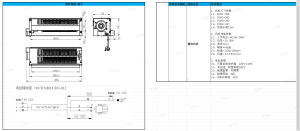
Here the final approved technical drawing gives design engineers the precise dimensional data, material specifications, and mounting details required for CAD integration.
If you are specifying for a fan coil
Choosing a compact fan coil blower is mostly about noise, and noise gets decided earlier than most people realise.
- Set the noise limit before the airflow target. Airflow can be met many ways; meeting it quietly narrows the field sharply. Deciding dB(A) first means you evaluate the right fans rather than eliminating them late.
- Prefer a lighter impeller in quiet applications. Aluminum over steel reduces vibration for the same balance grade, and vibration is what a room actually hears. The cost difference is small at this size.
- Insist on ball bearings for anything hard to reach. Sleeve bearings start quiet and get worse. In a ceiling or wall unit, that noise becomes a service call nobody wants to make.
- Check housing rigidity, not just the fan. A stiff housing keeps the assembly quiet. A thin one turns a well-balanced impeller into a drum, and no amount of fan specification fixes that.
See our cross flow fan range, the AC cross flow fan section, or fan coil units. Appliance safety follows IEC 60335-1.
Questions about this fan
Why does impeller material affect noise?
Because a lighter rotor stores less energy in whatever imbalance remains after balancing. That energy is what becomes vibration, and vibration is what the housing radiates as sound. Aluminum at this diameter is stiff enough structurally while weighing considerably less than steel.
Would an EC version be quieter?
At full speed, no, since noise comes from the aerodynamics. However, an EC fan can run slower when less air is needed, and slower is always quieter. If your product would benefit from a night setting, that is the argument for EC rather than efficiency.
Is 57 Pa enough for a fan coil?
For air crossing a coil and discharging into a room, yes, and that is what the fan type is for. It is not enough for ducting, a filter, or any extended air path. If your design adds any of those, the fan choice changes.
What is wrong with sleeve bearings?
Nothing, when new and when accessible. They are quiet and inexpensive. However, they wear steadily and become noisy, and their life falls off sharply if mounted at an angle. On a unit installed in a ceiling, ball bearings avoid a problem you cannot easily reach.
Technical Documentation & Resources
Need the same thing for your own unit?
Give us the numbers and the envelope, and you get a shortlist rather than a catalog. Meanwhile custom spec sheets and samples run to 90 days. Since 1990 Longwell has supplied EC fans and blowers to OEMs in HVAC, cold chain, data center and industrial markets.
Browse Related Products:
🏆 ISO 9001 / ISO 14001 / ISO 45001 | CE (TÜV) | UL/ETL | ATEX Zone 21/22 | AMCA 210/211 / ISO 5801 tested
Choose the right fan coil unit
Longwell manufactures 14 fan coil units in-house. Send airflow, static pressure and voltage — an engineer replies with a matching model, performance curve and price within one working day.