What the cabinet maker needed
An OEM developing high-density electronics cabinets asked for the spec sheet on a 200mm high pressure axial fan.
They had already picked it from catalog data, so this was a design-in exercise. Their targets were 1391 m3/h and 395 Pa.
Why the pressure figure stands out
395 Pa from a 200mm frame is a lot. Axial fans are usually chosen for volume rather than pressure, so a high pressure axial fan sits well beyond where most of them stop.
That number tells you what is inside the cabinet: dense component layouts, heat sinks and fine-particle filters, all of which resist airflow hard.
- A 225 by 225 mm mounting profile with maximum depth 88.8mm.
- Next, 230V nominal with a wide 176 to 264V tolerance, for European and Asian deployment.
- Meanwhile variable speed over 0-10VDC or PWM.
- IP55, which resists dust and water jets rather than just splashing.
- Finally, 64 dB(A) maximum, safety to EN 60335-1, and data verified to ISO 5801.
IP55 is worth noticing. It suggests the finished equipment goes into industrial spaces rather than a clean server room.
Choosing a high pressure axial fan
Our job was validating the choice. However, one alternative deserved serious consideration first.
The blower we did not propose
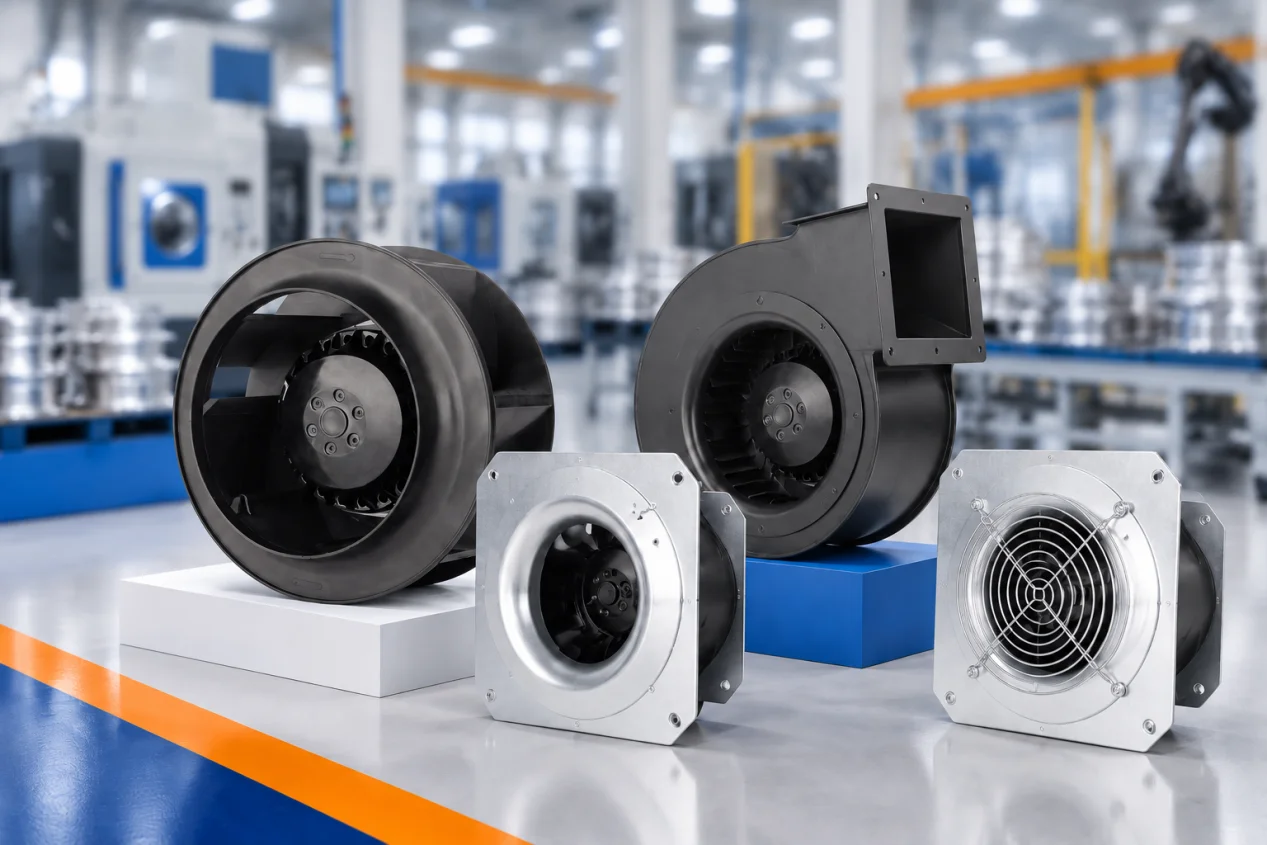
A centrifugal blower reaches 395 Pa easily. Certainly it is the obvious answer if you read only the pressure requirement.
We rejected it on layout grounds. A centrifugal fan takes air in axially and discharges it at 90 degrees, whereas an axial fan passes air straight through. Consequently swapping one for the other means redesigning the cabinet airflow path, the mounting and probably the sheet metal.
Their enclosure was already designed around a straight-through fan. So proposing a blower would have handed them a redesign and a schedule slip, in exchange for pressure a high pressure axial fan already provides.
Why AC was never an option
The requirement for 0-10V or PWM speed control rules out an AC motor immediately, since it cannot provide it without an external drive.
Meanwhile an EC motor brings more than speed control. This one includes tachometer feedback so the system knows the fan is actually turning, plus locked-rotor and over-temperature shutdown. In a sealed cabinet those protections matter, because a failed fan is invisible until something overheats.
Where the pressure comes from
Speed and blade design. The fan turns at 3600 RPM, fast for a 200mm impeller, while the blade profile is built for pressure rather than free-flow volume.
Consequently it draws 115W to deliver 1391 m3/h and 395 Pa, across the full -25C to +60C range.
What it cost
Noise and power, both traceable to that 3600 RPM. At 64 dB(A) this fan is audible, and 115W is more than a low-pressure fan of the same size would draw.
Neither is avoidable. Pressure in an axial fan comes from tip speed, and tip speed makes noise and consumes power. The speed control is what makes it liveable, since the fan only needs full output when the filters are loaded or the ambient is high.
Technical Specifications
Here the pressure figure below is unusual for this diameter. In short, that is the point of the selection.
| Parameter | Value |
|---|---|
| Model Number | LWAE3G200SS-7PKW-16 |
| Nominal Voltage | 230 VAC |
| Voltage Range | 176-264 VAC |
| Frequency | 50/60 Hz |
| Speed | 3600 RPM |
| Input Power | 115 W |
| Current | 0.85 A |
| Max Airflow | 1391 m³/h / 828 CFM |
| Max Static Pressure | 395 Pa |
| Noise Level | 64 dB(A) |
| Operating Temperature | -25°C to +60°C |
| Dimensions | 225 x 225 x 88.8 mm |
| Weight | Approx. 2.5 kg |
| Protection Class | IP55 |
| Insulation Class | Class B |
| Life Expectancy (L10) | 25,000 hours @ 40°C |
| Control | 0-10VDC / PWM |
| Certifications | CE, RoHS, Reach |
Technical Documentation
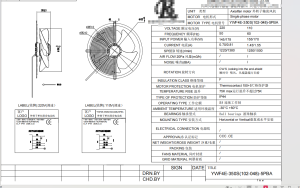
The specification sheet and drawing sit below. Between them they carry the performance curve and the mounting dimensions a high pressure axial fan needs checking against.
Meanwhile the complete technical specification sheet contains performance curves, dimensional drawings, and electrical connection data essential for design engineers and system integrators.
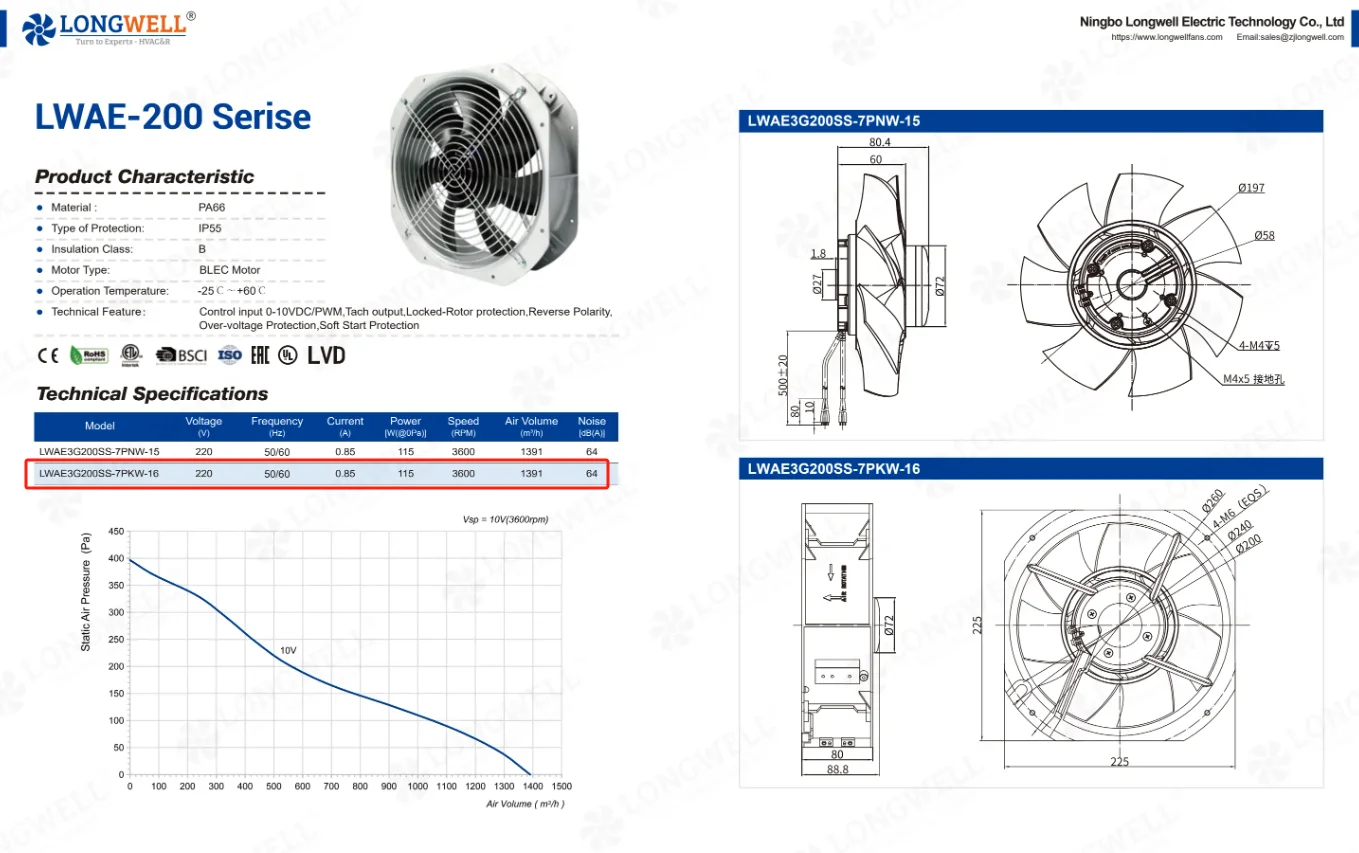
The summary product image with key specifications and dimensional drawings is useful for procurement managers and for quick reference in technical documentation.
The source document for the technical specification allows OEMs to integrate the data into their own documentation systems.
If you are cooling a dense cabinet
Cooling a dense cabinet is a pressure problem disguised as an airflow problem. So a high pressure axial fan is often the answer, and these help you specify one.
- Measure the cabinet impedance before choosing a fan. Component density, cable routing and filter choice set your system curve, and estimates are consistently optimistic. Without it you are comparing fans on free-delivery numbers that nobody will ever see.
- Decide the airflow direction before the pressure requirement. Straight-through and 90-degree discharge lead to completely different enclosures. Changing your mind afterwards is a sheet metal problem, not a fan problem.
- Use tachometer feedback in any sealed enclosure. A stalled fan gives no external sign until temperatures climb. A tacho output lets the controller alarm on a slowing fan, which turns a failure into a service call.
- Budget filter loading into the pressure, not just the clean figure. Fine-particle filters can double their resistance in service. A fan sized against a clean filter runs out of headroom long before the maintenance interval.
See our axial fan range, the EC axial fan section, or cabinet cooling fans. Ingress ratings follow IEC 60529.
Questions about this fan
Why not use a centrifugal blower for this pressure?
Because of the airflow path, not the pressure. A blower discharges at 90 degrees to its inlet, so it needs a different enclosure layout, mounting and ducting. If the cabinet is being designed from scratch a blower is a reasonable option. If it already exists, an axial fan that reaches the pressure is far cheaper overall.
What is the practical difference between IP54 and IP55?
Here the water test. IP54 covers splashing; IP55 covers low-pressure jets from any direction. For an industrial floor where equipment gets hosed down or sits near washdown areas, that difference is real. For a clean indoor cabinet, IP54 is usually sufficient and costs less.
Can the fan run continuously at full speed?
Yes, it is rated for continuous duty across the full temperature range. However, running at 3600 RPM all the time means living with 64 dB(A) and 115W permanently. Most installations use the speed control to run lower, stepping up only when temperature or filter loading demands it.
Why does an axial fan struggle at high pressure?
Because it pushes air along the axis, and at high back-pressure the flow separates from the blades and stalls. By contrast a centrifugal fan uses rotational energy, which holds up better against resistance. Consequently a high pressure axial fan needs a blade profile and tip speed chosen specifically for it, which is why this one runs fast for its size.
Technical Documentation & Resources
Have a fan requirement like this one?
Send the datasheet you are working against, or simply the duty point. Then our engineers tell you what fits and what does not. Meanwhile custom spec sheets and samples take up to 90 days. Since 1990 we have been building fans for OEMs worldwide.
Browse Related Products:
🏆 ISO 9001 / ISO 14001 / ISO 45001 | CE (TÜV) | UL/ETL | ATEX Zone 21/22 | AMCA 210/211 / ISO 5801 tested
Choose the right axial fan
Longwell manufactures 1,086 axial fans in-house. Send airflow, static pressure and voltage — an engineer replies with a matching model, performance curve and price within one working day.