What the electronics OEM needed
An OEM developing compact electronic enclosures needed two DC cross-flow fan sizes. Both, importantly, had to run from a fixed 24 VDC rail.
Basically the job is even airflow across circuit boards of different sizes. One model had to move at least 214 m3/h, while the other needed 152 m3/h. Our standard LWCD-65180MN-07 and LWCD-60180MN-06-00 covered both.
However, the interesting part is what the customer asked us to remove.
- Simple on/off control, so the 4-wire EC motor becomes a 2-wire power input.
- A factory-fitted wire finger guard on every DC cross-flow fan.
- A 500mm cable, already terminated with a 2-pin connector at 2.5mm pitch.
- Five units of each model first for validation, and afterwards volume production.
This is a very common OEM request, and it is rarely about the fan. Rather, it is about taking steps out of somebody else assembly line.
Simplifying the DC cross-flow fan
Initially we logged this as light customization of two proven platforms. Consequently most of the work sat in the motor electronics.
Removing two wires
Normally the 4-wire SmartEC interface gives PWM speed control and a tachometer output. Here, though, both are dead weight, since the control system simply switches the fan on and off.
So the internal controller board was reconfigured to run at a fixed optimal speed on a plain 24V two-wire input: 1800 RPM for the LWCD-65180, and 2000 RPM for the LWCD-60180.
The benefit lands on the customer side. They no longer terminate, insulate or even document two unused signal wires. As a result the harness is shorter, and two chances of a wiring error disappear from production.
Guards without tooling
Here the physical part was straightforward. We picked standard wire-form finger guards already in our supply chain to match each housing, at 100 by 112mm for the LWCD-65 and 90 by 86mm for the LWCD-60. No custom tooling, therefore no NRE charge.
The cable assembly
The connector request became a small sub-assembly. We sourced the specified 2-pin, 2.5mm pitch connector. Afterwards we set up a process to attach the 500mm leads in production rather than as a rework step.
Locking it down with a part number
Finally we consolidated all three changes into new part numbers. Namely LWCD-65180MN-07-37 and LWCD-60180MN-06-37.
That step matters more than it appears. A part number guarantees the tenth order matches the first. Furthermore, it lets the customer reference one item in their PLM system instead of describing three modifications every time.
Technical Specifications
Two models are listed below, and both carry the -37 suffix. Basically that suffix is the whole customization on each DC cross-flow fan: 2-wire input, guard fitted, cable terminated.
| Parameter | LWCD-65180MN-07-37 | LWCD-60180MN-06-37 |
|---|---|---|
| Voltage (VDC) | 24 | 24 |
| Current (A) | 0.6 | 0.2 |
| Speed (RPM) | 1800 | 2000 |
| Air Flow (m³/h) | 214 | 152 |
| Static Pressure (Pa) | 41 | 29 |
| Overall Length (mm) | 253 | 246 |
| Impeller Length (mm) | 184 | 184 |
| Impeller Diameter (mm) | 65 | 60 |
| Noise (dB(A)) | 47 | 38 |
| Bearings | Ball Bearing | Ball Bearing |
| Speed Control | No (Fixed Speed) | No (Fixed Speed) |
| Cabling | Custom 500mm length, 2-pin connector (2.5mm pitch) | |
Technical Documentation
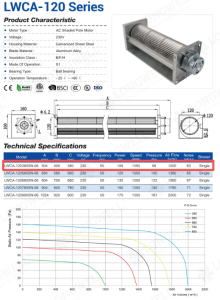
LWCD-60180MN-06-37 Technical Drawing
The final assembly drawing provides mechanical engineers with all critical dimensions, material specifications, and tolerances for the customized 60mm diameter cross-flow fan.
LWCD-65180MN-07-37 Technical Drawing
Procurement and quality teams use this specification sheet to confirm the performance parameters and physical configuration of the modified 65mm diameter fan.
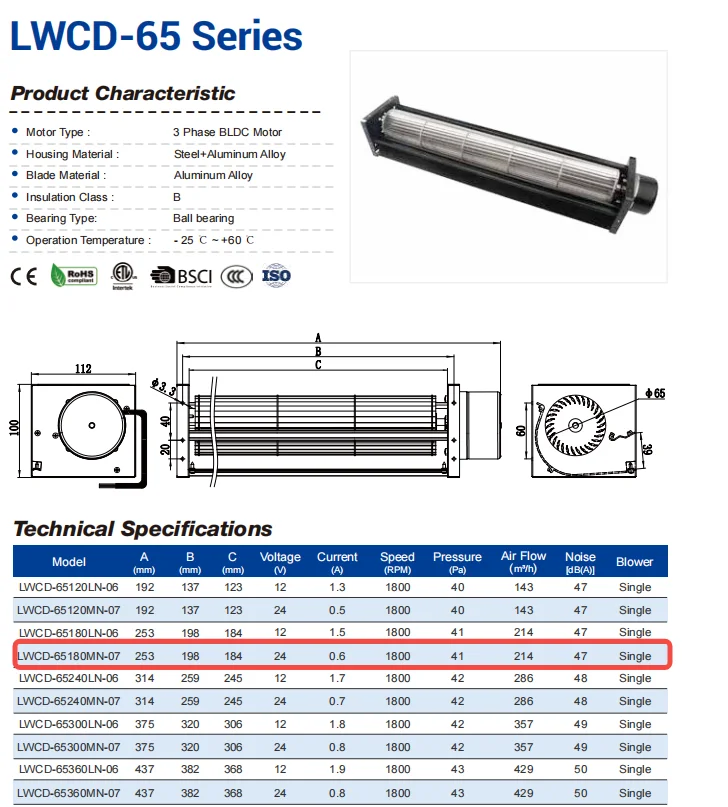
The final LWCD-65180MN-07-37 product, showing the aluminum impeller and the integrated wire guard and custom cable assembly.
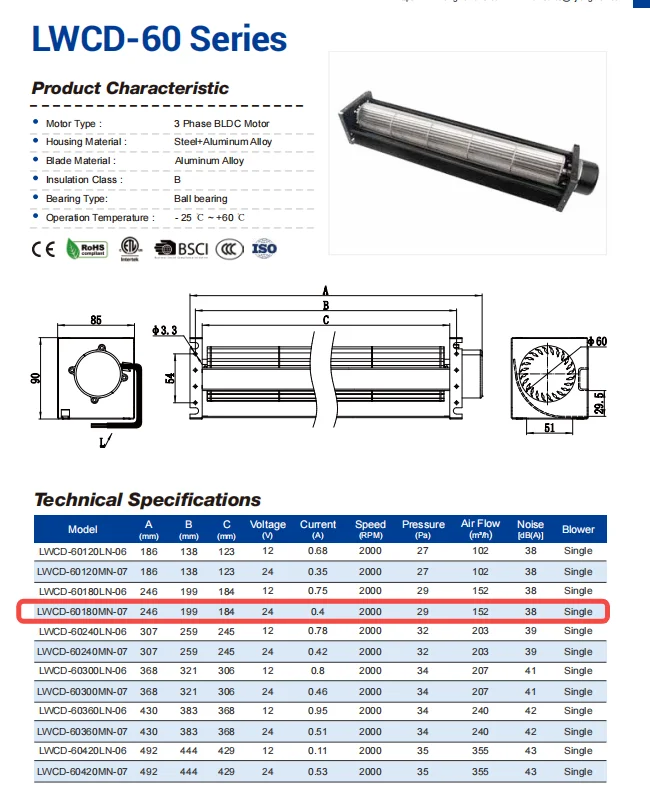
The LWCD-60180MN-06-37 variant, a more compact unit providing quieter operation for noise-sensitive sections of the customer’s equipment.
Why small modifications come here
In the end, four things made a set of small changes worth doing properly.
- Small modifications get a real answer. imported European brands often run 12 to 18 month NPI cycles and can be uninterested in minor changes. Here the 2-wire conversion, the guards and the cabling became a formal quoted solution quickly.
- One line item instead of three. Delivering the DC cross-flow fan with guard, cable and connector already fitted means the customer buys, stocks and handles one part rather than three. That saves procurement overhead as well as assembly labor.
- Custom work at close to standard pricing. We absorb the engineering effort on modifications like this for qualified OEM partners, so the finished part still lands materially below European equivalents.
- Documentation that survives the handover. The -37 part numbers and approved drawings give the customer something their PLM system can hold, and they guarantee every future fan against that number is identical.
Browse our cross-flow fan range, or the DC cross-flow fan series for other sizes. Enclosure protection ratings are defined in IEC 60529.
Questions about custom configurations
Can the LWCD series run from a simple 2-wire supply?
Yes. The standard EC motor uses four wires for power, ground, PWM and tacho. However, we can factory-configure a 2-wire version running at a fixed speed, which is exactly what happened here. The LWCD-60180MN-06-37 and LWCD-65180MN-07-37 both use that configuration on a 24V bus.
What is the lead time for a fan with a specific cable and connector?
For light modifications like a 500mm cable and a named connector, engineering and sampling usually complete in two to three weeks. Once the design is approved, production batches follow our standard make-to-order window of 15 to 25 days.
Are finger guards available for these fans?
Yes, and we fit them at the factory. This project used guards matched to the LWCD-60180MN at 90 by 86mm and the LWCD-65180MN at 100 by 112mm. Fitting them here means the customer performs no extra assembly and handles no loose parts.
Why remove PWM control if it is already built in?
Because an unused input is not free. It adds two conductors to the harness, two terminations in assembly, and two things a test procedure has to account for. Where the control system only switches a DC cross-flow fan on and off, taking those wires away makes the product more reliable, not less capable.
Technical Documentation & Resources
Sizing something comparable?
Share the airflow, pressure, voltage and control interface, and we come back with a tested curve and a drawing. Meanwhile custom work runs to 90 days for spec sheets and samples. Since 1990 Longwell has supplied fans to HVAC and industrial OEMs.
Browse Related Products:
🏆 ISO 9001 / ISO 14001 / ISO 45001 | CE (TÜV) | UL/ETL | ATEX Zone 21/22 | AMCA 210/211 / ISO 5801 tested
Choose the right dc cross flow fan
Longwell manufactures 50 dc cross flow fans in-house. Send airflow, static pressure and voltage — an engineer replies with a matching model, performance curve and price within one working day.