The Constraint for a Heavy-Duty Negative Pressure Exhaust Fan
A customer needed a ventilation system for a large industrial factory. First, they needed a negative pressure exhaust fan to move massive volumes of hot, stagnant air out of the building. This application required serious airflow. Therefore, the original engineering specification demanded a minimum baseline of 36,000 m3/h of continuous air movement.
The initial request asked for a basic belt-driven AC motor. Next, the customer specified a 400V 60Hz electrical supply because of their local facility grid. The physical space severely limited our structural options. First, the entire unit had to slide directly into a 1220 by 1220 mm square wall opening without any building modifications.
The maximum allowable depth was just 400 mm. Consequently, we could not extend the metal chassis outward. The noise limit created another incredibly strict engineering boundary. Furthermore, the acoustic profile could not exceed 70 dBA at full operation.
So, moving that much air quietly became the central design problem for our engineering team. The negative pressure exhaust fan also faced continuous harsh weather conditions. First, the target temperature range stretched from a freezing -20 to a blistering 50 degrees Celsius. Therefore, the negative pressure exhaust fan would live outside year-round.
This wide temperature span forced us to upgrade our standard metal and bearing choices. Finally, the customer needed full CE certification to legally install the unit in the European market. Next, the completed design had to pass stringent EN 60335-1 safety tests and GB 12350 motor standards. In short, we reviewed all these conflicting constraints to engineer a solid, compliant mechanical plan.
Selecting the Mechanical and Electrical Architecture
We studied several different methods to hit the massive airflow target. First, we evaluated a large grid array containing several smaller direct-drive axial fans. We rejected this idea immediately. The complex parallel wiring added too much cost and increased the risk of electrical failure.
Instead, we selected a single large rotor. This approach kept the overall fan design wonderfully simple. Next, we had to pick the best mechanical drive system for the blade. A direct-drive motor spinning an 1100 mm blade creates severe aerodynamic noise at high speeds. Therefore, we picked a belt-driven hammer-type steel frame.
Balancing the Negative Pressure Exhaust Fan Blade Speed
The mechanical belt drive completely fixed the acoustic noise problem. First, it mechanically separates the motor’s electrical speed from the blade’s physical rotation. We used a standard 1400 RPM AC induction motor. Next, we added a thick physical reduction belt to step down the final speed.
Consequently, the 1100 mm blades spin safely at only 460 RPM. This extremely low rotational speed keeps the noise strictly under 70 dBA. By contrast, a direct-drive fan pushing this much air would easily exceed 85 dBA. This specific engineering choice came with a real physical cost.
First, rubber drive belts wear out over time. They require manual tension checks. Furthermore, they need occasional physical replacement to prevent unexpected fan failures. Direct drives completely avoid this heavy ongoing maintenance.
Even so, the customer gladly accepted this physical downside. They absolutely had to meet the strict 70 dBA limit. Therefore, this acoustic trade-off made complete sense for the project.
Standardizing the Electrical Specification
The initial customer request asked for a 400V 60Hz electrical input. However, the customer needed CE certification for the European hardware market. Therefore, we changed the electrical baseline to a standard 3-phase 380V 50Hz supply. Next, we paired this updated supply with a highly efficient 1100W YE3 motor.
This tough motor handles continuous heavy duty easily. Furthermore, it works perfectly outside down to -20 degrees Celsius without freezing. We also built a strong mechanical louver system for weather protection. First, the main 1100W motor spins up to speed.
Centrifugal force physically pushes the heavy metal shutters wide open. Next, the motor cuts power. Gravity pulls a weighted iron hammer down instantly. Consequently, the protective shutters slam closed.
This action tightly seals the building against heavy rain and high wind. Finally, the completed LWAA4D1220T-5MKB-01 model moves 38,000 m3/h at exactly 73 Pa of static pressure.
Technical Specifications
| Parameter | Specification |
|---|---|
| Model Number | LWAA4D1220T-5MKB-01 |
| Nominal Voltage | 3~380 VAC |
| Frequency | 50 Hz |
| Motor Speed | 1400 RPM |
| Blade Speed | 460 RPM |
| Motor Power | 1100 W (YE3 Motor) |
| Air Flow | 38,000 m3/h |
| Static Pressure | 73 Pa |
| Noise Level | ≤ 70 dBA |
| Ambient Temperature | -20 to 50 °C |
| Dimensions | 1220 x 1220 x 400 mm |
| Insulation Class | F |
| Protection Type | IP 54 |
| Bearings | Maintenance-free deep groove ball bearings |
| Certifications | CE, RoHS, REACH |
These specific electrical and mechanical numbers define the exact cooling capacity of the unit. First, the massive airflow row proves it can successfully cool the large factory space. Next, the IP54 protection rating means unexpected rain will not ruin the electrical motor. Finally, the dimensions confirm it slides exactly into the existing 1220 mm square wall cutouts.
Reference: AMCA 210 covers the test method behind these figures.
Technical Documentation
longwell-lwpve-1220-technical-doc-01.pdf
First, this document details the crucial safety standards and electrical motor limits. Engineers absolutely need this file to check CE compliance before installation.

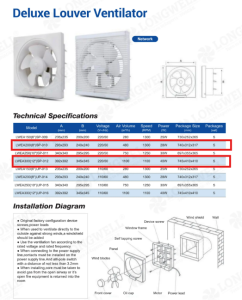
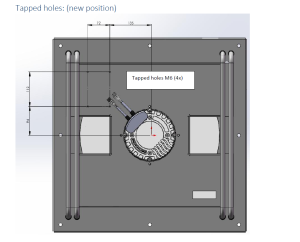
Next, this image shows the exact steel frame and louver layout. Builders need this dimensional drawing to properly frame the structural wall opening.
Specifying Your Own Negative Pressure Exhaust Fan
You might face a similar high-volume ventilation problem in your own facility. Therefore, you should learn from the specific engineering decisions in this project. Check these practical steps before you specify your own negative pressure exhaust fan.
- First, measure your facility wall openings carefully. A 1220 mm square frame needs heavy steel support. The 1100W motor creates strong mechanical vibration. Therefore, a weak wall will slowly crack over time.
- Next, verify your local electrical power grid frequency. An AC motor built for 50Hz spins much faster on a 60Hz grid. Consequently, the motor will pull excessive electrical current and quickly burn out.
- Furthermore, you must measure your system static pressure exactly. This fan easily pushes past 73 Pa of physical resistance. However, adding thick intake filters changes everything. In short, always tell your supplier your true system pressure.
- Finally, check your absolute lowest winter temperature. Standard bearing grease physically freezes solid below -20 degrees Celsius. Therefore, cold climates demand special low-temperature lubricants. We install the correct bearings from our stock when requested.
Related: Exhaust Fans.
Engineering FAQs
Technical Documentation & Resources
Browse our axial fans range, the AC axial fans section, or EC axial fans.
Have a Similar Fan Requirement?
Longwell’s engineering team delivers custom spec sheets and samples within 90 days. Since 1990, we have supplied EC fans and blowers to OEMs across HVAC, cold chain, data center, and industrial applications worldwide.
Browse Related Products:
🏆 ISO 9001 / ISO 14001 / ISO 45001 | CE (TÜV) | UL/ETL | ATEX Zone 21/22 | AMCA 210-16 / ISO 5801 tested
Choose the right exhaust fan
Longwell manufactures 241 exhaust fans in-house. Send airflow, static pressure and voltage — an engineer replies with a matching model, performance curve and price within one working day.