What the integrator ordered
A European HVAC integrator ordered 1,200 units across four residential exhaust fan models, 300 of each.
They wanted finalized drawings and CE certification. However, nothing needed designing, so this was procurement rather than development.
What the application dictates
These go into bathrooms and kitchens. Consequently four constraints bind before any airflow number is discussed.
- First, constant humidity, which decides materials and motor protection.
- Next, noise, since the fan runs in a small room with someone in it.
- Meanwhile safety, because a domestic appliance faces different scrutiny than industrial equipment.
- Finally, price, as consumer ventilation is a competitive market with thin margins.
Meanwhile the range spans 150mm to 300mm ducts, reaching 1100 m3/h at the largest size.
Confirming the residential exhaust fan choice
Initially our job was checking the choice and getting the compliance papers out fast. Even so, the reasoning behind it is worth setting out. Many OEMs get this one wrong.
Why single-phase AC, not EC
Certainly an EC version would be more efficient, and it would offer variable speed over 0-10V or PWM. Even so, we agreed with the customer that it was wrong here.
The reason is the market. A residential exhaust fan competes on shelf price. So the EC premium would push their product out of its band.
Furthermore, nobody expects a speed dial on a bathroom fan. It runs when the light goes on, then stops. In short, nobody pays for a speed dial they never turn.
Where the money should go instead
Instead the budget belongs on things a user actually notices.
First, noise. A fan heard through a wall brings complaints and returns. Notably, noise at this size comes from impeller balance and housing stiffness, not motor type.
Second, bearings. A residential exhaust fan sits in a ceiling or wall, and nobody ever services it. Consequently a bearing that degrades quietly becomes the product failure mode.
What CE certification covers here
Here the documentation matters as much as the fans. An integrator selling into Europe owns the product responsibility. So component certification lets them build their own declaration without retesting.
Consequently supplying verified drawings alongside the certificates made this a same-cycle order rather than a qualification project.
What it cost
Efficiency and control, both given up on purpose. A shaded-pole AC motor is not efficient. Even so, at these power levels the gap is small.
One honest caveat. This reasoning holds at domestic scale, and stops holding as fans get larger or run longer. On a commercial unit running continuously, the same argument reverses and EC wins.
Technical Specifications
Four residential exhaust fan models sit below, from 150mm to 300mm. Note the airflow spread against the noise figures.
| Model | Voltage (V) | Frequency (Hz) | Airflow (m³/h) | Speed (RPM) | Input Power (W) | Frame Dimensions (A) (mm) | Cutout Dimensions (B) (mm) |
|---|---|---|---|---|---|---|---|
| LWEA150(6″)SP-051 | 220 | 50 | 150 | 2000 | 25 | Ø205 | Ø190 |
| LWEA200(8″)SP-052 | 220 | 50 | 200 | 1800 | 30 | Ø280 | Ø250 |
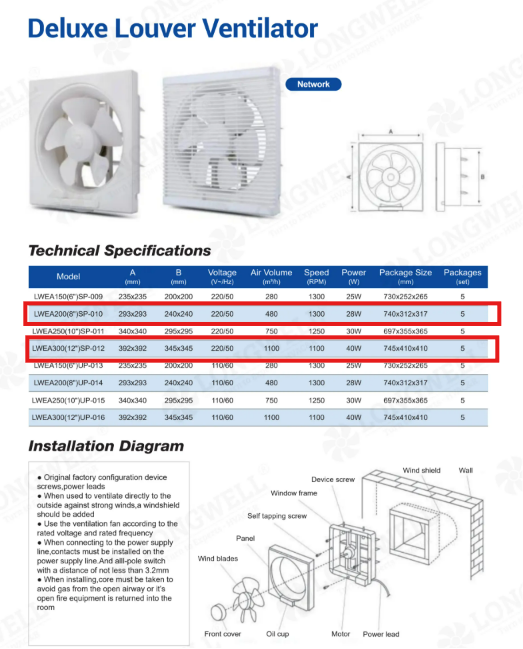
| LWEA200(8″)SP-010 | 220 | 50 | 480 | 1300 | 28 | 293 x 293 | 240 x 240 |
| LWEA300(12″)SP-012 | 220 | 50 | 1100 | 1100 | 40 | 392 x 392 | 345 x 345 |
Technical Documentation
Every model came back with its own drawing. Together they give the mounting sizes, cutout sizes and airflow an installer needs.
LWEA150(6″)SP-051 Engineering Drawing
The drawing for the 6-inch circular fan provides all necessary mounting dimensions and electrical specifications for the system integrator.
LWEA200(8″)SP-052 Engineering Drawing
Here the document specifies the dimensions for the 8-inch circular model, including the Ø250 mm cutout requirement and performance data.
LWEA200(8″)SP-010 Engineering Drawing
The engineering drawing for the 8-inch louvered fan details its 240×240 mm mounting profile and 480 m³/h airflow capacity.
LWEA300(12″)SP-012 Engineering Drawing
This document outlines the specifications for the LWEA300(12″)SP-012, the highest-capacity 1100 m³/h fan selected for this project.

If you are building a domestic fan line
Building a residential exhaust fan line is mostly about matching technology to price point. So these help.
- Decide EC or AC by run hours, not by taste. A fan running a few minutes a day saves almost nothing. By contrast one running all day repays the premium fast. So work out the yearly hours first.
- Spend on noise and bearings first. Users notice sound and they notice failure. Motor technology improves neither at this size. So put the budget into balance grade, housing stiffness and ball bearings.
- Get the certificates with the drawings. Selling into Europe means you own the product declaration. Meanwhile CE evidence at part level saves you testing the whole assembly.
- Order the range together. Four sizes from one series means one supplier, one set of papers and one quality standard. In practice that beats a small price gap on any single model.
See our exhaust fan range, the bathroom exhaust fan section, or wall exhaust fans. Appliance safety follows IEC 60335-1.
Questions about this range
When does EC become worth it on a domestic fan?
When run hours get long. A bathroom fan running fifteen minutes a day saves almost nothing from higher efficiency. By contrast a trickle ventilation unit running all year is a different sum, and there EC repays itself.
What actually makes a small exhaust fan quiet?
Impeller balance, housing stiffness and running speed, roughly in that order. Motor type barely enters into it at this size. In short, a well-balanced fan in a stiff housing beats a poorly built one with a better motor.
Why does humidity matter more than temperature here?
Because bathroom and kitchen air stays wet for hours a day, and the moisture reaches the motor. It corrodes bearings and ages insulation slowly. Consequently the fan gets noisy, then stops, usually well after the warranty. Materials and motor protection are what address it.
Do component certificates cover my finished product?
No, and it is worth being precise here. Part-level CE evidence supports your own declaration. However, it does not replace it. You still own the assembled product. What it saves you is retesting the parts you did not make.
Technical Documentation & Resources
Working on something similar?
Send us the duty point, the envelope and the supply, and our engineers come back with a shortlist rather than a catalog. Meanwhile custom spec sheets and samples run to 90 days. Since 1990 we have built fans for HVAC, cold chain, data center and industrial OEMs.
Browse Related Products:
🏆 ISO 9001 / ISO 14001 / ISO 45001 | CE (TÜV) | UL/ETL | ATEX Zone 21/22 | AMCA 210/211 / ISO 5801 tested
Choose the right exhaust fan
Longwell manufactures 241 exhaust fans in-house. Send airflow, static pressure and voltage — an engineer replies with a matching model, performance curve and price within one working day.