Two fans for faster drying, sold into Europe
A European maker of industrial dehumidifiers needed to replace their old fan units, and fan efficiency regulations framed the order before any airflow number did. The fans go to the EU, so ErP Regulation 327/2011 applies to every unit shipped.
The application is construction drying. Standalone fans push air across wet floors, walls and ceilings while the dehumidifiers strip out the moisture. So faster surface airflow shortens the whole drying cycle.
The two tiers
- First, Model A: 2,500 m3/h, at 2,000 to 3,000 units a year.
- Next, Model B: 5,000 m3/h, at 1,000 to 1,500 units a year.
- Meanwhile both on single-phase 230 V, free-blowing, from 0C to +40C.
- Finally, IP54 minimum with IP55 preferred, since construction sites are damp and dusty, plus CE and the Machinery Directive.
The line that ended the AC discussion
Here the legacy unit drew 100 W for 3,000 m3/h and weighed 13 kg. However, replacing like with like was never on the table, because under the fan efficiency regulations, the shaded-pole and capacitor-run motors that class of fan uses cannot clear the ErP bar for continuous duty.
So the motor debate this article would normally contain simply did not happen. The regulation had already held it.
Fan efficiency regulations reshape the job
When fan efficiency regulations remove the cheap option, the engineering question changes shape. It is no longer which motor, but how to spend the required efficiency well.
What EC gave beyond compliance
Firstly, the EC platform meets the ErP curve and brings the stepless 0-10V and PWM control the customer wanted anyway. So operators tune air velocity to the room size and the drying phase.
That control is not a luxury in drying. Early phases want maximum velocity across soaked surfaces, while late phases want less air and less noise as the dehumidifier finishes. A fixed-speed fan does one phase well and wastes the other.
The unbundling decision
Secondly, we supply the internal EC axial fans alone, and the customer sources cylindrical housings and brackets locally.
A fan core ships dense, while an empty housing ships air. Splitting them cuts the freight footprint sharply at these volumes, and housings are exactly what local fabrication does well. In short, the engineering stays where it is hard, and the sheet metal stays where it is cheap.
Sizing the pair honestly
Thirdly, the 5,000 m3/h Model B is not Model A run faster. Each tier gets its own blade design at its own duty, because a fan stretched 60% past its design point pays in efficiency, the one currency this project cannot spend.
Moreover, both designs sit inside the ErP grades with room to spare, since a fan certified at the edge has nowhere to go when a tolerance stacks the wrong way.
The environment clause
Finally, IP55 covers the damp, gritty reality of drying sites, and the 0C floor matters, because unheated buildings in winter are exactly where drying equipment works. Efficiency requirements for fans in the EU are set by Regulation (EU) 327/2011.
Technical Specifications
The compliance rows are not paperwork trailing the design. On this project they arrived first and the design followed.
| Parameter | Model A Equivalent (LWAE3G315ST) | Model B Equivalent (LWAE3G400SS) |
|---|---|---|
| Airflow | 2,575 m³/h (1,515 CFM) | 4,944 m³/h (2,908 CFM) |
| Power Input | 165 W | 315 W |
| Operating Speed | 2,100 RPM | 1,600 RPM |
| Nominal Voltage | 230 VAC | 220 VAC |
| Frequency | 50/60 Hz | 50/60 Hz |
| Nominal Current | 1.1 A | 1.4 A |
| Noise Level | 66 dB(A) | 69 dB(A) |
| Operating Temperature | -25 °C to +60 °C | -25 °C to +60 °C |
| Insulation Class | Class B | Class B |
| Protection Type | IP54 | IP54 |
| Impeller Material | PA66 Plastic | Sheet Steel |
| Certifications | CE, ErP, RoHS, REACH | CE, ErP, RoHS, REACH |
Technical Documentation
Meanwhile the following engineering documents govern the performance and compliance of the supplied axial fans.
longwell–spec-sheet-01.pdf – The primary specification sheet for the 315mm fan, providing the P-Q performance curve and dimensional drawings for engineers designing the local fan housing.
longwell–technical-doc-02.pdf – The datasheet for the 400mm fan, detailing the steel impeller layout, 0-10V wiring diagram, and acoustic noise ratings for procurement verification.

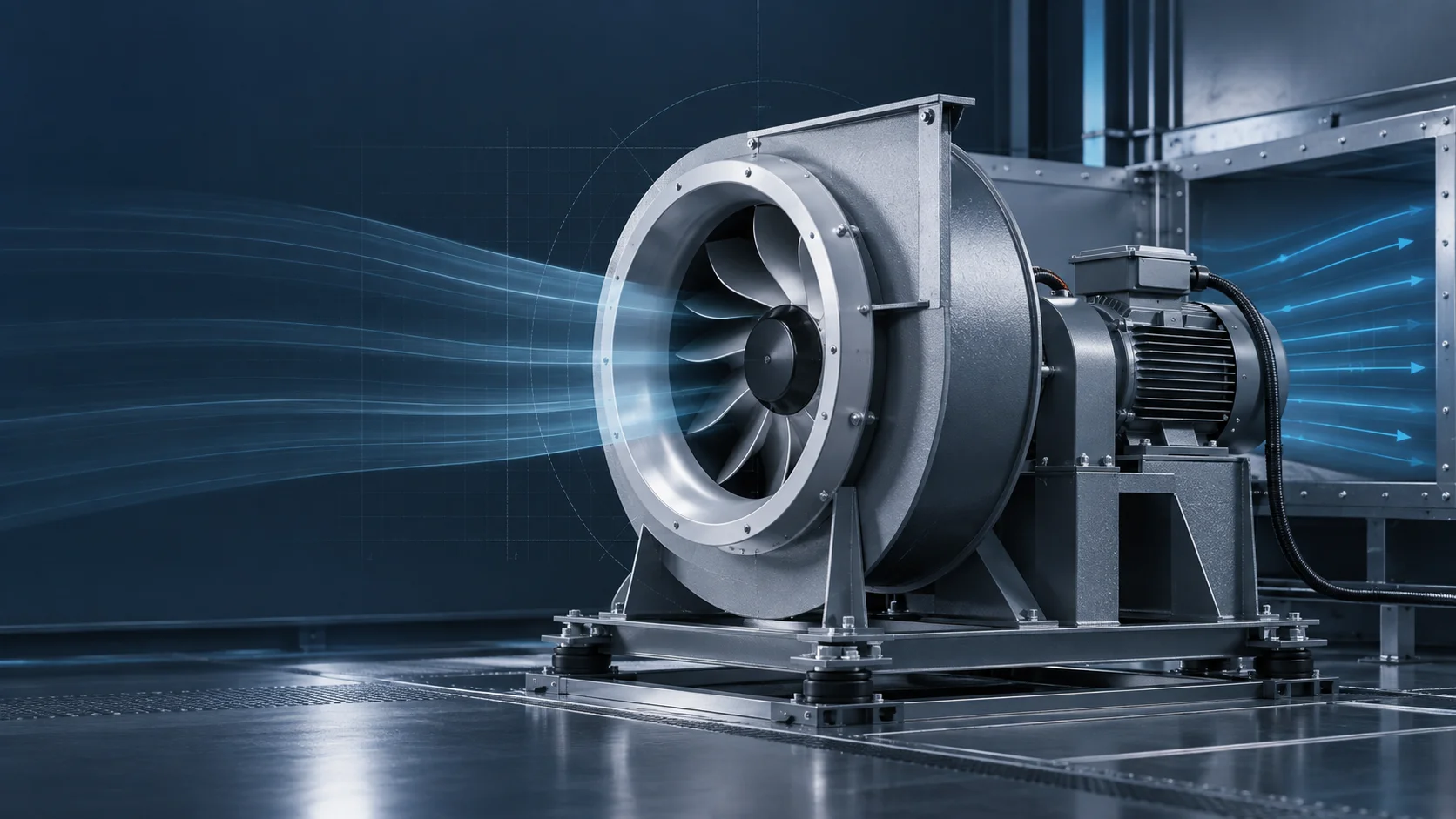
A diagram illustrating the required airflow dynamics, showing the axial fan pushing high-velocity air away from the desiccant unit to dry floor panels.
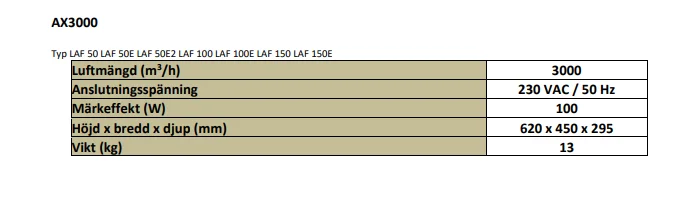
The legacy AX3000 technical specifications provided by the customer to establish the baseline replacement metrics.
Selecting under efficiency rules
Fan efficiency regulations now shape selection in most major markets. In practice, four habits keep you ahead of them.
- Check the regulatory floor before comparing motors. Fan efficiency regulations in the EU, and their versions elsewhere, rule out whole motor classes above certain powers. Finding out what is even legal to ship saves an evaluation nobody can use.
- Buy margin above the threshold, not the threshold. A fan that barely clears its grade has no room for production spread or a future tightening of the rule. So ask where the design sits against the limit, not just whether it passes.
- Let mandated efficiency pay you back in control. The EC platform the fan efficiency regulations push you toward carries speed control as a side effect. A product that uses it, as this drying job does, turns a compliance cost into a feature.
- Match the certificate to the market, per variant. ErP applies to units placed on the EU market, while other regions run their own schemes on their own schedules. A product family shipping globally needs its compliance mapped per destination, not assumed from one approval.
See our axial fans range, the EC axial fans section, or industrial axial fans.
Questions about ErP and fan choice
What does ErP 327/2011 actually require?
It sets minimum efficiency grades for fans driven by motors between 125 W and 500 kW sold in the EU. In effect, low-efficiency motor types cannot ship in many fan classes, no matter how cheap or proven they are.
Does ErP apply to a fan sold inside another machine?
Generally yes. The rule covers fans placed on the market whether alone or built in, with a few set carve-outs. That is why component suppliers state ErP conformity, and why an OEM should ask for it rather than assume the final machine CE mark covers the fan.
Why does buying at the efficiency boundary carry risk?
Real units vary, and rules tighten. A design passed with room to spare absorbs both. By contrast, one certified at the line can drift out of compliance with a winding batch or a rule revision, and the fix at that point is a redesign rather than a paperwork update.
Is EC always the answer under efficiency rules?
Not automatically, since efficient AC designs pass in many classes. EC wins where the duty also wants speed control, as here. The rule narrows the field, then the job picks among what remains, which is the healthy order for the decision.
Technical Documentation & Resources
Sizing something comparable?
Share the airflow, pressure, voltage and control interface, and we come back with a tested curve and a drawing. Meanwhile custom work runs to 90 days for spec sheets and samples. Since 1990 Longwell has supplied fans to HVAC and industrial OEMs.
Browse Related Products:
🏆 ISO 9001 / ISO 14001 / ISO 45001 | CE (TÜV) | UL/ETL | ATEX Zone 21/22 | AMCA 210/211 / ISO 5801 tested
Choose the right axial fan
Longwell manufactures 1,086 axial fans in-house. Send airflow, static pressure and voltage — an engineer replies with a matching model, performance curve and price within one working day.