What the procurement team needed
A procurement manager was sourcing 100 units for a new equipment platform, and it was a competitor fan replacement job. The duty point was 14,400 m3/h at 200 Pa on a 400V three-phase supply.
The brief was short, and the attachment told the rest. A rival P-Q curve came with it. In other words they wanted a competitor fan replacement with equal or better performance, available now.
Here the application follows from the numbers. A duty like this belongs to a large heat exchanger. A chiller, a dry cooler, or a data center condenser. Any competitor fan replacement has to hold that duty, not just approach it.
- 400V three-phase, since that is the industrial standard across Europe and much of Asia.
- The stated duty point, with predictable power draw rather than a best-case figure.
- CE marking, because market access depends on it.
- Performance verifiable to ISO 5801 or AMCA 210/211.
Variable speed was never written down, yet the P-Q curve implies it. A condenser running flat out regardless of load wastes most of its annual energy. Consequently any modern platform is designed around modulating instead.
Selecting the EC axial fan
The duty point pointed straight at our 710mm LWAE3G platform. Therefore the first real decision was motor technology.
Why this competitor fan replacement is EC
We evaluated an AC induction variant, then dismissed it. Reaching the variable performance that curve implies would need a separate variable frequency drive.
That drive costs money, adds a line to the bill of materials, and introduces a failure point. More importantly it loses efficiency at part load, which is precisely where an HVAC system spends most of its life. An integrated EC axial fan avoids all three.
Finding the competitor fan replacement
So we proposed the LWAE3G710TS-5PKW-04-00. Its performance map comfortably contains the customer duty point, rather than sitting right on it.
Meanwhile the five-blade impeller uses a high-strength composite, shaped under our AcousticFlow approach. It moves a large volume of air without the noise that usually follows. Meanwhile electronic commutation and the built-in driver come from our SmartEC platform, so no external VFD is needed.
Built for an outdoor condenser
The component choices follow directly from where these fans live.
- IP55 protection, against dust and low-pressure water jets, since condensers sit outdoors.
- Class F motor insulation, giving safe margin at ambients up to +65C.
- Maintenance-free deep groove ball bearings, with 30,000 hours L10 design life at 40C.
In the end the customer gets a complete EC axial fan. It connects straight to their 400V supply, and to their 0-10V, PWM or RS485 signal. Consequently their system gets simpler rather than more complicated.
Technical Specifications
Here the maximum figures below sit well above the customer duty point. That gap is deliberate, since a condenser fan needs headroom for a dirty coil and a hot afternoon.
| Parameter | Value |
|---|---|
| Model Number | LWAE3G710TS-5PKW-04-00 |
| Nominal Voltage | 400 VAC |
| Voltage Range | 380 ~ 480 VAC |
| Frequency | 50 / 60 Hz |
| Rated Speed | 1400 RPM |
| Maximum Airflow | 21,919 m³/h / 12,894 CFM |
| Maximum Static Pressure | 311 Pa |
| Power Input (at max efficiency) | 2465 W |
| Current (at max efficiency) | 2.89 A |
| Operating Temperature | -25°C to +65°C |
| Ingress Protection | IP55 |
| Insulation Class | Class F |
| Dimensions (Overall) | 850 x 850 x 262 mm |
| Weight | 41.7 kg |
| Speed Control | 0-10VDC / PWM / RS485 Modbus RTU |
| Duty Cycle | S1 (Continuous) |
Technical Documentation
The official technical data sheet contains all nominal data, performance curves, and electrical specifications for the LWAE3G710TS-5PKW-04, essential for design engineers and compliance teams.
View Technical Data Sheet (PDF)
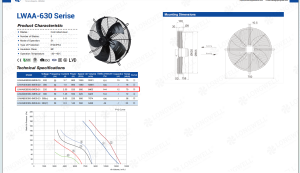
Meanwhile the image, provided by the customer, shows their required performance envelope, which served as the baseline for our engineering team’s solution selection.
The source document for the spec sheet is available for integration into customer technical documentation.
Get Source Document (DOCX)
How to evaluate a competitor fan replacement
Beyond the specification itself, four things carried this.
- Availability, and a fallback if it had not fitted. This used a standard model shipping in 15 to 30 days. Had the mounting differed, our 90-day NPI cycle would give a tested prototype in weeks. European suppliers quote a year or more for that.
- A direct reduction in bill-of-materials cost. Across 100 units, integrated control removes a separate drive from every one of them. That is a component deleted from the bill of materials, rather than a discount negotiated on it.
- Numbers from a bench, not a simulation. The fan ships CE marked. Furthermore, the specification data is measured in our own lab, independently audited and calibrated to AMCA 210/211 and ISO 5801 methods.
- One fewer box on the wall. Removing the VFD simplifies wiring, cuts component count, and removes a source of electromagnetic interference. We supplied the Modbus register map at quotation stage so their software work could start immediately.
Browse our EC axial fan range, or the condenser fan series for refrigeration duty. Test methods are published by AMCA International.
Questions before ordering
How do I compare a competitor curve fairly?
Check both curves were measured to the same standard, usually AMCA 210/211 or ISO 5801, at the same air density. Then find your duty point on each. Do not compare headline maxima. A competitor fan replacement that matches at free delivery can fall short at the pressure you run.
What is the lead time on 100 units?
Standard production for a 100-unit batch runs 15 to 30 days after the purchase order is confirmed. A sample for testing usually leaves Ningbo within one to two weeks. Custom variants follow the 90-day NPI schedule for first prototypes.
Does it need an external VFD?
No. Our SmartEC drive is inside the motor. It accepts a 0-10V analogue signal, a PWM signal between 0.1 and 1 kHz, or RS485 Modbus RTU, all directly. That removes a cabinet, a set of terminations and a recurring source of electrical noise.
Is it suitable for coastal installations?
Here the standard IP55 rating suits general outdoor use, protecting against dust and water jets. In genuinely corrosive coastal air we would recommend an upgrade instead: enhanced anti-corrosion coating on all metal parts and IP56, validated with a 96-hour salt spray test based on ISO 9227.
Where does the energy saving actually come from?
Not mainly from peak efficiency. Fan power falls with the cube of speed, so a condenser at 70% speed for most of the year uses roughly a third of full-speed power. An EC axial fan sits at that point cleanly. A fixed-speed fan simply cannot.
Technical Documentation & Resources
Got a duty point you need matched?
Tell us the airflow, the pressure and the space you have. Then we mark your duty point on a tested curve and send the drawing back. Meanwhile samples and custom spec sheets take up to 90 days. Since 1990 we have supplied OEMs across HVAC, refrigeration and industry.
Browse Related Products:
🏆 ISO 9001 / ISO 14001 / ISO 45001 | CE (TÜV) | UL/ETL | ATEX Zone 21/22 | AMCA 210/211 / ISO 5801 tested