What the request actually implied
A European HVAC OEM asked us for one thing: a 3D STEP model of the LWCD-60360MN-07 DC cross-flow fan.
That request tells you where the project sits. The customer is deep in mechanical design, finalising sheet metal, mounting points and virtual fitment. Nothing else gets asked for at that stage.
Furthermore, the choice of model reveals the constraints.
- An overall height of only 90mm, so the fan drops into a trench heater, an over-door air curtain or a 2U rack chassis.
- A 24 VDC internal bus, since that is standard in modern control systems.
- Roughly 305 m3/h, though against an estimated 34 Pa of system pressure.
- CE and RoHS compliance for the European market, both standard on the LWCD series.
Nobody wrote down an acoustic limit, and yet somebody clearly thought about it. Picking a DC cross-flow fan rated at 42 dB(A) tells you the end product goes into an occupied commercial space.
Validating the DC cross-flow fan choice
This was a request for a design asset rather than a new product. Consequently our job was to check the chosen model really suits the application, then send verified documentation.
Cross-flow was the right architecture
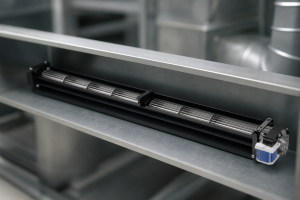
A cross-flow impeller produces a wide, even sheet of air across its full 368mm length. That is what gives uniform temperature distribution across a heater outlet, or even cooling across a row of components.
The alternatives do not fit. An axial fan makes a narrow, turbulent column instead. Meanwhile a centrifugal blower cannot deliver this airflow inside a 90mm height limit.
Was it the right model in the series?
We checked, since the LWCD-60 series covers several lengths. Reading the P-Q curve, the LWCD-60360MN-07 lands precisely on 305 m3/h at 34 Pa.
Here the next size down, the LWCD-60300MN-07, gives only 253 m3/h. That falls short. Therefore the 368mm impeller length was the correct pick rather than a generous one.
What MN means in the part number
The 24V input corresponds to the MN variant in our naming system. That variant carries a three-phase brushless motor with the driver built in.
That internal controller is part of our SmartEC platform, and it accepts 0-10V or PWM directly. Consequently the customer needs no external motor controller and no variable frequency drive, which simplifies their system architecture and their wiring loom.
Finally we pulled the LWCD-60360MN-07.stp file from our design library, had a technical manager check it, and sent it on.
Technical Specifications
Meanwhile the three length dimensions below matter as much as the airflow. An overall length of 430mm with a 383mm mounting distance is what a sheet metal designer actually needs.
| Parameter | Value |
|---|---|
| Model | LWCD-60360MN-07 |
| Voltage | 24 VDC |
| Airflow | 305 m³/h |
| Static Pressure | 34 Pa |
| Speed | 2000 RPM |
| Current | 0.51 A |
| Noise Level | 42 dB(A) |
| Overall Length (A) | 430 mm |
| Mounting Distance (B) | 383 mm |
| Impeller Length (C) | 368 mm |
| Motor Type | 3 Phase BLDC (EC Motor) |
| Speed Control | 0-10V / PWM |
| Operating Temperature | -25°C to +60°C |
| Insulation Class | B |
Technical Documentation
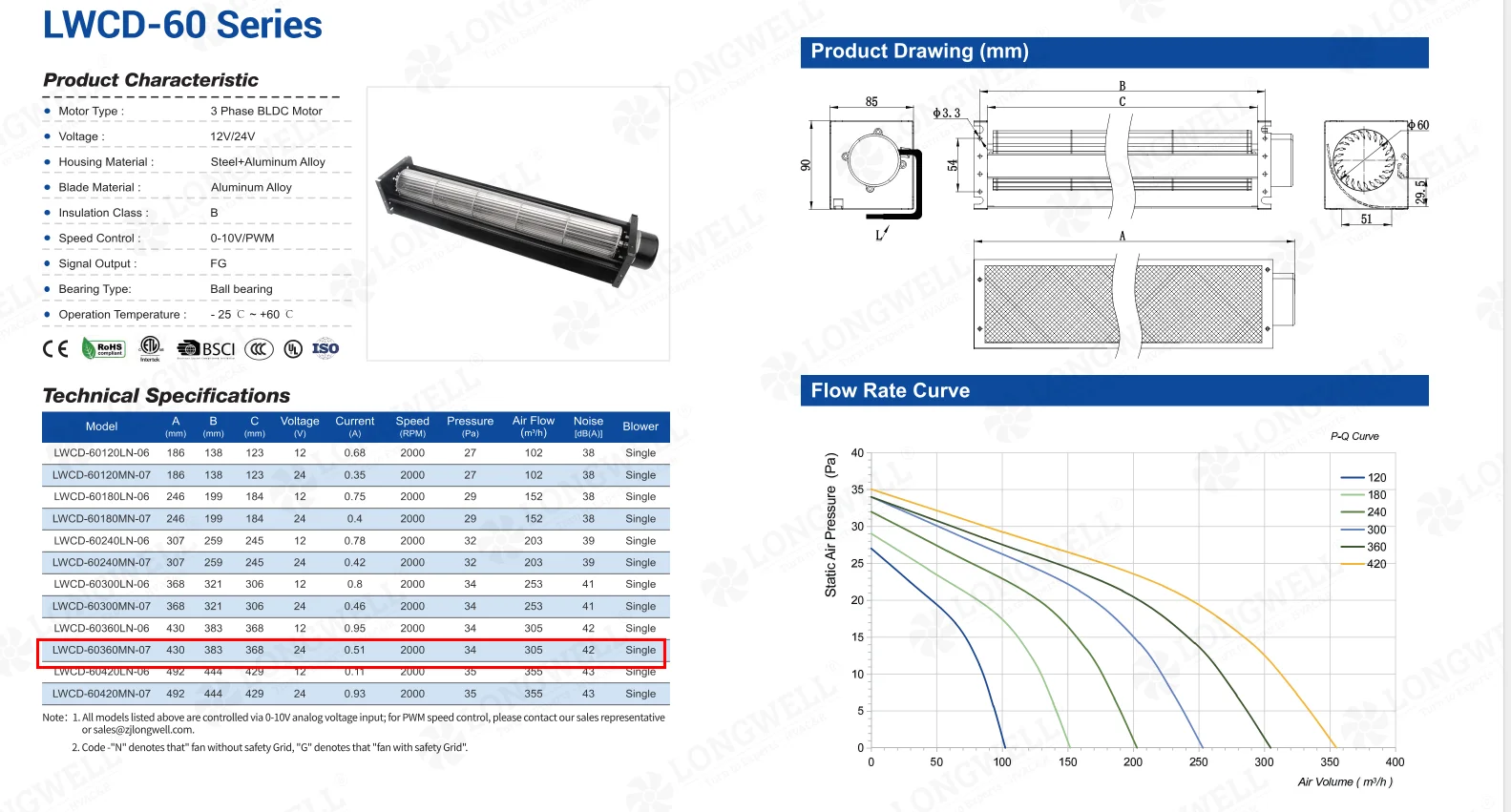
The provided product data image contains the key specifications, dimensional drawings, and P-Q performance curve for the entire LWCD-60 series, which is essential for initial engineering assessment.
Here the primary deliverable for this project was a dimensionally accurate LWCD-60360MN-07.stp 3D model. This file is used by mechanical design engineers to import into their native CAD software (e.g., SolidWorks, CATIA, Autodesk Inventor) to finalize enclosure design and verify mounting compatibility without physical prototypes.
Why the OEM specified our part
On a request like this, two things mattered. Neither of them is the fan itself.
- The file arrived in one working day. A design engineer waiting on a 3D model means a design cycle standing still. In practice, turning that around quickly is worth more to an OEM than most people credit.
- The numbers behind it are measured. The 305 m3/h and 34 Pa figures come from testing to AMCA 210/211 and ISO 5801 methods. Consequently the customer can design to them rather than de-rating defensively.
Browse our cross-flow fan range, or the DC cross-flow fan series for other lengths. Test methods are defined in ISO 5801.
Questions design engineers ask
What is the lead time on a production order?
A make-to-order DC cross-flow fan in the LWCD series runs 15 to 25 days at typical quantities of 100 to 500 units. Small pilot runs may come from stock and ship in 1 to 5 days. Larger customers usually move to a forecast-based schedule under a frame agreement.
Can it be controlled over Modbus RTU?
Not as standard. The SmartEC controller here accepts 0-10V analogue or PWM. However, the same EC platform supports Modbus RTU, so a variant with that protocol can be developed through our 90-day NPI process where the volume justifies it.
Will it work below -25C?
The published range stops at -25C, though the underlying ThermoFlex motor and bearing technology is engineered down to -40C. For guaranteed starting below -25C we run a custom validation, usually specifying a low-temperature bearing lubricant. Send us the thermal profile and we will confirm.
Why does a STEP file matter more than a datasheet at this stage?
Because a datasheet tells you whether the fan performs, whereas a STEP model tells you whether it fits. Once somebody is drawing sheet metal, clearances, cable exits and mounting holes decide the design. Only a solid model settles those questions.
Sizing something comparable?
Share the airflow, pressure, voltage and control interface, and we come back with a tested curve and a drawing. Meanwhile custom work runs to 90 days for spec sheets and samples. Since 1990 Longwell has supplied fans to HVAC and industrial OEMs.
Browse Related Products:
🏆 ISO 9001 / ISO 14001 / ISO 45001 | CE (TÜV) | UL/ETL | ATEX Zone 21/22 | AMCA 210/211 / ISO 5801 tested
Choose the right dc cross flow fan
Longwell manufactures 50 dc cross flow fans in-house. Send airflow, static pressure and voltage — an engineer replies with a matching model, performance curve and price within one working day.