An integrator counting installation minutes
A UK systems integrator needed 200mm inline duct fans for a commercial indoor air quality rollout. Along with the airflow figures, they asked for a fused mains plug fitted at the factory.
Specifically a BS 1363 13A fused mains plug, wired into the motor harness before shipping, rather than a bare tail for an electrician to terminate.
Why that request is not trivial
In practice, an integrator installing across many sites is buying labor as much as hardware. Every unit that arrives ready to plug in is a task removed from a schedule.
Meanwhile a terminated lead removes a category of site error: the wrong core into the wrong terminal, at height, in a ceiling void.
The performance envelope around it
- First, 1200 m3/h against 300 Pa, which is real duct resistance rather than free air.
- Next, 220 VAC at 50 Hz, inside a 130 W input limit.
- Meanwhile a 565mm maximum length and under 300mm height, set by the ceiling grid.
- Finally, 55 dB(A) at 2500 RPM, and an ambient range of -20C to +50C.
They needed CE and EN 60335-1 evidence up front, because the compliance file has to close before the rollout starts rather than after.
What a terminated plug commits you to
Hitting 1200 m3/h against 300 Pa inside 130 W set the aerodynamic problem. Meanwhile the fused mains plug set a different kind of problem, and that is the one worth writing about.
Why we did not offer EC
An EC motor was evaluated and rejected. The customer building management system has no 0-10V or PWM signal to give it.
Consequently an EC drive would have added cost and one more thing to fail, in exchange for control nobody could use. On a rollout of identical units, that multiplies.
What a fused mains plug commits the supplier to
Fitting a fused mains plug moves part of the electrical installation into our factory, and the responsibility moves with it.
The core colors have to be right and consistent: blue to neutral, brown to live, green and yellow to earth. On a run of hundreds, a single transposed batch is a recall rather than a rework.
Here the fuse rating has to suit the appliance rather than the socket. A 13A plug is commonly sold with a 13A fuse in it, and on a 130 W fan that fuse will never protect anything. The fuse should be sized to the flex and the load.
Where the acoustic limit landed
Meanwhile 55 dB(A) at 2500 RPM in an occupied commercial space is a genuine constraint, not a comfort target.
The fan sits in a ceiling void directly above people. So the noise budget was fixed first and the impeller selected inside it, rather than the other way round.
The temperature range, and why it matters here
Lastly, a -20C to +50C span looks undemanding until you remember the housing and blades must survive the cold end without becoming brittle.
Safety requirements for appliances in this class are published by the IEC as IEC 60335-1.
Technical Specifications
One line on this sheet is not a performance figure at all. It is the termination, and it saved the most time on site.
| Parameter | Value |
| Voltage Range | 220 VAC |
| Frequency | 50 Hz |
| Speed | 2500 RPM |
| Rated Input Power | 130 W |
| Airflow (Max) | 1200 m³/h (706 CFM) |
| Static Pressure (Max) | 300 Pa |
| Noise Level (LpA) | 55 dB(A) |
| Max Ambient Temp | 50 °C |
| Min Ambient Temp | -20 °C |
| Protection Type | IP44 |
| Work System | S1 |
| Life Expectancy | 50,000 Hours (L10) at 25°C |
| Length (L) | 565 mm |
| Height (H) | 300 mm |
| Duct Connection (D) | 195 mm |
| Balancing Grade | G6.3 |
| Certifications | CE, FCC, RoHS, REACH |
Technical Documentation
LWDA-200(8″)S-PWN-05-17 Technical Specification Sheet: This complete 8-page engineering specification outlines exact P-Q airflow performance curves, internal wiring diagrams, and ISO5801-1997 test data required by system designers for regional compliance verification.
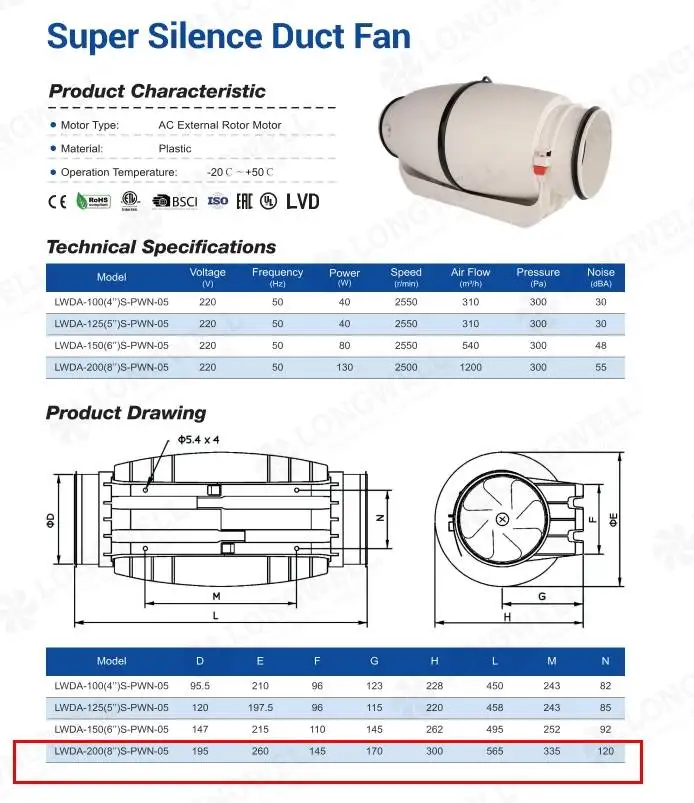
Catalog data confirms the physical dimensions of the polymer casing and maps the acoustic performance across the wider Super Silence Duct Fan series, providing OEM procurement teams with clear scaling options for larger volume projects.
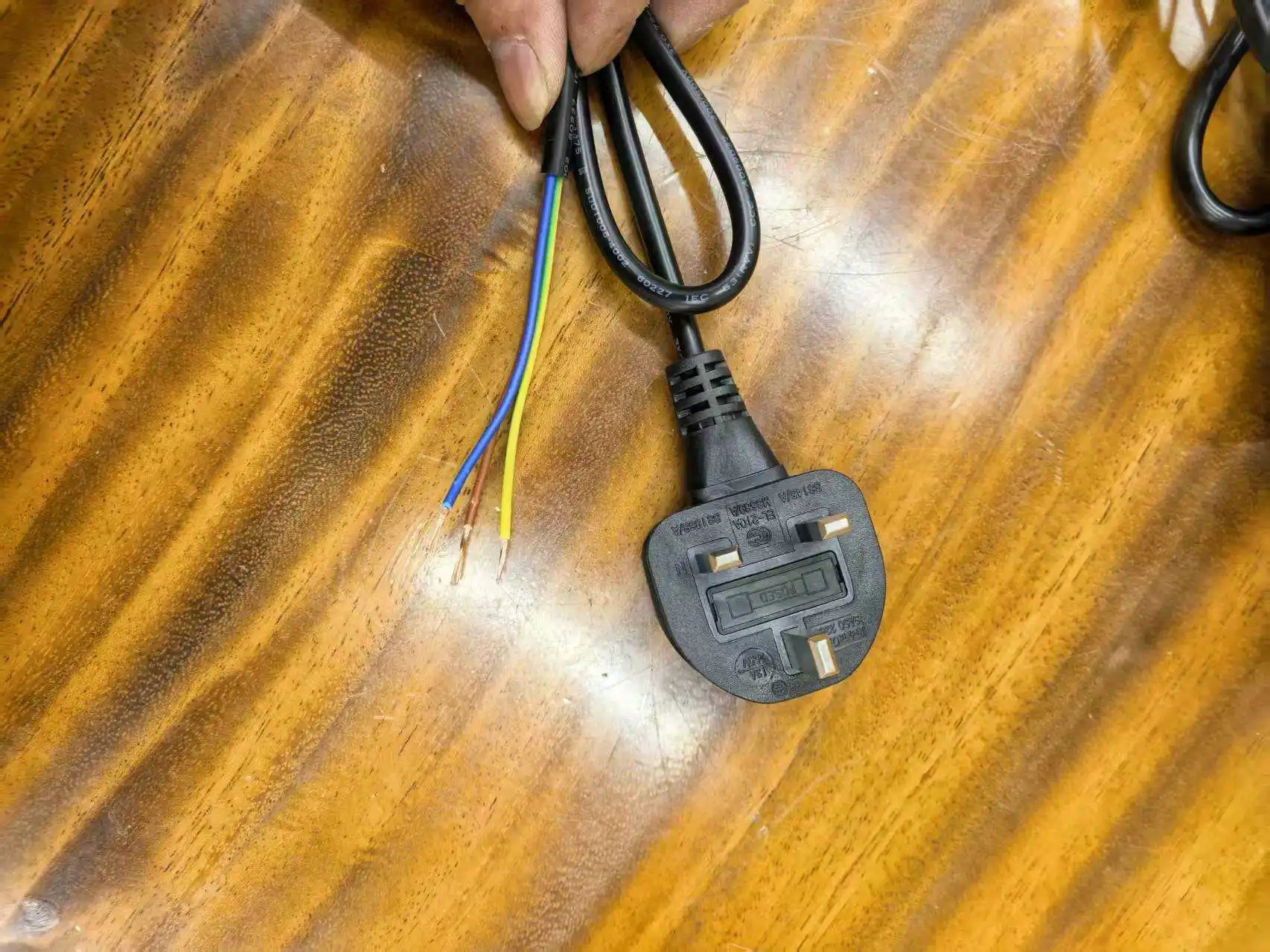
Visual verification of the factory-fitted UK standard fused plug confirms immediate electrical compatibility with the client’s localized distribution setup, detailing the specific Blue, Brown, and Yellow/Green ground wiring connections.
Specifying a factory-fitted lead
If you are asking a supplier to fit a fused mains plug, settle these four points in the order.
- Specify the fuse rating, not just the plug. A fused mains plug is only as useful as the fuse inside it. State the rating you want against the flex and the load, since a default 13A fuse in a 130 W appliance protects the socket and not the fan.
- Put the core colors in writing. Blue neutral, brown live, green and yellow earth is standard, and it is still worth stating. Color conventions differ by region, and a factory building for several markets can get it right for the wrong one.
- Ask who holds the compliance evidence for the terminated assembly. A fan with a plug on it is an assembly, and your safety file needs to cover it as supplied. Confirm the documentation matches the configuration you receive, not the bare-tail version.
- Check the lead length against the real installation. Ceiling voids rarely have a socket where the drawing suggests. Specifying a lead too short creates the field wiring you were trying to avoid, and an extension defeats the purpose entirely.
See our duct fans range, the inline duct fans section, or metal duct fans.
Questions about supplied plugs
Why does the fuse rating matter if the plug is rated 13A?
Because the fuse protects the flexible cable and the appliance, not the socket. A 130 W fan draws well under an amp, so a 13A fuse would let a fault current flow far beyond what the flex can carry. Size the fuse to the load and the cable.
Can a supplier fit a plug for any market?
Usually, but each market has its own plug standard, color conventions and approval regime. Fitting a plug also brings the assembly into the scope of your product safety documentation, so it is worth agreeing the exact configuration and the evidence that goes with it.
Does a factory-fitted lead really save much time?
On one unit, no. Across a rollout it removes an electrician task from every installation, along with the risk of a mis-termination in an awkward position. That is why integrators ask for it and one-off buyers rarely do.
What if I need a different lead length later?
Say so before the first production batch. Changing lead length afterwards means re-terminating units that are already assembled, which costs more than it would have to specify correctly at the start.
Technical Documentation & Resources
Sizing something comparable?
Share the airflow, pressure, voltage and control interface, and we come back with a tested curve and a drawing. Meanwhile custom work runs to 90 days for spec sheets and samples. Since 1990 Longwell has supplied fans to HVAC and industrial OEMs.
Browse Related Products:
🏆 ISO 9001 / ISO 14001 / ISO 45001 | CE (TÜV) | UL/ETL | ATEX Zone 21/22 | AMCA 210/211 / ISO 5801 tested
Choose the right duct fan
Longwell manufactures 254 duct fans in-house. Send airflow, static pressure and voltage — an engineer replies with a matching model, performance curve and price within one working day.