Is an EC fan always cheaper to run than an AC fan? No. EC technology can be a strong choice when a system spends many hours at reduced load, but the result belongs to a complete fan, motor, controller, and installation—not to the motor label alone. A fair comparison holds the airflow and pressure duty constant, uses mains input power for both options, and applies the real operating schedule.
That distinction matters during both new-equipment selection and retrofit work. The useful question is not “EC or AC?” in isolation. It is which fully specified package will deliver the required air duty, integrate with the controls, remain serviceable, and produce an acceptable life-cycle cost under the buyer’s own hours and tariff.
Define the buying decision before comparing motors
Write down what success means before requesting quotations: required airflow, static or total pressure, air density, normal and worst-case resistance, allowable sound, supply, control signal, temperature, installation space, and expected hours in each operating mode. If one candidate is allowed to move less air or work against less pressure, its lower electrical input is not an efficiency win for the original duty.
Also define the comparison boundary. For a retrofit, the baseline might be an existing fixed-speed AC fan, an AC fan with a damper, or an AC motor already controlled by a variable-frequency drive. Those are materially different starting points. Comparing EC only with the weakest baseline can make the business case look better than the real alternative.
Compare complete fan packages at matched duty points
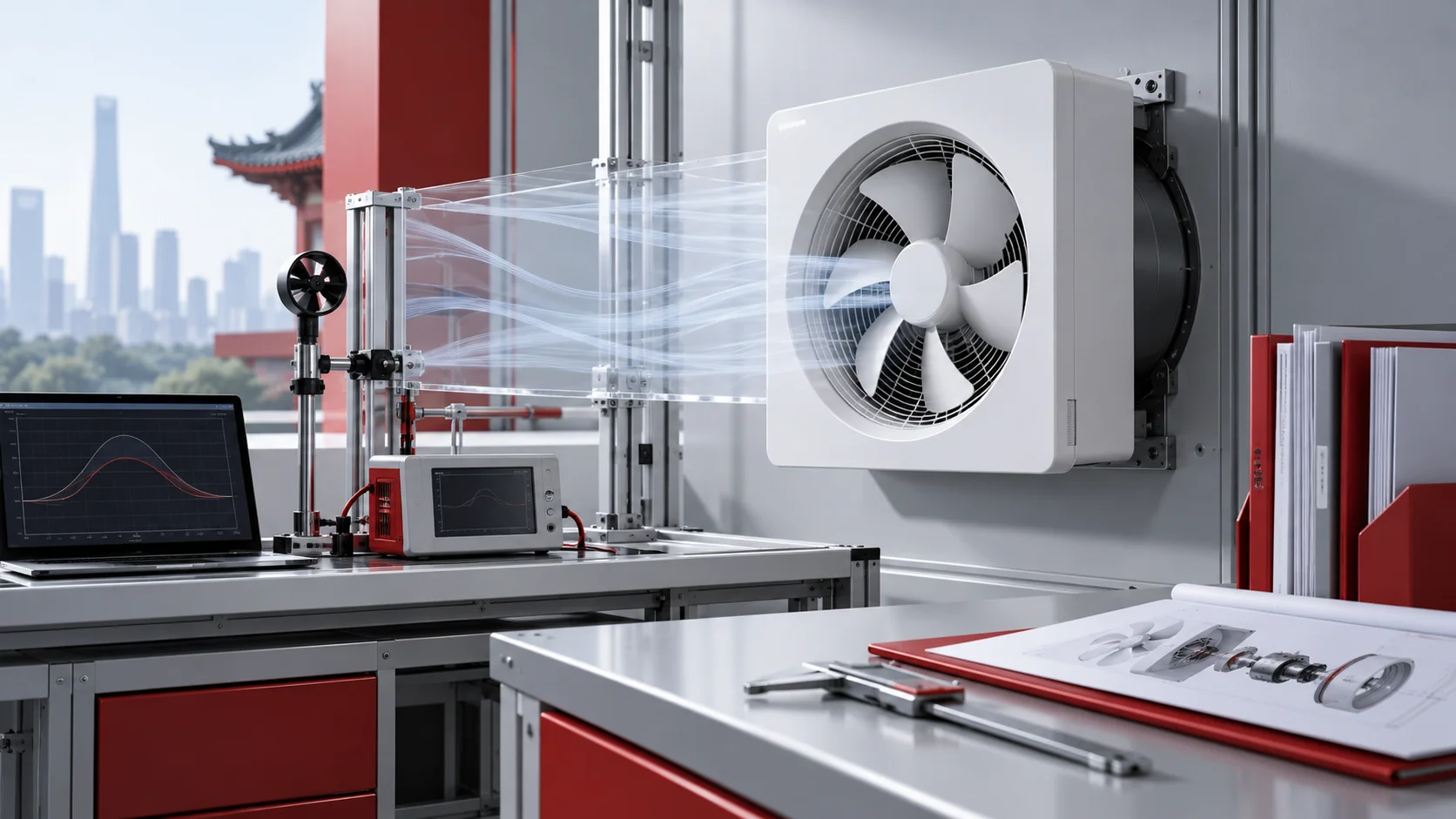
Ask for electrical input at the same airflow, pressure definition, density, speed or command, and test configuration. Include the motor drive or EC electronics inside the power boundary. Motor efficiency by itself does not describe wire-to-air performance; the impeller, inlet, housing, controller, and installed system all affect the result.
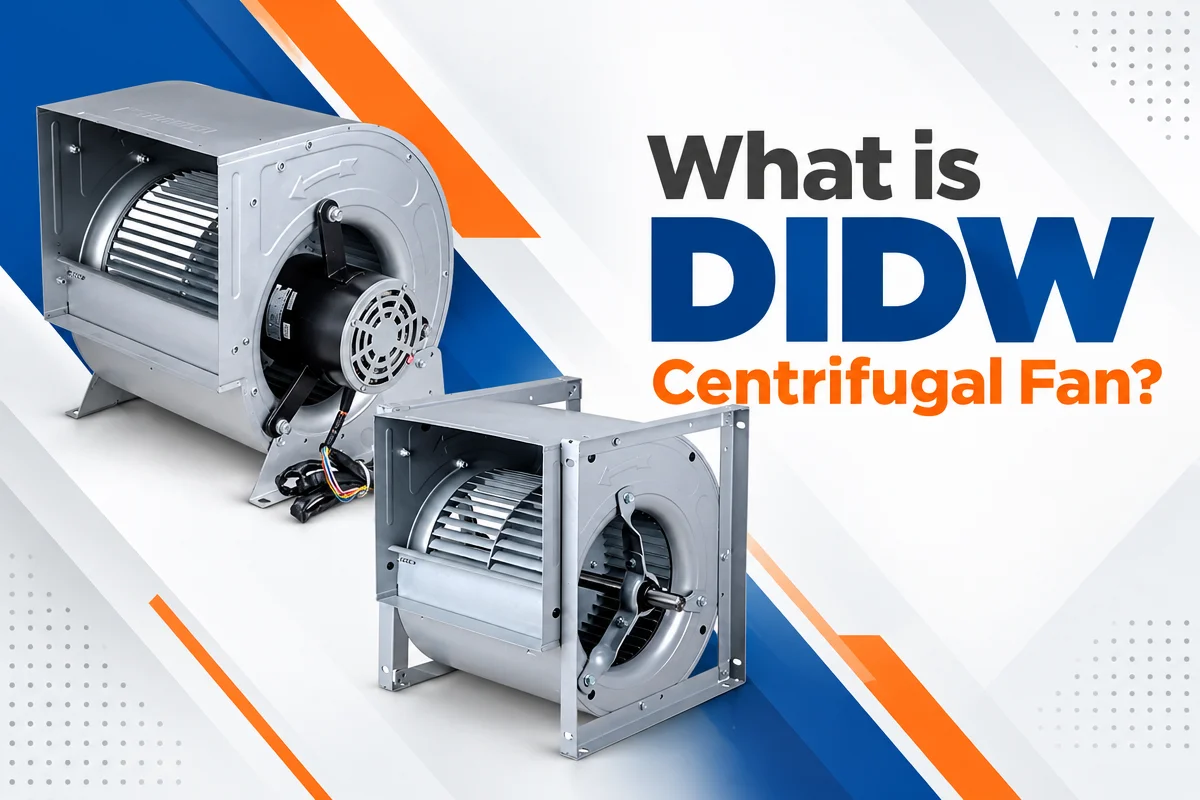
Do not compare maximum airflow, nameplate watts, or two different wheel geometries as though they were a controlled test. The centrifugal fan-curve guide explains how to read duty points and operating regions. A photograph or CAD model can confirm visible construction, but it cannot prove a curve, energy result, or replacement fit.
Treat AC plus VFD as a real alternative
An integrated EC package typically combines a permanent-magnet motor and electronic commutation, making speed control convenient. An AC induction motor can also run at variable speed when the motor, drive, cabling, protection, and application are suitable. The comparison should therefore include the control hardware and losses of each complete package.
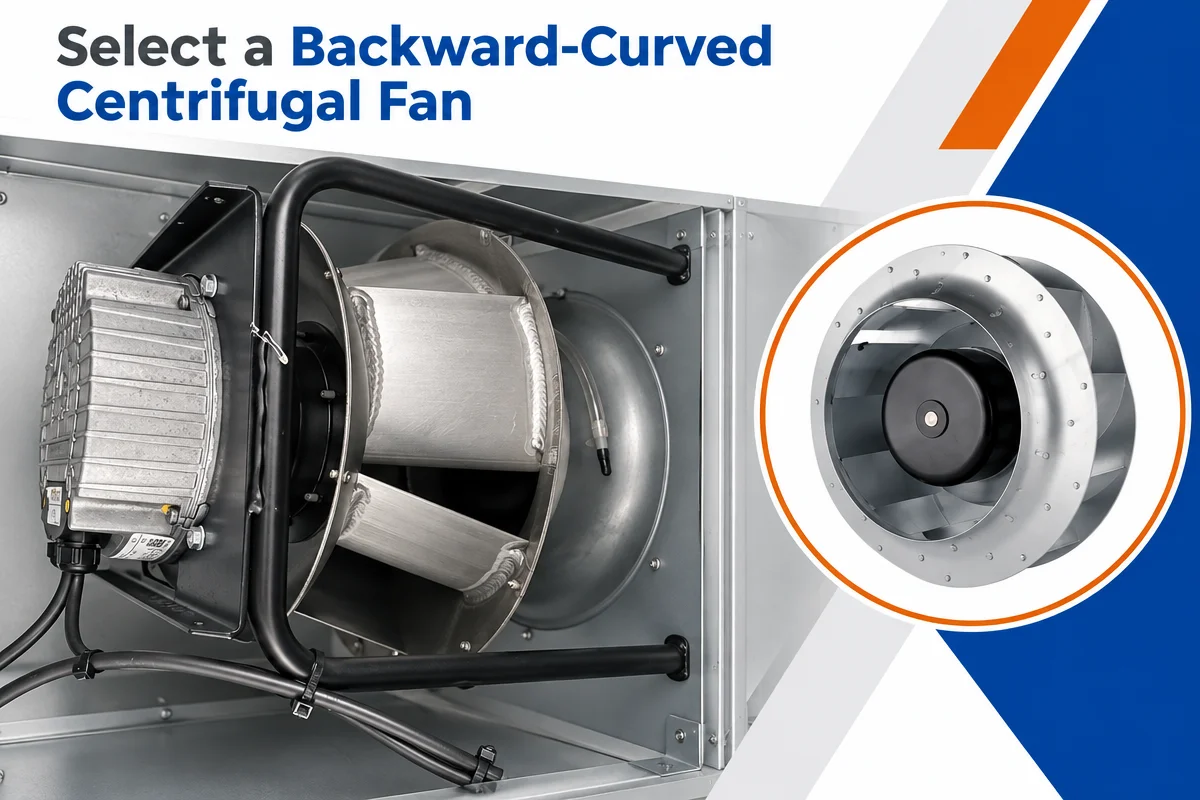
The current EC backward-curved fan family and AC backward-curved fan family pages are useful discovery routes. They do not establish that a listed product meets a project duty or that one family will save a fixed percentage. Exact suffixes, curves, electrical data, controls, and revisions still need to be returned with the quotation.
Build annual energy from the operating profile
A single full-load point rarely represents a variable-duty system. Divide the year into useful operating bins—for example, occupied high load, normal load, setback, cleaning, and off or standby. For each bin, multiply validated mains input power by operating hours, then sum the bins: annual energy equals Σ(Pᵢ × hᵢ).
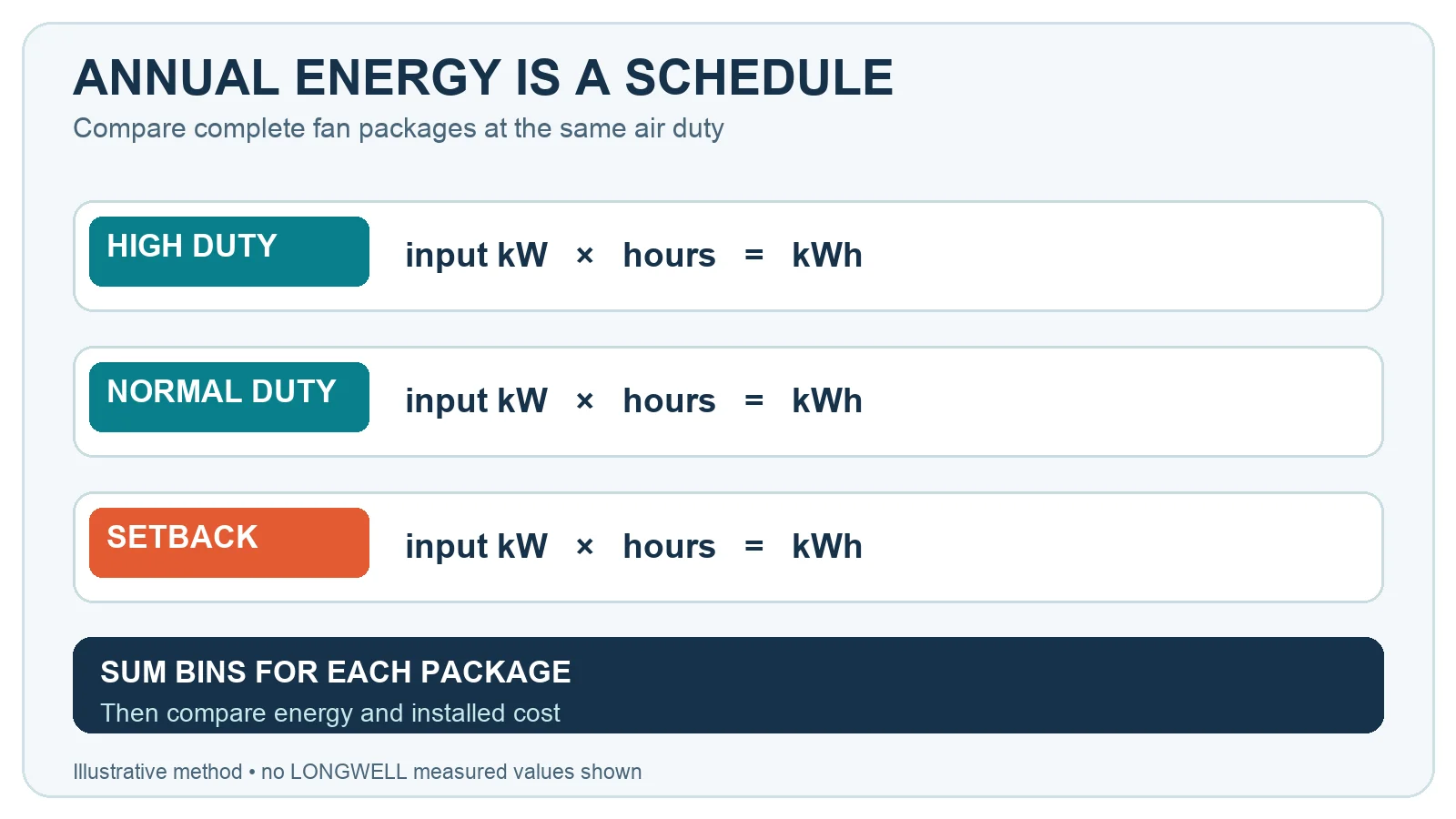
Fan-law trends explain why speed reduction can be valuable, but the familiar cube relationship is an ideal guide for the same fan under appropriate system conditions. Static-pressure offsets, filters, controls, efficiency changes, minimum speed, and standby power can move the measured result. Use the actual candidate curves and input-power data rather than turning an affinity-law estimate into a quotation.
Calculate payback from incremental installed cost
Start with annual energy difference at matched duties, then apply the site’s tariff. Keep energy charges, demand charges, and time-of-use rates separate. Add maintenance effects only when the scope and evidence are explicit. Annual net benefit is verified energy-cost reduction plus supported maintenance benefit minus new recurring costs.
Simple payback equals incremental installed cost divided by annual net benefit. Incremental cost includes the equipment difference plus adapters, wiring, protection, controls integration, sensors, commissioning, access, downtime, and training that differ between options. Use simple payback as a screening measure; financing, escalation, replacement timing, residual value, and the time value of money require a life-cycle analysis.
Check controls, power quality, faults, and service
A low calculated energy figure is not enough if the package cannot be integrated or maintained. Confirm voltage and frequency, command and feedback signals, minimum stable speed, startup behavior, alarms, fault reset, overload protection, EMC, harmonics, leakage current, grounding, ambient derating, ingress protection, sound, vibration, and cable limits for the exact configuration.
Ask who can diagnose the controller, which spares are replaceable, how long they remain available, and what happens if the electronics or drive fails. An AC-plus-VFD package may offer familiar service practices; an integrated EC package may simplify components and control. Neither advantage should be assumed without the actual service plan.
Require evidence that another reviewer can reproduce
A useful supplier return is more than a brochure. Request the complete model suffix and revision, controlled fan curve, pressure basis, test arrangement, reference density, mains input at each required duty, speed and command, sound basis, electrical limits, dimensional drawing, control documentation, protection data, and stated tolerances. If efficiency or compliance is represented, request the exact test method, scope, rating, and current supporting record.
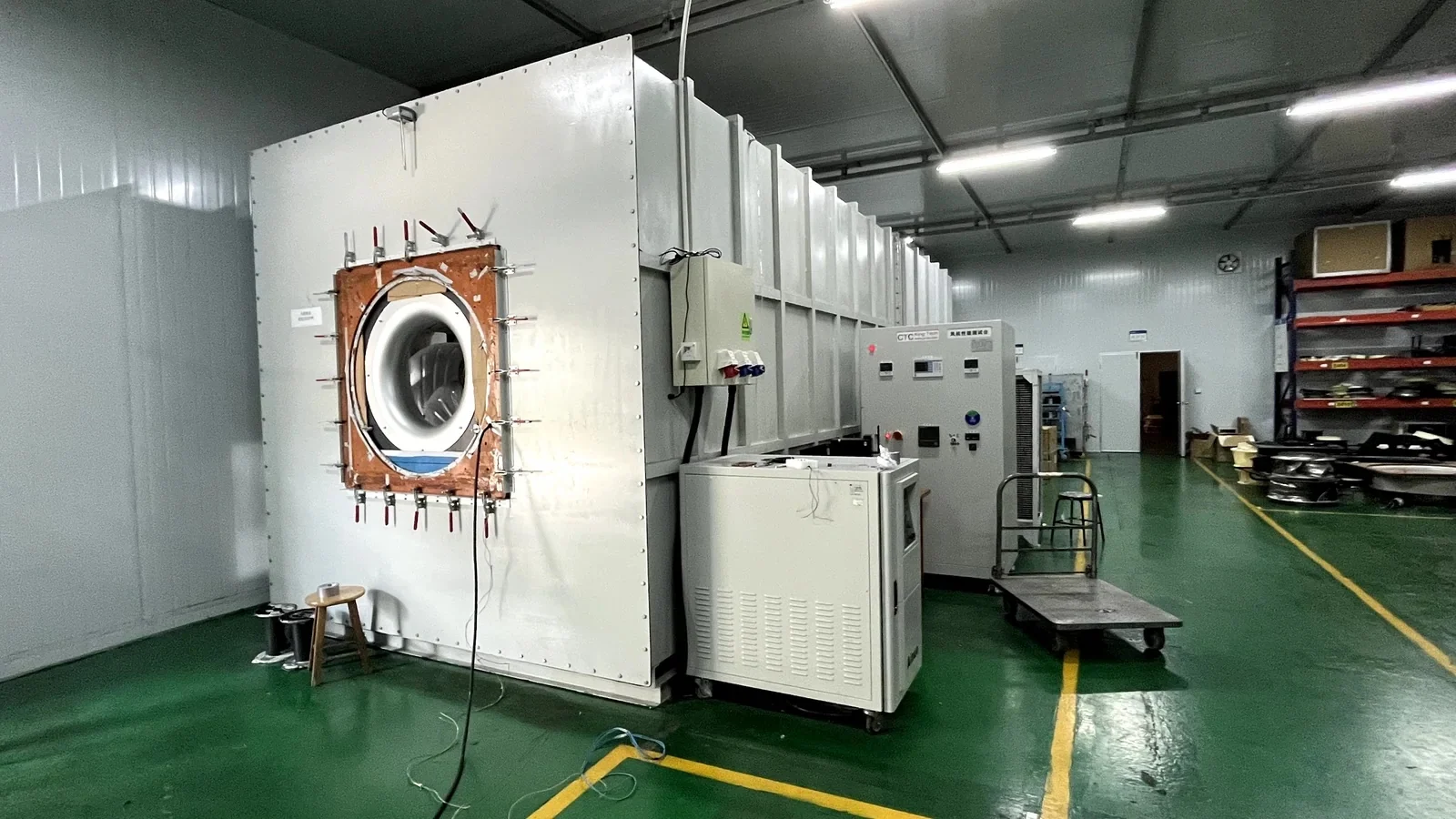
For retrofit work, add the existing fan and motor details, field measurements, system resistance, mounting and duct photographs, control sequence, meter boundary, and acceptance criteria. Mark every calculated value as modeled and every measured value with its instrument, date, and condition. That separation prevents a catalogue statement from becoming an unsupported project promise.
Commission the selected package and close the loop
At startup, verify airflow, pressure, mains input, speed command, sound or vibration limits, alarm behavior, and the sequence of operation across representative loads. Preserve clean-filter and expected dirty-filter conditions where they matter. Trend runtime and power after handover so the annual model can be checked against real use.
Choose EC when matched-duty data, the load profile, controls, service plan, and life-cycle calculation support it. Choose AC or AC plus VFD when that package meets the same duty with a better justified outcome. The defensible decision is the one that keeps the duty point, evidence boundary, assumptions, and acceptance test visible from RFQ through operation.
Choose the right ac motor
Longwell manufactures 22 ac motors in-house. Send airflow, static pressure and voltage — an engineer replies with a matching model, performance curve and price within one working day.