One evaporator, two power grids
A precision cooling OEM was building a refrigeration platform for North America and Europe at once. So this was a dual voltage fan brief from the first line: equal performance on 115 V (104 to 126 V) and on 230 V (184 to 276 V), with no change to the mechanical chassis.
The evaporator fixed the geometry. Namely, two impeller sizes at 90mm and 100mm, with the 90mm variant delivering 1200 m3/h at 1500 RPM.
The rest of the brief
- First, 55 dB(A) on the 90mm units and 59 dB(A) on the 100mm ones, since the racks stand in commercial spaces.
- Next, -25C to +60C ambient, with materials that stay tough through freeze cycles.
- Meanwhile IP55 and integrated guards, for condensation and operator safety.
- Finally, ETL to UL 507 and CSA C22.2#113 for North America, CE for Europe.
The strategic request buried in it
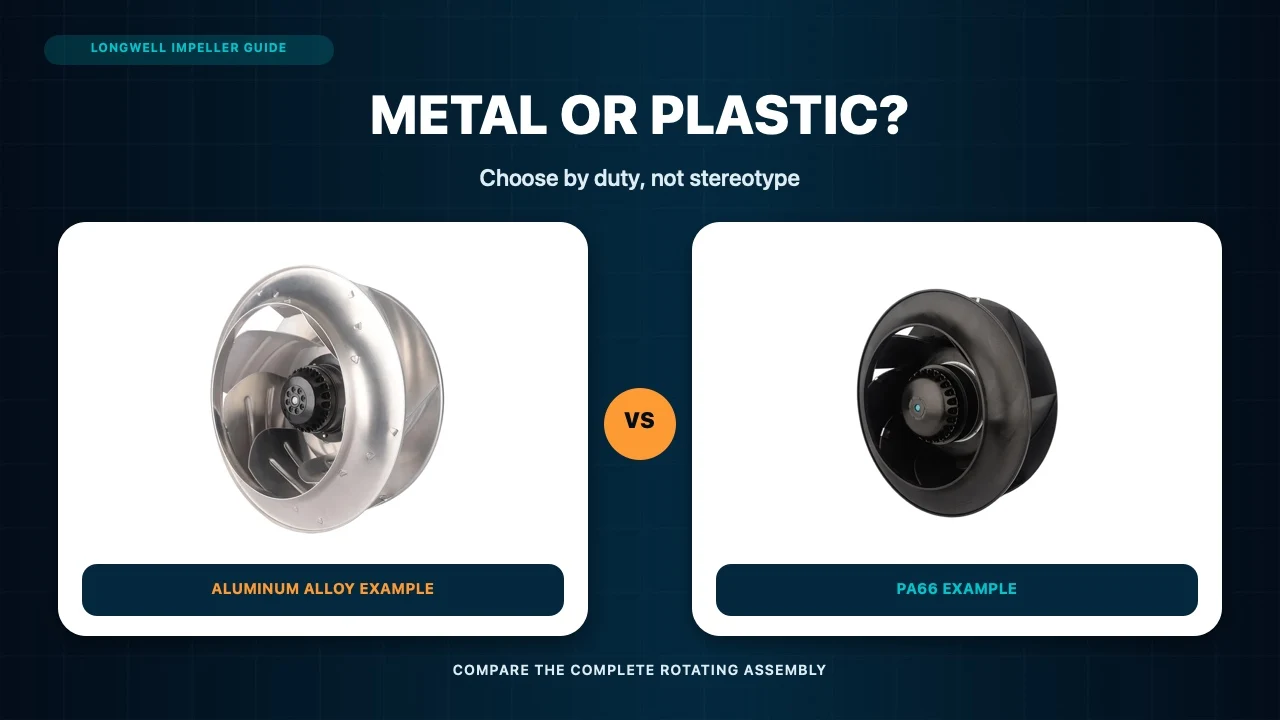
They also asked for metal and plastic impeller paths developed side by side, SGCC steel and aluminum against PA66, to serve different tiers of their product range from one platform.
So the real order was not a fan. It was a matrix: two voltages, two sizes, two materials, one chassis. Every dual voltage fan project hides a matrix like this somewhere.
Building a dual voltage fan with two windings
A dual voltage fan can be built two ways. Either one motor that accepts the whole 104 to 276 V span, or two fixed-voltage variants sharing everything mechanical. We built the second, on purpose.
Why not one universal input
Electronics that ride the full span from 104 to 276 V must survive the worst of both worlds. You pay for that rating in every unit shipped, including the ones that spend their lives on a stable grid.
On a cost-driven refrigeration platform, that overhead multiplies across thousands of fans. Consequently two lean fixed windings beat one heavy universal build, as long as the variants stay mechanically identical.
What identical actually means here
Same impellers, same housings, same mounting, same guards, same acoustic behavior. Meanwhile the 115 V and 230 V builds differ only in the stator winding and the drive electronics rating.
That is what protects the customer. In practice it means one set of tooling, one set of drawings, one acoustic test campaign, and a certification file where the variants differ on paper only where they differ in fact.
Why EC underneath both
Thirdly, we evaluated and rejected a shaded-pole AC motor, because variable speed was non-negotiable and AC would need an external drive to provide it.
Instead, the EC platform takes 0-10 VDC and PWM directly, sliding from 450 RPM to 1500 RPM. In refrigeration that range gets used daily, since cooling demand swings with load and defrost cycles.
The material split
Lastly, the steel and aluminum impellers serve the heavy-duty series, and PA66 serves the lighter tiers. We engineered both paths together, so a customer moving between tiers changes a part number, not an interface.
For North America, the safety rules for this class come from UL Solutions as UL 507.
Technical Specifications
Every mechanical row below is shared. The electrical rows exist twice, and that duplication is a decision, not an accident.
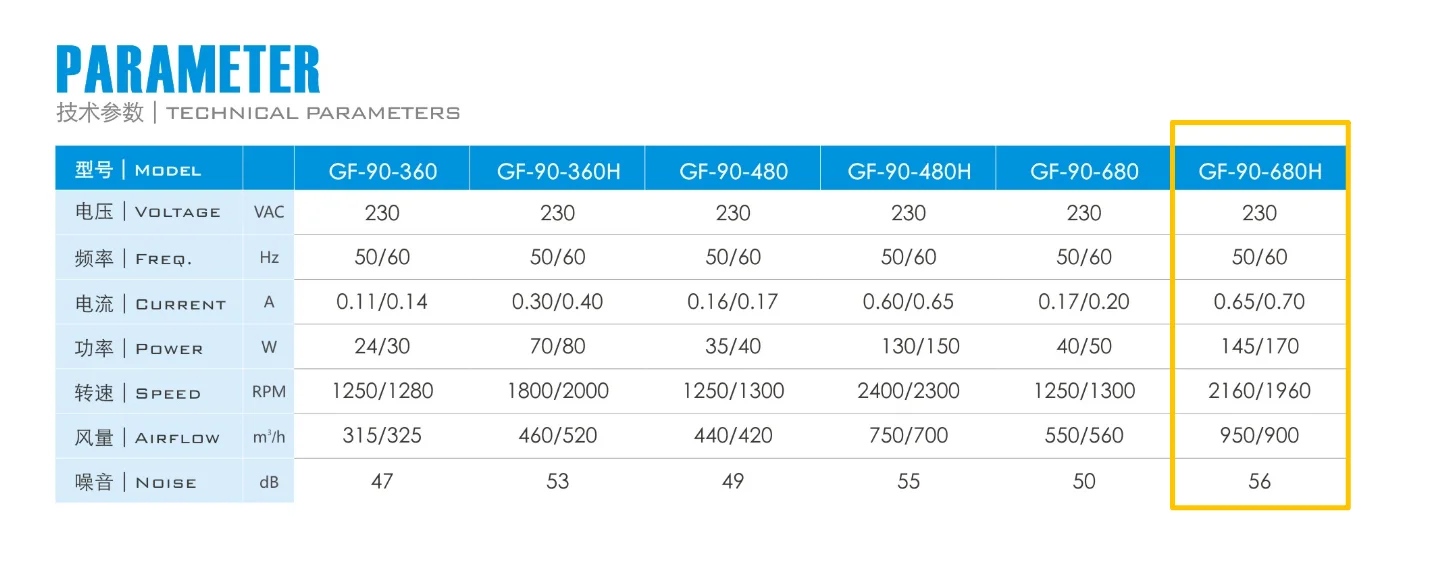
| Parameter | LWCE-90680 (90mm Series) | LWCE-100620 (100mm Series) |
|---|---|---|
| Maximum Airflow | 1200 m³/h (706 CFM) | 1250 m³/h (736 CFM) |
| Rated Speed | 1500±10% RPM | 1500±10% RPM |
| Minimum Speed | 450±5% RPM | 450±5% RPM |
| Input Power | 60±10% W | 70±10% W |
| Operating Voltage | 115V (104-126V) / 230V (184-276V) | 115V (104-127V) / 230V (184-276V) |
| Frequency | 50/60 Hz | 50/60 Hz |
| Noise Level (LpA) | 55 dB(A) | 59 dB(A) |
| Operating Temperature | -25°C to 60°C | -25°C to 60°C |
| Protection / Insulation | IP55 / Class B | IP55 / Class B |
| Certifications | CE, ETL (UL 507, CSA C22.2) | CE, ETL (UL 507, CSA C22.2) |
Technical Documentation
longwell-ec90-spec-sheet-04.pdf
The detailed specification sheet provides electrical characteristics, bearing types, and operating temperature constraints for system engineers.
longwell-ec90-drawing-01.pdf
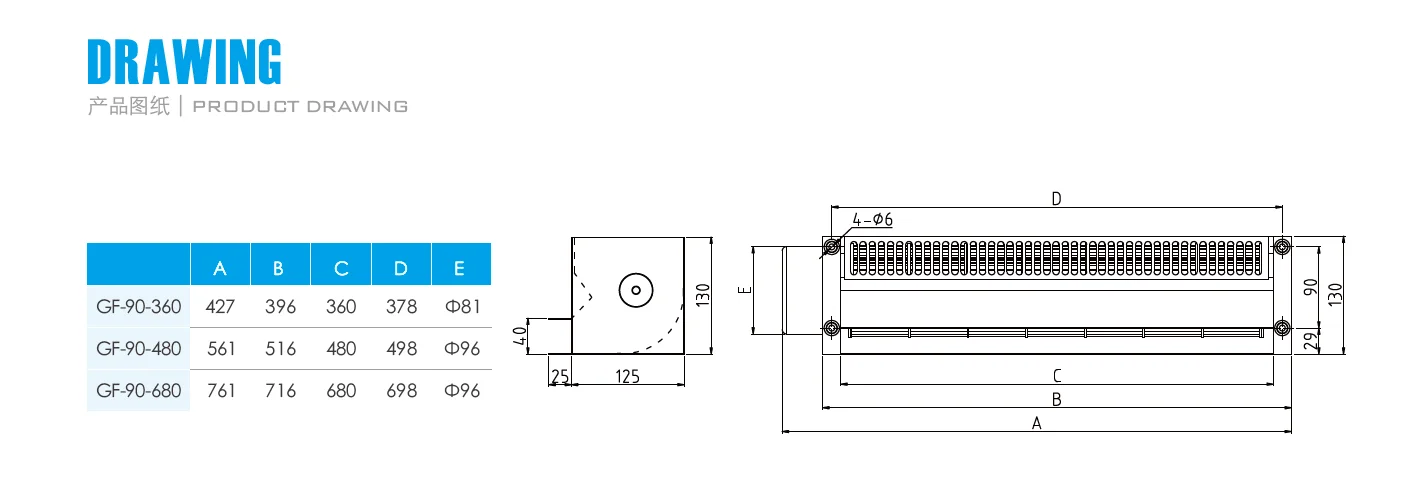
Dimensional drawings outline the exact mounting hole patterns and 680mm/620mm frame lengths required for OEM chassis integration.
longwell-ec90-technical-doc-02.pdf
The technical protection document defines the 0-10VDC wiring schematic, VSP control logic, and locked-rotor safety parameters.
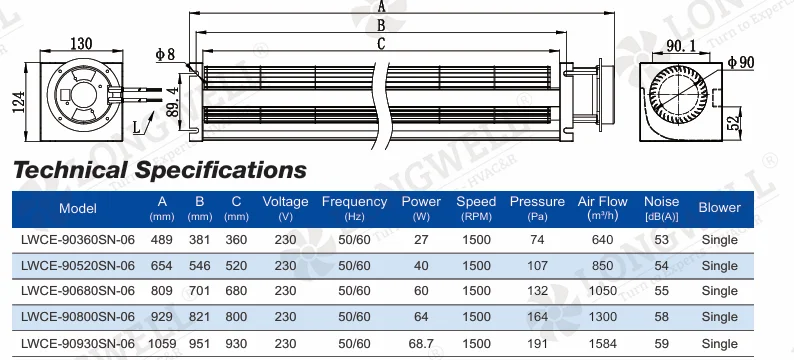
Visual reference of the final assembled EC cross-flow fan with the required structural safety grille attached.
longwell-ec90-drawing-05.pdf
Additional structural processing diagrams specify the cold-rolled steel frame tolerances and wire routing paths.
Choosing your dual-voltage strategy
If your product needs a dual voltage fan, choose the strategy before choosing the fan.
- Count your volumes per market first. A universal-input dual voltage fan earns its premium when volumes are small or hard to predict per region. However, at high volume with known markets, two fixed variants usually cost less per unit shipped.
- Keep the variants mechanically identical, and audit that. The saving melts away if the variants drift apart. Therefore, insist that the 115 V and 230 V builds share tooling, dimensions and acoustics, so every mechanical qualification covers both.
- Certify as a family, not as strangers. ETL and CE files that treat the variants as one platform with an electrical difference cost less to build and keep up than two unrelated filings. So structure the papers that way from the start.
- Watch the voltage windows, not the nominals. After all, 104 to 126 V and 184 to 276 V describe real grids, brownouts included. So confirm the dual voltage fan holds its curve at the window edges, because nominal voltage is the one condition your field units rarely see.
See our cross-flow fans range, the EC cross-flow fans section, or cross-flow impellers.
Questions about dual-voltage fans
Is a universal-input fan ever the better answer?
Yes, when regional volumes are small, forecasts are shaky, or logistics favor one SKU everywhere. Above all, the single part number keeps stock and service simple. In exchange, you pay for electronics rated for the whole span in every unit, which high-volume fixed-market products rarely justify.
Do the 115 V and 230 V variants perform identically?
That is the design requirement, and it is why both share the impeller, housing and speed range. Moreover, the drive electronics are sized so the motor gives the same curve from either supply. We test both variants, rather than inferring one from the other.
Why does refrigeration need variable speed at all?
Because the cooling load is not constant. For instance, demand swings with ambient heat, door openings and defrost cycles. So a fan that slides from 450 to 1500 RPM tracks the load instead of cycling on and off, which is quieter and gentler on the system.
What breaks if the two variants drift apart mechanically?
The economics break. After all, shared tooling, shared acoustics and family certification all assume the variants are one machine with two windings. Consequently a drifted variant needs its own tests and its own file, at which point you maintain two products and gain nothing for it.
Technical Documentation & Resources
- View the technical drawing (PDF)
- Open the technical drawing 2 (PDF)
- View the technical drawing 3 (PDF)
- Get the specification sheet (PDF)
- Get the technical drawing 4 (PDF)
- Open the technical drawing 5 (PDF)
- View the technical drawing 6 (PDF)
- Get the specification sheet 2 (PDF)
- Download the technical drawing 7 (PDF)
- Open the technical drawing 8 (PDF)
- View the technical drawing 9 (PDF)
- Get the technical drawing 10 (PDF)
- Open the technical drawing 11 (PDF)
- Open the specification sheet 3 (PDF)
Working on something similar?
Send us the duty point, the envelope and the supply, and our engineers come back with a shortlist rather than a catalog. Meanwhile custom spec sheets and samples run to 90 days. Since 1990 we have built fans for HVAC, cold chain, data center and industrial OEMs.
Browse Related Products:
🏆 ISO 9001 / ISO 14001 / ISO 45001 | CE (TÜV) | UL/ETL | ATEX Zone 21/22 | AMCA 210/211 / ISO 5801 tested
Choose the right cross flow fan
Longwell manufactures 495 cross flow fans in-house. Send airflow, static pressure and voltage — an engineer replies with a matching model, performance curve and price within one working day.