A drawing request, late in the design
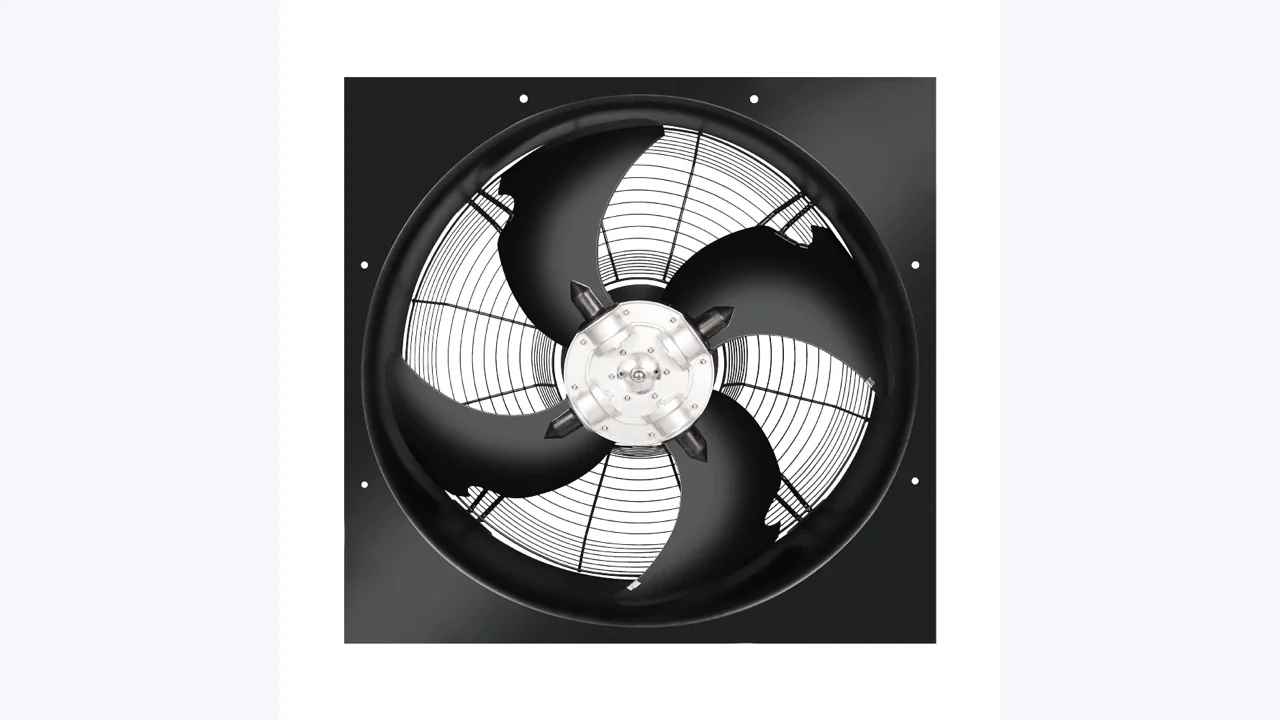
An OEM customer asked for the approved technical drawing of a 300mm axial fan, model LWEA4E300SM-088. Among the electrical data on that sheet sits a run capacitor rated at 3 microfarads.
No selection question, and no performance debate. Just a request for the final sheet.
What a drawing request tells you
A drawing request this specific usually means late design or pre-production. The fan is chosen; what is still open is the sheet metal around it.
So the customer needs mounting hole positions, depth, and the electrical data their wiring and safety documents will quote.
The fixed points
The application was a compact air-cooled condenser for commercial refrigeration. Everything else followed from that.
- First, 1905 m3/h at 103 Pa, which is a condenser coil resistance rather than a duct.
- Next, 220 VAC single phase at 50 Hz, the supply available in the target markets.
- Meanwhile a 340 by 340mm frame, no deeper than 155mm.
- Finally, 60 dB(A) maximum, set by the noise limits where the equipment is installed.
Here the customer also had to satisfy IEC 60335 for appliance safety, which is one reason the electrical line items matter to them and not only to us.
Why AC, and what the capacitor does
This was validation rather than selection. The fan was already the right one, so the work was confirming it, releasing the drawing, and checking that the run capacitor rating on it still matched the build.
Why we did not push an EC motor
We considered an EC motor version internally, then set it aside.
The duty point here is fixed. A condenser fan on this unit runs at one speed, so variable speed control has nothing to do. Consequently the extra cost and extra electronics would buy the customer nothing on this build.
That answer would reverse on a unit with head pressure control, where fan speed tracks ambient temperature. There, EC pays for itself. Here it does not.
What the run capacitor is actually for
Meanwhile the run capacitor is not an accessory. On a single-phase motor it is what makes the rotor turn at all.
Meanwhile a single-phase supply on its own produces a pulsing field rather than a rotating one. The capacitor shifts the current in the auxiliary winding out of phase with the main winding, and those two out-of-step fields together produce rotation.
So the run capacitor is in circuit the whole time the fan runs, not just at start-up. Its value suits the winding design at the rated speed and load.
Where the trade-off sat
At 1350 RPM the fan delivers the duty point and stays inside 60 dB(A). Pushing speed higher would have bought airflow and spent the noise budget, which was not available.
Input power is 85 W at 0.39 A. For an AC motor of this class, moving over 1900 m3/h, that is a fair place to land.
Technical Specifications
One row in this table gets skipped more than any other. It is the last electrical line: capacitor, 3 microfarads.
| Parameter | Value |
|---|---|
| Model | LWEA4E300SM-088 |
| Voltage (VAC) | 220 |
| Frequency (Hz) | 50 |
| Input Power (W) | 85 |
| Current (A) | 0.39 |
| Speed (RPM) | 1350 |
| Airflow (m³/h) | 1905 |
| Airflow (CFM) | ~1121 |
| Static Pressure (Pa) | 103 |
| Noise Level [dB(A)] | 60 |
| Capacitor (µF) | 3 |
| Dimensions (mm) | 340 x 340 x 155 |
Technical Documentation
The final approved mechanical drawing specifies all critical dimensions, mounting hole patterns, and performance parameters for system integration. Mechanical engineers and designers use this document to finalize their product assembly.
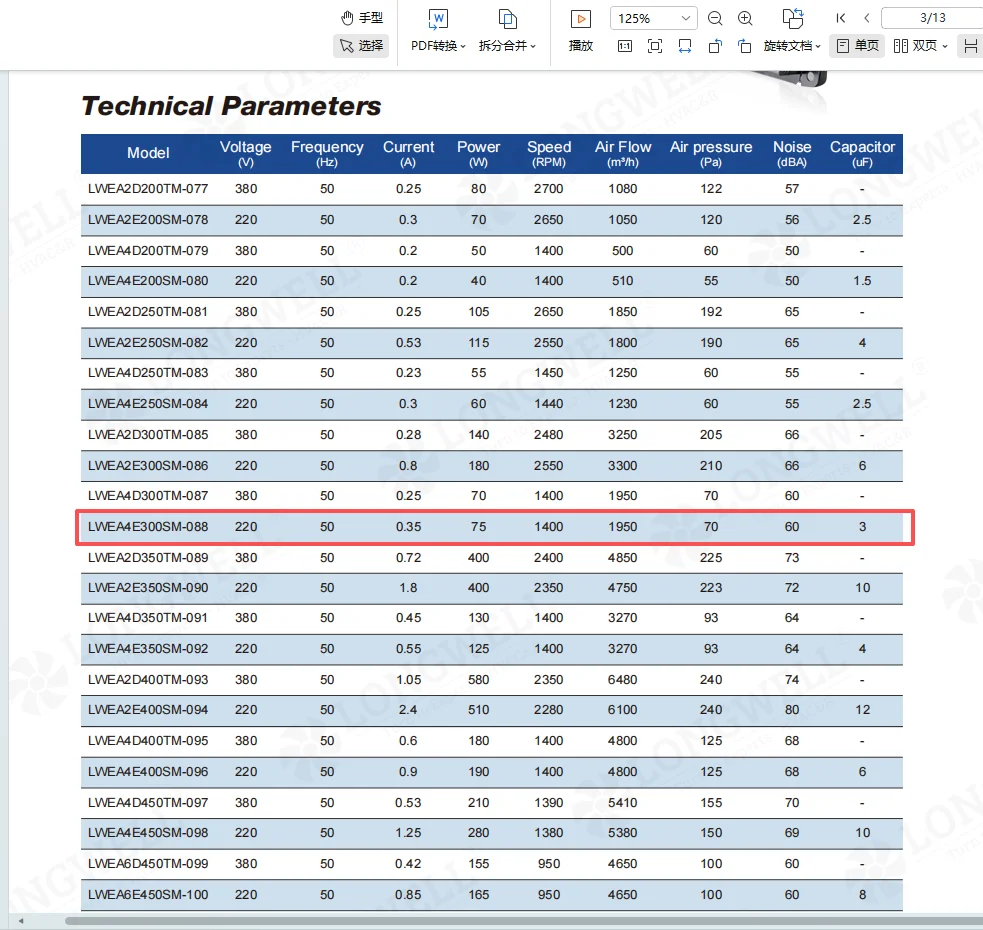
Here the complete technical data sheet provides a comprehensive summary of the fan’s operational specifications for both electrical and HVAC engineers. This document is used for system qualification and compliance checks.
Open Technical Data Sheet for LWEA4E300SM-088 (PDF)
What to check on your own capacitor
If you are specifying or servicing a single-phase fan, the capacitor is worth more attention than it usually gets.
- Treat it as a wear item. A run capacitor ages. It loses capacitance slowly, and as it does the motor draws more current, runs hotter and gets louder, often for months before anything stops. A fan that hums and will not start is the end of that process, not the beginning.
- Match the value, not just the voltage. Fitting a 4 microfarad part because it was on the van changes the phase shift, the torque and the current. The fan may well run. It will not run the way it was designed to, and the winding pays for it.
- Check the voltage rating and the class. A run capacitor carries a continuous AC rating and a safety class. A start capacitor is a different part with a different duty, so it will not substitute.
- Do not fit a VFD to it. A capacitor-run motor cannot handle frequency control. If your application genuinely needs variable speed, that is an argument for a different motor type, not for a drive bolted onto this one.
See our axial fans range, the condenser fan section, or AC axial fans. For appliance safety, see the IEC and its IEC 60335 series.
Questions about run capacitors
How do I know the run capacitor has failed?
The usual sign is a motor that hums but does not start, or one that starts only if you nudge the blade. Before that stage, a tired run capacitor shows up as higher running current and more noise. A capacitance meter reading well below the marked value confirms it. Always discharge the part before touching the terminals.
Can I fit a capacitor with a slightly different value?
Not without accepting a change in how the motor behaves. The value matches the winding, so a different one shifts torque and current away from the design point. Small deviations may seem harmless, but they push the winding warmer, and that is what shortens motor life.
Why is there no capacitor on a three-phase fan?
Because a three-phase supply already produces a rotating field on its own. The capacitor exists only to fake that rotation from a single-phase supply. It is the price of running on single phase, which is why it disappears the moment three phases are available.
Should this fan have been an EC motor instead?
Not for this unit. The duty point is fixed, so there is no speed variation for EC control to exploit and no energy saving to recover. On a condenser with head pressure control, where fan speed follows ambient temperature, the answer changes and EC becomes the better choice.
Technical Documentation & Resources
Sizing something comparable?
Share the airflow, pressure, voltage and control interface, and we come back with a tested curve and a drawing. Meanwhile custom work runs to 90 days for spec sheets and samples. Since 1990 Longwell has supplied fans to HVAC and industrial OEMs.
Browse Related Products:
🏆 ISO 9001 / ISO 14001 / ISO 45001 | CE (TÜV) | UL/ETL | ATEX Zone 21/22 | AMCA 210/211 / ISO 5801 tested
Choose the right condenser cooling fan
Longwell manufactures 17 condenser cooling fans in-house. Send airflow, static pressure and voltage — an engineer replies with a matching model, performance curve and price within one working day.