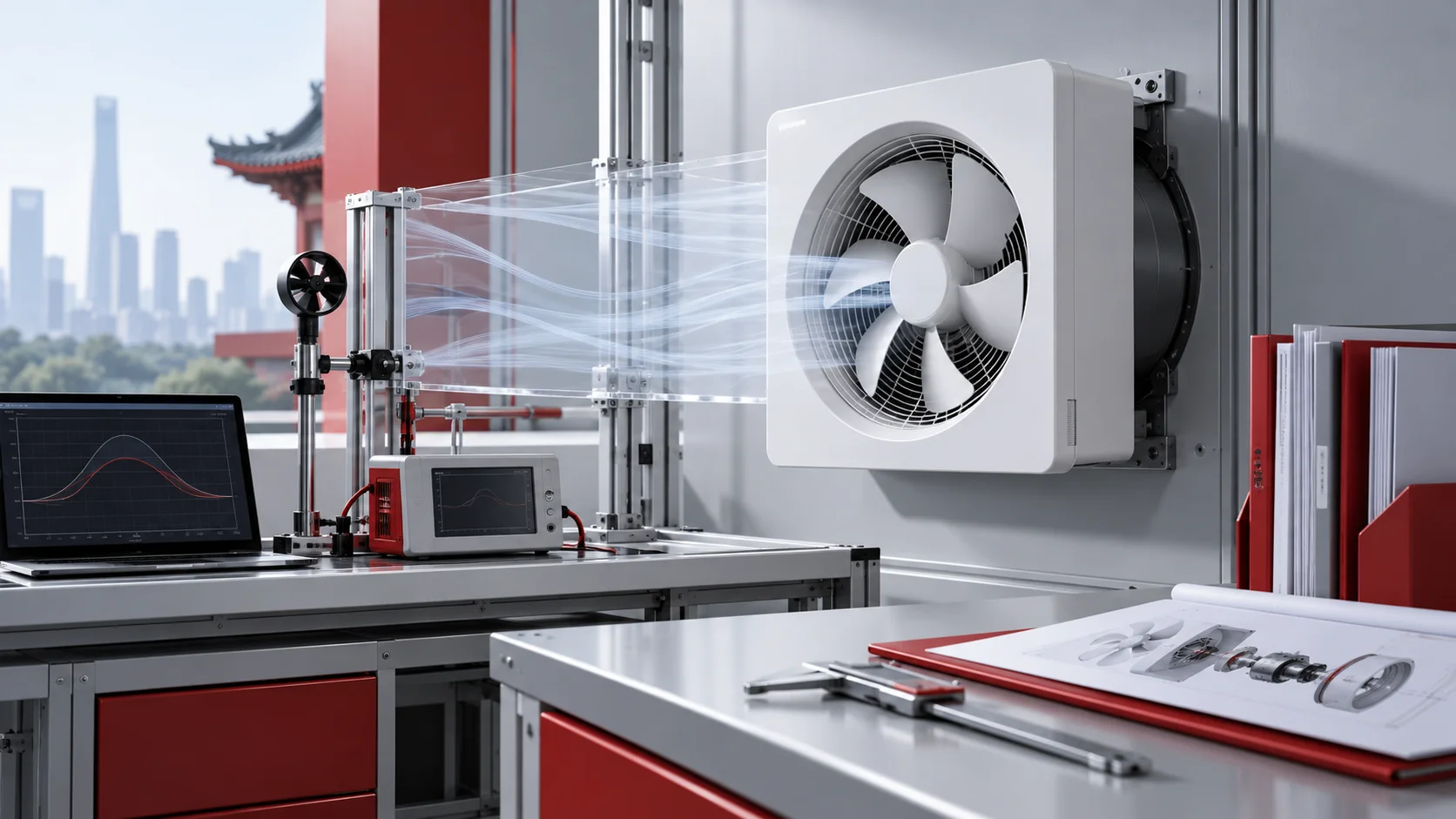
System Cooling Requirements
A customer came to us with a new HVAC project. They needed a custom EC axial fan to cool their commercial units. This system required two distinct sizes. Our main unit needed a 450 mm diameter.
Meanwhile, the smaller loop needed a 250 mm fan. Both parts had to meet strict limits. Teams also faced tough noise rules. Input power was 230V AC nominal.
However, the grid power often changed in the field. These units had to run smoothly between 176V and 264V. Furthermore, the system lives outdoors. The fans had to run from -25°C to 60°C.
Storage temps could drop to -40°C. Such extreme temps require tough internal parts. Noise presented another big issue here. The 450 mm fan had to push 6695 m³/h of air.
It faced a high static pressure of 242 Pa. Even so, testing could not exceed 68 dB(A). By contrast, the 250 mm loop had an even lower noise limit. It had to stay at or below 60 dB(A).
Any new fan must pass strict sound tests. Engineers test these fans to AMCA 210-16 methods. They also use ISO 5801 guidelines for tests. Safety standards were just as strict for this build.
Both units had to meet EN 60335-1 safety rules. Instead, standard catalog fans could not meet all these goals. Most default models were too loud or too weak. Therefore, the customer needed a new design.
Designing the Custom EC Axial Fan System
Next, we looked at our standard 250 mm model. This stock fan moved 1916 m³/h of air. It drew 115 W of power during use. Motor speed maxed out at 2950 RPM.
However, the high spinning caused too much wind noise. Our baseline fan hit over 60 dB(A) in acoustic tests. So, we had to reject this high-speed setup right away. It clearly violated the customer noise limits.
Instead, we changed the internal motor winding. Furthermore, engineers updated the software mapping. We lowered the top speed to 2480 RPM. This simple change fixed the loud noise issue.
Consequently, the acoustic output dropped to exactly 60 dB(A). Therefore, total power draw also fell to just 85 W. This change had a clear mechanical cost. Max airflow dropped to 1627 m³/h.
Even so, the customer approved this trade-off. Meeting the firm noise limit was more important than peak airflow.
Upgrading the 450 mm Unit
We then moved to the larger 450 mm unit. Furthermore, this main fan needed to handle a high static pressure of 242 Pa. Consequently, standard plastic blades bend under this much force. We rejected PA66 plastic for the large frame.
Instead, we chose cold-rolled sheet steel for the custom EC axial fan. Heavy metal adds extra weight to the moving parts. Therefore, the custom EC axial fan needs more time to reach full speed safely. So, we set a soft-start delay of under 20 seconds.
Slow starts protect the internal parts from sudden stress. Finally, we added our SmartEC control logic to both fans. Furthermore, each circuit board accepts 0-10VDC and PWM signals. These inputs let the main HVAC brain drive fan speed.
Next, we also provided a tachometer pulse output. This specific wire sends speed data back to the system monitor. In short, these upgrades gave the customer exactly what they needed. The custom fans balanced good airflow with safe noise levels.
Technical Specifications
| Parameter | LWAE3G250SS-7PKW-08-00 | LWAE3G450SS-5MEW-03-00 |
|---|---|---|
| Max Airflow | 1627 m³/h (957 CFM) | 6695 m³/h (3985 CFM) |
| Max Static Pressure | Not Specified | 242 Pa |
| Input Power | 85 W | 420 W |
| Speed | 2480 RPM | 1590 RPM |
| Voltage Range | 176-264 VAC (230V Nominal) | 176-264 VAC (230V Nominal) |
| Frequency | 50/60 Hz | 50/60 Hz |
| Current | 0.61 A | 2.0 A |
| Noise Level | 60 dB(A) | 68 dB(A) |
| IP Class | IP55 | IP54 |
| Insulation Class | Class B | Class B |
| Impeller Material | PA66 Plastic | Cold-Rolled Sheet Steel |
| Control Input | 0-10VDC / PWM | 0-10VDC / PWM |
| Soft Start Delay | Under 10 Seconds | Under 20 Seconds |
| Life Expectancy | 40,000 Hours (L10) | 30,000 Hours (L10) |
| Certifications | CE, ETL, CSA | CE |
First, input power and spinning speed drive the main acoustic results here. Engineers must balance fan RPM against target noise limits. Meanwhile, the heavy steel material on the big unit prevents blade damage at high pressures.
Reference: AMCA 210 covers the test method behind these figures.
Technical Documentation
First, this section provides the images and final engineering drawings.
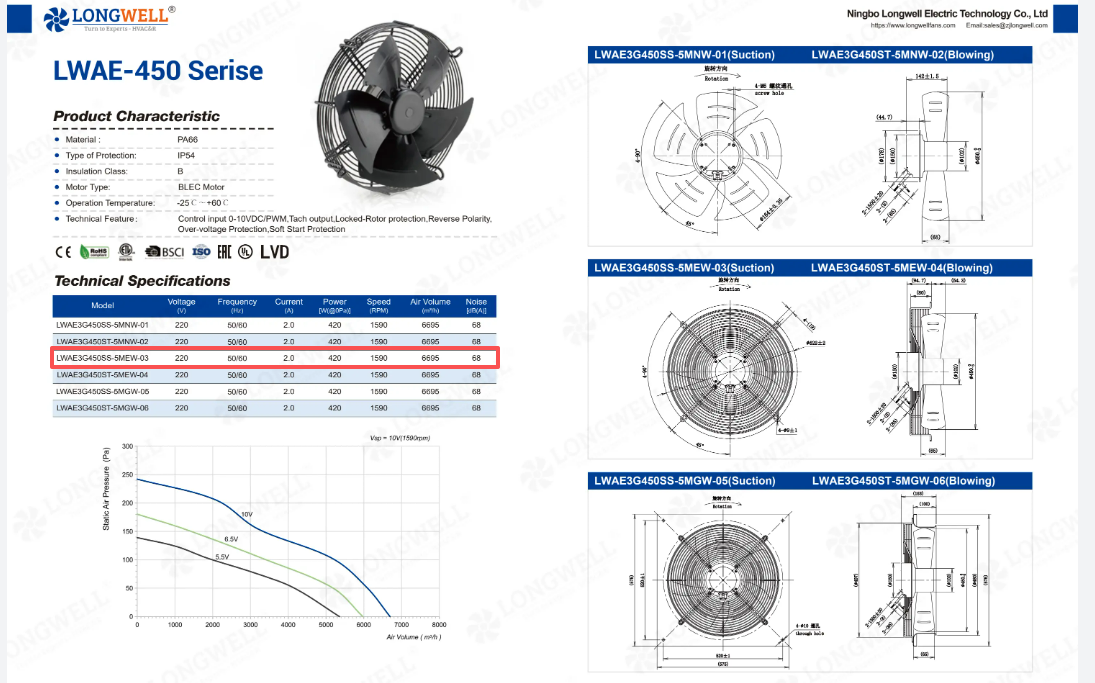
The first image shows the early catalog data for the 450 mm unit.
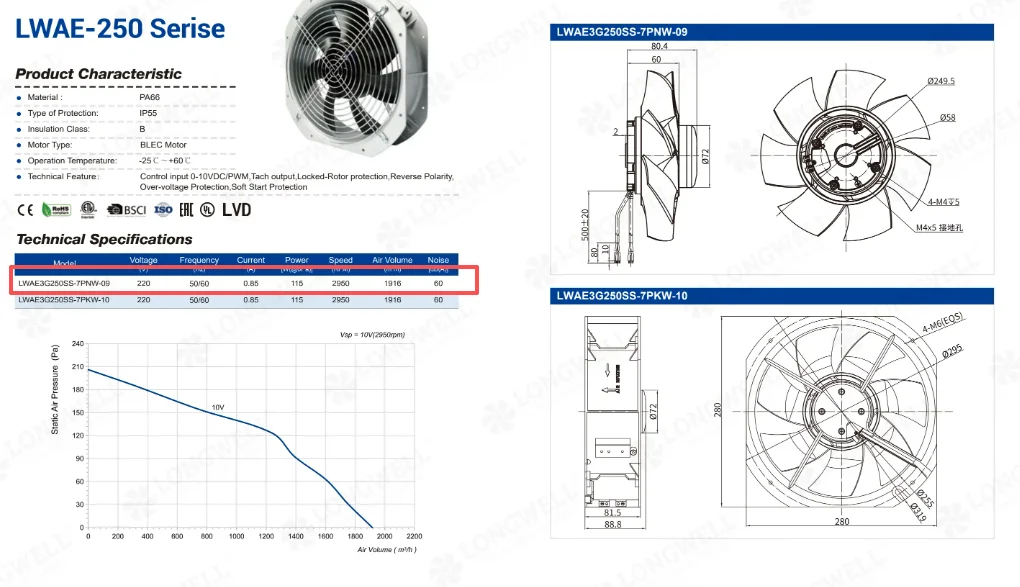
Next, our second graphic highlights the stock 250 mm fan running at 2950 RPM.
LWAE3G250SS-7PKW-08-00 Final Spec
This PDF details the 2480 RPM setup and limits for the smaller unit.
LWAE3G450SS-5MEW-03-00 Final Spec
Finally, our final file gives the mechanical dimensions and steel blade details to the custom EC axial fan team.
How to Specify Your Next Air Moving Solution
First, write down your hard limits before you talk to a supplier. Acoustic goals will often drive your motor choices. When you specify a custom EC axial fan, you must know what trades you can make.
- Find the voltage range: Outdoor gear often sees power drops. Specify a wide input band like 176V to 264V. Do not just list a nominal 230V target.
- Accept airflow drops for noise limits: You cannot run a 250 mm blade near 3000 RPM and keep it quiet. Expect to lose 10% to 15% of your airflow if you cap noise at 60 dB(A).
- Pick the right blade material: Plastics work well for low pressure. However, high static pressure points like 242 Pa can bend plastic. Use cold-rolled steel or aluminum for heavy loads.
- List your control signals: Tell the factory how your main board talks. Standard inputs include 0-10VDC and PWM. This helps the factory map the logic before they ship the units.
Related: Axial Fans.
Engineering Questions Answered
Technical Documentation & Resources
Browse our axial fans range, the AC axial fans section, or EC axial fans.
Have a Similar Fan Requirement?
Longwell’s engineering team delivers custom spec sheets and samples within 90 days. Since 1990, we have supplied EC fans and blowers to OEMs across HVAC, cold chain, data center, and industrial applications worldwide.
Browse Related Products:
🏆 ISO 9001 / ISO 14001 / ISO 45001 | CE (TÜV) | UL/ETL | ATEX Zone 21/22 | AMCA 210-16 / ISO 5801 tested
Choose the right axial fan
Longwell manufactures 1,086 axial fans in-house. Send airflow, static pressure and voltage — an engineer replies with a matching model, performance curve and price within one working day.