What the chiller OEM needed
An OEM building commercial water chillers needed a 350mm condenser fan at 800 to 1,000 units a year. Sample and production voltage differed from the start.
Their requirement named an exact figure: a low speed of 1050 RPM. That is unusually specific, and it comes from acoustics rather than from cooling.
Why two speeds
A chiller condenser rejects heat against a load that varies through the day and the season. Full airflow is needed at peak; at part load it is wasted, and at night it is a noise complaint.
So the fan runs fast when the chiller is working hard, and at 1050 RPM when it is not.
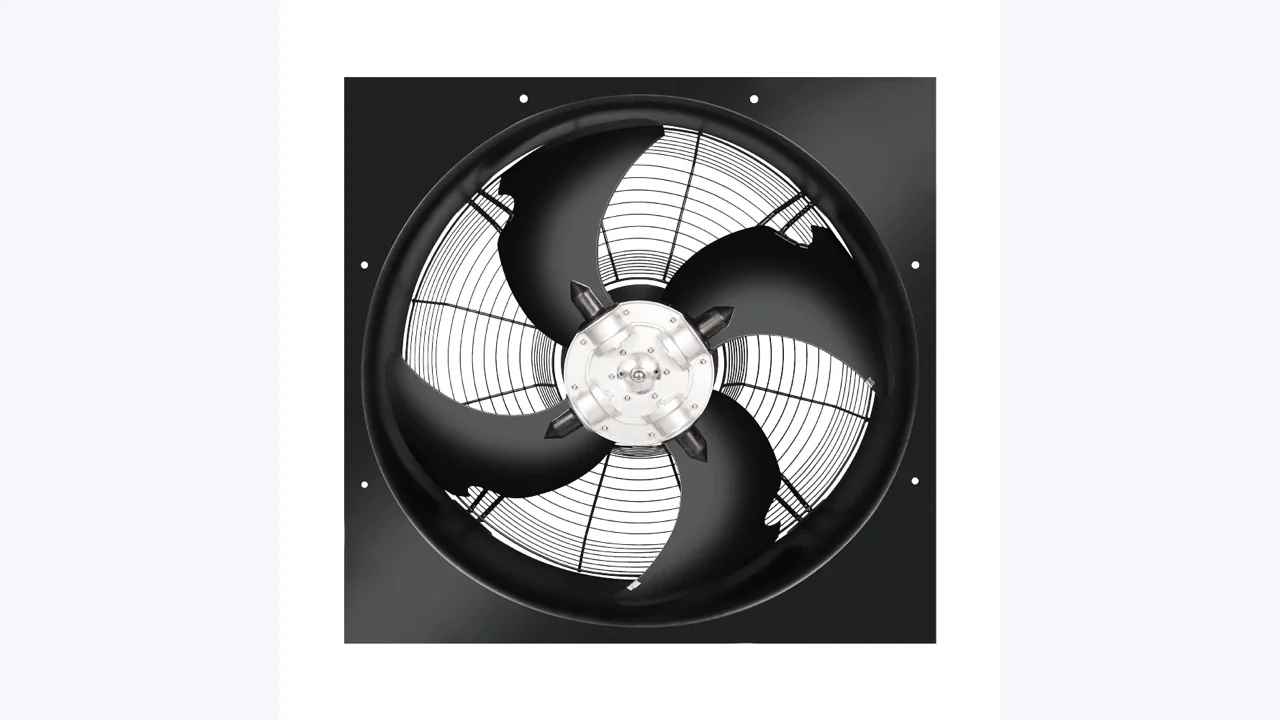
- Delivery as a complete assembly with a flat guard grille.
- Next, appliance safety to EN 60335-1, supporting their own UL work.
- Meanwhile normal commercial HVAC exposure: moisture and a wide ambient range.
- Finally, engineering samples on 220V AC, with mass production on 115V AC.
That last line is the one worth pausing on.
Where sample and production voltage diverge
The two-speed requirement settled the motor type quickly, and the voltage split raised a question we put back to the customer.
Why tapped windings rather than EC
An EC fan gives infinitely variable speed. However, this customer needs exactly two operating points, and their chiller control board has no 0-10V or PWM output.
Adding one means new control circuitry on their main board. So an AC motor with tapped windings does the job with two contactors and no electronics at all.
The detail in the voltage split
Sample and production voltage differ outright. Samples run on 220V at 50Hz, while production units run on 115V.
On the 220V build the two speeds are 1050 and 1380 RPM. On the 115V build they are 1050 and 1500 RPM.
Here the low speed matches exactly, which is what the customer specified. The high speed does not, and it differs by 120 RPM.
Why that matters at validation
Samples are how an OEM proves a design before committing to volume. Consequently a sample that behaves differently from the production unit proves less than it appears to.
Here the difference lands where it is most visible. Higher speed means more airflow, and it also means more noise. So acoustic testing done on the 220V samples will not describe what the 115V units do at full speed.
We flagged it rather than shipping the samples quietly. Whether it matters is their call, and it is a much cheaper call to make now.
The platform
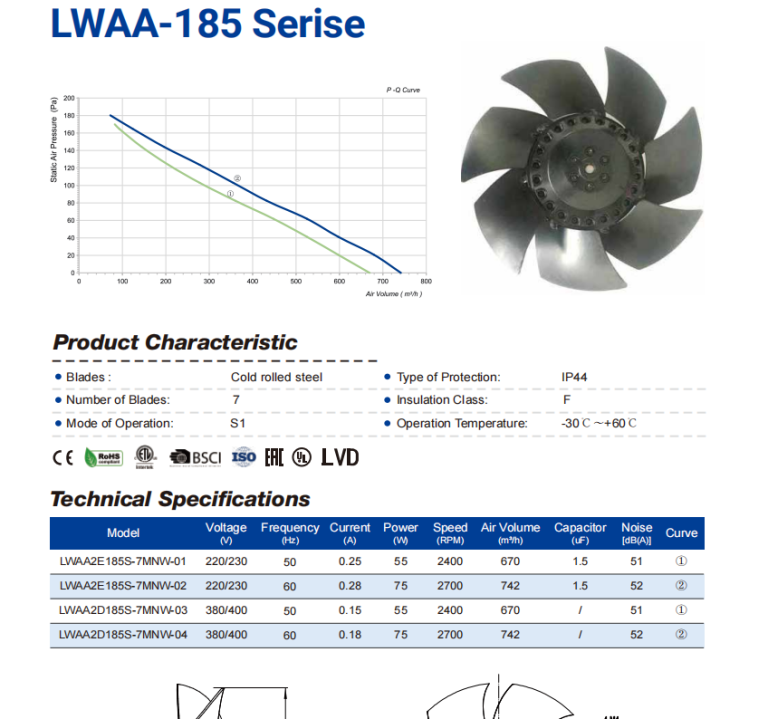
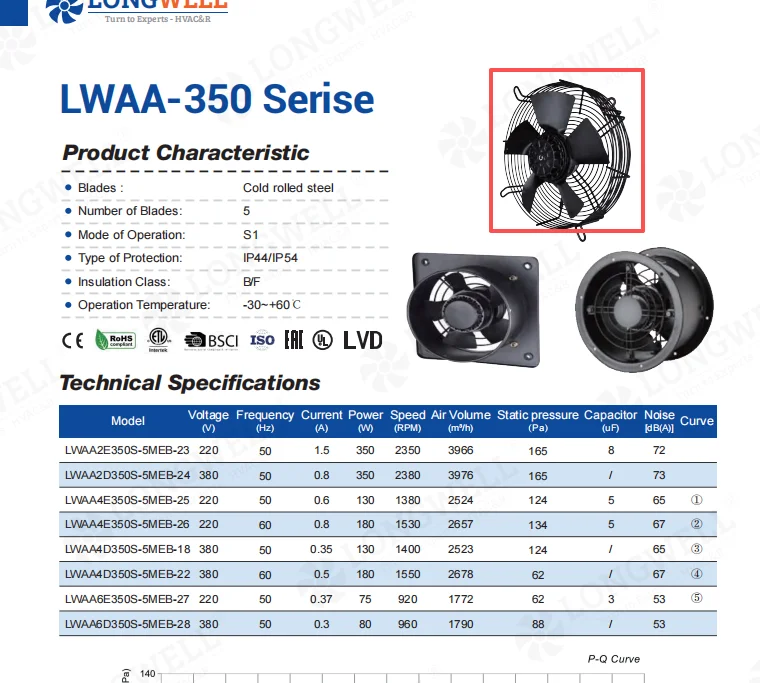
The base is our 350mm AC axial series with a five-blade cold-rolled steel impeller, which suits pushing air through condenser coil resistance.
What it cost
Two fixed points instead of a range. If the chiller would benefit from modulating airflow against head pressure rather than switching between two settings, EC is the better answer and this is not it.
Technical Specifications
Two columns appear below, one per supply. Compare the speed figures, since sample and production voltage do not give the same answer.
| Parameter | LWAA4E350S-5MCW-41-46 (Sample) | LWAA4E350S-5MCW-42-46 (Production) |
|---|---|---|
| Nominal Voltage | 220 VAC | 115 VAC |
| Frequency | 50 Hz | 50 Hz |
| Speed | 1050 / 1380 RPM | 1050 / 1500 RPM |
| Current | 0.6 A | 0.6 A |
| Input Power | 110 / 180 W | 110 / 180 W |
| Max Airflow (m³/h) | 2575 m³/h | 2730 m³/h |
| Max Airflow (CFM) | 1515 CFM | 1606 CFM |
| Capacitor | 6 µF | 16 µF |
| Protection Class | IP44 | IP44 |
| Insulation Class | Class F | Class F |
| Operating Temperature | -30°C to +60°C | -30°C to +60°C |
| Dimensions (Impeller) | 350 mm | 350 mm |
| Dimensions (Grille) | Ø 422 mm x 105 mm deep | Ø 422 mm x 105 mm deep |
| Life Expectancy (L10) | 30,000 Hours | 30,000 Hours |
| Certifications | CE, RoHS, Reach | CE, RoHS, Reach |
Technical Documentation
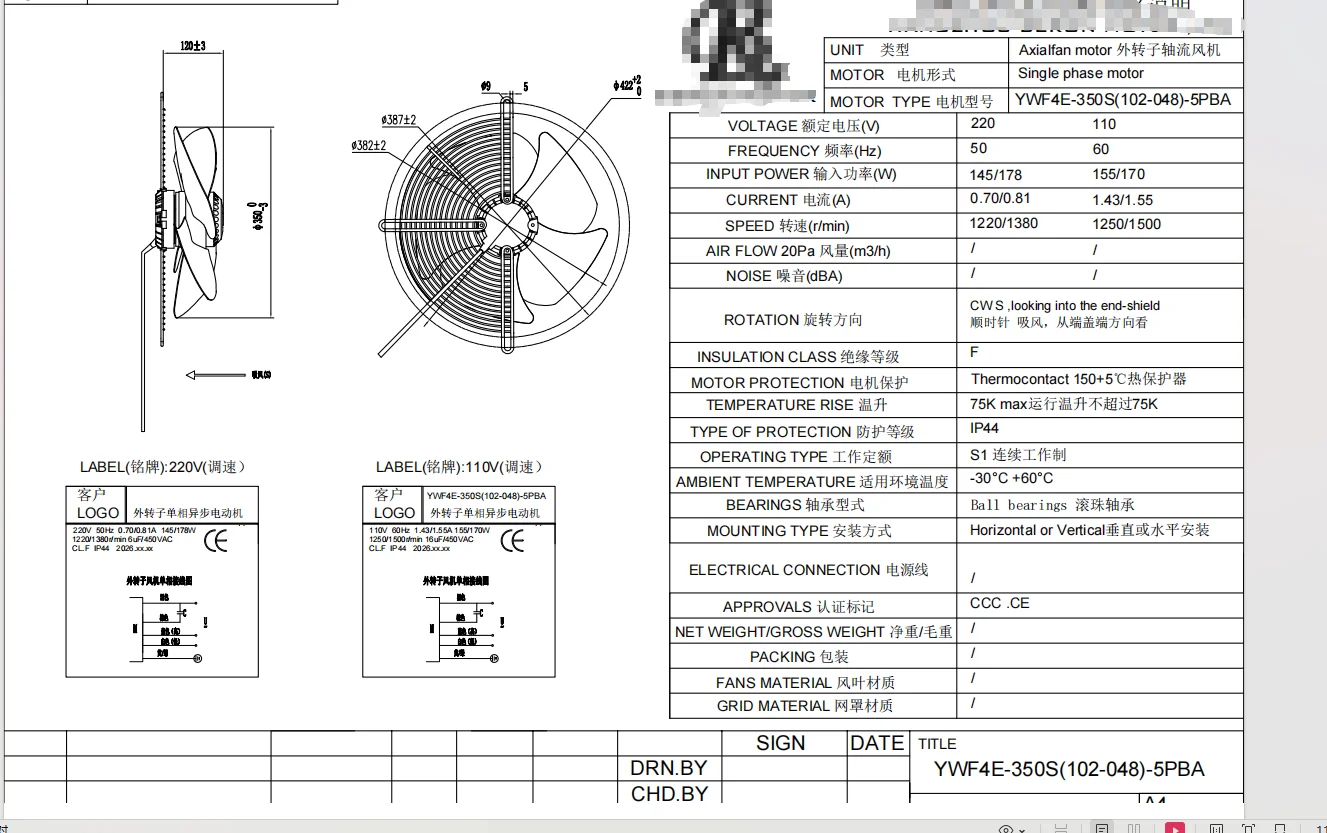
An OEM procurement manager can use this image to confirm the fan’s form factor and the included flat guard grille assembly.
A design engineer uses this dimensional drawing to verify fit and clearance within the chiller chassis, noting the 422mm overall diameter and 105mm depth.
Download Production Model Spec Sheet (115V)
This is the final approved specification sheet for the LWAA4E350S-5MCW-42-46, containing all performance data, P-Q curve, and wiring diagrams for the mass production unit.
Download Sample Model Spec Sheet (220V)
Meanwhile the document provides the full technical details for the LWAA4E350S-5MCW-41-46, which was used for initial customer validation and sampling.
If you validate on one supply and ship on another
A split between sample and production voltage is common, and quietly risky.
- Compare every row across both builds. Sample and production voltage differences do not affect all figures equally. Here the low speed matched and the high speed did not, which is exactly the kind of gap that survives a casual comparison.
- Do acoustic testing on the production voltage. Noise follows speed steeply, and sample and production voltage change that speed. If your samples run slower at full speed than production will, your sound measurements are optimistic and you will find out after launch.
- Ask for both datasheets, not one. A supplier quoting a fan for two supplies should provide the figures for each. If only one sheet arrives, the other build has not been characterised or has not been checked.
- Ask whether samples can be built on the production voltage. Often they can, with a longer lead time. Where the validation is acoustic or thermal, that wait is usually worth it.
See our axial fan range, the condenser fan section, or AC axial fans. Appliance safety follows IEC 60335-1.
Questions about dual-speed fans
Why do the two builds have different high speeds?
Because a tapped winding produces the speed that winding delivers on the supply it sees, not a chosen round number. Rewinding for a different voltage lands the high tap in a slightly different place. The low tap was matched deliberately because the customer specified it exactly.
Can the high speed be matched across both voltages?
Usually yes, by recalculating the winding for the second voltage rather than adapting an existing one. That makes it a development item rather than a selection, so it costs time. Whether it is worth doing depends on how much the 120 RPM actually affects your product.
Why not use an EC fan and avoid the issue entirely?
Because an EC fan needs a control signal, and this chiller board has no analog or PWM output. Adding one means new circuitry on their main board. Where a product already has that output, an EC fan does sidestep the voltage question, since the controller regulates to a commanded speed.
How much quieter is 1050 RPM than full speed?
Noticeably, because sound power rises steeply with speed. The exact figure depends on the build, which is the point of this article. Ask for the noise level at both taps, on the voltage you will actually ship.
Technical Documentation & Resources
Working on something similar?
Send us the duty point, the envelope and the supply, and our engineers come back with a shortlist rather than a catalog. Meanwhile custom spec sheets and samples run to 90 days. Since 1990 we have built fans for HVAC, cold chain, data center and industrial OEMs.
Browse Related Products:
🏆 ISO 9001 / ISO 14001 / ISO 45001 | CE (TÜV) | UL/ETL | ATEX Zone 21/22 | AMCA 210/211 / ISO 5801 tested