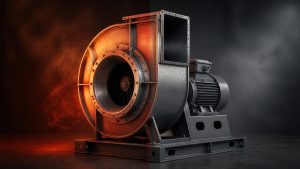
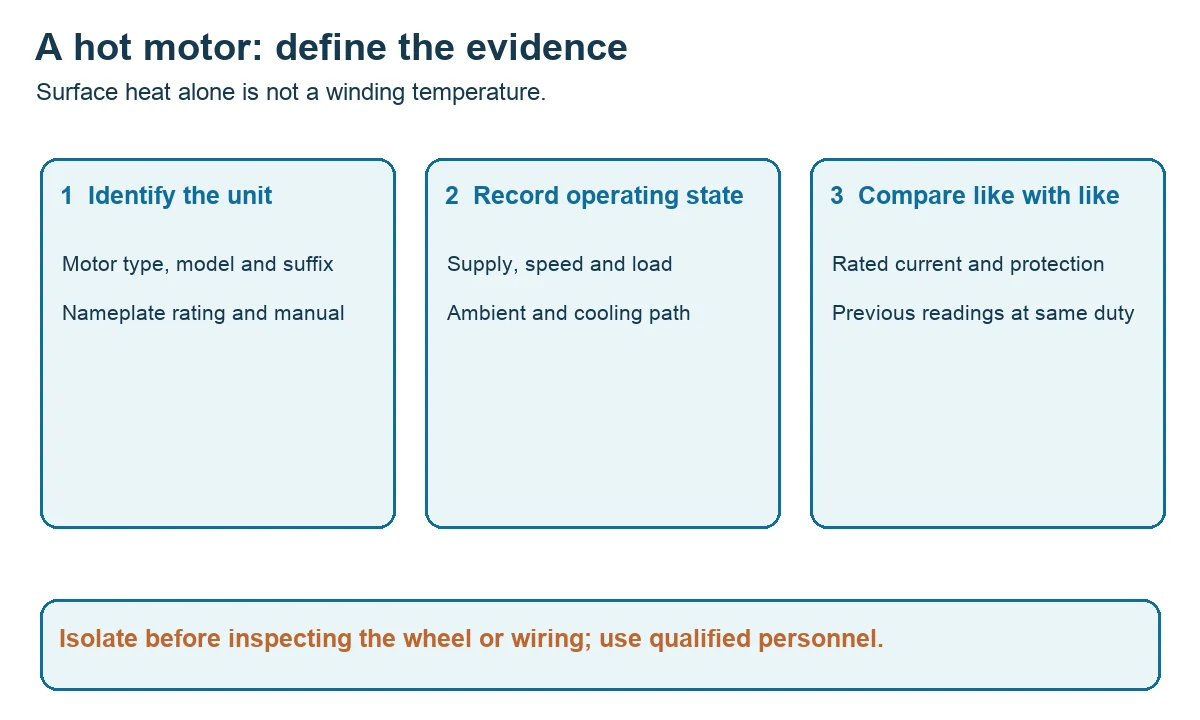
A hot fan motor is a symptom. The useful question is which operating condition changed: electrical supply, mechanical load, motor cooling, or the surrounding temperature. Begin with the exact motor nameplate and its operating instructions. A hand on the housing cannot measure winding temperature or establish that an insulation limit has been exceeded.
First establish whether the motor is outside its rating
Surface temperature depends on motor design, ambient air and where it is measured. A case that feels uncomfortable may still be operating within its rated temperature rise; another motor may be in trouble while its case looks ordinary. Use the nameplate and manufacturer instructions to identify voltage, frequency, rated current, duty, ambient limit, insulation system and protection method. Compare readings at a defined operating point, not with a remembered touch test.
The fan and motor nameplate guide helps assemble the identification data. It is a reading aid, not a substitute for the exact model manual. Keep the suffix and revision with any curve, drawing or wiring sheet. LONGWELL’s motor-cooling fan family illustrates a possible construction for a separate cooling duty; that family page does not establish that an accessory is suitable for this motor.
Separate cooling from fan airflow
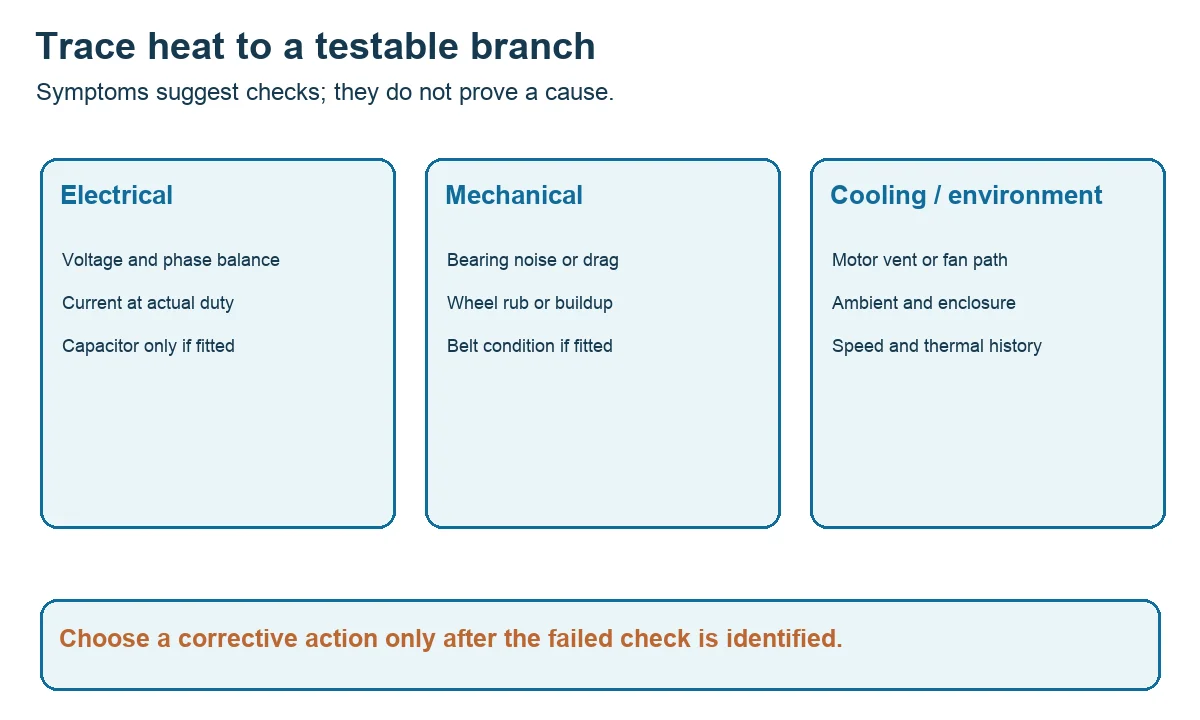
Different fan motors are cooled differently. Some have a shaft-mounted external fan or ventilation openings; some are in an airstream; some are sealed or have independent cooling. A blocked process filter does not automatically mean that the motor has lost its cooling air. Identify the motor’s actual cooling path before making that connection. Then inspect only after safe isolation for obstructed vents, packed dirt, a failed external cooling fan or an unusually hot enclosure.
Record the ambient near the motor and compare it with the rating for the exact installation. A hot roof space, process air or poor cabinet ventilation can reduce thermal margin, but no fixed ambient allowance applies to every product. If the motor runs at reduced speed, check whether its cooling method remains effective at that speed. The correct response may be a ventilation change, a different operating point or a differently rated motor; the relevant manual and measured duty decide.
Check the electrical branch with the motor under its actual load
Qualified personnel should compare measured supply voltage, phase balance where applicable, current and protection settings with the nameplate and the exact motor instructions. Record the command and speed for an EC fan as well as any fault code. A low-voltage or phase problem is a candidate cause, not a diagnosis from heat alone. An excessive current reading may reflect supply, winding, control or mechanical load; isolate those possibilities before replacing parts.
A run capacitor belongs in the checklist only for a motor that actually uses one. EC electronics and many three-phase motors do not have the same external capacitor arrangement as a single-phase permanent-split-capacitor motor. Do not prescribe a capacitor replacement to every hot fan. If the fitted design calls for capacitor testing, follow the correct discharge and measurement procedure and use the specified replacement value and rating.
Inspect the mechanical load after isolation
Listen for bearing noise and check for wheel contact, debris buildup or damaged mounts. On a belt-driven assembly, include belt condition and tension according to its instructions. A wheel that is dirty or rubbing can change loading; it does not prove which component caused the motor heat. Avoid a universal hand-spin time: inertia, bearings, seals and drive construction all affect the result. Record what you observed and compare with the applicable maintenance guide.
Fan duty matters as much as visible condition. A change in damper, filter, duct or speed can shift the operating point, but the resulting shaft load depends on the exact fan design and curve. Do not assume every restriction raises motor current or that cleaning a filter will fix every trip. Recheck airflow, pressure, speed and motor current at the same defined state after any correction.
Read thermal trips as evidence, not a diagnosis
A stop followed by a restart may be consistent with a thermal protector, controller fault or another control action. The interval alone cannot identify the device or prove an airflow restriction. The thermal protection guide describes common protection arrangements; verify the exact motor’s device and fault record before resetting. Repeated trips warrant stopping the equipment until the cause is found.
ABB’s motor troubleshooting material lists ventilation blockage, supply imbalance and rubbing as separate possibilities. It supports the diagnostic branches, not a prediction about this LONGWELL unit. A safe restart should follow the exact motor and system instructions, with the fault addressed and operating readings retained for comparison.
What to send for a useful engineering review
Send the full fan and motor model including suffix, nameplate photo, installation drawing, supply and control arrangement, ambient near the motor, measured current and voltage at a stated duty, any fault history, and photographs of the cooling path and wheel. If the unit has a curve or test sheet, include its revision and the measured airflow and pressure reference points. This lets an engineer distinguish a motor rating question from a fan-system question without inventing a universal temperature threshold.
Need help narrowing the cause? Send the operating evidence to sales@longwellfans.com.