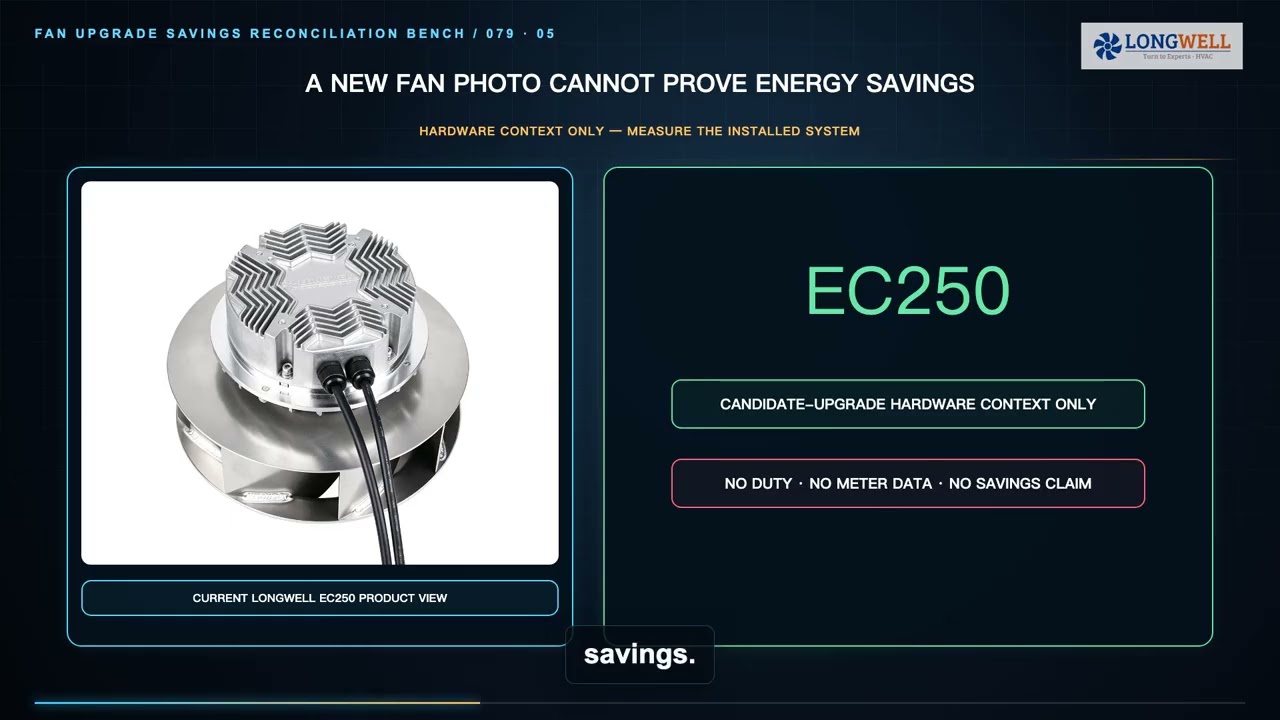
EC fan noise claims need unpicking, because the honest answer depends entirely on speed.
At full duty an EC fan and a good AC fan sound broadly similar. The difference appears the moment the EC fan can slow down and the AC fan cannot.
At full speed, EC fan noise is comparable with an equivalent AC fan. The advantage comes from part-load operation: sound power falls roughly 15 dB when speed halves, so a fan that spends most of its hours at 60 to 70 percent speed is dramatically quieter in practice. Compare octave-band sound power at your duty point rather than a single dB figure.
Where the reduction actually comes from
EC fan noise, like any fan noise, is dominated by tip speed. It rises steeply with it.
| Speed | Airflow | Approx. sound power change |
|---|---|---|
| 100% | 100% | Reference |
| 90% | 90% | −2.3 dB |
| 80% | 80% | −4.8 dB |
| 70% | 70% | −7.7 dB |
| 60% | 60% | −11.1 dB |
| 50% | 50% | −15.1 dB |
A 10 dB reduction is heard as roughly half as loud. So running at 60 percent speed changes the character of a plant room rather than merely improving a measurement.
What is not different
It is worth being straight about this, because overclaiming damages trust.
At identical speed and identical wheel geometry, an EC fan and an AC fan produce very similar aerodynamic noise. The impeller does the work, and the motor technology barely enters into it.
EC motors avoid the mains-frequency hum of an induction motor, which removes a tonal component around 100 or 120 Hz. That is audible in quiet spaces, although it is small next to the aerodynamic noise at full speed.
Why arrays sound different from one big fan
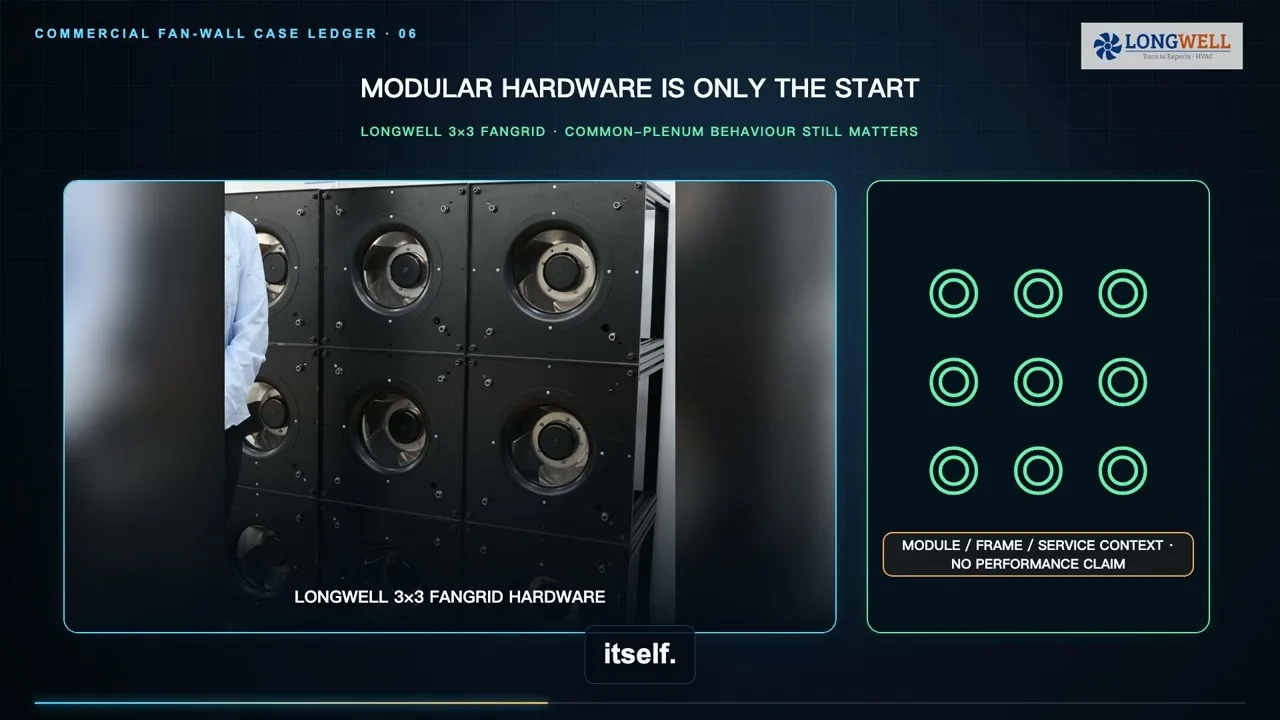
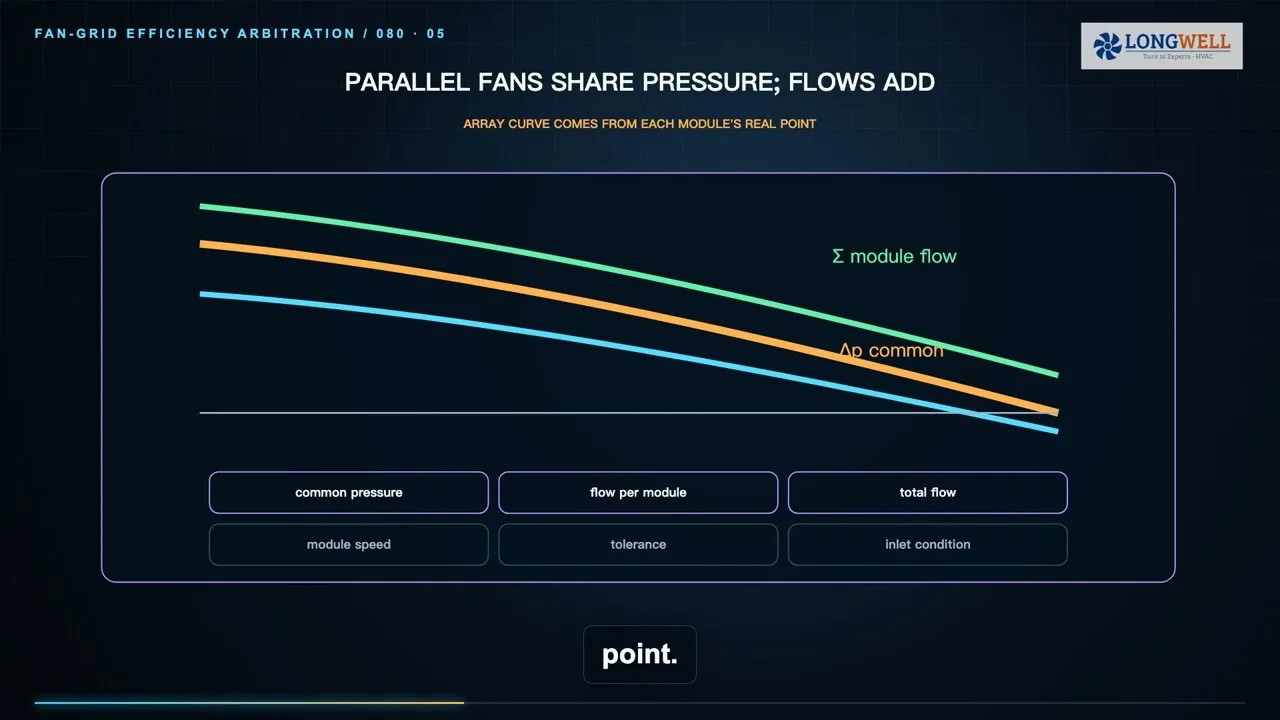
Replacing one large fan with several small ones changes the spectrum as well as the level.
- Smaller wheels turn faster, so blade passing frequency rises.
- Higher frequencies attenuate more easily in ductwork and linings.
- Multiple sources can interact, producing beating if speeds differ slightly.
- Running every fan at the same speed avoids that beating entirely.
- Plenum turbulence adds low-frequency energy that travels further.
- Finally, total sound power rises with the number of sources, all else equal.
Consequently an array is often perceived as quieter even when measured sound power is similar. Our fan wall guide covers the array trade-offs more broadly.
Comparing suppliers honestly
- Ask for sound power, not sound pressure, since pressure depends on the room.
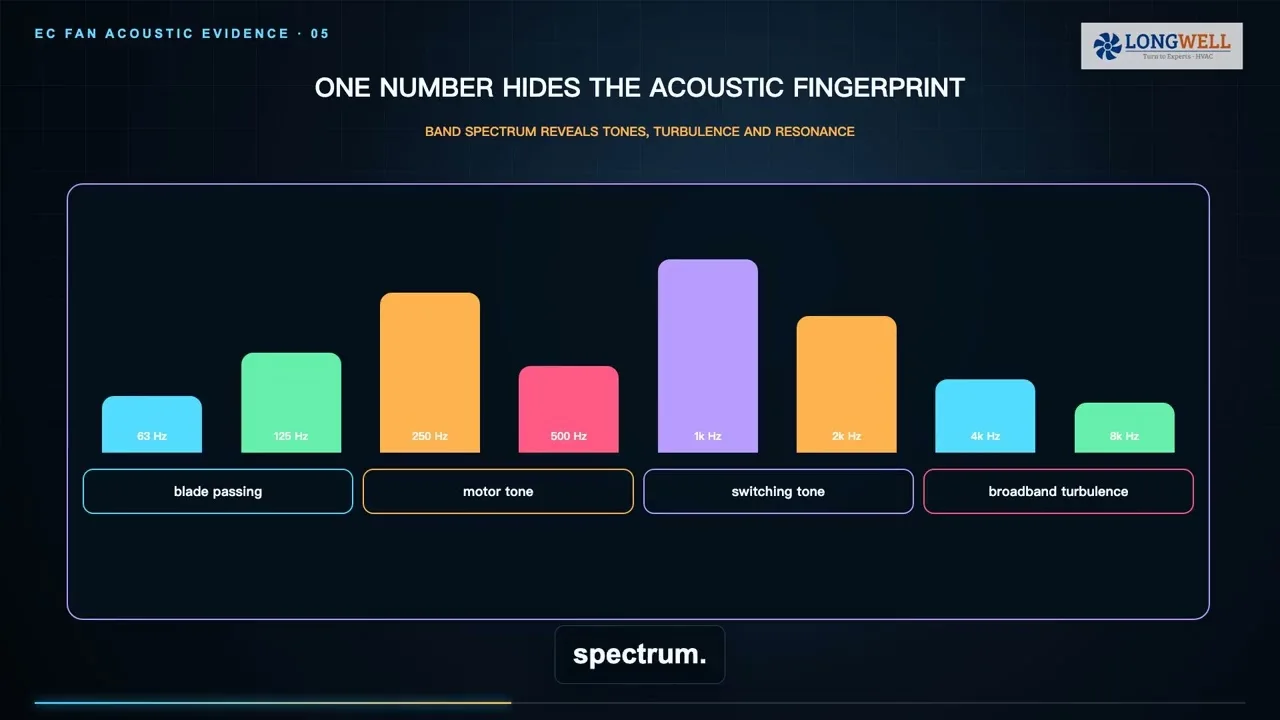
- Insist on octave-band data rather than a single A-weighted number.
- Specify the duty point, because noise at free air means nothing.
- Check the measurement standard used to produce the data.
- Compare inlet and outlet sound power separately where relevant.
- Finally, ask what speed the quoted figure corresponds to.
That last question catches a surprising number of optimistic datasheets. We measure sound power alongside airflow using AMCA 210/211 methods and provide the data on request.
Getting the most acoustic benefit
Speed control only helps if the control strategy actually calls for less air.
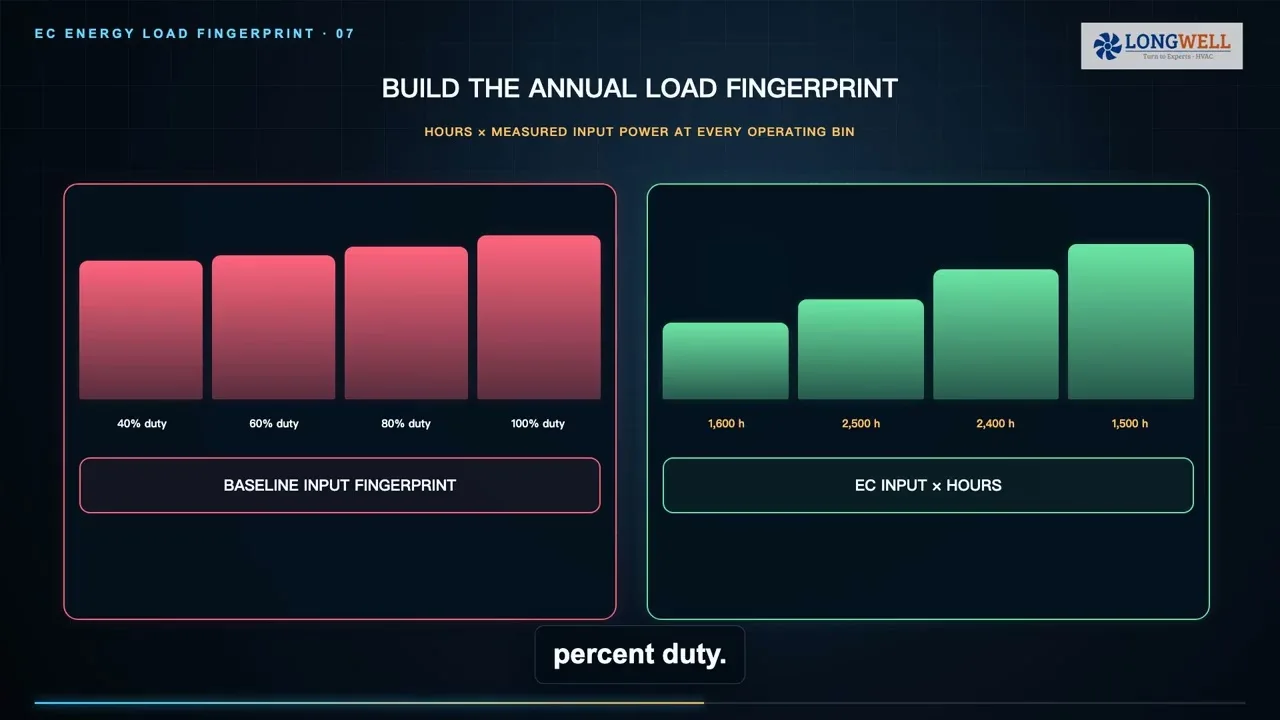
Pair EC fans with demand-based control such as CO2, occupancy or static pressure reset. Then the fan spends most of its hours at reduced speed, which is where the acoustic benefit lives. Meanwhile a fan running flat out on a fixed schedule sounds exactly like the AC fan it replaced.
Our part-load energy guide covers the control strategies, and they deliver the noise benefit as a side effect of the energy saving.
Do not skip the basics
No motor technology rescues a bad installation, and EC fan noise is no exception.
A bend against the fan inlet produces rumble that no silencer removes. Rigid ductwork transmits structure-borne noise around it. A dirty wheel creates unbalance that no control strategy quietens.
Fix those first, then let speed control do the rest. For background on inlet effects, AMCA Publication 201 covers system effect in detail.
EC fan noise FAQ
Are EC fans quieter than AC fans?
At the same speed, only marginally. In practice they are much quieter because they can run slowly for long periods, and sound power falls steeply with speed.
How much quieter is half speed?
Roughly 15 dB in sound power terms, which sounds close to a quarter as loud. Airflow halves too, so this only helps when the system genuinely needs less air.
Why did my new EC fan sound louder?
Check the installation first. A different inlet arrangement, a smaller wheel turning faster, or a plenum discharge can all shift the spectrum even when total power is similar.
Should I still fit attenuators?
Often yes, particularly for low-frequency content. Speed control and attenuation address different parts of the spectrum, so they work together rather than as alternatives.
EC fan noise falls with speed, not with the badge. Give the fan a reason to slow down and the acoustic improvement arrives with the energy saving.
Choose the right ec fan
Longwell manufactures 34 ec fans in-house. Send airflow, static pressure and voltage — an engineer replies with a matching model, performance curve and price within one working day.