Choosing an industrial fan supplier is not simply a catalog or price comparison. A defensible OEM decision connects the real duty, the offered configuration, technical evidence, manufacturing controls, commercial scope and approval path. If those pieces are reviewed separately, two quotations that look similar may describe different products and different responsibilities.
Use two layers: non-negotiable gates that remove an unsuitable offer, followed by consistent criteria for comparing the candidates that remain. This is a sourcing method, not an endorsement or a claim that any supplier or model is approved.
Define the fan duty and purchasing boundary first
Begin with the application, not the supplier list. Record required airflow and pressure together, plus the air or gas condition, density basis, operating temperature, installation altitude, inlet and outlet conditions, duty cycle, acoustic target, electrical supply, control interface and expected operating range. State where each value applies. A free-air figure cannot stand in for an installed duty that includes filters, coils, guards, dampers or duct resistance.
Describe normal, minimum and maximum conditions rather than one attractive point. The fan-curve reading guide helps keep airflow, pressure, speed and power attached to a common point. Then freeze the purchasing boundary: fan only, or fan plus motor, drive, guards, accessories, controls, documentation and spares. Every bidder should receive the same boundary.
Freeze decision rules before opening quotations
Name the owners of technical, quality and commercial review and the final approval authority. Define conflict-of-interest rules, evidence requirements, criteria and weights before prices are known. Separate preferences from hard gates. A missing configuration-specific drawing, an incompatible interface or evidence that cannot be tied to the proposed site may be a gate; a high score elsewhere should not erase it.
If a requirement changes, record why, approve the change and apply it to every candidate. A scorecard organizes judgment, but it cannot replace accountable review or turn an unresolved safety, legal or technical condition into an approval.
Verify the legal entity and actual manufacturing role
Confirm the contracting entity, quotation issuer, payment recipient, proposed production site and the party controlling the technical file. Ask whether the offer comes from a manufacturer, assembler, distributor or representative. None of those roles is automatically unacceptable; the purpose is to make responsibility visible.
Map who approves design changes, purchases critical components, assembles the unit, performs final testing, retains records and handles nonconforming output. A website, factory photograph or shared brand name does not by itself establish that chain. This centrifugal fan manufacturer sourcing guide provides additional questions for organizing the review.
Request evidence for the exact offered configuration
Catalogs are useful for screening, but approval should rely on the proposed model and revision. Request the dimensional drawing, mounting and discharge arrangement, impeller type, motor and drive data, electrical limits, control method, materials, surface treatment, accessories and operating limits. Performance information should identify the configuration, test basis, density assumption, speed and relevant tolerances, with enough curve range to assess the required duty rather than a single headline value.
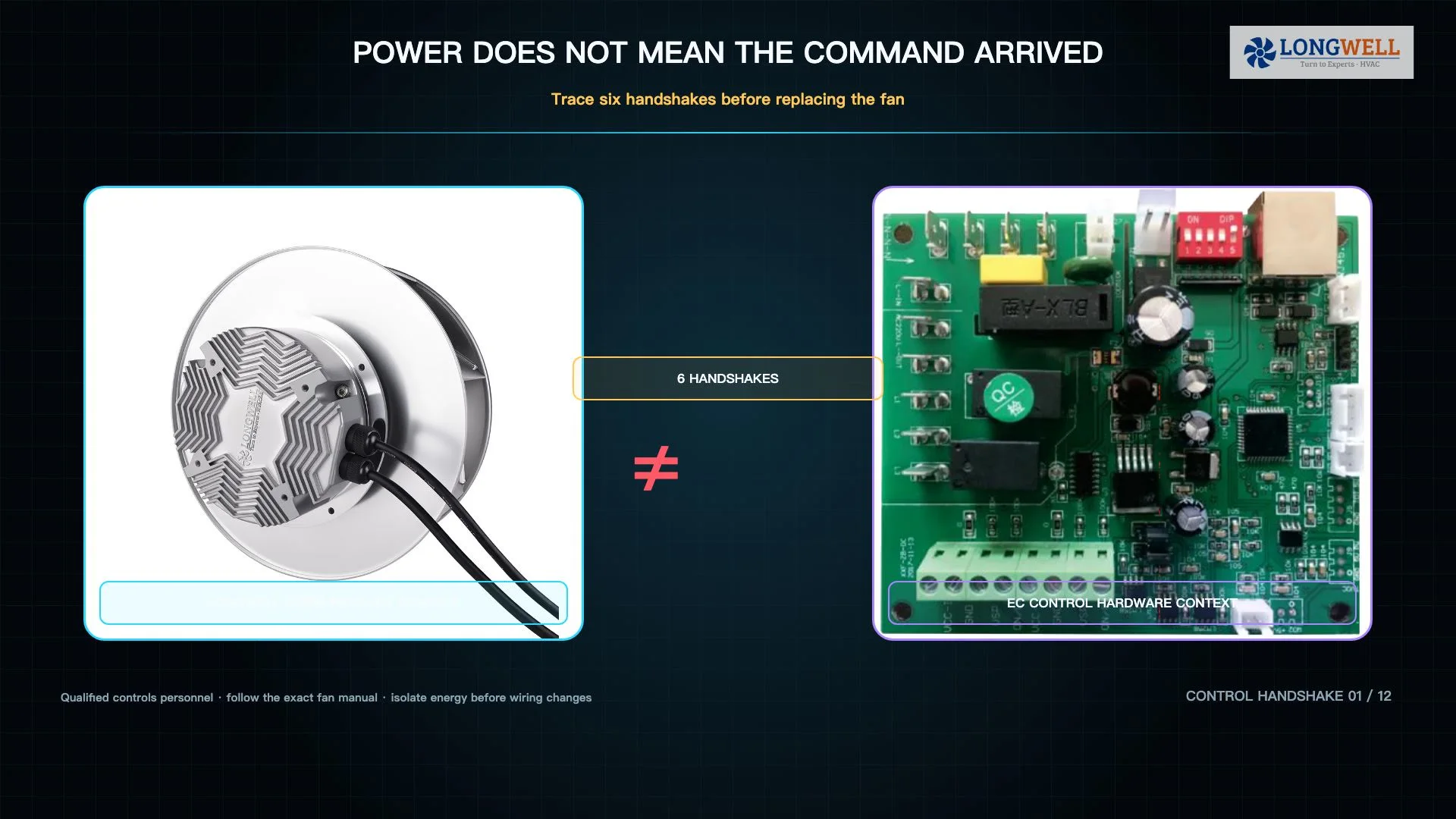
For a controlled fan, require the signal type, control range, feedback behavior, protective functions and interface documentation. The EC fan selection workflow helps structure duty and integration questions. Record every deviation explicitly; silence is not proof that the offer matches the request.

A useful supplier file connects each requirement to a specific configuration, supporting record, finding and approval decision. This illustration is a workflow concept, not a test result.
Validate certificates and reports at document level
A logo or report title is not enough. Check each document’s holder, covered model or family, number, method version, manufacturing site, status, issuer and scope. Reconcile those identities with the contracting entity, offered product and production site.
For test reports, determine whether the tested sample matches the offered dimensions, motor, impeller, materials, controls and firmware where relevant. Note whether the record covers the complete assembly, a component or a related model. Use an official issuer verification route when available, and record any gap rather than bridging it with an assumption.
Inspect the controls behind a successful sample
A sample can pass while production remains undefined. Review incoming material control, work instructions, special processes, inspection, equipment calibration, nonconformance handling, corrective action, traceability, document control and release authority. A reviewer should be able to follow the record from a critical component to the released unit.
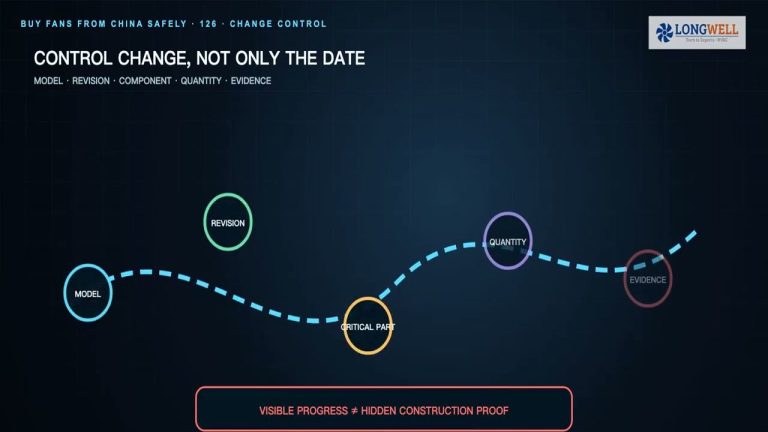
Define the change boundary too. Material substitutions, different motors or controllers, tooling changes, firmware revisions, process moves and site changes may alter performance, safety or evidence scope. State which changes require advance notice, approval, renewed testing or a new first article. “Equivalent” should be an engineering conclusion supported by a documented comparison, not an informal purchasing label.
Use a risk-based first article or pilot
Before a pilot, freeze the drawing and configuration, test method, instruments and calibration status, conditions, sample quantity, acceptance criteria and nonconformance process. If an input changes, record it and decide whether affected tests must be repeated.
The pilot should represent the configuration and control plan intended for later supply. Keep measured results separate from observations, and give borderline or failed outcomes an owner, disposition and closure record. A specially prepared sample does not prove production equivalence unless the approved configuration and process connect it to future units.
Normalize commercial scope before comparing price
Use one currency, quantity basis, delivery basis and purchasing boundary. Separate unit price from tooling, testing, documentation, packaging, freight, taxes, spares and accessories. Record payment protection, quotation validity, warranty scope, lead-time assumptions and exclusions. The lowest total may omit required work; the highest does not prove capability.
Leave uncertainty visible. If a cost, responsibility or delivery dependency is not confirmed, mark it open instead of inserting an optimistic assumption. A reconciled scope table lets decision-makers see what is actually comparable and what still requires negotiation.
Approve in stages and monitor the released baseline
Keep desktop qualification, evidence review, factory-process review, first-article acceptance, production release and preferred-supplier status separate. Each gate should identify its inputs, reviewer, open-item rule and exit criteria. The released baseline should name the entity, site, product revision, accepted deviations, evidence set and commercial boundary.
Continue reviewing incoming acceptance, recurring nonconformances, corrective-action closure, documentation accuracy and change-notification discipline. Reassess after significant design, ownership, site or process changes, expired evidence or repeated failures. The best-controlled fit is the supplier whose offer remains traceable from the stated duty to the delivered configuration—not the supplier with the longest presentation.
Choose the right industrial fan
Longwell manufactures 37 industrial fans in-house. Send airflow, static pressure and voltage — an engineer replies with a matching model, performance curve and price within one working day.