When a fan delivers less air than expected after installation or motor service, rotation belongs near the top of the checklist. A moving wheel is not proof that it turns in the specified direction, and weak flow is not proof of reversal. The practical decision is to verify the direction from the correct viewing side, then test whether the fan and connected system meet the intended duty.
The video explains the principle. For an actual unit, use its marked arrow, wiring documentation and tested performance data. Do not apply a generic percentage of lost flow to diagnose a particular fan.
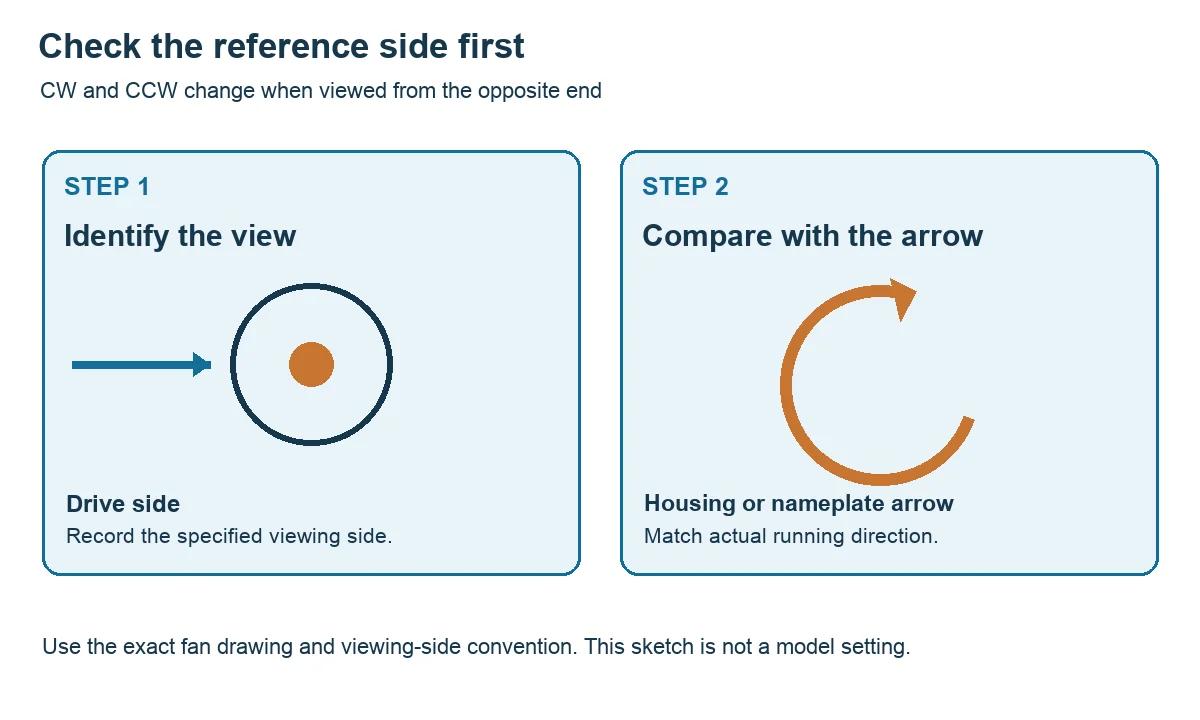
Start with the specified viewing side
Clockwise and counterclockwise reverse when the observer moves to the other end of a shaft. First identify the reference side in the exact fan drawing or nameplate. For a centrifugal fan, the AMCA designation convention defines rotation from the drive side and gives rules for identifying that side on single and double inlet arrangements. A site arrow may be easier to use, but it must be read from its intended perspective.
Do not decide direction from the apparent blade lean alone. A backward-curved wheel is defined relative to its actual direction of rotation; an inlet-side photograph can invert a casual reading. The LONGWELL forward and backward curved selection guide explains this geometry, but the exact equipment drawing remains the source for the installed unit.
Observe running direction without exposure to moving parts
Read the arrow on the housing or assembly and confirm that it belongs to the wheel being inspected. Follow the site’s isolation and guarding procedure. Where an approved sight window or guarded view exists, a trained technician can observe the wheel from a safe location while it runs. If no safe view exists, use the manufacturer’s approved check or arrange an instrumented inspection. Never remove a guard, put a hand near an inlet, or use an improvised probe to establish direction.
For axial equipment, confirm which side is intended to be the inlet and which is the discharge. Air direction may change if a reversible design is commanded to reverse, but that capability cannot be inferred from its shape. The motor and controller configuration must be checked against the exact unit documentation.
Separate wrong rotation from other causes of weak airflow
Rotation is only one diagnostic branch. A loaded filter, partly closed damper, blocked inlet, disconnected duct or changed speed can also produce low delivered flow. Record the operating condition before interpreting a measurement: fan speed, control command, filter state, damper position, active parallel fans and the measurement locations. A nameplate maximum airflow is not the duty point of a connected system.
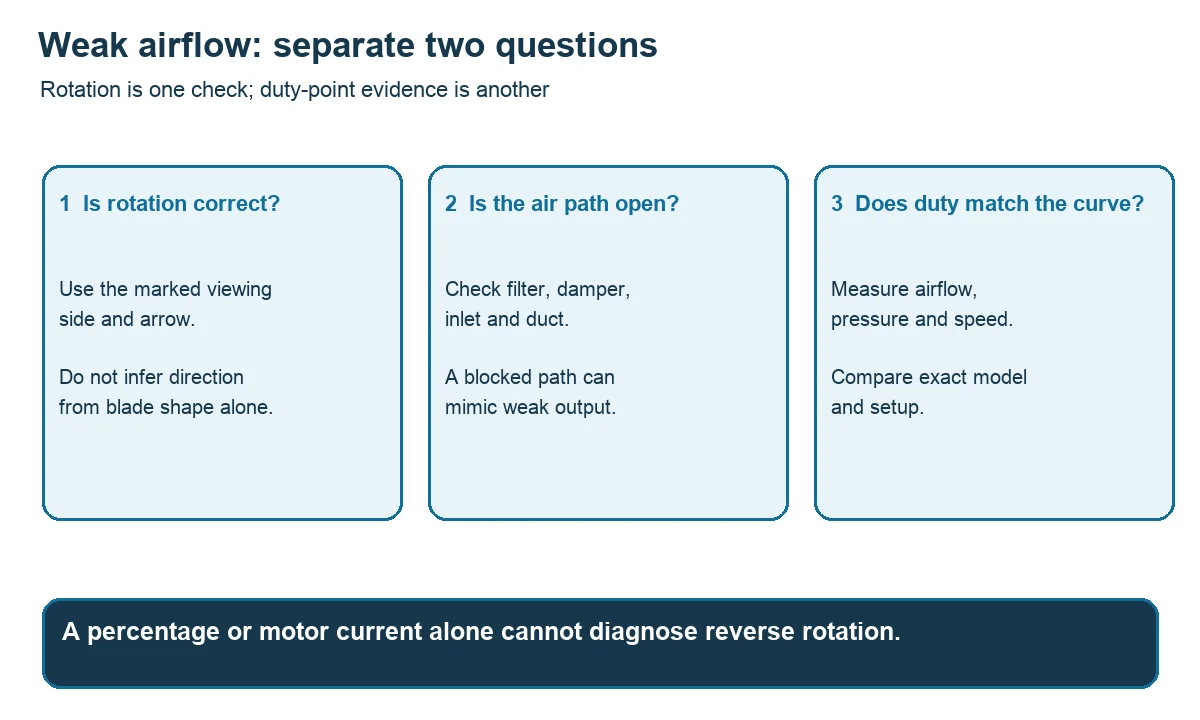
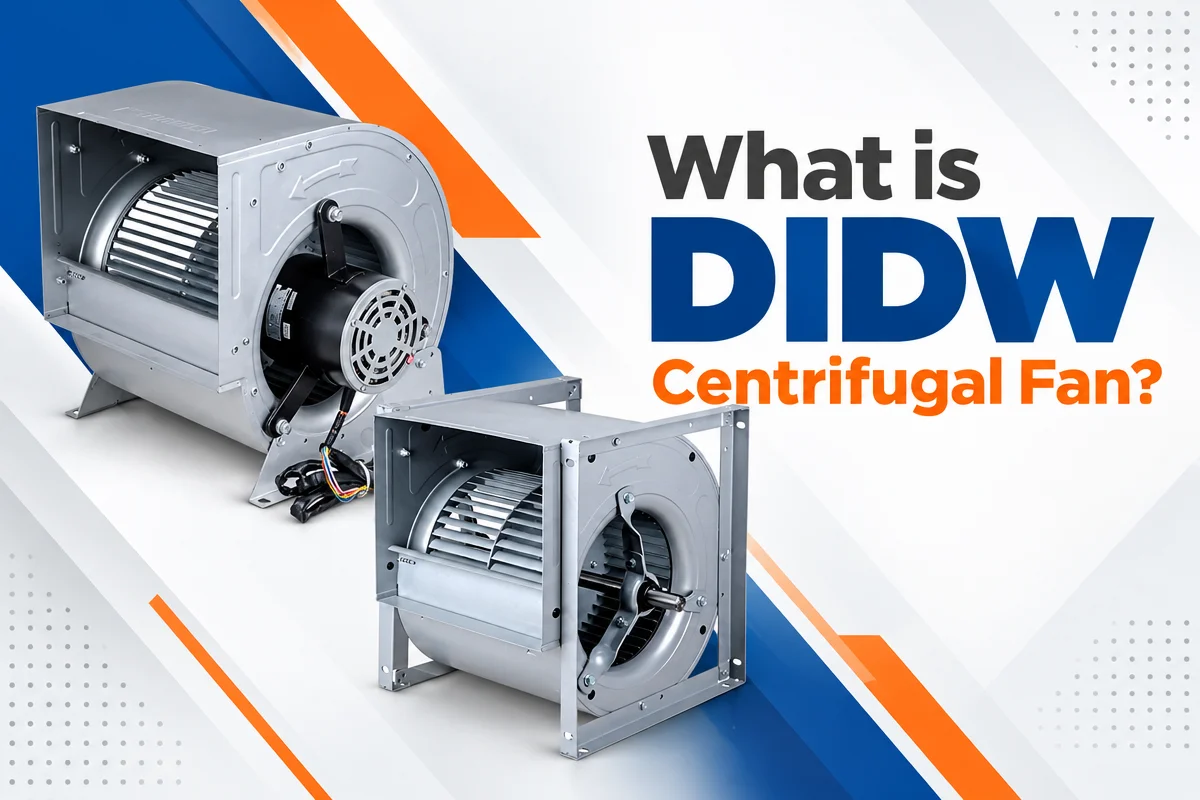
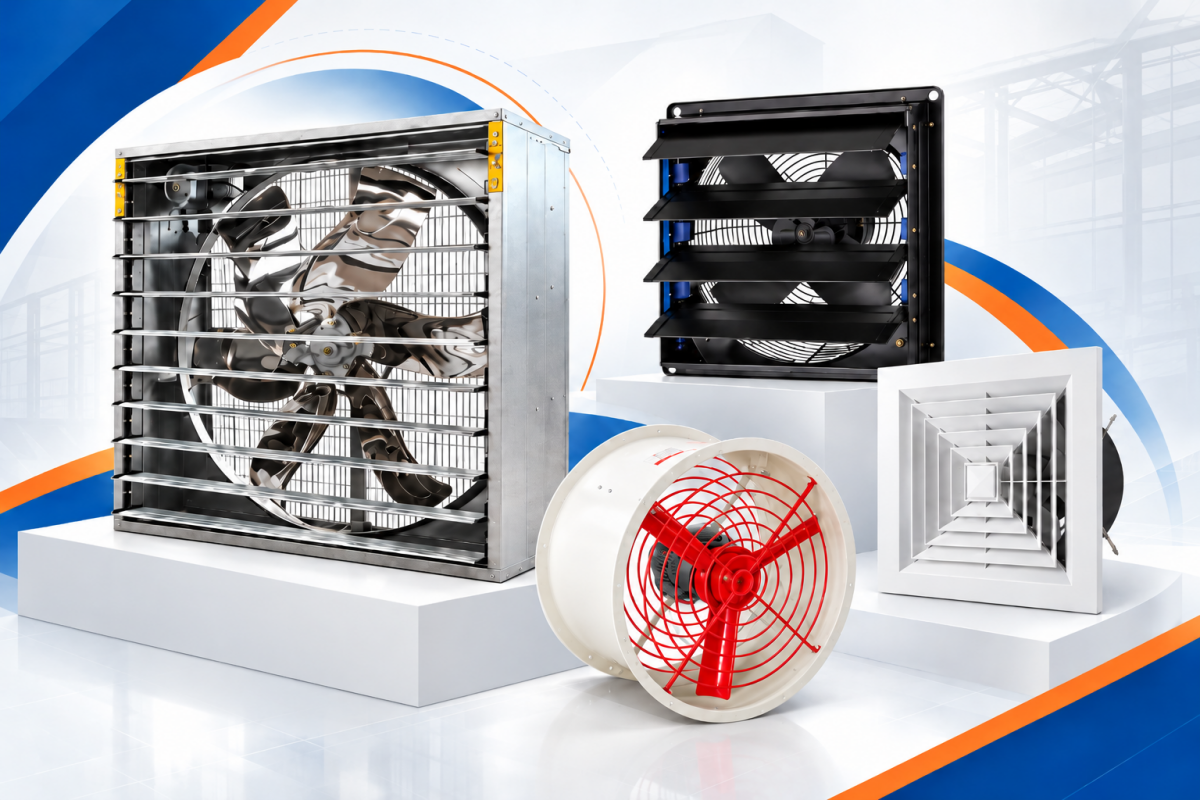
Measure airflow and pressure by an appropriate method and compare them with the tested curve for the exact model, configuration, speed and air density. If the unit is a LONGWELL industrial centrifugal fan family candidate, the family page establishes product scope, not performance in this installation. Ask for the controlled curve and the unit’s rotation marking. No generic family photograph validates the installed direction or expected airflow.
Correct the cause through the unit’s electrical instructions
If reverse rotation is confirmed, stop the unit and have qualified personnel apply the exact motor, drive and controller instructions. A three-phase motor, single-phase capacitor motor, EC assembly and deliberately reversible fan can require different procedures; a blanket instruction to swap leads or change polarity is unsafe. Some controller parameters affect commanded direction while other assemblies are built for one direction only. Verify the model and wiring diagram before making a change.
After any correction, repeat the direction check from the same reference side, then remeasure airflow, pressure and electrical input at the intended operating condition. Record the result with the equipment identity and configuration. If flow remains low, continue the air-path and duty-point investigation instead of declaring the rotation fix complete.
Build the check into commissioning
Include rotation verification after motor replacement, drive work, panel rewiring and first startup. The record should contain the direction arrow or drawing reference, viewing side, observed rotation, technician and date. Pair it with measured speed and duty rather than a visual tick alone. This makes a later comparison possible when filters, controls or ductwork change.
A fan whose wheel visibly follows the arrow can still underperform because the system resistance differs from the design. Conversely, a measured shortfall does not identify reversal without the direction check. Keep those conclusions separate and ask for the exact model revision, curve and site measurements when a diagnosis remains uncertain.
For a rotation and duty review, send the exact fan model, nameplate and arrow photos, motor or controller documentation, airflow, pressure and installation layout to sales@longwellfans.com.