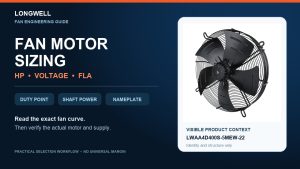
Before changing a fan motor’s direction, identify the motor, controller and fan wheel. The safe method depends on that complete assembly. A three-phase induction motor, a permanent-split-capacitor (PSC) motor, a shaded-pole motor and an electronically commutated (EC) fan do not share one reversal instruction. Correct shaft rotation also does not prove that the fan delivers the required air in its installed housing.
Start with the complete model and direction reference
Record the full motor and fan model, suffix, nameplate supply, controller type and the revision of the wiring drawing. Look for the rotation arrow on the motor or housing, and record the viewing end: clockwise viewed from the shaft end becomes counterclockwise from the opposite end. Do not decide from the word “clockwise” alone. The installer should isolate the supply, verify it is de-energized and follow the site’s electrical safety procedure before any connection work.
LONGWELL’s public AC motor families and EC axial fan family help identify candidate technologies. Those family pages do not authorize a reversal on a particular suffix. For example, a LONGWELL YDK300-4 supplier specification records 220 V, 50 Hz, 300 W and 1400 rpm for that particular document, but the inspected page does not provide a reversible-lead diagram. Its ratings cannot be turned into wiring instructions for another YDK motor.
Three-phase AC: confirm the supply and drive arrangement
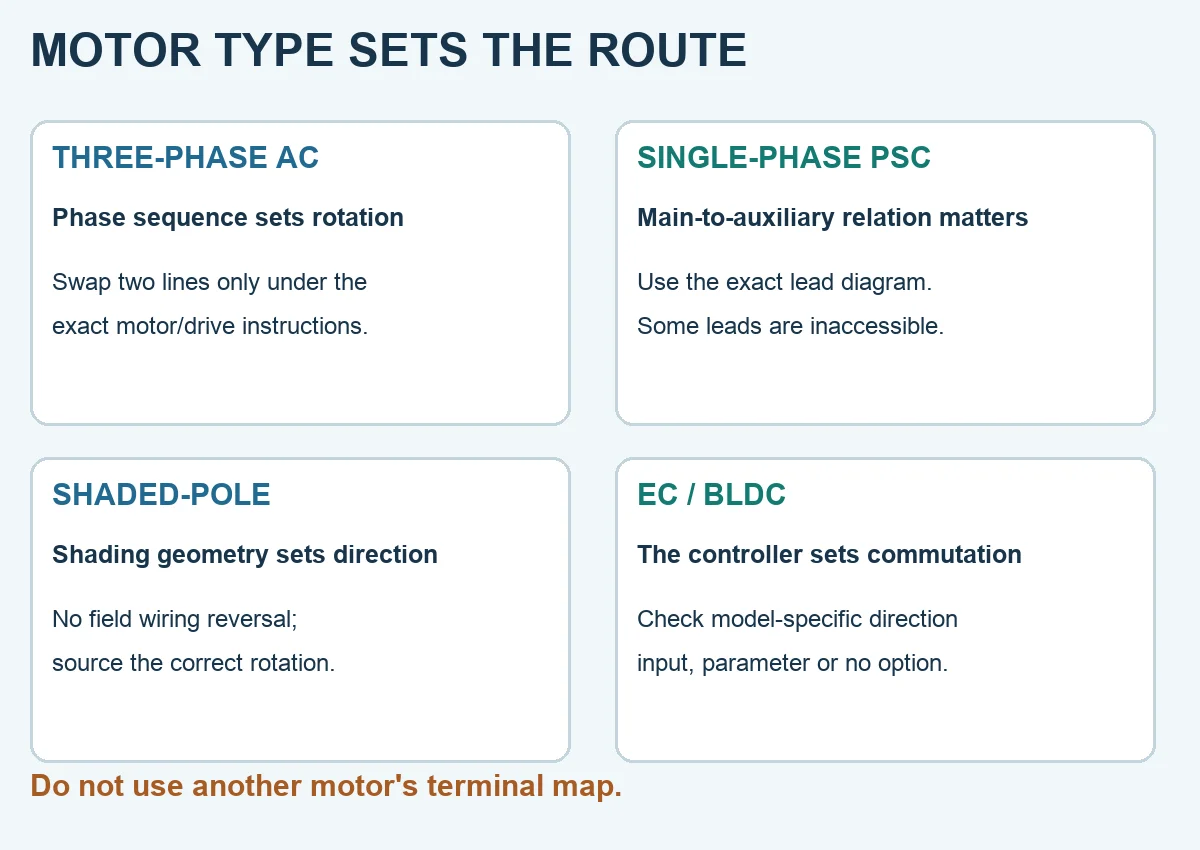
For a direct-on-line three-phase induction motor, interchanging any two supply phases reverses the rotating field. That principle is supported by motor-maker installation guidance. The actual work still belongs to a qualified person using the exact motor and panel drawing, with the supply locked out and the correct protection restored. Mark the original connections before changing them and verify direction during a controlled restart.
A motor supplied by a variable-frequency drive adds another control layer. Depending on the drive and machine, direction may be assigned in parameters or by the approved output connection scheme. Follow the drive maker’s procedure and the complete equipment design; a generic “swap two wires” instruction does not cover every drive, interlock or controlled process. Confirm whether the fan housing and wheel permit the intended direction.
Single-phase PSC: the auxiliary winding relationship matters
A PSC motor uses a run capacitor and a phase-shifted auxiliary winding. Reversal, where designed for it, changes the auxiliary winding’s connection relative to the main winding. The exact terminal names and capacitor connections vary. Use only the motor maker’s diagram for the complete model and suffix, and discharge and handle the capacitor according to the applicable service procedure. If the necessary leads are not brought out, treat that motor as non-reversible in the field.
The LONGWELL AC capacitor motor family shows the product category, but does not establish that every listed motor exposes reversible leads. Ask for the controlled drawing before ordering a replacement with a specified rotation.
Shaded-pole: specify the required rotation at purchase
In a conventional shaded-pole motor, the position of the shading ring establishes the starting direction. Swapping the supply conductors does not move that ring, so there is no ordinary field-wiring reversal. Select a motor built with the required rotation and verify the direction from the stated viewing end. The LONGWELL shaded-pole family is a way to identify candidates; its general catalogue text is not an exact-model direction approval.
EC and BLDC: verify the controller’s supported option
Electronic commutation makes direction a controller and firmware question. Some designs expose a direction input or a configurable parameter; others are fixed. A speed-control signal does not automatically provide reversal. Do not invert supply polarity or move phase wires unless the exact fan/controller instructions explicitly permit it. Obtain the current wiring and parameter sheet, including the applicable software revision, then verify any direction setting and fault behavior on the assembled unit.
The fan wheel may itself be directional even when its motor can run either way. For a replacement, send the complete original and proposed fan identities, controller and drawing revisions, supply, control interface and rotation reference. A family match is a search starting point, not a proof of electrical compatibility or airflow performance.
Confirm rotation, then measure the installed duty
After the approved connection or setting change, make a controlled run with guards in place. Confirm rotation against the arrow from the specified viewing end, then check discharge direction. Keep hands and loose objects out of the inlet. A fan that turns does not necessarily develop the required flow or pressure through the real grille, coil, duct and housing. Compare measured airflow, static pressure, current and operating state against the specified fan curve and equipment acceptance procedure.
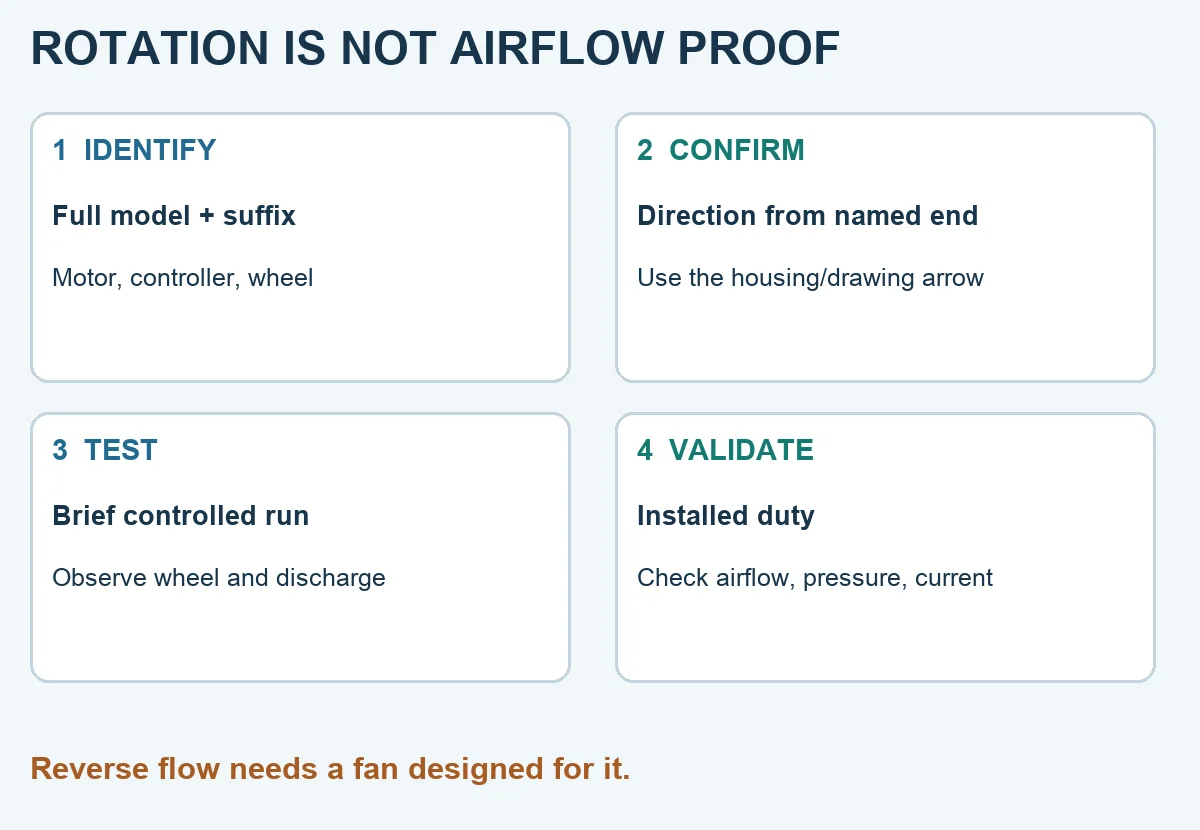
If the objective is to switch a system between supply and exhaust, motor reversal alone is not a design. The impeller, housing, controls and performance curve must be specified and validated for both directions. Otherwise use the correct wheel and assembly for the required duty. This distinction is especially important when diagnosing a replacement that spins in the wrong direction: correct the installation to its approved design instead of treating reverse operation as a second rated mode.
Watch the direction explanation
The video compares the motor routes and the final rotation check. Use it to identify which documents to request; follow the exact assembly instructions for electrical work.
Choose the right ac motor
Longwell manufactures 22 ac motors in-house. Send airflow, static pressure and voltage — an engineer replies with a matching model, performance curve and price within one working day.