Short answer: start with the airflow and pressure the installed system must deliver at a stated air condition and measurement boundary. Use airflow direction, available space and the airstream to build a shortlist. Then let the exact model curve decide.
“Axial means airflow; centrifugal means pressure” is a useful memory aid, but a poor purchase specification. The ranges overlap, and a catalogue maximum is not the airflow delivered through a coil, filter, grille or duct. A defensible decision ends at a verified duty point.
Start with one comparable duty point
Write down required airflow and pressure together. State whether pressure is static or total, the air density or design temperature and altitude, and the inlet and outlet boundaries. For a modulating system, add minimum, normal and maximum operating points.
Do not combine free-air airflow, shutoff pressure and motor nameplate power. They usually describe different conditions. Likewise, two quotations are not comparable when one uses fan static pressure and the other uses total pressure. Ask each supplier to return data at the same duty and on the same basis.
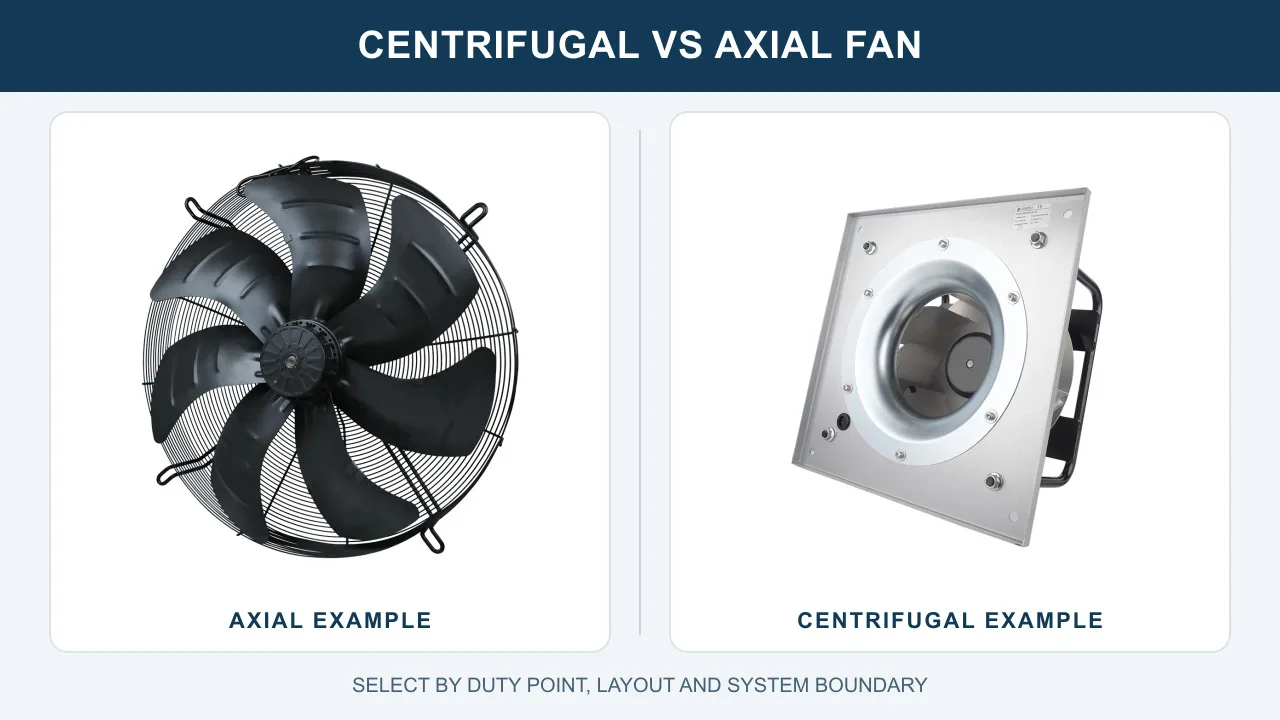
Use airflow direction as a shortlist clue
In an axial fan, air travels broadly parallel to the shaft. That straight-through arrangement can be a practical starting point for a wide face area and a direct air path. The LONGWELL industrial axial fan family is useful for seeing the available architectures, but the family page is not a substitute for an exact model curve.
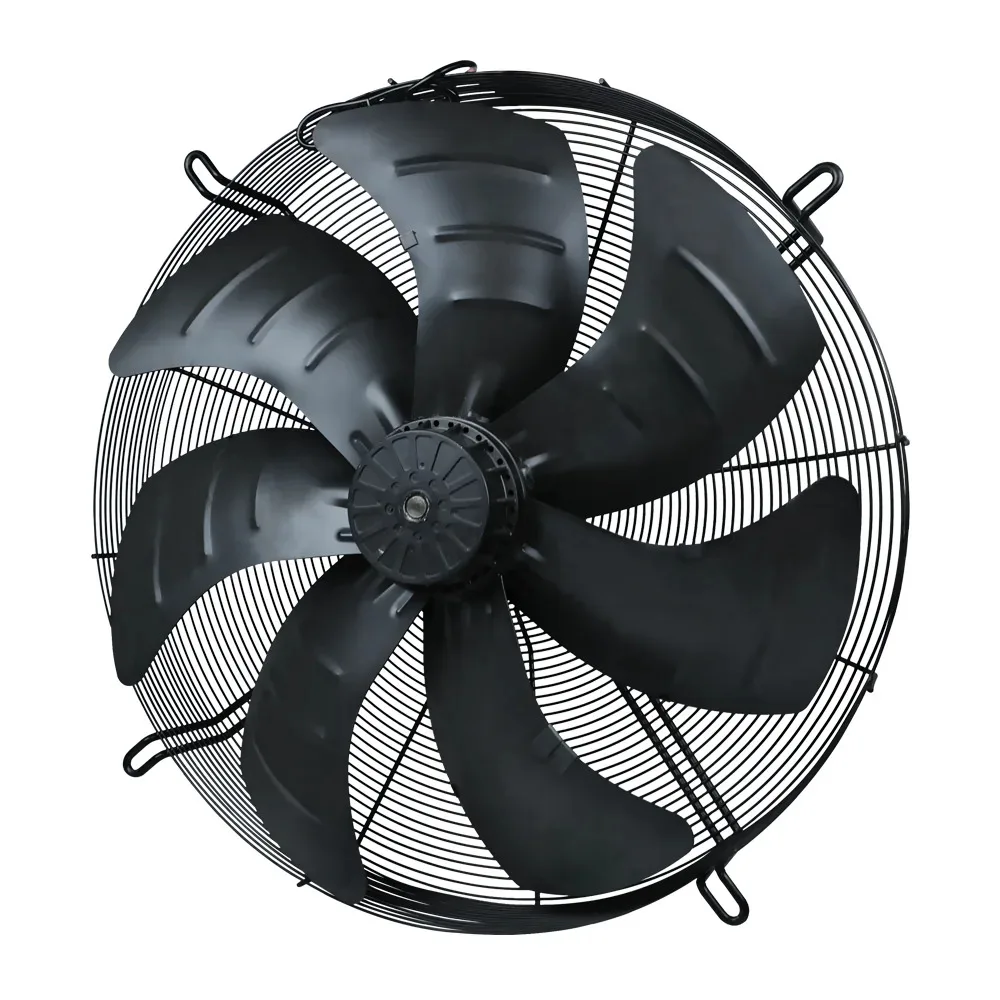
The photograph above is a real LONGWELL asset labelled LWAA6D800S-7MEB-05. It shows visible axial construction only. It does not prove airflow, pressure, sound, efficiency, compatibility or suitability for a particular condenser.
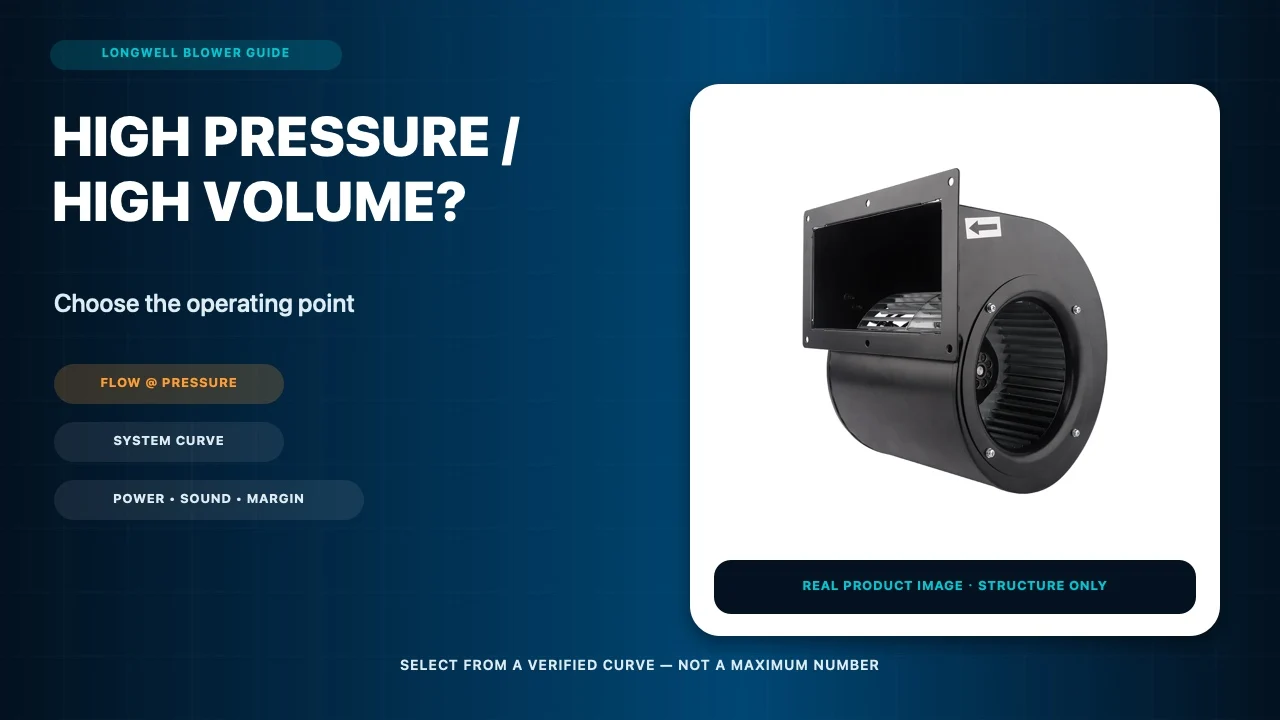
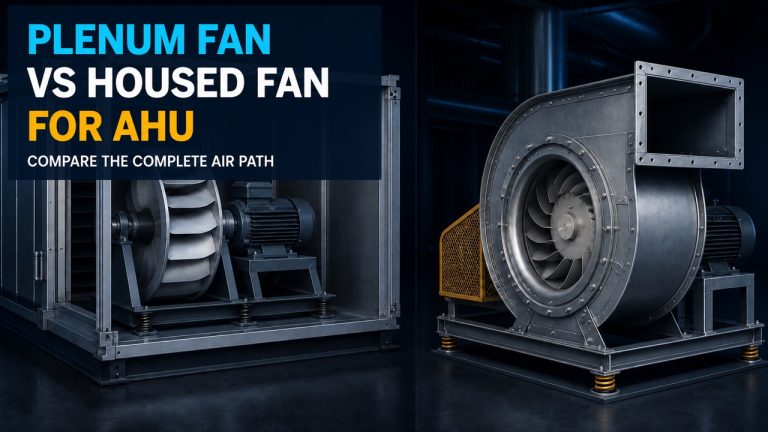
A centrifugal wheel accepts air at the wheel eye and moves it outward. Housed blowers can provide a defined discharge direction; plug fans can discharge into a plenum. Those features may put a centrifugal arrangement on the shortlist when the air path turns. They do not establish performance.
Count the resistance before opening a catalogue
Build the pressure requirement from the actual system: coil and filter losses, guards, louvers, silencers, heat exchangers, duct friction, fittings, dampers and the terminal or discharge condition. Keep clean and loaded-filter cases separate. Use a project-specific allowance only when the design basis supports it; a universal percentage is not a safe replacement for missing data.
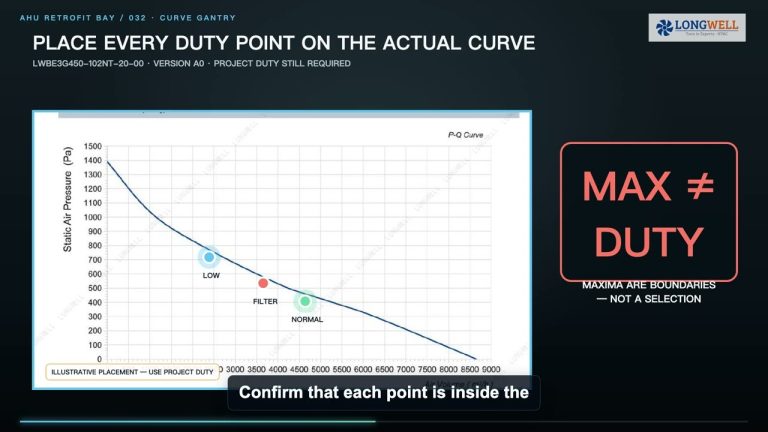
The fan operates where its curve meets the system curve. That point may move as filters load, dampers change position or speed changes. Our guide to reading fan performance curves explains the graph; the procurement step is to obtain the current curve for the exact suffix and confirm the manufacturer’s recommended operating range.
Check the package, inlet and discharge
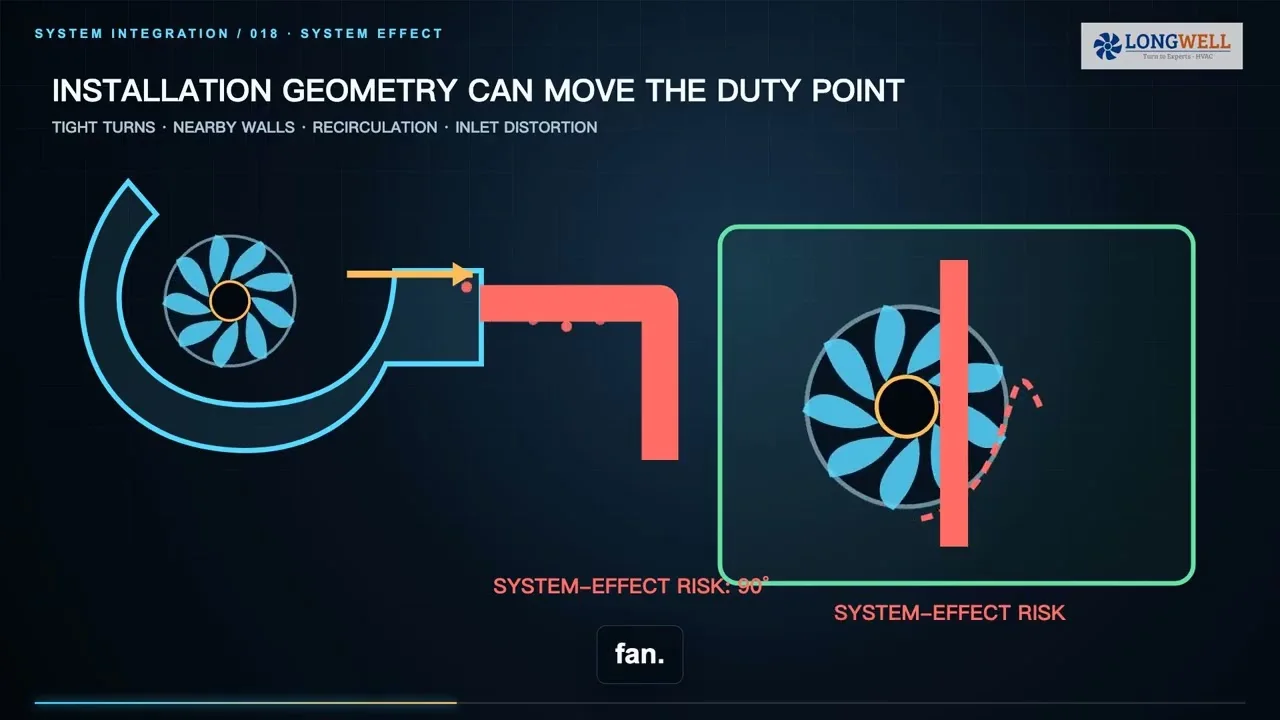
Record the opening or plenum size, fan depth, removal path, guard and transition geometry, cable route, drainage needs and inlet and discharge clearances. A nearby elbow, wall or grille can change the installed result even when the catalogue selection was sound.
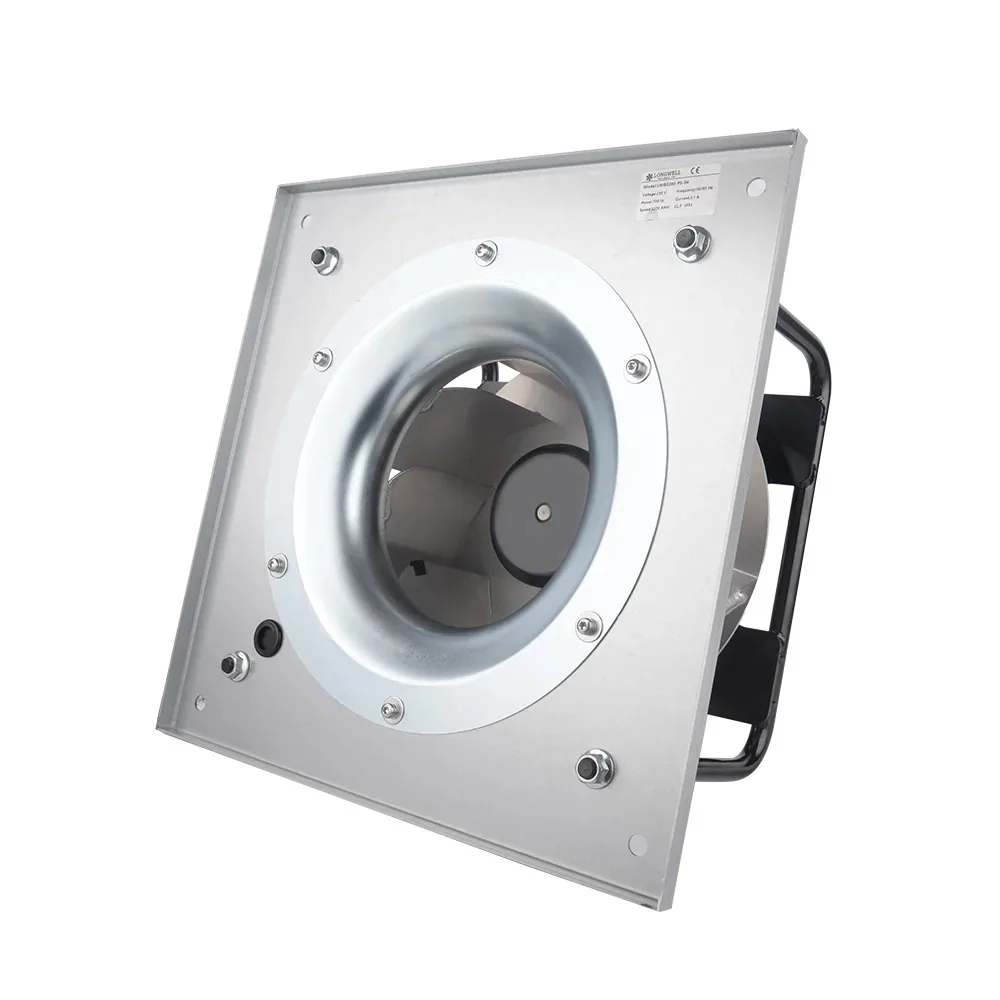
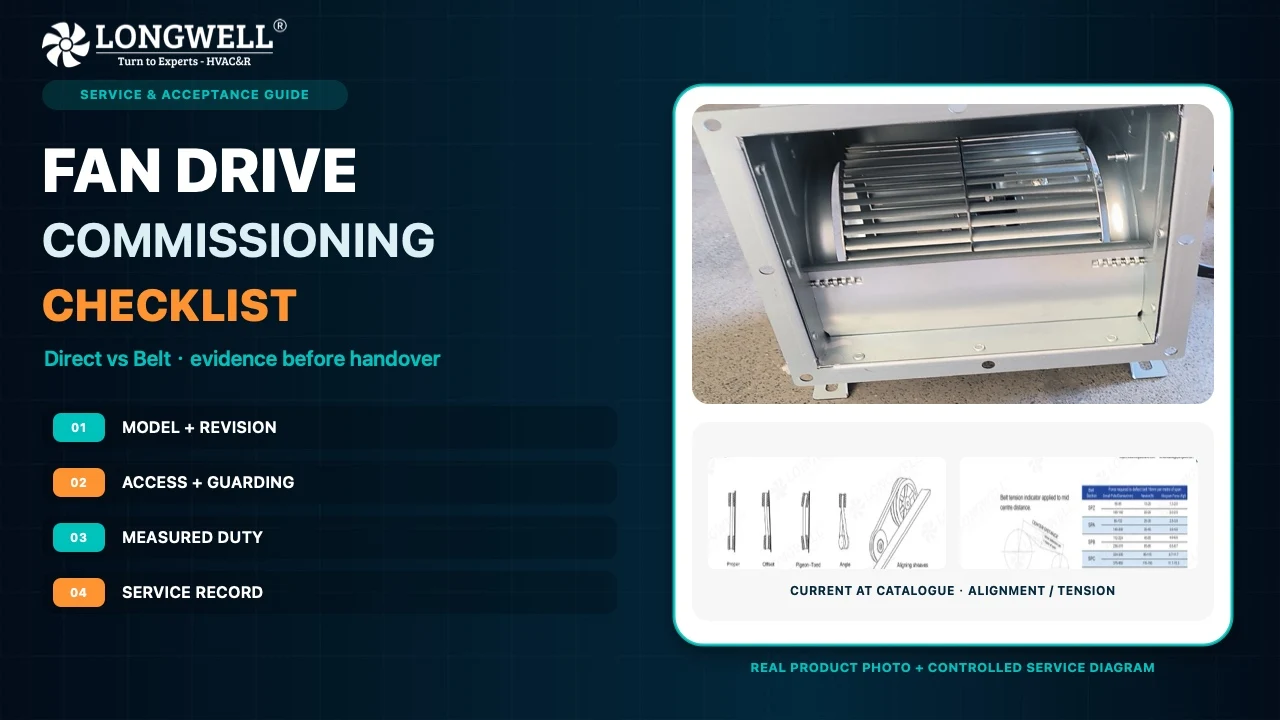
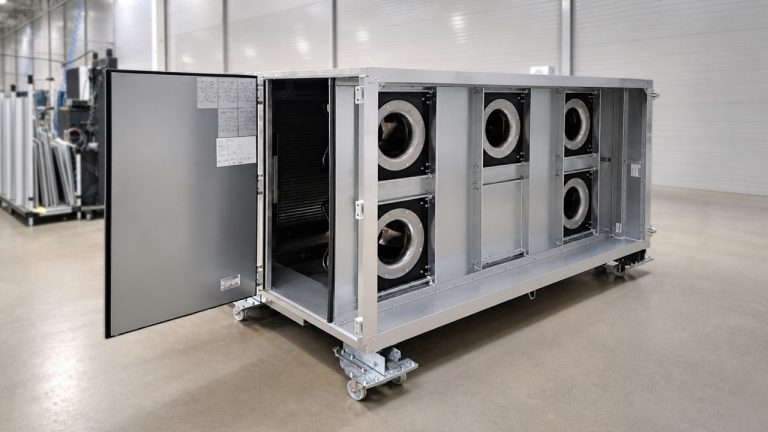
This second photograph is a real LONGWELL asset labelled LWBE3G250-102PS-22. It documents the visible plug-fan and mounting-plate arrangement only. The controlled A0 material record confirms the model identity; the image and CAD inventory do not establish a project duty, certification or interchangeability.
Use the LONGWELL centrifugal fan family as an architecture browse route after the layout is known. Final selection still requires the exact wheel, motor, controller, inlet arrangement and revision proposed in the quotation.
Treat the airstream and access as design inputs
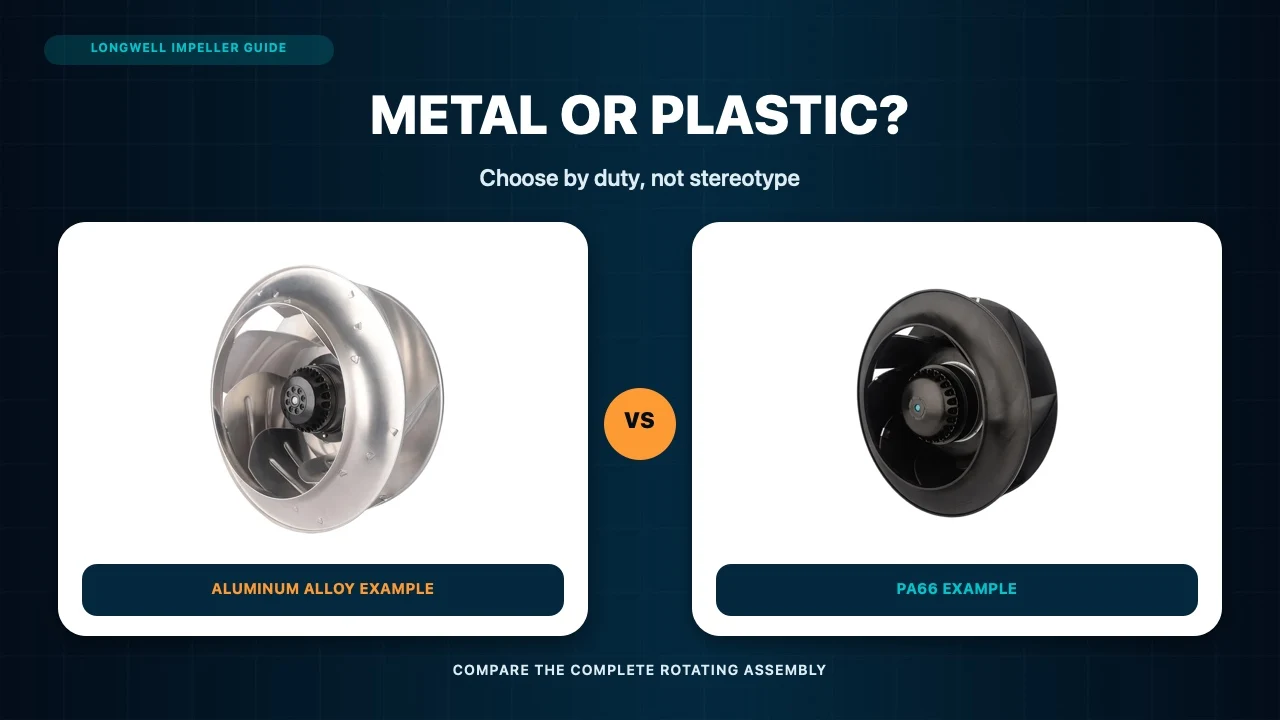
Tell the supplier what the air carries and at what temperature: clean air, moisture, condensate, grease, lint, dust or corrosive vapour. Material, coating, motor protection, sealing, drainage and allowable temperature must match that duty. A generic product photograph cannot answer any of those questions.
Decide how the fan will be cleaned and removed. Include access panels, lifting space, guard removal and the parts that stay connected during service. A compact layout becomes expensive if the wheel or motor cannot leave the cabinet.
Compare power, sound and controls on the same basis
Compare absorbed electrical input, efficiency and sound at the required operating point and test boundary. Motor wattage alone is not wire-to-air performance, and one headline sound value cannot describe installation effects or tonal content. Ask whether the quoted value is sound power or sound pressure and what distance, room or duct condition applies.
Motor technology is separate from airflow geometry. Define supply voltage and frequency, control signal, speed range, fault output, communications and power-interruption behaviour. Confirm that the proposed motor and controller remain suitable across every expected point.
Work through two familiar HVAC layouts
For an air-cooled condenser or dry cooler, a wide coil and direct airflow path often make axial geometry a sensible first candidate. The selection is not finished until coil and grille losses, wind, recirculation risk, face area, fan spacing and the operating envelope are included. A free-air value cannot predict airflow through the assembled unit.
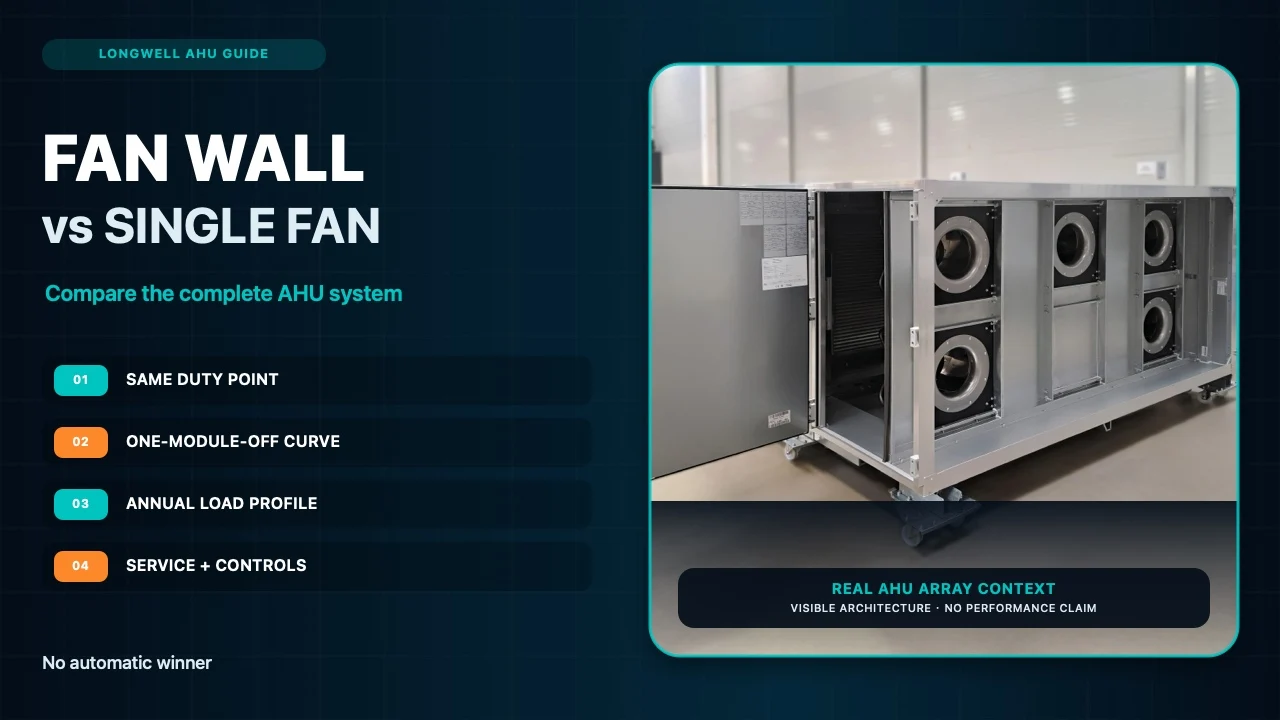
For an air-handling unit, filters, coils, silencers and downstream ductwork often make a centrifugal or plug-fan arrangement worth evaluating first. The actual plenum, inlet clearance and discharge condition still matter. The curve must cover clean and loaded-filter duties, and the electrical and sound data must be checked at those same points.
These are shortlist examples, not rules. A verified axial design may beat a poor centrifugal layout, and the reverse is equally possible. Compare exact candidates at the same system boundary.
Send an RFQ that can be verified
- Application, required airflow and static or total pressure.
- Design temperature, altitude or air density, plus the expected operating range.
- Pressure-loss breakdown and an arrangement drawing with inlet and outlet clearances.
- Airstream contents, material, protection, temperature and cleaning requirements.
- Supply voltage, frequency, control signal, communications and fault behaviour.
- Exact model, full suffix, document revision and dimensional drawing.
- Performance curve, electrical input, efficiency and sound data on the declared boundary.
- Test or rating method, tolerances, recommended operating range and claimed certification scope.
That package gives engineering, purchasing and the supplier one version of the problem. An undefined pressure basis, missing suffix or curve for another revision should pause the comparison. Calculate the duty, shortlist the geometry, then verify the exact fan.
Choose the right axial fan
Longwell manufactures 1,086 axial fans in-house. Send airflow, static pressure and voltage — an engineer replies with a matching model, performance curve and price within one working day.