A poultry or livestock house can have a full bank of running fans and still leave animals in a hot, humid, or poorly ventilated zone. Fan count alone does not reveal whether fresh air reaches the occupied area, whether moisture and contaminants are removed, or whether airflow remains uniform around equipment and partitions.
A reliable design connects inlets, the house pressure field, exhaust fans, cooling pads, controls, alarms, and backup power. It also distinguishes the goals of minimum ventilation, transition operation, and tunnel ventilation. This guide gives livestock producers, poultry-house designers, and agricultural engineers a practical framework for selecting fans at real duty and verifying the complete air path.
Separate Minimum and Tunnel Ventilation
Minimum ventilation is largely an inlet-jet and mixing problem. The inlet opening and house static pressure must create a ceiling jet with enough throw to mix incoming air before it descends. If cold air drops directly onto animals or litter, the building may reach a planned air-change rate while still producing wet litter, local chilling, or poor air quality at animal level.
Tunnel ventilation is a different operating mode. Air enters through a tunnel inlet or cooling-pad area, travels along the occupied length, and exits through the exhaust bank. The design must control this path, limit bypass leakage, and check velocity from end to end. A satisfactory average does not eliminate a slow pocket behind equipment, around a partition, or near a weak section of the fan bank.
Define Conditions Where the Animals Live
Air exchange and animal-level air speed solve related but distinct problems. Moisture, ammonia, carbon dioxide, dust, litter condition, animal heat, and spatial uniformity all matter. Measure pressure, temperature, humidity, air quality, and velocity at representative animal height and across the full house, not only beside a controller or in the center aisle.
The required ventilation rate and air-speed targets depend on species, age or mass, stocking density, building geometry, climate, equipment, production strategy, and applicable welfare requirements. No single numerical target is suitable for every project. Define the animal load and the expected seasonal states first, then specify acceptance criteria for minimum, transition, tunnel, and cooling-pad operation.
Select Fans at the House Operating Point
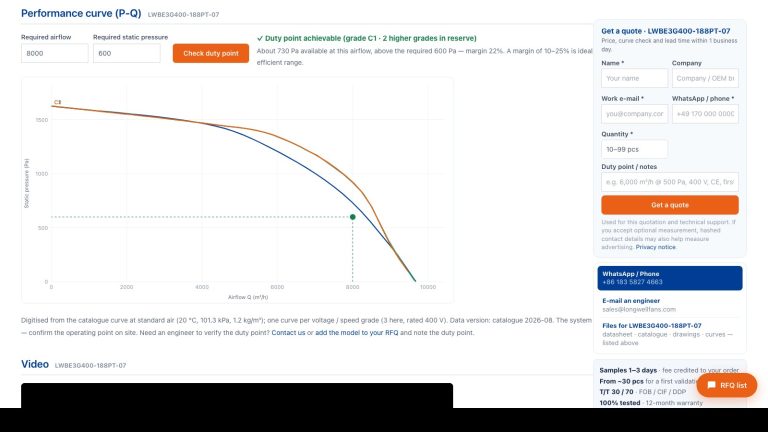
Fan capacity changes with static pressure. Inlets, shutters, guards, cones, evaporative pads, leakage paths, and accumulated dirt all contribute to the house resistance. The installed operating point is where the fan curve intersects the house system curve. Free-air airflow is not the airflow delivered in the building.
Compare candidate fans at the expected operating pressure using tested airflow, electrical input, efficiency, airflow ratio, speed range, drive arrangement, materials, shutter and cone configuration, corrosion resistance, sound, and service access. A practical review of how airflow, static pressure, and efficiency relate at a fan operating point can help structure that comparison, but project acceptance still depends on the selected fan and complete house. Review clean and realistically loaded conditions. Wet or blocked pads and dirty shutters increase pressure loss; as pressure rises, airflow and house velocity may fall. The design needs a validated hot-weather margin rather than an assumption based on catalog maximum airflow.
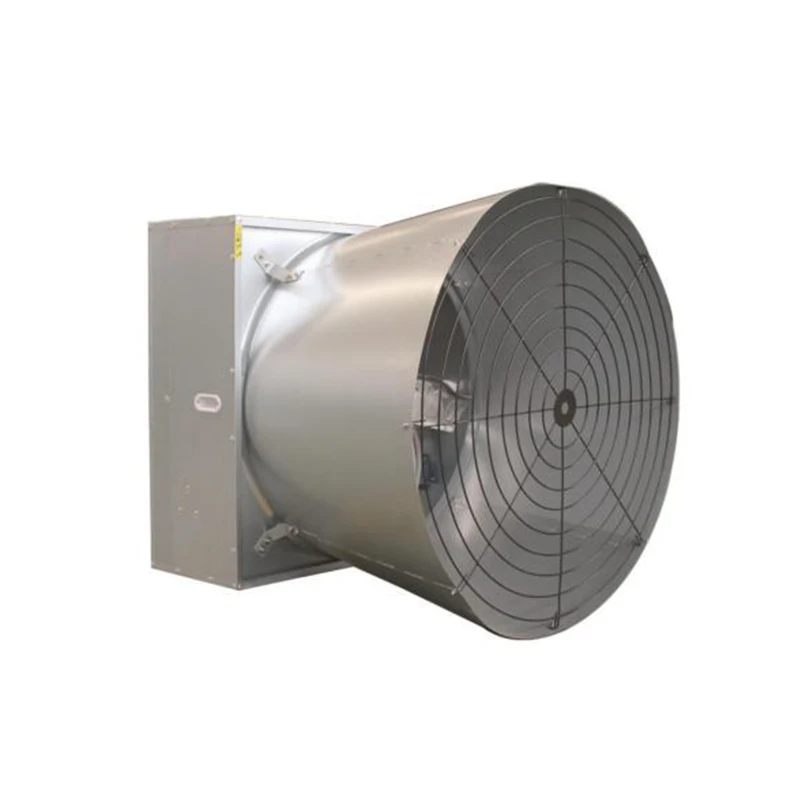
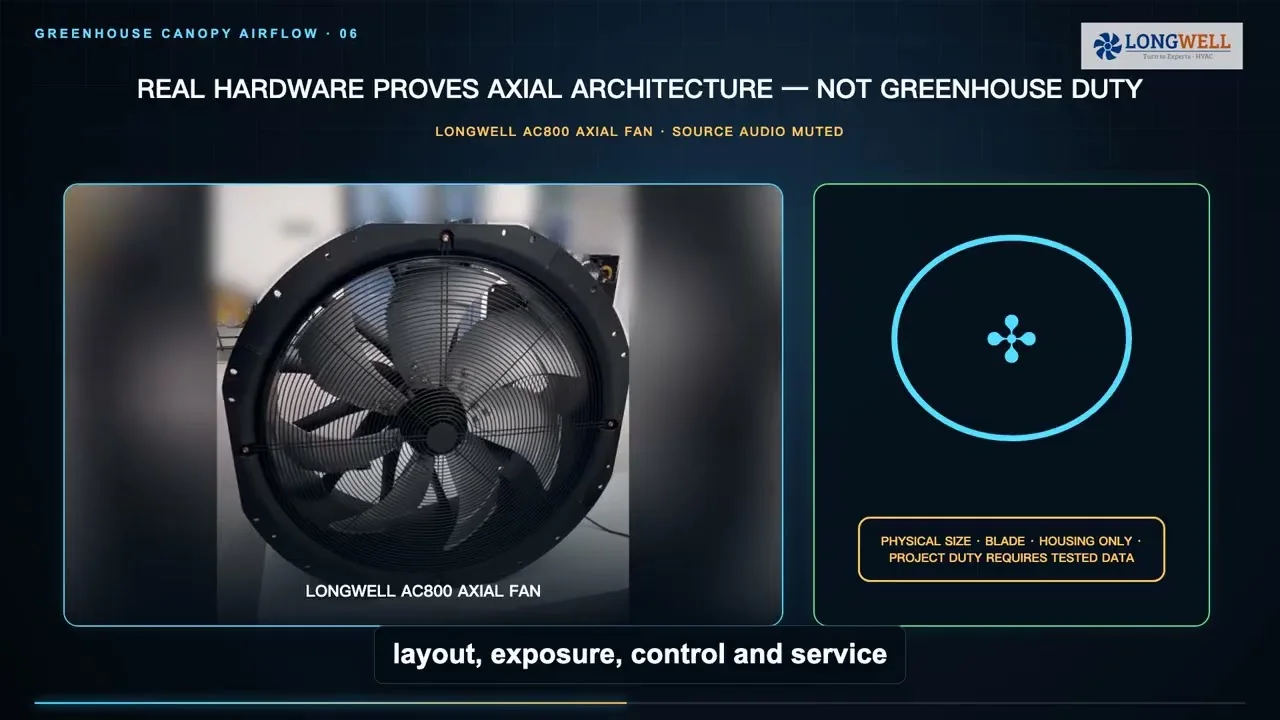
The available LONGWELL poultry-ventilation catalog, shutter-cone fan image, and poultry exhaust fan family page show product-family context and visible architecture only. They do not prove installed airflow, operating pressure, efficiency, corrosion life, animal-welfare results, or suitability of an exact model. One retained catalog derivative depicts a hanging exhaust fan despite its legacy filename; no shutter-cone conclusion should be drawn from that image. Final selection still requires the actual house-duty data.
Coordinate Staging, Alarms, and Backup Response
Ventilation should stage from animal load, outdoor conditions, house temperature, humidity, air quality, inlet position, and cooling-pad state. Each stage must preserve a useful pressure field and inlet pattern rather than merely switch on another fan. Minimum, transition, tunnel, and pad-cooling modes place different demands on components that share the same building.
Loss of grid power or a fan bank can become an urgent thermal and animal-welfare event. Define alarm timing, backup-power start, safe inlet positions, fan-status monitoring, and recovery logic as part of the ventilation design. A generator nameplate does not prove that the complete sequence will start quickly enough or restore the required air map. Test the response under a credible animal and weather load, including recovery after power returns.
Controls should also detect degradation before it becomes severe. Useful checks may include house static pressure, fan current, shutter position, pad pressure drop, temperature spread, and representative air speed. Alarm limits and automated responses must be derived from the validated house design and production plan, not copied from an unrelated facility.
Commission the Full Occupied-Zone Air Map
Commissioning should record operating static pressure, inlet-jet throw, animal-level velocity, end-to-end tunnel speed, temperature, humidity, and required air-quality indicators. Confirm fan rotation, inlet and shutter travel, pad condition, control transitions, and leakage-sensitive areas. Repeat the checks with realistic shutters and pads rather than relying only on a clean, empty house.
Include credible degraded conditions such as a failed fan, a weak fan-bank section, restricted pad, dirty shutter, or failed inlet. Verify both the environmental result and the alarm or backup response. Maintenance should preserve the tested condition through pad and shutter cleaning, corrosion inspection, drive service where applicable, sensor checks, and periodic reassessment as the animal load or house layout changes.
A reviewable house-duty package should contain geometry, animal type and load, climate, ventilation modes, target pressure and speed, inlet and pad data, installed resistance, electrical supply, controls, backup response, and acceptance tests. That evidence allows the fan bank and air-distribution system to be evaluated together without turning general guidance or product imagery into an unsupported performance claim.
Choose the right exhaust fan
Longwell manufactures 241 exhaust fans in-house. Send airflow, static pressure and voltage — an engineer replies with a matching model, performance curve and price within one working day.