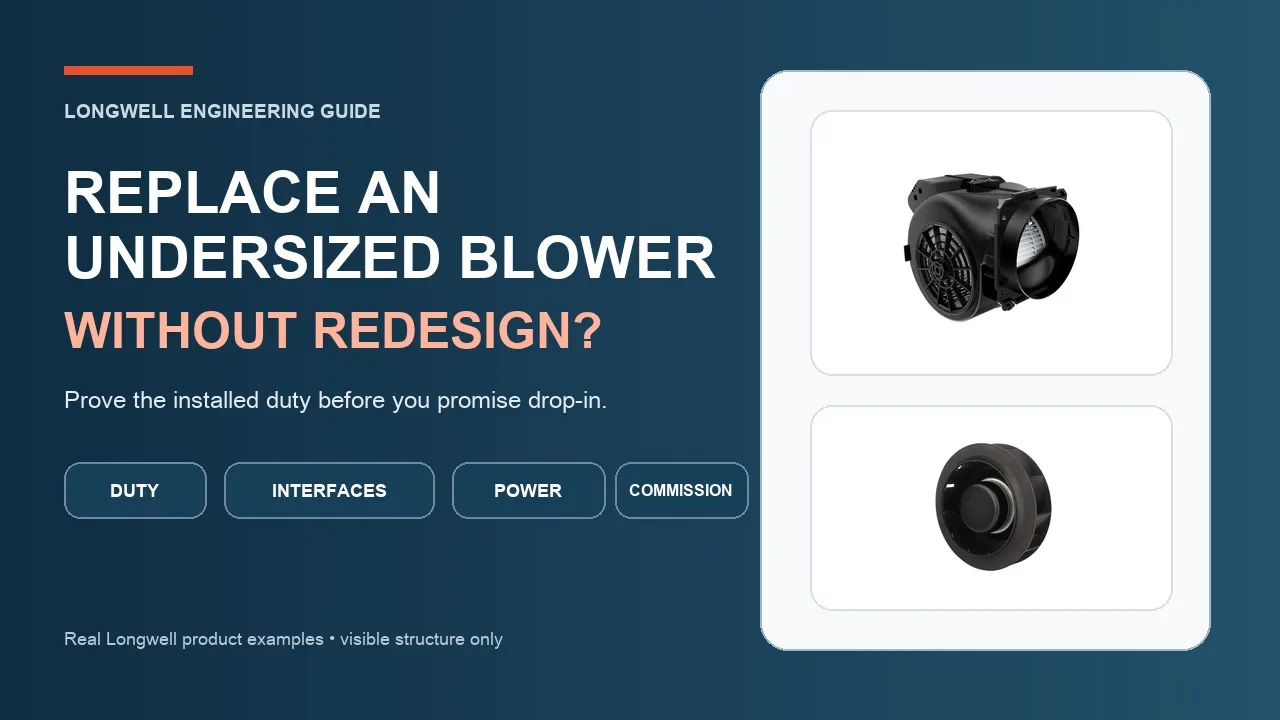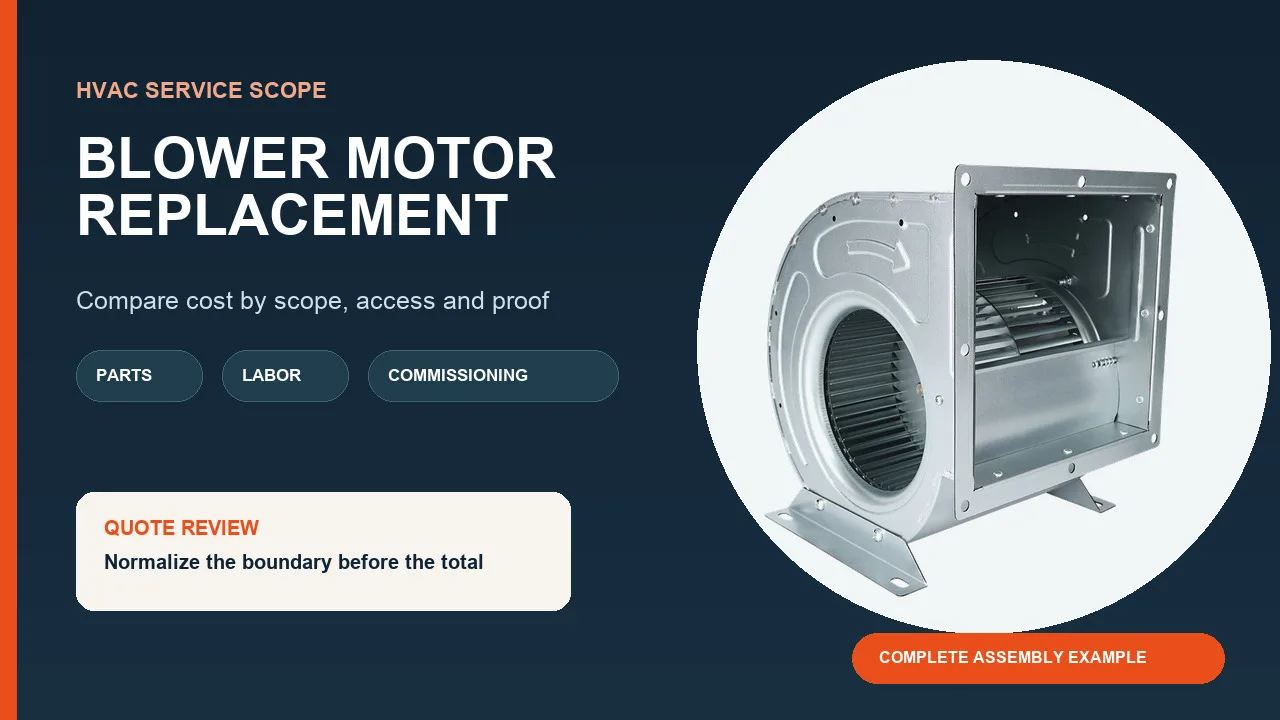
You can replace an undersized blower without redesigning the whole machine only when the proposed fan passes four separate tests: it reaches the measured airflow-and-pressure duty, fits the mechanical envelope, matches the power and controls, and passes commissioning in the installed system. Treat “drop-in” as a conclusion, not a product label.
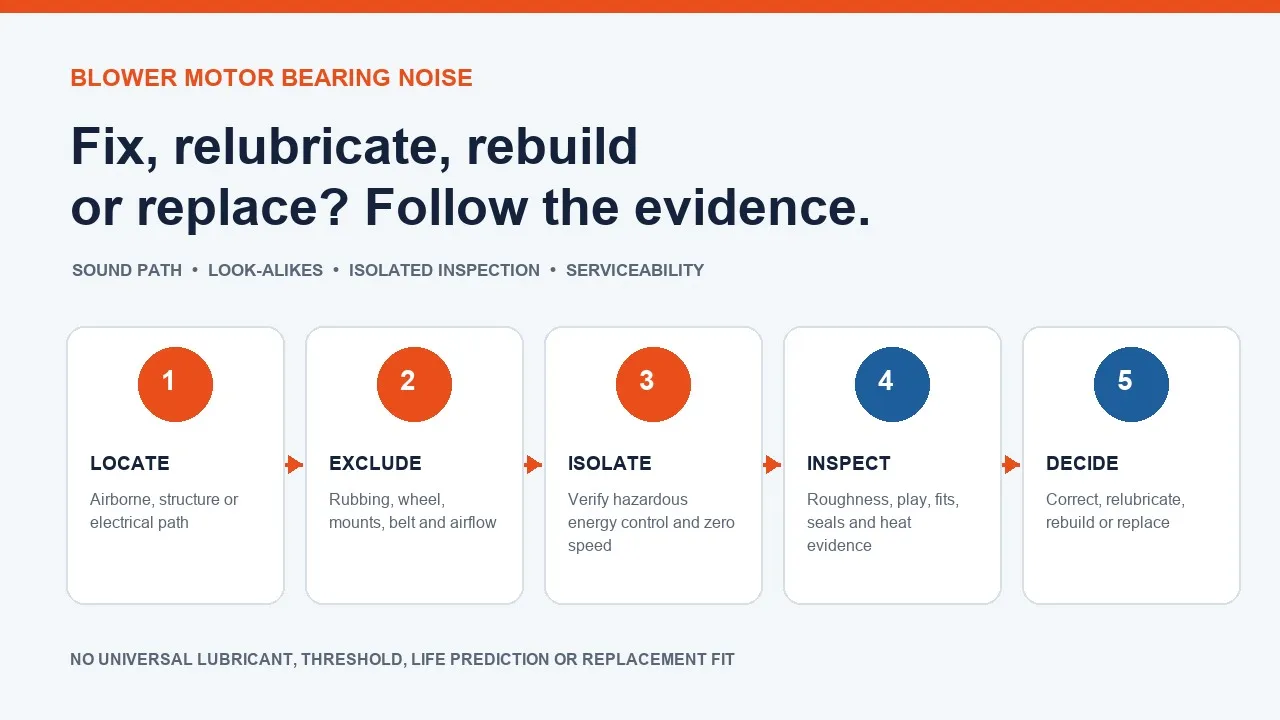
Start with the reason airflow is low. A larger blower will not cure a loaded filter, fouled coil, closed damper, collapsed flexible duct, wrong rotation, belt slip, inlet blockage, or leakage. Fix what you find, repeat the measurements, and then decide whether the fan is genuinely short of duty.
Record the existing operating point before shopping
Measure volume flow and fan pressure at a stated test boundary. Record speed, supply voltage, running current, control signal, air temperature and, where density matters, the relevant site condition. Keep the required duty beside the measured duty. “More airflow” is not a specification; a reviewable request is airflow at pressure under named conditions.
Also note the system state during the test: filter condition, damper positions, coil cleanliness, production load, and any temporary openings. Without that context, two readings taken on different days may look like a fan change when the resistance changed instead.
If the current fan delivers what its curve predicts at the measured pressure, investigate the system resistance before blaming the fan. If it falls below the curve, look for rotation, speed, drive, inlet, installation, or fan-condition problems. Longwell’s fan curve guide explains how airflow, pressure, and power should be read at one operating point.
Compare the fan curve with the system curve
Plot the measured point, the required point, and the candidate fan curve at the proposed speed and air density. Then add the system curve. The installed operating point is where the fan and system curves meet; a free-air maximum or a motor wattage cannot predict that intersection.
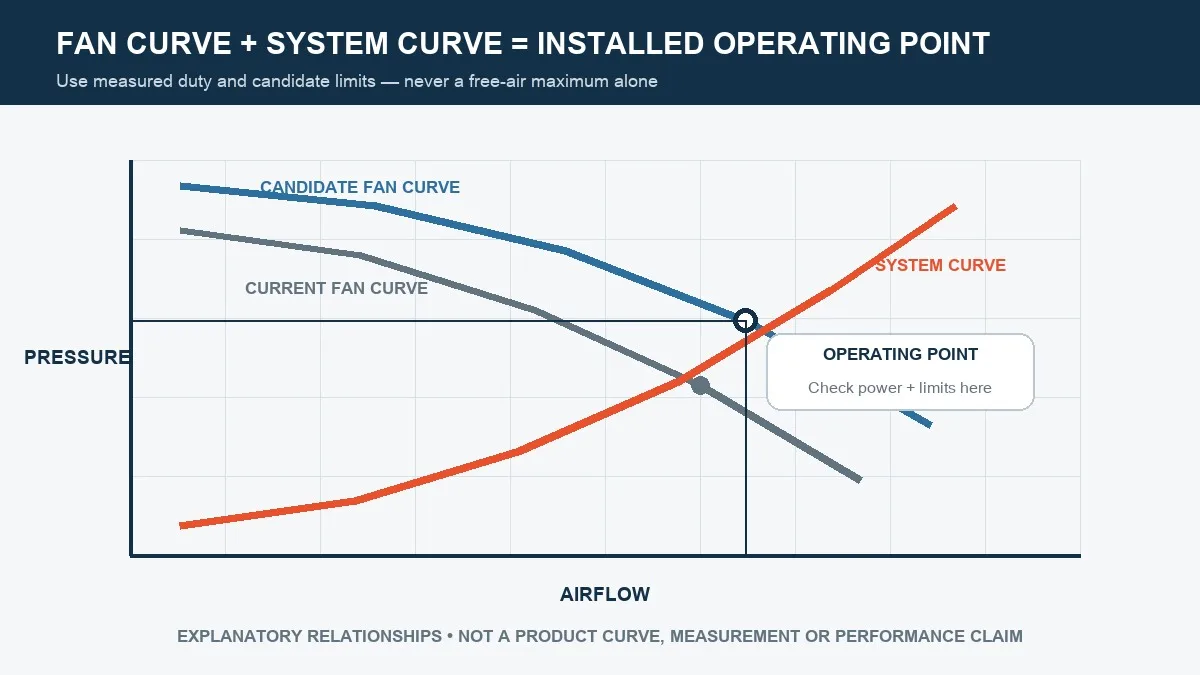
Affinity laws are useful for a first check only when the geometry and similarity conditions remain valid. At unchanged diameter and density, a 10% speed increase predicts about 10% more flow, 21% more pressure, and 33% more input power. That power rise is why “turn it up” needs a curve, motor and electronics review—not just spare speed on a controller.
Read every candidate limit at the intended point: maximum speed, input power or current, temperature, stable operating region, and any drive or electronics restriction. Check the downstream process too. Extra velocity or pressure can change sound, vibration, leakage, damper authority, filter loading, and the load on connected components.
Build a replacement envelope, not a diameter match
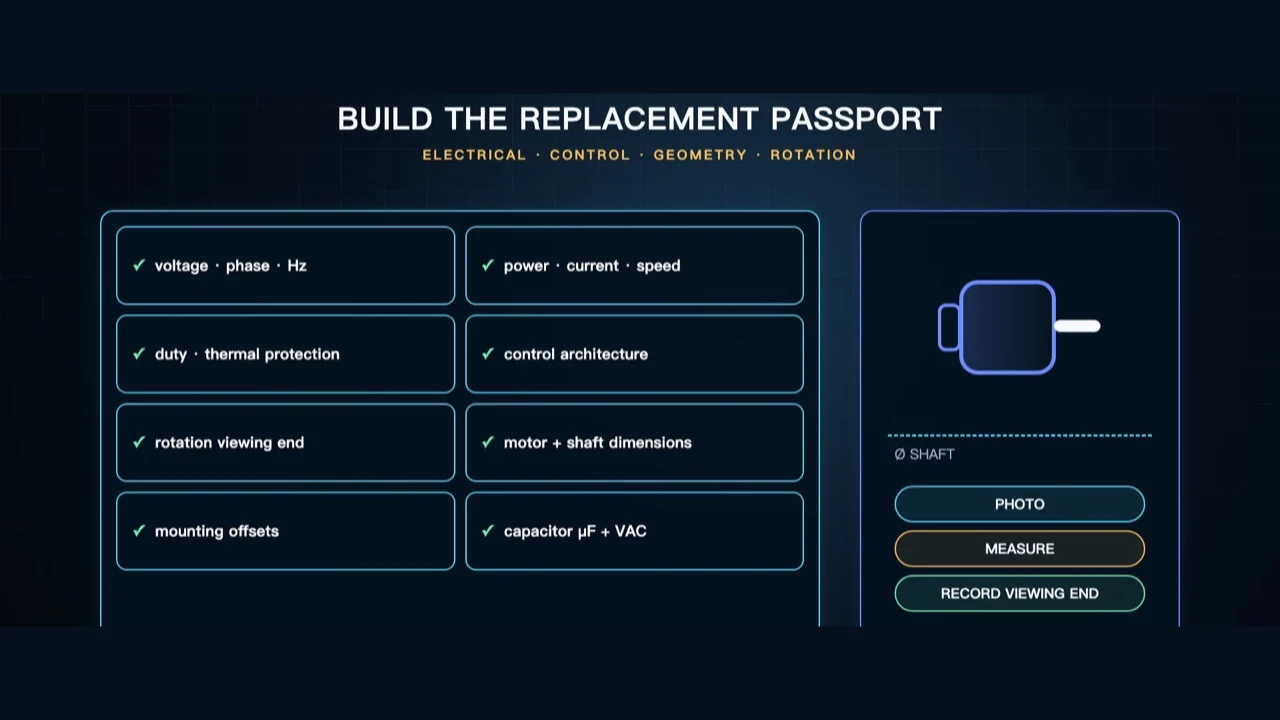
Capture the old assembly before removal. Useful photographs include a reliable scale, but a dimensioned interface sheet is better. Record:
- overall width, height, depth, weight, and service clearance;
- inlet and outlet size, shape, flange position, and airflow direction;
- mounting-hole pattern, support points, orientation, and rotation;
- guard, connector, cable, sensor, and drain clearances; and
- the route available to remove the old unit and install the new one.
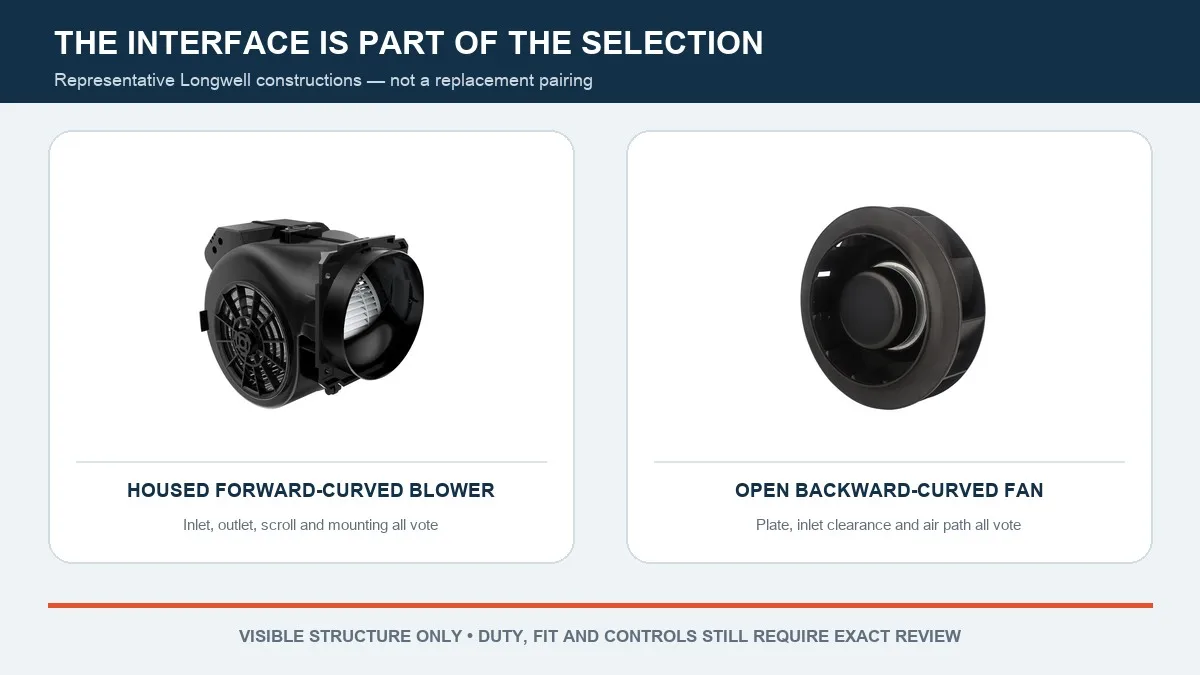
Two Longwell products below illustrate why the family name or nominal diameter is not enough. The housed forward-curved blower and the open backward-curved fan have visibly different air paths and interfaces. They are examples of construction only, not a recommended replacement pair.
Use the Longwell centrifugal fan family as an architecture-discovery page after the duty and interface envelope are fixed. A family page does not prove that any listed fan is compatible with your machine.
Make the electrical and control passport explicit
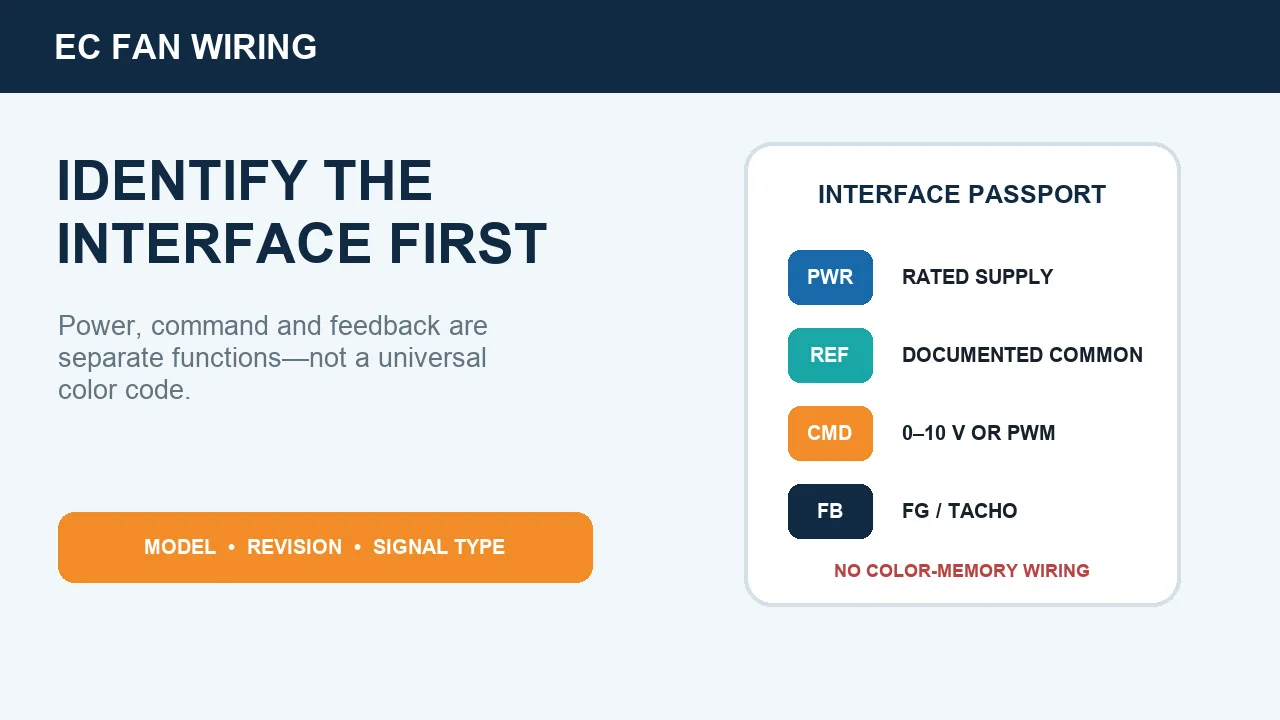
A fan that bolts in but cannot be powered, protected, or commanded correctly is not drop-in. Verify voltage, phase, frequency, running and starting current, grounding, protection, connector and wire functions, starter or drive, control input, feedback, alarms, and loss-of-signal behaviour. Match the candidate documentation to the actual controller and site sequence.
Do not assume that equal voltage means equal control compatibility. An AC motor, EC motor, and motor operated through a VFD can present very different command, feedback, fault, and protection requirements. Any adapter, rewiring, parameter change, or control-logic change belongs in the approved modification record.
Decide what “without redesign” really means
Use three outcomes. Unmodified drop-in means every mechanical, electrical, control, performance, and service boundary passes without an interface change. Approved modification means the change is defined—such as a documented adapter, support, connector, or control update—and its downtime and risk are accepted. Redesign required means the duty cannot be reached inside the available limits or the surrounding system cannot accept the new operating point.
This wording prevents a small adapter from being hidden inside a “drop-in” promise, and it stops a force-fit from moving risk into the housing, wiring, controls, or ductwork.
Commission against a written go/no-go sheet
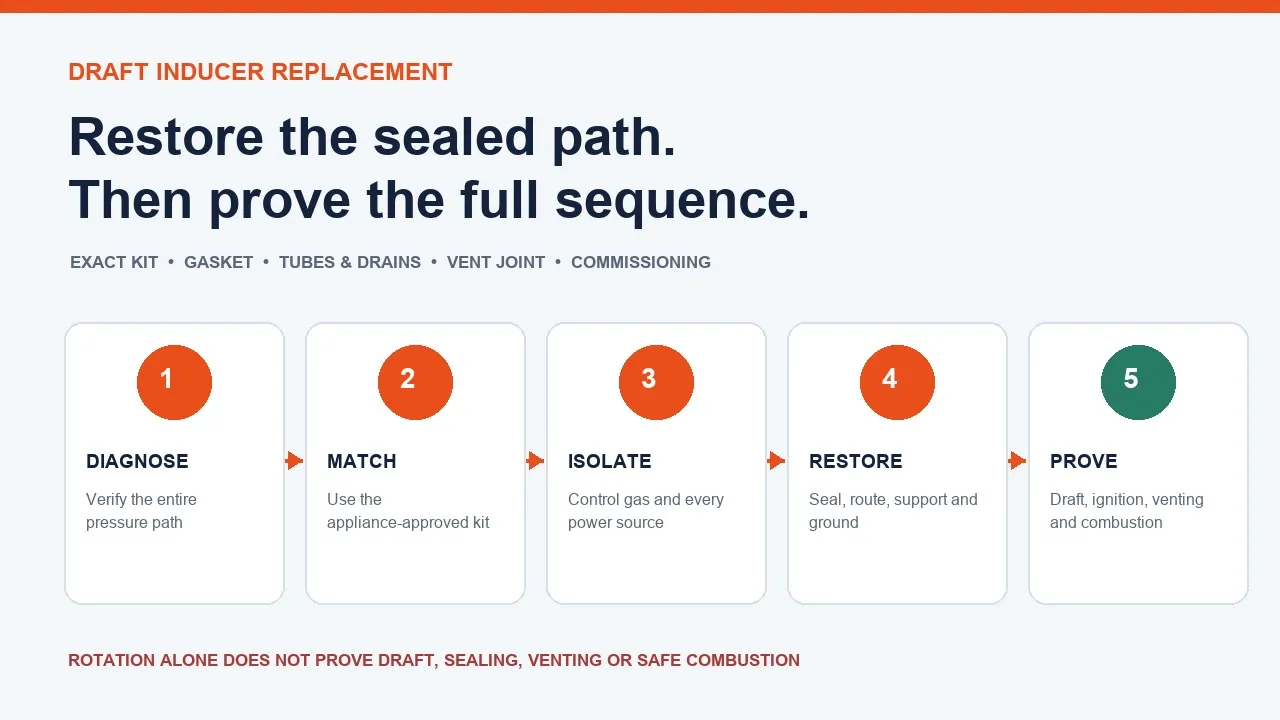
Servicing rotating equipment requires the site’s hazardous-energy procedure and authorised personnel. After installation and before normal operation, confirm guards, fasteners, clearances, rotation, and control direction. Then measure airflow, pressure, speed, current, vibration, sound, leakage, temperature where relevant, control response, alarms, and the actual process result.
Record the test boundary and operating conditions. Compare each value with the approved duty and the exact candidate limits. A mechanical fit does not prove airflow; a catalogue curve does not prove that the installation introduced no system effect. If one boundary fails, document the required modification or redesign instead of forcing acceptance.
Send suppliers a comparison-ready package
For a useful replacement review, send the measured and required duty points, current fan nameplate and curve, fan speed, dimensions and mounting pattern, inlet and outlet details, photographs, voltage and controls, downstream constraints, and a commissioning acceptance sheet. Ask the supplier to return the candidate curve, power data, dimensioned drawing, wiring and control information, operating limits, and a list of every required interface change.
That package turns “we need a stronger blower” into a decision that purchasing, engineering, maintenance, and commissioning can all review before the order is placed.
Choose the right blower
Longwell manufactures 247 blowers in-house. Send airflow, static pressure and voltage — an engineer replies with a matching model, performance curve and price within one working day.