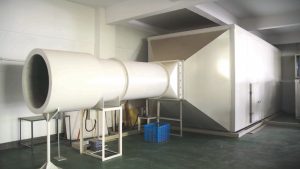
“Ducted” and “ductless” describe how equipment is arranged. They do not, by themselves, tell you whether a room receives outdoor air, exhausts a source, changes temperature, or filters recirculated air. A room air conditioner can cool without supplying outdoor air. A wall exhaust fan can discharge outdoors without a long duct. A ducted unit can circulate indoor air without meeting an outdoor-air requirement. The practical choice begins with the service you need, followed by a traceable air path.
Decision in one line: list the required air services, draw where each stream enters and leaves the building, then verify the delivered flow and equipment at the installed resistance. Compare a central duct route with room-by-room devices only after both proposals perform the same required functions.
Separate four services before comparing equipment
Outdoor-air supply brings air from a known exterior intake into occupied space. Source exhaust carries air from a bathroom, kitchen, process enclosure, or other source to an exterior discharge. Heating and cooling change air temperature; a cooling coil may also remove moisture when its controls and drain are suitable. Recirculating filtration passes indoor air through a filter and sends it back indoors. These services can be combined in one system or provided by separate devices. The product label alone does not prove which service is present.
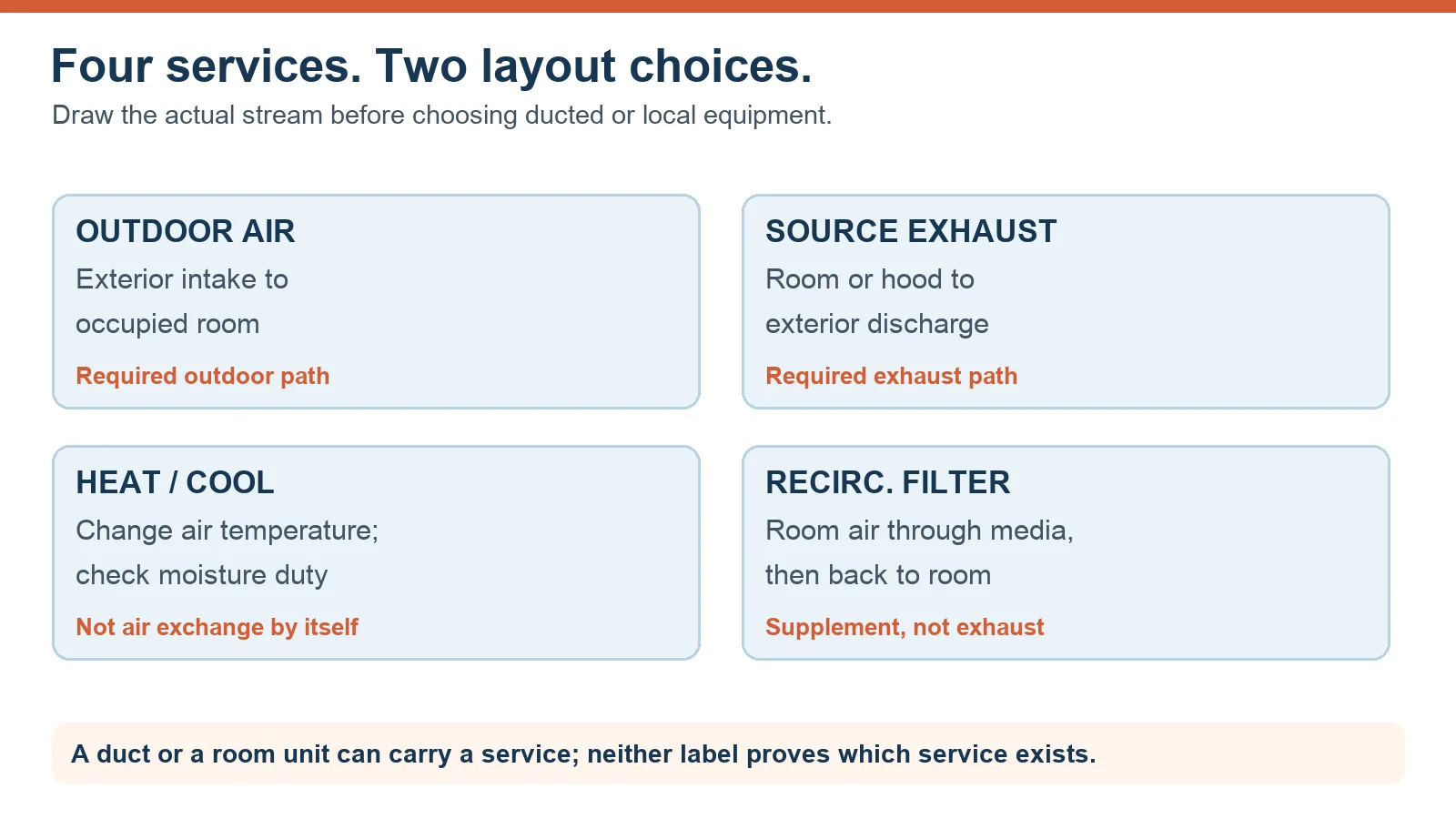
A typical split room air conditioner has refrigerant lines between indoor and outdoor units, but those lines are not an outdoor-air path. A portable air cleaner can lower selected airborne particles in the room, subject to its filter and airflow, yet it does not create fresh-air exchange. An exhaust fan needs a replacement-air path; otherwise pressure may shift flow through unintended openings. Check the actual equipment instructions and the building route rather than assuming that “ductless” means recirculating or that “ducted” means fresh air.
Trace the air path, then check the building boundary
Mark the exterior intake, occupied zone, source pickup, transfer path, and discharge. If a proposal says “fresh air,” identify its weather-protected opening and where that air reaches the room. If it says “exhaust,” identify the exterior outlet and how make-up air enters. If it says “heat recovery,” confirm that the unit actually has separate intake and exhaust paths and the appropriate controls; a recirculating filter does not recover the energy of exhausted air. Inspect pressure relationships where combustion equipment, attached garages, or contaminated process zones are involved.
Ducts can distribute supply and collect exhaust across several rooms, but they bring pressure loss, leakage, acoustic, fire-penetration, and balancing questions. Local devices may shorten distribution routes, but each exterior opening still needs weather protection, access, electrical provision, and coordination with the building envelope. Neither architecture removes the need for commissioning. The applicable code, exact equipment instructions, and qualified building design set the acceptance criteria.
What a fan specification can and cannot establish
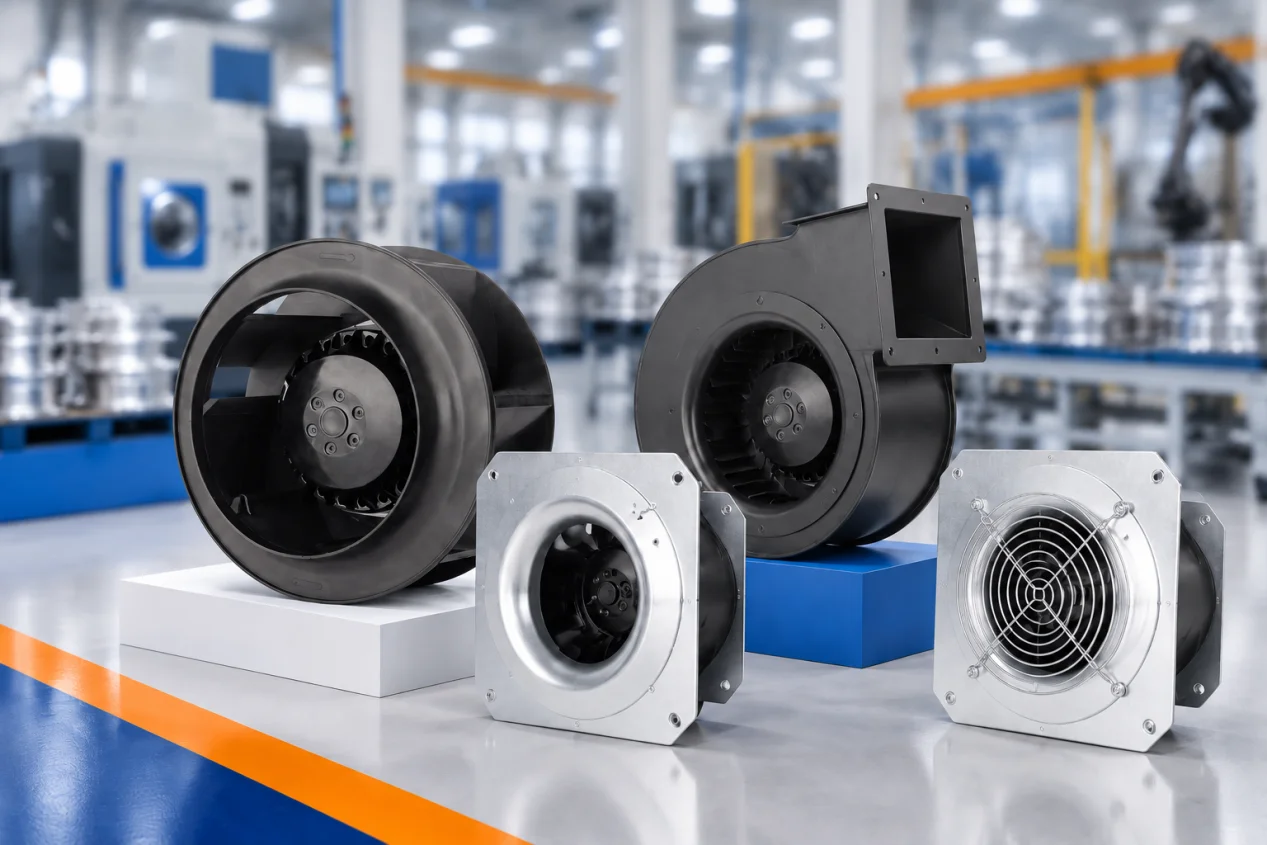
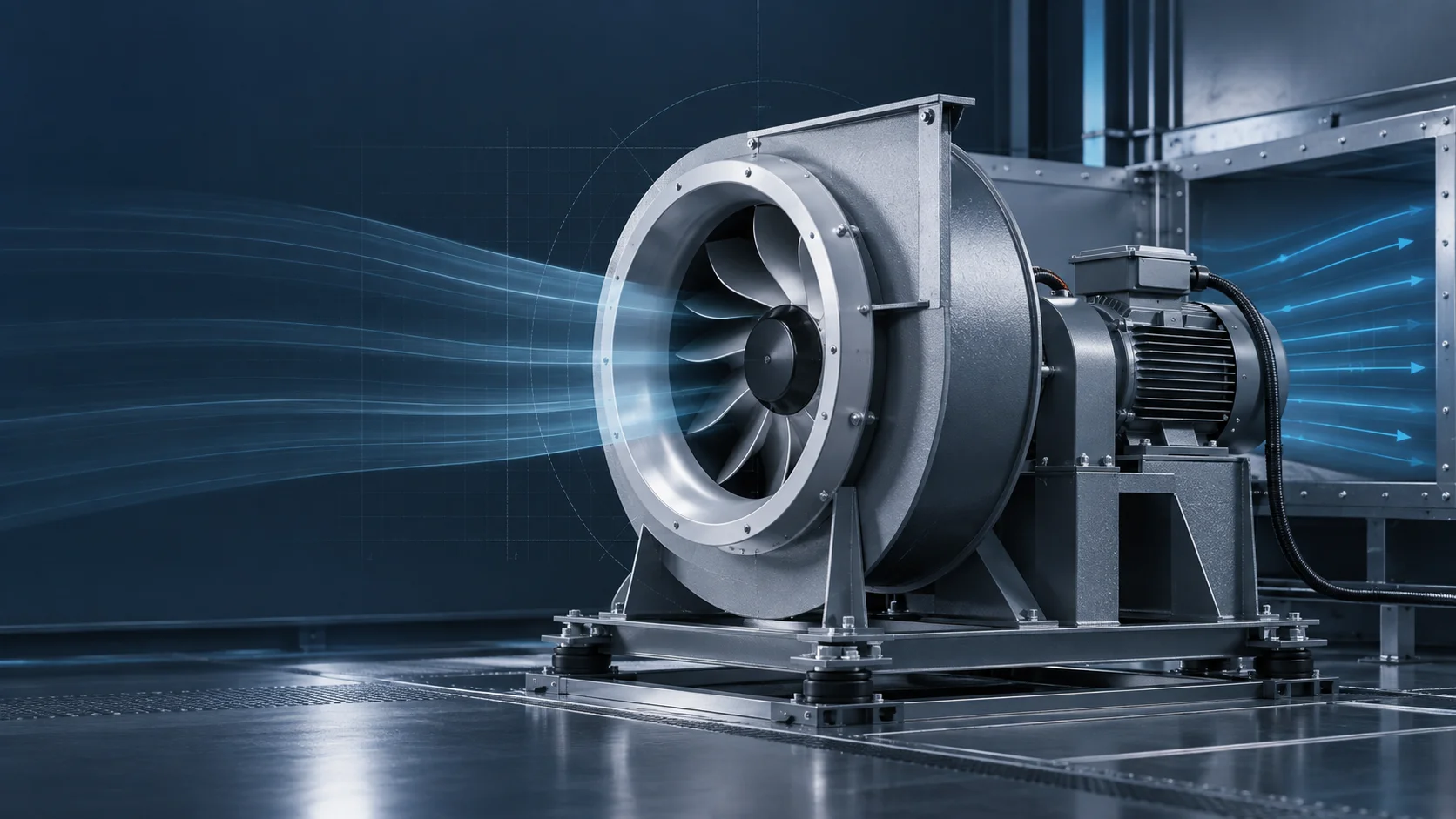
LONGWELL’s duct fan family shows components intended for a ducted air path. As one document-controlled example, the LWDA-100(4″)S-PBN-002 specification, revision A0 dated 9 December 2024, identifies an inline fan with a 100 mm nominal connection and an airflow–pressure chart. That drawing and chart help an engineer identify a candidate and check a proposed operating point. They do not establish that any installed room meets an outdoor-air rate, that a kitchen exhaust use is approved, or that another model suffix performs the same way.
A fan’s maximum airflow and maximum static pressure are different endpoints. A real duct, grille, filter, damper, and terminal impose resistance; the delivered airflow is the intersection of the selected fan curve and the system curve. For room-by-room devices the same principle applies to their own grilles, filters, and exterior openings. The duct fan and exhaust fan comparison gives additional product-family vocabulary, while the exact project still needs a measured and documented duty point.
Compare proposals with one ventilation passport
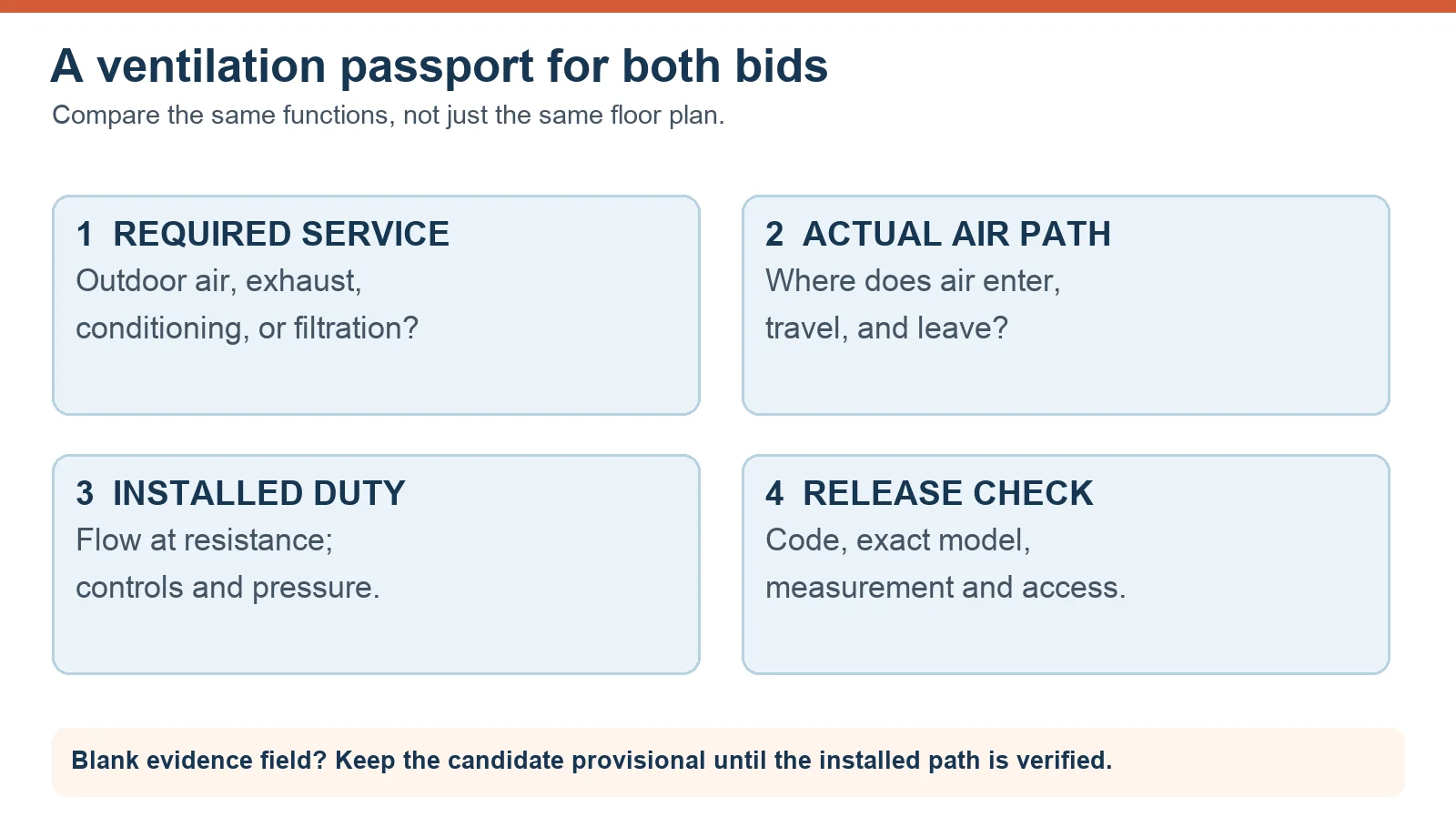
Use the same schedule for a central duct proposal and a distributed proposal. For each room or source, record the required service, outdoor connection, intended flow, pressure path, filtration if any, thermal or moisture function, control sequence, sound requirement, maintenance access, and verification method. If a line is blank, the proposal may be comparing different functions rather than different architectures.
For example, a homeowner may ask whether a ductless cooling unit can replace a bathroom exhaust route. First confirm whether the unit admits outdoor air or discharges bathroom air outdoors. If it only cools and recirculates, retain a separate code-compliant moisture exhaust strategy. The final airflow and installation depend on the locally adopted requirement and the exact products; no universal fan size follows from the words “bathroom” or “ductless.”
Filtration and heat recovery are separate decisions
Filtration can supplement source control and clean outdoor-air ventilation. The US EPA guidance on air cleaners makes that distinction. A filter’s usefulness depends on the contaminant, media, airflow, leakage, replacement condition, and the device’s verified instructions. A carbon filter is not a universal answer for gases or odours; a particle filter is not an exhaust path. Plan how performance will be checked after installation rather than relying on the presence of a filter housing.
Energy comparisons also need the same functions on both sides. Outdoor air may need heating, cooling, dehumidification, or frost control. A suitable heat- or energy-recovery ventilator may reduce some conditioning load while still exchanging air, but its benefit depends on climate, operating conditions, installation, and the device. Do not compare a recirculating cooling appliance with a complete outdoor-air system as if they deliver identical ventilation.
Release the design against the installed system
Before choosing a product, obtain the exact model and suffix, revision-controlled curve and drawing, electrical and control requirements, installation orientation, filter schedule, and access plan. Verify intake and discharge locations, duct or local-opening resistance, balancing and measured delivered flow, acoustic conditions, condensate handling, and the relevant local code. If the fan is part of a safety-related or special contaminant application, require the exact approval and installation scope rather than extending a general product-family description.
The outcome is a functional choice, not a verdict that one architecture always wins. Ducted distribution can serve multiple locations; local devices can serve distinct rooms. Either approach works only when the necessary outdoor-air, exhaust, conditioning, and filtration paths are actually provided and verified.
Choose the right duct fan
Longwell manufactures 254 duct fans in-house. Send airflow, static pressure and voltage — an engineer replies with a matching model, performance curve and price within one working day.