What the OEM wanted improved
An OEM wanted more from an existing air curtain chassis without changing it. Shaded-pole motor speed control is where that ran into trouble.
They asked for 1500 m3/h where the current fan gives 1300, plus variable speed for building management. Meanwhile the envelope stays at 840 by 140 by 140 mm.
Two requirements, one enclosure
- First, roughly 15% more airflow than the existing unit.
- Next, 0-10VDC or PWM control, for a building management system.
- Meanwhile a 230V supply at 50 to 60Hz.
- Finally, no change to the housing dimensions at all.
The control requirement is what drives energy compliance. Standards such as ASHRAE 90.1 assume a fan that modulates, not one that runs flat out whenever it is on.
Why shaded-pole motor speed control failed here
Here the obvious first move is to keep the AC motor and add a drive. That is where this project ran into a wall.
Why a VFD does not work here
The existing fan uses a shaded-pole motor. It is cheap, simple and reliable, and it is also the motor type least suited to external speed control.
A shaded-pole motor develops torque through a shorted copper ring rather than through a proper second winding. Consequently its torque falls away sharply as frequency drops, and it has very little starting torque to begin with.
Feed one from a variable frequency drive and it stalls, overheats, or simply refuses to turn at the low end. So shaded-pole motor speed control by frequency is not a cost question. It does not work.
Consequently the AC path was stuck at a fixed 1400 RPM, capping airflow at 1300 m3/h.
What the EC motor changed
So a direct-drive EC motor was the only route to both requirements at once.
Specifically it runs to 1500 RPM, which is what reaches the 1500 m3/h target. Furthermore its integrated controller accepts 0-10V or PWM directly, so the OEM control board connects without any intermediate electronics.
Notably nothing about the housing changed, which was the point.
What it cost
Unit price. An EC motor with integrated electronics costs more than a shaded-pole motor, and that gap is real at volume.
Meanwhile the offset is running cost and compliance. A fan that modulates spends most of its life well below full speed, where the energy saving is large, and it satisfies efficiency requirements a fixed-speed fan cannot. On a unit running seasonally that arithmetic favours EC; on one running rarely it may not.
Technical Specifications
The specification below is the EC version. Its AC predecessor, limited by shaded-pole motor speed control, managed 1300 m3/h at a fixed 1400 RPM.
| Parameter | Value | Notes |
|---|---|---|
| Model | LWCE-100720SN-06 | EC Motor Cross-Flow Fan |
| Voltage | 230 V | Single Phase |
| Frequency | 50/60 Hz | |
| Air Volume | 1500 m³/h (±10%) | 883 CFM |
| Static Pressure | ~175 Pa | Estimated based on similar AC model performance curve |
| Speed | 1500 RPM (±150) | |
| Speed Control | 0-10VDC / PWM | SmartEC™ integrated controller |
| Bearings | Ball Bearing | |
| Overall Dimensions (L x W x H) | 840 x 140 x 140 mm | |
| Impeller Diameter | 110 mm | |
| Impeller Length | 720 mm | |
| Housing Material | Iron (Galvanized Steel) | |
| Impeller Material | Aluminum |
Technical Documentation
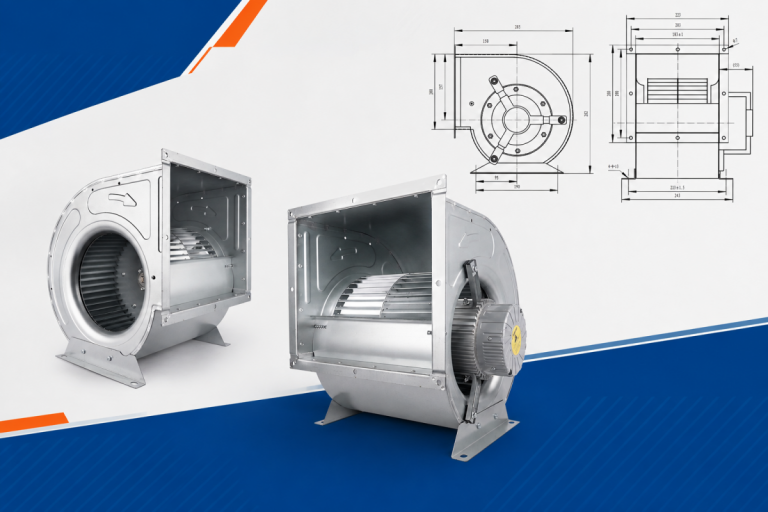
Here the engineering drawing provides all critical dimensions, material specifications, and electrical parameters for the LWCE-100720SN-06, essential for system integrators and mechanical design engineers for chassis integration.
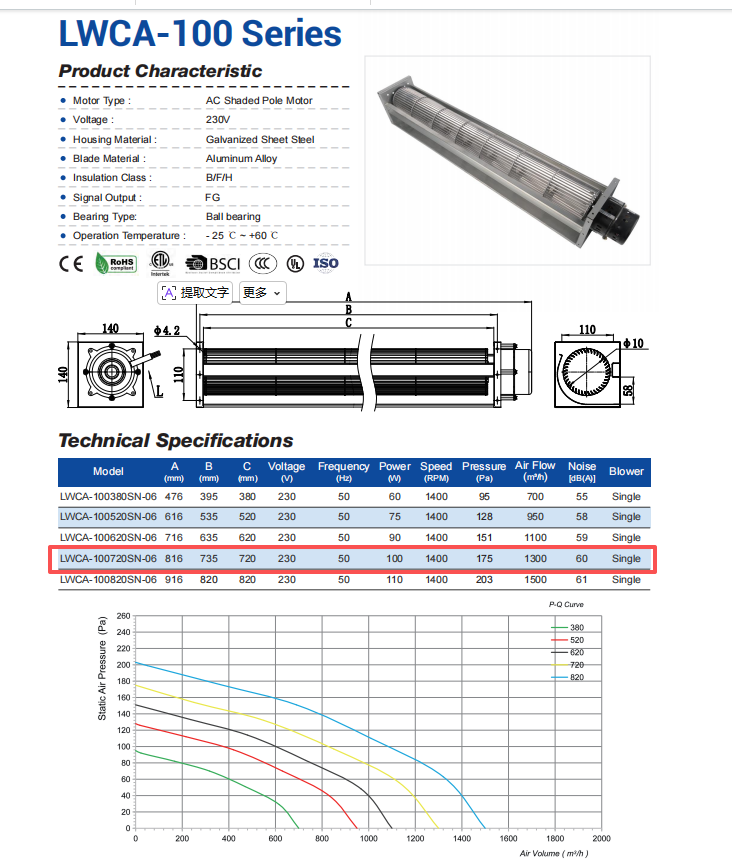
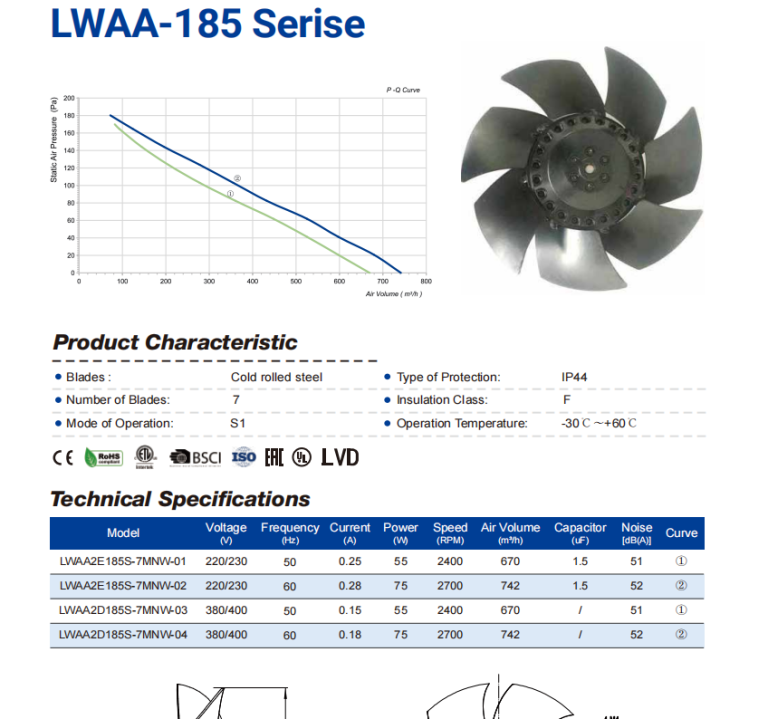
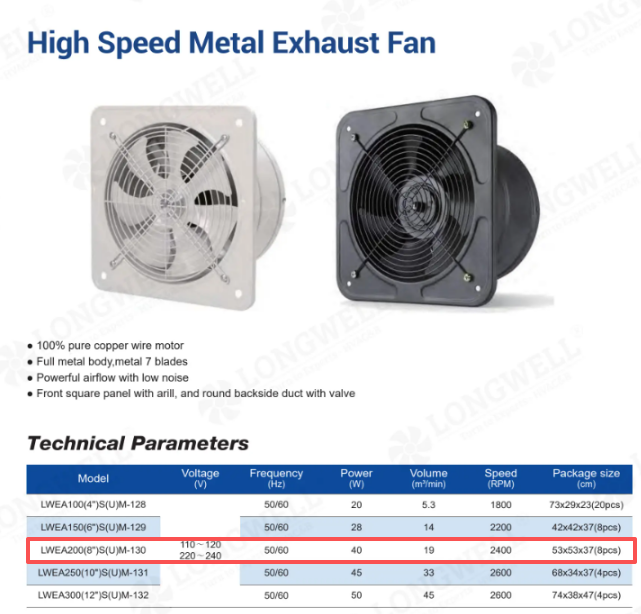
Here the image shows a completed cross-flow fan assembly and comparative performance data, useful for procurement managers to quickly assess product family capabilities.
If you are upgrading an AC fan
Upgrading an existing AC fan runs into limits that no datasheet mentions. Shaded-pole motor speed control is the commonest of them.
- Check the motor type before planning a drive. Shaded-pole motor speed control by VFD does not work, and a permanent-split capacitor motor is only marginally better. Three-phase induction motors take drives well. Find out which you have before designing around one.
- Voltage reduction is not the same as frequency control. A triac or voltage regulator will slow some AC fans, at the cost of torque, heat and noise. It is a crude tool, and it degrades bearing life. Treat it as a last resort rather than a design.
- Ask what speed the existing fan actually runs. A fixed-speed AC fan caps your airflow at whatever that speed delivers. If you need more air in the same envelope, the motor has to change, not the impeller.
- Work out the running hours before paying the EC premium. The saving comes from operating below full speed. Equipment that runs continuously repays it quickly. Equipment that runs occasionally does not.
See our cross flow fan range, the EC cross flow fan section, or speed controllers. Efficiency rules come from ASHRAE 90.1.
Questions about the upgrade
Why does a shaded-pole motor not tolerate a VFD?
Because it produces torque through a shorted ring rather than a properly phased second winding, and it has poor starting torque to begin with. Lower the frequency and the available torque collapses, so the motor stalls or overheats. The limitation is in the motor design, not in the drive.
Can I slow an AC fan with a voltage controller instead?
Sometimes, and it is a blunt instrument. Reducing voltage reduces torque and increases slip, so the motor runs hotter and noisier at low speed. It works for modest reductions on some motor types, and it shortens bearing and winding life. Where real control is needed, change the motor.
How much energy does variable speed actually save?
It depends on how much time is spent below full output. Fan power falls roughly with the cube of speed, so running at 70% speed uses around a third of full power. On equipment that rarely needs maximum airflow, that is where the return comes from.
Does the EC version fit the same chassis?
Yes, that was the requirement. Housing length, cross-section and mounting are unchanged at 840 by 140 by 140 mm. Only the motor and its electronics differ, so it drops into an existing design without sheet metal changes.
Technical Documentation & Resources
Sizing something comparable?
Share the airflow, pressure, voltage and control interface, and we come back with a tested curve and a drawing. Meanwhile custom work runs to 90 days for spec sheets and samples. Since 1990 Longwell has supplied fans to HVAC and industrial OEMs.
Browse Related Products:
🏆 ISO 9001 / ISO 14001 / ISO 45001 | CE (TÜV) | UL/ETL | ATEX Zone 21/22 | AMCA 210/211 / ISO 5801 tested
Choose the right ac motor
Longwell manufactures 22 ac motors in-house. Send airflow, static pressure and voltage — an engineer replies with a matching model, performance curve and price within one working day.