Meeting a 1730 m3/h Airflow Target in a Tight Cabinet
Our customer needed a new metal EC centrifugal fan. First, they outlined strict limits for an indoor HVAC unit. The machine had to move exactly 1730 m3/h (1030 CFM) of air. Next, it faced a maximum static pressure of 247 Pa.
Furthermore, the physical space allowed only a small footprint. The flange plate measured just 302 by 185 mm. Meanwhile, the total housing depth stopped at exactly 297 mm. Consequently, a bulky fan would not fit inside the tight metal cabinet.
Noise was another major issue. So, the customer set a hard sound limit of 63 dB(A). By contrast, most standard fans run much louder at full speed. The equipment also sits in harsh outdoor spots.
Therefore, it must survive freezing winter air down to -25°C. Finally, summer heat inside the cabinet can reach 60°C. The target market also enforces strict safety and performance rules. Consequently, the fan needs proper CE and ETL safety marks.
Engineers must test it to UL 507 safety standards. Furthermore, household electrical safety rules fall under the EN 60335-1 code. Engineers also verify the airflow using standardized airways. This method follows ISO 5801-1997 rules.
Meanwhile, sound testing follows the GB/T2888 method. In short, the Longwell design team faced a tight physical box, a strict acoustic limit, and extreme cold.
Engineering the Metal EC Centrifugal Fan
We reviewed several options for this metal EC centrifugal fan. First, we looked closely at a backward-curved wheel. However, a backward-curved fan needs a very high speed to reach the 247 Pa pressure target. Therefore, the fast air creates loud rushing sounds. It easily breaks the rigid 63 dB(A) noise limit. By contrast, a forward-curved fan features many small blades facing the air stream. This shape grabs large chunks of air. Consequently, it moves 1730 m3/h at just 1090 RPM. This low speed acts as the key to quiet operation. Instead of spinning fast, the motor just works harder at low speeds. So, the customer gets the right airflow without the loud noise.
Choosing the Impeller Material
Next, we had to pick the best material for the fan blades. Many modern fans use plastic impellers. First, molded plastic parts weigh very little. Next, they lower the mechanical load on the motor.
Even so, plastic has a fatal flaw in extreme cold. At -25°C, normal plastic becomes hard and brittle. A small bump can easily crack the blades. Therefore, we rejected plastic entirely for this tough outdoor job.
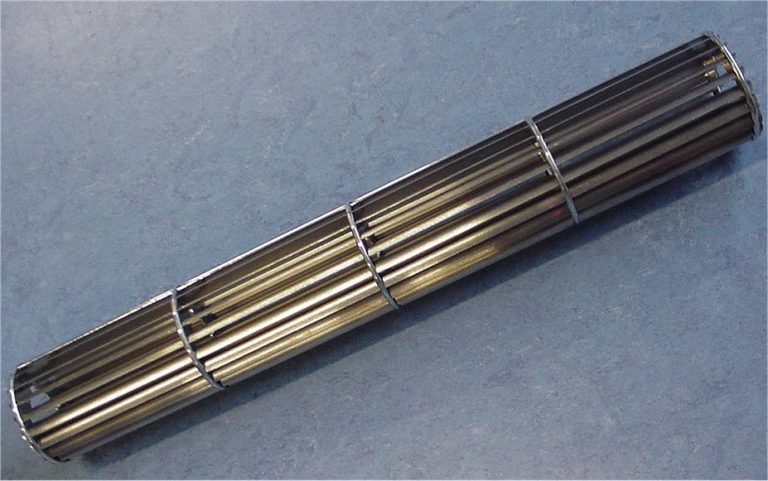
Instead, we formed a fully metal impeller. This choice added significant weight to the spinning wheel. Furthermore, the heavy wheel forced us to upgrade the center shaft. We installed heavy-duty twin ball bearings to carry the extra mass.
These high-grade bearings last up to 40,000 hours. Furthermore, the engineers balanced the wheel to G6.3 standards. This strict balance grade stops bad shaking. Ultimately, the metal parts cost more to build. However, the metal guarantees a perfect shape from -25°C all the way to 60°C.
Integrating the Motor and Control
The electrical system also required a custom layout. First, we installed a strong 165 W EC motor. This smart motor spins the heavy wheel at exactly 1090 RPM. Next, it accepts a very wide power supply.
The fan runs perfectly on anything from 175 to 264 VAC. Therefore, voltage spikes on the local grid will not crash the machine. Meanwhile, the motor uses a simple 0-10VDC signal for speed control. The main computer sends a tiny voltage to adjust the speed.
So, the fan ramps up very slowly. A built-in soft start program takes under 30 seconds to reach top speed. This slow start protects the power supply from sudden spikes. Finally, the system features a 4 Pulse/R tachometer wire.
This white wire sends exactly four electrical pulses for every full turn. Consequently, the main control board constantly monitors the real speed. In short, the final LWFE3G180-092DS-02 model solves the exact problem.
Technical Specifications
These numbers define the metal EC centrifugal fan performance limits.
| Parameter | Value |
|---|---|
| Airflow (Max) | 1730 m3/h / 1030 CFM |
| Static Pressure (Max) | 247 Pa |
| Input Power | 165 W |
| Speed | 1090 ±10% RPM |
| Nominal Voltage | 220 VAC (Range 175-264 VAC) |
| Frequency | 50/60 Hz |
| Rated Current | 1.22 A |
| Dimensions | 302 x 185 mm flange, 297 mm depth |
| IP Rating | IP44 |
| Insulation Class | Class B |
| Certifications | CE, ETL (UL 507), RoHS, REACH |
These numbers show the true limits of the fan. First, the wide 175-264 VAC voltage range acts as a shield. It stops the motor from stalling during bad power dips. Meanwhile, the IP44 rating blocks small tools and splashing water. Furthermore, the Class B insulation rating protects the motor wires. It ensures electrical safety even when the air hits the 60°C maximum limit. So, the machine runs safely all day in the S1 work mode.
Reference: AMCA 210 covers the test method behind these figures.
Technical Documentation
Download the technical specification sheet. This file lists the exact wiring rules, dimensions, and test data for design engineers.
 This drawing shows the exact dimensions of the metal EC centrifugal fan flange. It helps engineers fit the unit into tight boxes.
How to Specify Fans for Cold Environments
When you specify a metal EC centrifugal fan for cold air, follow these simple steps.
- First, map out the exact physical space inside your box. A tight depth limit often forces you to use a forward-curved design instead of a backward-curved one.
- Next, check your lowest winter temperature. If the air drops below freezing, always pick metal fan blades. Cold plastic cracks easily under stress.
- Finally, look at your local power grid. Choose a wide voltage range like 175-264 VAC. Therefore, your machine will survive brownouts and power surges without tripping offline.
Related: Centrifugal Fans.
Frequently Asked Questions
Technical Documentation & Resources
Browse our centrifugal fans range, the backward-curved fans section, or forward-curved fans.
Have a Similar Fan Requirement?
Longwell’s engineering team delivers custom spec sheets and samples within 90 days. Since 1990, we have supplied EC fans and blowers to OEMs across HVAC, cold chain, data center, and industrial applications worldwide.
Browse Related Products:
🏆 ISO 9001 / ISO 14001 / ISO 45001 | CE (TÜV) | UL/ETL | ATEX Zone 21/22 | AMCA 210-16 / ISO 5801 tested
Choose the right centrifugal fan
Longwell manufactures 956 centrifugal fans in-house. Send airflow, static pressure and voltage — an engineer replies with a matching model, performance curve and price within one working day.