A sample, and a failed first attempt
An HVAC OEM handed our sales team a physical part: an 8-blade, 300mm metal axial impeller from equipment they already build. They wanted impeller reverse engineering to produce a dimensionally and functionally identical replacement.
They had asked another supplier to do this first. The drawing that came back was wrong, which is why the brief stressed precision so heavily.
Why they wanted a second source
A single supplier for a critical rotating part is a supply chain exposure, and they had decided to close it.
So the request was not only for drawings. They wanted tooling and die costs, a minimum order quantity, and a unit price at volume. In other words, a decision package rather than a technical exercise.
What that implies about the part
A metal impeller with riveted blades in an air handler or condenser has to hold together for years while spinning.
Consequently durability and safety mattered here, even though the brief did not spell that out.
Why impeller reverse engineering needs a scan
The previous failure is the useful part of this story, because it shows where impeller reverse engineering usually goes wrong.
What calipers can and cannot capture
Hand measurement gets you diameter, hub bore, blade count, material thickness and overall height. All correct, all easy.
What it misses is the shape of the blade: how it curves along the span, its pitch, and its angle at each radius. Those are curved surfaces, not numbers.
That is the gap impeller reverse engineering falls into. A drawing can be right about every number on it and still describe a blade that moves a different amount of air.
Scanning instead of measuring
So we put the sample through high-resolution 3D laser scanning, capturing the whole geometry to under 0.1mm without touching it.
Here the point cloud then became a model in CAD. At that stage we had a twin of the part rather than one engineer interpretation of it, and that is the whole difference.
Checking it would survive, not just fit
A copy that matches the geometry can still fail if the material or the joint is different.
So we ran stress analysis at the speeds this class of fan runs, 1400 to 1800 RPM, looking at the riveted joints between blade and hub. We proposed galvanized steel for rust resistance. The analysis was there to prove the joint held up, not to assume it.
What this approach costs
Honestly, impeller reverse engineering by scan is slower and dearer up front than measuring a part and drawing it.
The customer had already paid for the cheap version once and got a wrong drawing back. Tooling gets cut from whatever drawing you approve. So the costly step is the one that comes after the mistake, not before it.
Balance requirements for rotating assemblies are set out by ISO in ISO 21940.
Technical Specifications
Meanwhile the dimensions below are outputs of the scan, not inputs to it. Nothing here was measured by hand.
| Parameter | Value |
|---|---|
| Impeller Diameter | 300 mm |
| Number of Blades | 8 |
| Impeller Material | Galvanized Steel / Aluminum Alloy |
| Target Airflow | 2650 m³/h / 1560 CFM |
| Target Static Pressure | 120 Pa |
| Typical Motor Pairing | Longwell 120W SmartEC™ Motor |
| Nominal Speed | 1450 RPM |
| Control Input | 0-10V / PWM |
Technical Documentation
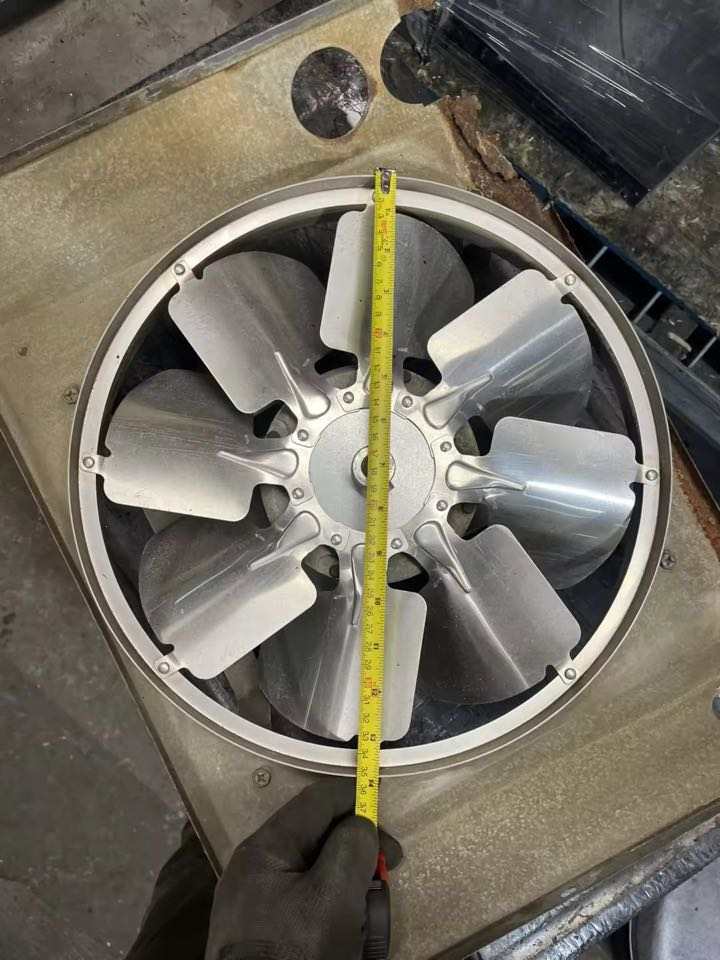
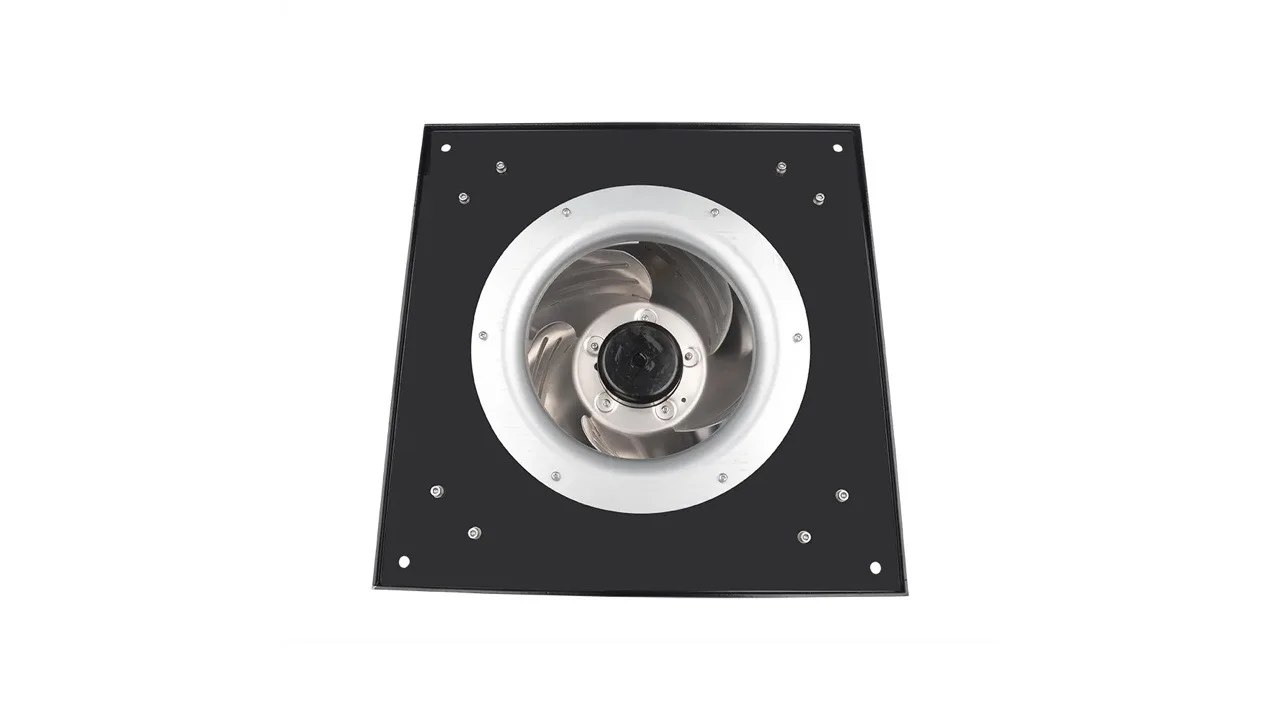
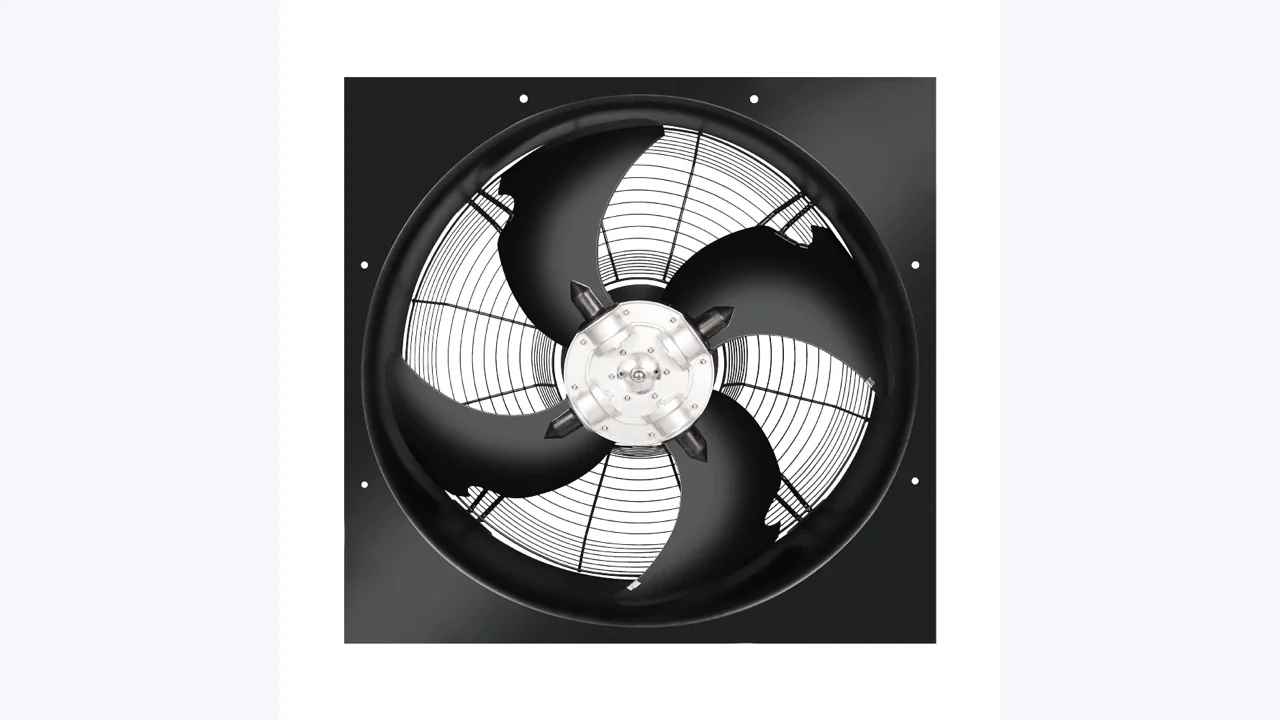
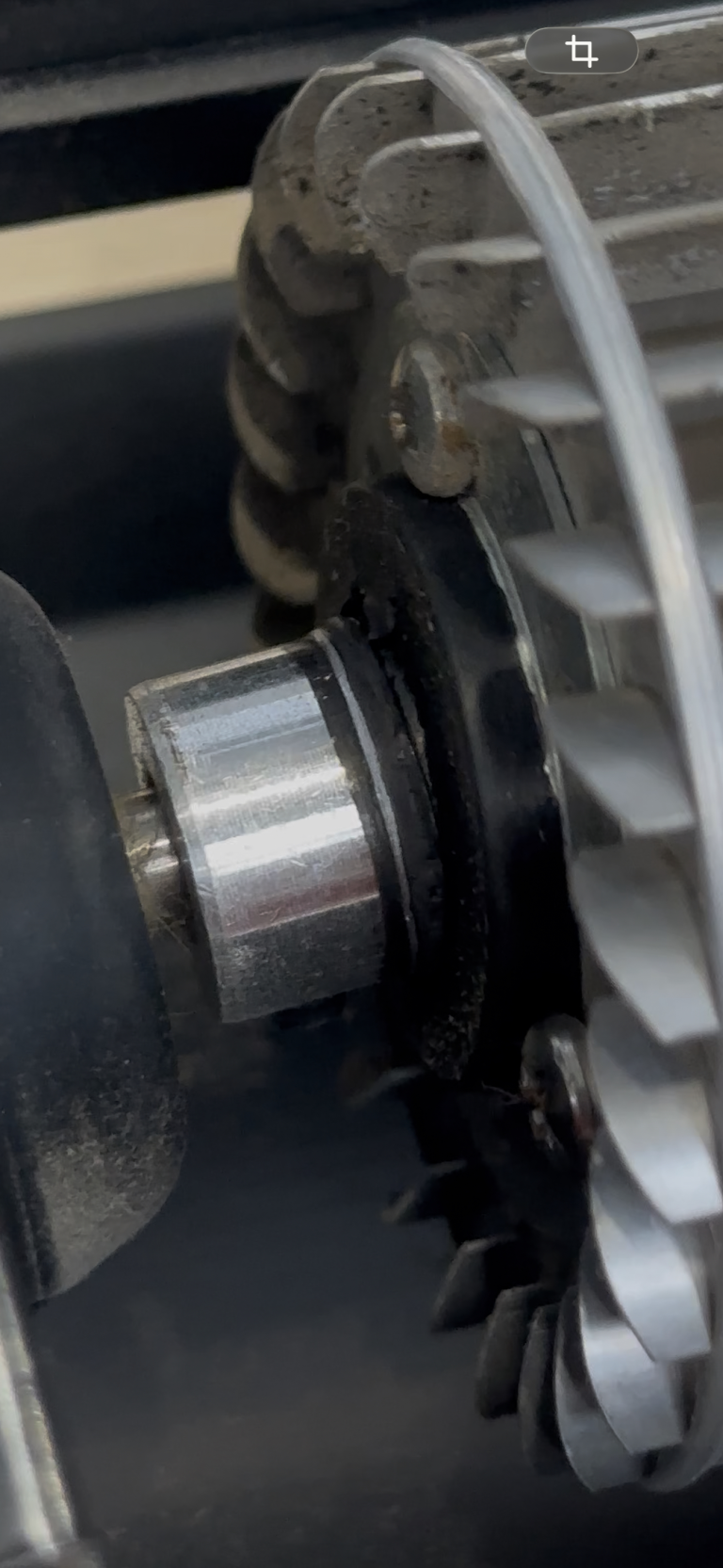
The customer’s original 300 mm 8-blade metal impeller sample, shown here, was used for 3D scanning to initiate the reverse engineering process.
Quotation for Metal Axial Impeller & Tooling Cost.pdf
Here the document, whose filename translates to “Longwell Quotation – Metal Cross-Flow Impeller and Tooling Fee – Quotation.pdf” (Note: file title contains a typo, project is for an Axial Impeller), provides the detailed breakdown of one-time tooling costs, MOQ, and unit pricing requested by the OEM’s procurement team.
Commissioning a copy of a part
If you are commissioning impeller reverse engineering yourself, these four points decide whether you get a usable part.
- Ask how the blade geometry will be captured. This is the question that separates real impeller reverse engineering from a drawing exercise. If the answer involves calipers and a protractor, expect the airflow to differ from the original.
- Send the part, not photographs of it. Curvature does not survive a photograph, and neither does thickness variation across a stamped blade. A supplier working from images is guessing at the parts that matter most.
- Ask for performance verification, not only dimensional matching. Geometric identity is the goal, but the proof is a measured curve on the finished part. Agree up front what test will be run and against what standard.
- Settle tooling ownership before the die is cut. A stamping die is a substantial cost and someone owns it. Establish who that is, and what happens to it if you move production, while the quotation is still open.
See our fan impellers range, the axial fans section, or industrial axial fans.
Questions about reverse engineering
Why does a small blade angle error matter so much?
Because the blade angle sets how much air each blade grips per turn. A degree or two across the span shifts the whole airflow and pressure curve, and it changes the power the motor draws. The part looks the same and behaves differently.
Is 3D scanning necessary for every replacement part?
No. For a flat bracket or a simple machined component, careful measurement is entirely adequate and cheaper. Scanning earns its cost on parts defined by curved surfaces, which is exactly what an impeller blade is.
Can you copy a part that is worn or damaged?
Partly. A scan captures the part as it is now, including wear, so a worn sample produces a worn digital model. It is workable if the wear can be identified and corrected in CAD, but a good condition sample makes the result far more reliable.
Who owns the drawings and tooling afterwards?
That depends entirely on what you agree, which is why it belongs in the quotation rather than in a later conversation. Establish ownership of the CAD model and the stamping die separately, since they are different assets and may be treated differently.
Working on something similar?
Send us the duty point, the envelope and the supply, and our engineers come back with a shortlist rather than a catalog. Meanwhile custom spec sheets and samples run to 90 days. Since 1990 we have built fans for HVAC, cold chain, data center and industrial OEMs.
Browse Related Products:
🏆 ISO 9001 / ISO 14001 / ISO 45001 | CE (TÜV) | UL/ETL | ATEX Zone 21/22 | AMCA 210/211 / ISO 5801 tested