What the power systems OEM needed
A European power systems OEM wanted an airflow upgrade on its dry-type transformer units. Their existing fan managed 880 m3/h. Meanwhile the new target sat above 1000 m3/h.
The customer sent a proper package. Namely 3D STP files, assembly drawings, and video of the old fan sitting in its galvanized steel bracket. Volume was serious too, at roughly 5,760 units a year, or 480 a month.
Two constraints mattered more than the airflow figure.
- A 490mm length, matched exactly, so the sheet metal assembly needs no change.
- 220 to 240VAC at 50Hz, since that supply is already wired in.
- CE certification, but supplied under a standard cross-flow model number.
That third point was clever rather than routine. By taking a standard model number, the customer uses our existing general-purpose CE certificate. Consequently there is no application-specific certification to pay for, which saves money and several weeks.
Upgrading the transformer cooling fan
Here the detailed input let us skip discovery and go straight to matching the airflow upgrade. Our S490-90 platform already shares the 490mm length and 90mm impeller diameter. Consequently the mechanical fit was settled from the start.
The lower-speed option, and why it lost
We modeled the LWF-S490-90AS-01 first. At 1400 RPM it draws only 38W and delivers 600 m3/h. Efficient, quiet, and yet well short of the requirement. So it was set aside.
The airflow upgrade that shipped
The LWF-S490-90AS-02 uses a stronger AC shaded-pole motor with identical dimensions, which is the key point. Therefore it reaches the 2600 RPM the customer asked for while leaving the mounting untouched.
Validation against AMCA 210/211 confirmed 1300 m3/h, or 765 CFM. That clears the 1000 m3/h requirement by 30%, and it beats the outgoing fan by 47%. In short, the customer gains real thermal margin rather than just meeting the number.
Construction for a transformer enclosure
Meanwhile the impeller is aluminum and the bearings are ball type, which gives a 30,000-hour L10 life. Meanwhile the operating range runs from -30C to +60C.
That upper figure matters here. A transformer cooling fan lives inside the heat it removes. Consequently a motor rated only to +40C spends its life on the edge of its own protector. Specifying to +60C is what turns a working installation into a long-lived one.
Technical Specifications
We quoted two options, and both are listed below. The second one shipped, and the airflow row shows why.
| Parameter | LWF-S490-90AS-01 (Alternative) | LWF-S490-90AS-02 (Selected Solution) |
|---|---|---|
| Model No. | LWF-S490-90AS-01 | LWF-S490-90AS-02 |
| Voltage | 220 VAC | 220 VAC |
| Voltage Range | 198-242 VAC | 198-242 VAC |
| Frequency | 50 Hz | 50 Hz |
| Speed | 1400 RPM | 2600 RPM |
| Power Input | 38W (±10W) | 110W (+10W) |
| Max Airflow (m³/h) | 600 m³/h | 1300 m³/h |
| Max Airflow (CFM) | 353 CFM | 765 CFM |
| Operating Temperature | -30°C to +60°C | -30°C to +60°C |
| Life Expectancy (L10) | 30,000 Hours (at 25°C) | 30,000 Hours (at 25°C) |
| Impeller Material | Aluminum | Aluminum |
| Bearing | Ball Bearing | Ball Bearing |
| Certification | CE | CE |
Technical Documentation
The following documents were central to the project’s success. They are provided for technical reference for procurement managers and design engineers.
Final Specification Sheet (LWF-S490-90AS-02): Final datasheet for the selected model, detailing performance curves, mechanical drawings, and electrical data for system integration.
Alternative Specification Sheet (LWF-S490-90AS-01): Datasheet for the lower-power alternative, evaluated as a baseline during the engineering selection process.
Customer Assembly Drawing (KV00001): The OEM’s original drawing illustrates how the fan integrates with the galvanized steel stand and wiring harness.
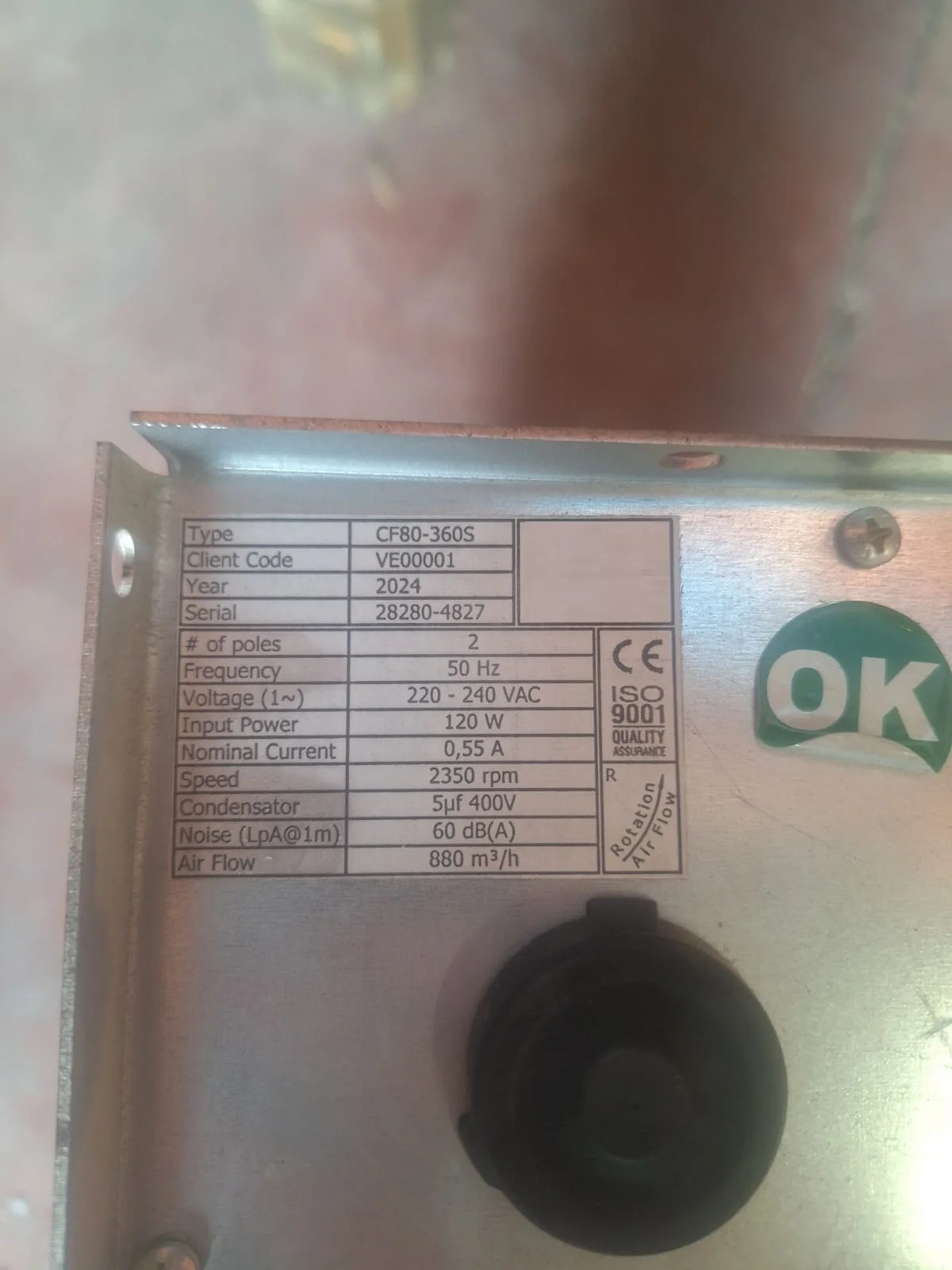 The image of the incumbent fan’s nameplate was used to establish the baseline performance requirement of 880 m³/h.
How to plan an airflow upgrade
In the end, three things made this straightforward for the customer.
- Two costed proposals within days. The customer received full specification sheets for both options almost immediately. That speed comes from our 90-day NPI framework, where imported European brands often quote 12 to 18 months even for a minor change.
- An airflow upgrade with no retooling. The new transformer cooling fan gives 47% more airflow and drops straight in. Nothing changes in the tooling or the assembly process, which is exactly what makes a mid-life upgrade affordable.
- Volume the line can actually carry. Nearly 5,800 units a year needs proven capacity. Our annual output of over 30,000 cold chain units and 120,000 data center fans is what backs that up.
Browse our cross-flow fan range, or the AC cross-flow fan series for a transformer cooling fan in another length. Dry-type transformer classes are defined in IEC 60076-11.
Questions about the upgrade
Can an airflow upgrade keep my existing certification?
Often yes, provided the mounting, the electrical connection and the enclosure stay unchanged. Certification covers the assembled product, so a fan swap inside the same sheet metal and the same supply is usually a component change rather than a redesign. Confirm it with your notified body before committing volume.
How does it compare with the previous 880 m3/h fan?
It is a straight upgrade. At 2600 RPM this transformer cooling fan delivers 1300 m3/h, which is 47% more air, inside the same 490mm length and mounting footprint. The 120W AC motor runs from the existing 220 to 240VAC supply, so nothing else changes.
Will it cope with the temperatures around a transformer?
Yes. It is specified from -30C to +60C, which covers cold starts and full thermal load in a distribution enclosure. L10 bearing life is 30,000 hours referenced at 25C, and it falls as ambient rises, which is why the upper rating matters.
What lead time applies to 5,700 units a year?
For recurring volume at around 480 a month, we plan production against your rolling forecast. Standard make-to-order lead time is 15 to 25 days, and a frame agreement lets us hold safety stock so shipment stays just in time.
Why does keeping the standard model number help?
Because certification follows the model number. A standard cross-flow number sits under our existing general-purpose CE certificate, so nothing new is tested or issued. Conversely, ask for a bespoke number and you inherit a fresh certification exercise with it.
Technical Documentation & Resources
Working on something similar?
Send us the duty point, the envelope and the supply, and our engineers come back with a shortlist rather than a catalog. Meanwhile custom spec sheets and samples run to 90 days. Since 1990 we have built fans for HVAC, cold chain, data center and industrial OEMs.
Browse Related Products:
🏆 ISO 9001 / ISO 14001 / ISO 45001 | CE (TÜV) | UL/ETL | ATEX Zone 21/22 | AMCA 210/211 / ISO 5801 tested