What the condenser OEM asked for
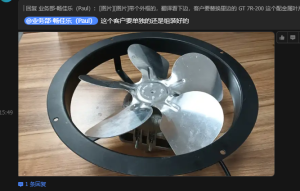
An HVAC OEM developing compact air-cooled condensers needed at least 2060 m3/h. Their enquiry was brief: a note naming a fan airflow direction, plus a drawing of a competitor model.
A drawing tells you more than a paragraph does. This one made the constraints explicit. It also showed a fan airflow direction that did not match the note beside it.
- 220/230 VAC single phase at 50Hz, for the European market.
- A square mounting frame of 280 by 280mm, with installation depth under 80mm.
- An ambient range from -30C to +60C, since these go outdoors.
- Continuous S1 duty, with L10 life of at least 30,000 hours.
- CE marking against EN 60335-1, so their own approval stays simple.
The tight depth is what makes this awkward. Eighty millimetres covers frame, motor and blade. Consequently there is no room to solve anything by making the AC axial fan bigger.
Getting the AC axial fan direction right
Before any of the engineering, there was an ambiguity worth stopping for.
The fan airflow direction did not match the drawing
Here the text said blowing, and the drawing was a B-type model, which pushes air away from the motor struts.
For a condenser, however, a suction S-type is usually the better answer. It pulls air across the coil and then over the motor, so the motor gets cooled by air that has already done its job. Getting this backwards costs airflow, motor life, or both.
So our first action was to call their engineering team and confirm what the thermal design really needed. After a short review, they agreed suction was correct. That conversation took an afternoon, and it prevented a wrong order.
Fan airflow direction settled, motor type next
The existing design used a simple AC asynchronous motor, which the capacitor in the wiring diagram gives away. We considered a SmartEC motor as an alternative.
It was the wrong recommendation here. Their control system is an on/off relay, with no 0-10V or PWM behind it. Consequently an EC motor would add cost and deliver nothing usable. A C-frame AC motor met the target price, and it dropped into the existing wiring unchanged.
Steel rather than plastic blades
Meanwhile the impeller is cold-rolled steel. Plastic would be cheaper and lighter. However, it is less predictable at the ends of a -30C to +60C range, where some polymers stiffen or creep.
On a fan that lives outdoors through a full year of weather, dimensional stability matters more than the saving.
In the end the specification was the LWAA2E250S-7MKW-50. Suction airflow, a 280mm frame, 80mm depth, and every performance figure inside the customer constraints.
Technical Specifications
These figures cover the suction AC axial fan that shipped. The blowing variant is mechanically identical, so every row below applies to it as well.
| Parameter | Value |
|---|---|
| Model Number | LWAA2E250S-7MKW-50 |
| Nominal Voltage | 220/230 VAC |
| Voltage Range | 198~242 VAC |
| Frequency | 50 Hz |
| Input Power | 130 W |
| Current | 0.6 A |
| Speed | 2700 RPM |
| Max Air Flow | 2060 m³/h / 1212 CFM |
| Noise Level (LpA) | 68 dB(A) |
| Capacitor | 4 µF |
| Operating Temperature | -30°C to +60°C |
| Protection Class | IP44 |
| Insulation Class | Class F |
| Work System | S1 (Continuous) |
| Bearing | Maintenance-free deep groove ball bearings |
| Life Expectancy (L10) | 30,000 Hours at 40°C |
| Certifications | CE, RoHS, Reach |
Technical Documentation
The technical specification sheet contains all performance data, mechanical drawings with dimensions, P-Q curves, and wiring diagrams that a design engineer needs for system integration and validation.
Open Full Technical Specification (PDF)
Here the product series image provides a quick-reference table for the LWAA-250 family, allowing procurement managers to compare standard models and verify key performance characteristics at a glance.
How to state fan airflow direction
On a job like this, four things counted.
- Both directions are standard. The B and S ambiguity was resolved without a redesign, because we build both as interchangeable stock configurations. An OEM can therefore match the thermal design rather than working around what a supplier happens to stock.
- A price that competes with European brands. Making the parts ourselves in Ningbo puts this AC axial fan materially below the established names. Meanwhile nothing is traded away on core reliability, such as the 30,000-hour L10 life.
- A P-Q curve, not a headline number. We test to AMCA 210/211 and ISO 5801 methods and supply the full performance curve, which is what lets the customer model system impedance properly.
- CE already done. The fan ships CE certified against EN 60335-1, so the OEM avoids a round of third-party testing on their own condenser.
Browse our AC axial fan range, or the condenser fan series for refrigeration work. Appliance safety requirements come from IEC 60335-1.
Questions about direction and control
What is the difference between the S and B models?
Mechanically and electrically they are identical, both giving 2060 m3/h on 130W. Only the fan airflow direction relative to the frame differs. The S model pulls air towards the motor side, which suits drawing through a coil. The B model pushes away from it. We stock both.
Can I control its speed with a VFD or triac?
Not with a VFD, since this AC axial fan uses a single-phase asynchronous motor. A phase-angle triac controller varies it to a limited degree, though expect more audible hum and lower efficiency. For quiet, programmable control, take a SmartEC fan that accepts 0-10V or PWM directly.
What is the lead time on 500 units?
This is a high-volume product, so a standard make-to-order run of 500 units takes 15 to 25 days from order confirmation. Customers on a frame agreement can have stock held, which brings shipment down to 1 to 5 days from Ningbo.
Why does airflow direction matter so much on a condenser?
Because the motor sits in the airstream either way, and the direction decides what temperature that air is. Drawing air across the coil first means the motor is cooled by air that has already picked up heat, which sounds worse but places the motor outside the hottest discharge. Choosing wrongly shortens motor life measurably.
Technical Documentation & Resources
Need the same thing for your own unit?
Give us the numbers and the envelope, and you get a shortlist rather than a catalog. Meanwhile custom spec sheets and samples run to 90 days. Since 1990 Longwell has supplied EC fans and blowers to OEMs in HVAC, cold chain, data center and industrial markets.
Browse Related Products:
🏆 ISO 9001 / ISO 14001 / ISO 45001 | CE (TÜV) | UL/ETL | ATEX Zone 21/22 | AMCA 210/211 / ISO 5801 tested