What the equipment builder needed
An industrial equipment OEM needed a 440V axial fan, and that voltage is the whole story. Their kit ships into North America, where 440V three-phase is common on the shop floor.
The airflow target was above 1,000 m3/h, enough to hold the cabinet inside its heat limits. Volumes were modest. Two samples first, then a batch of 80 units.
Physically the fan had nowhere to hide.
- A 200mm 440V axial fan, matching the space already cut into the cabinet.
- A frame no larger than 225 by 225mm, with 80mm of depth.
- No transformer and no VFD, so the fan itself must take 440V directly.
- UL 507 compatibility, since the finished machine needs safety sign-off in that market.
Consequently that third point turned a catalog enquiry into an engineering job. Everything else we already had on the shelf.
Rewinding for a 440V axial fan
Here the target pointed straight at our LWAA-200 series. Specifically, the LWAA2D200S-7MKW-30 already gives 1009 m3/h, but on a 380/400V 60Hz supply rather than 440V.
Why you cannot just connect it to 440V
This is the part worth understanding. Feed a 380V motor from a 440V supply and the magnetic core saturates. Current climbs, the windings heat, and the motor fails quickly. Initially it runs fine, which is exactly what makes the mistake expensive.
Why not a step-down transformer
A transformer would solve it. Even so, we dismissed the idea. It adds cost, weight and cabinet space, plus another part the OEM must buy, mount and warrant. In a machine sold into the field, that is a poor trade.
We also weighed a SmartEC version and set it aside. The customer wanted fixed speed. Variable control and bus protocols would only have added cost for something nobody would use.
Rewinding the stator
So the work went into the motor itself. Our engineers redid the wire gauge and the turns count for 440V, which is easy only if you wind your own motors.
The goal was to match the original performance, not merely to survive the voltage. Our rewound motor makes the torque needed to spin the 7-blade steel impeller at 2600 RPM. Airflow therefore stays at 1009 m3/h, and power draw stays at 80W. Class F insulation was already good enough for the higher voltage, so no material change was needed.
Meanwhile the approved model, LWAA2D200S-7MKW-30-00, is a full 440V axial fan, with performance checked in our AMCA 210/211 lab.
Technical Specifications
These are the approved figures for the rewound motor. Notice, above all, that airflow and speed match the 380V original exactly. That was the point of the exercise.
| Parameter | Value |
|---|---|
| Model | LWAA2D200S-7MKW-30-00 |
| Voltage | 440 V |
| Frequency | 60 Hz |
| Airflow | 1009 m³/h / 594 CFM |
| Speed | 2600 RPM |
| Input Power | 80 W |
| Current | 0.24 A |
| Static Pressure (Max) | 160 Pa |
| Noise Level | 60 dB(A) |
| Impeller Diameter | 200 mm |
| Dimensions (Frame) | 225 x 225 mm |
| Depth | 80 mm |
| Weight | 2.1 kg |
| Protection Class | IP44 |
| Insulation Class | F (155°C) |
| Operating Temperature | -30°C to +60°C |
| Certifications | CE, RoHS, ISO 9001 |
Technical Documentation
The following documents were generated as final deliverables for the project, moving from the PM Assignment stage to Approved and Archived.
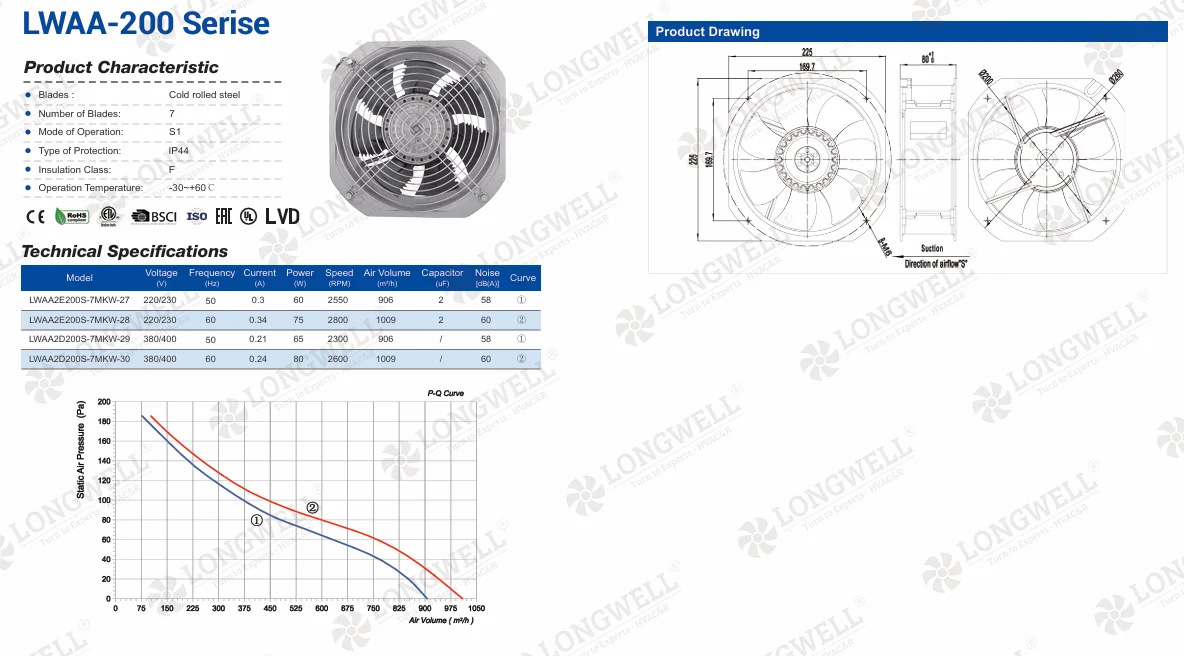
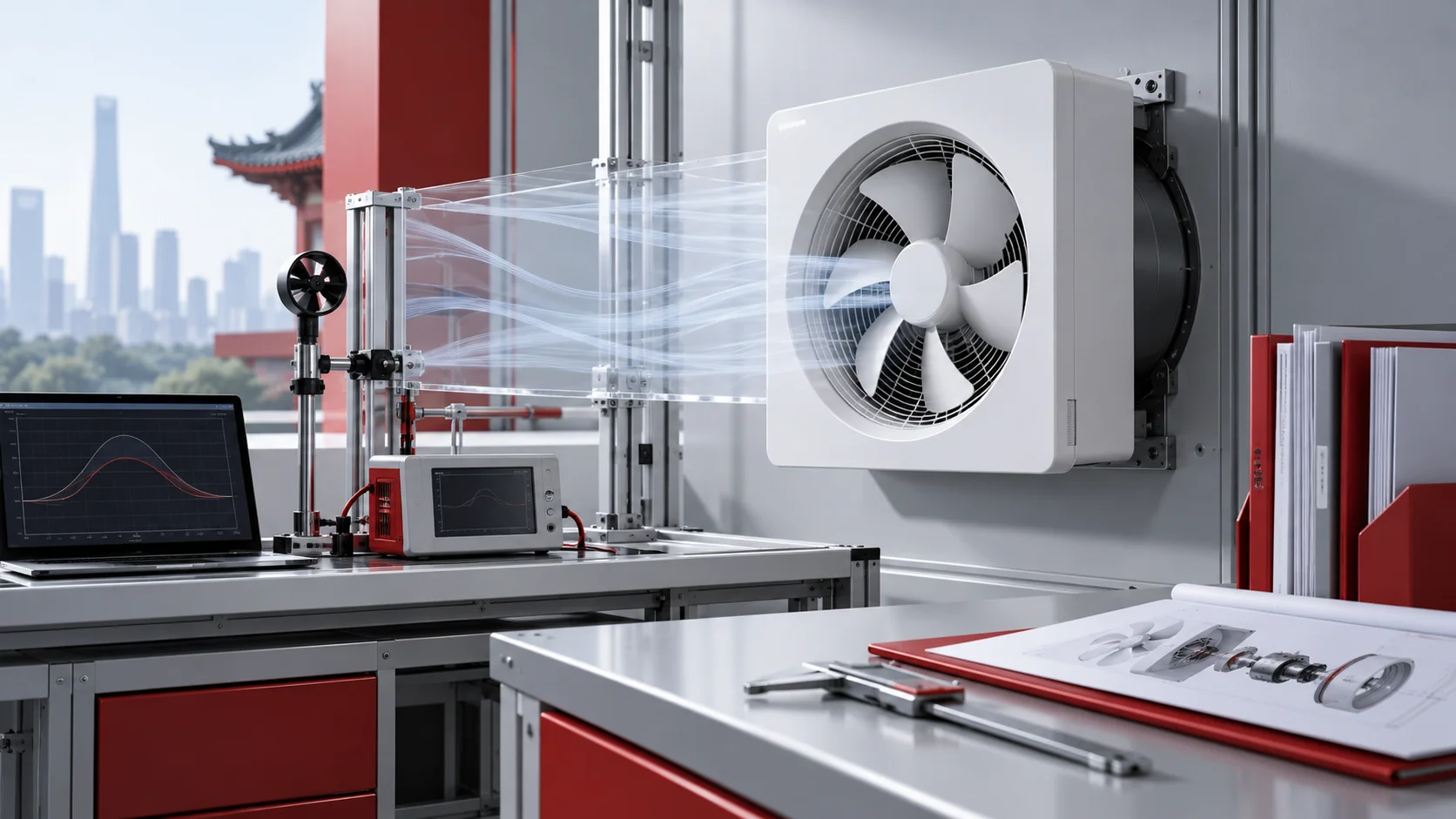
Here the series datasheet provides the essential performance data, including the P-Q curve that allows an engineer to map the fan’s operation against their system’s impedance.
Open Mechanical Drawing LWAA2D200S-7MKW-30-00 (PDF)
The final approved mechanical drawing gives an OEM procurement manager or system integrator the precise dimensional data needed for chassis design, mounting hole placement, and integration checks.
Why this went to a vertically integrated maker
Here the job shows plainly what it buys a customer when one firm makes the whole fan.
- A winding redesign in days. Since motor R&D happens in our own building, the recalculation, the quote and the specifications went back quickly. A European supplier will often route even a minor electrical change through a 12-month NPI process.
- A transformer the customer never buys. Winding the motor for 440V took a part off the bill of materials, along with the work of fitting it and the risk of warranting it. Add our baseline price gap, and the cost across 80 units drops noticeably.
- Airflow that is measured. The 1009 m3/h and 60 dB(A) figures come from labs verified to AMCA 210/211 and ISO 5801 methods. Consequently the customer thermal design carries far less risk.
- One team, one project. We handled two samples and an 80-unit quote together, from engineering through costing to order confirmation. There is no coordination gap between a fan assembler and a separate motor supplier.
Browse our AC axial fan range, or the industrial axial fan series for larger frames. Motor insulation classes are defined by the IEC in IEC 60085.
Questions about custom voltage fans
What is the lead time on an 80-unit order?
This is a make-to-order configuration, so expect 20 to 25 working days from order confirmation for batches under 500 units. That window covers winding, balancing, final build and a full test on every unit before packing.
Is a UL-certified version available?
Yes. Our mainstream series, including the LWAA platform, hold component recognition under UL 507 and UL 1004-1. Furthermore, a 440V axial fan from this family is no exception. For a custom model such as this one, full UL certification is available as a project option, and we supply the documentation your system-level listing needs.
Can it work down to -40C?
Not as standard, since this model is rated -30C to +60C. However, we can configure it using our ThermoFlex approach, which means low-temperature bearing grease and materials rated to -40C. We do this regularly for cold chain and outdoor telecom equipment.
Why rewind rather than derate an existing motor?
Derating means running the 440V axial fan slower to keep current in check. That costs airflow, and airflow was the requirement. Rewinding for the real supply voltage keeps the original duty point intact. In other words, the customer gets the same performance, simply on a different mains supply.
Technical Documentation & Resources
Sizing something comparable?
Share the airflow, pressure, voltage and control interface, and we come back with a tested curve and a drawing. Meanwhile custom work runs to 90 days for spec sheets and samples. Since 1990 Longwell has supplied fans to HVAC and industrial OEMs.
Browse Related Products:
🏆 ISO 9001 / ISO 14001 / ISO 45001 | CE (TÜV) | UL/ETL | ATEX Zone 21/22 | AMCA 210/211 / ISO 5801 tested
Choose the right axial fan
Longwell manufactures 1,086 axial fans in-house. Send airflow, static pressure and voltage — an engineer replies with a matching model, performance curve and price within one working day.