What the transformer builder asked for
A European OEM building dry-type transformers needed a drop-in fan for an existing line, at 5,760 units a year. It turned into an oversized fan replacement.
They sent a full technical pack. Namely drawings of the galvanized bracket, wiring notes, and the spec of the fan they already use. Currently that fan draws 120W and gives a nominal 880 m3/h at 2350 RPM.
The constraints were firm.
- An exact physical match, since the 490mm housing and mounting points are fixed.
- No change at all to their three-fan bank sheet metal.
- 220 to 240VAC at 50Hz, as already wired.
- Lastly, cover under an existing CE certificate, since a new one costs months.
They also asked for three commercial options. Either fans only, fans assembled onto their own brackets, or a complete turn-key unit. Evidently the customer is thinking about their production line as much as about the fan.
Questioning the transformer cooling fan spec
Initially the brief asked us to match a 120W fan giving 880 m3/h. Our engineers looked at that product first, and something stood out.
Spotting an oversized fan replacement
Basically a 120W draw at 2350 RPM points at an oversized fan replacement. In short, too much fan. Furthermore, speeds like that make noise. Meanwhile both matter more each year for equipment sited near people.
Of course a like-for-like swap would meet the spec exactly, avoiding any oversized fan replacement argument. Equally, it would preserve a problem nobody had questioned.
So we questioned the airflow requirement
Judging by typical heat loss for transformers in this kVA class, the original looked far larger than the job needs.
Rather than simply assert it, we proposed an alternative backed by calculations. Namely, optimize for energy and noise instead of peak airflow.
What the alternative gives
Our LWF-S490-90AS-01 gives a steady 600 m3/h. Thermal sums showed that is comfortably enough to hold the winding temperature inside its insulation class limits at full load.
Certainly the trade is a modest cut in airflow. However, what it buys is considerable.
- Motor speed falls from 2350 to 1400 RPM, which directly lowers noise.
- Power consumption falls from 120W to 38W per fan.
- That is a 68% reduction in running energy, on 5,760 fans a year.
Afterwards the customer reviewed the analysis and approved the change. For supply, the project settled on us providing the fans and doing final assembly onto their own brackets.
Technical Specifications
Compare the input power row against the old figure of 120W. That single line is the whole story of this transformer cooling fan project.
| Parameter | Value |
|---|---|
| Model Number | LWF-S490-90AS-01 |
| Voltage | 220 VAC |
| Frequency | 50 Hz |
| Current | 0.35 A |
| Input Power | 38 W |
| Speed | 1400 RPM |
| Airflow | 600 m³/h |
| Bearings | Ball Bearing |
| Housing Length | 490 mm |
| Overall Height | 130 mm |
| Overall Depth | 150 mm |
Technical Documentation
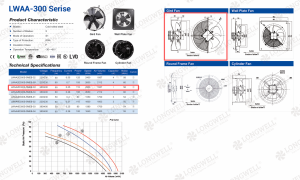
LWF-S490-90AS-01 Specification Sheet
Here the document provides the official performance curves, dimensional drawing, and electrical specifications for the selected Longwell fan, used by design engineers for system integration.

Here the image shows the final assembled units, with three LWF-S490-90AS-01 fans mounted to the customer’s bracket, ready for shipment and direct installation at their facility.
Customer Assembly Drawing KV00001
This is the customer’s master drawing for the complete ventilation set, which Longwell engineers used to ensure perfect mechanical and electrical interface compatibility.
Assembly & Wiring Instructions
Procurement and assembly teams use these instructions, provided by the customer, to guide the final assembly and wiring process performed at Longwell’s facility.
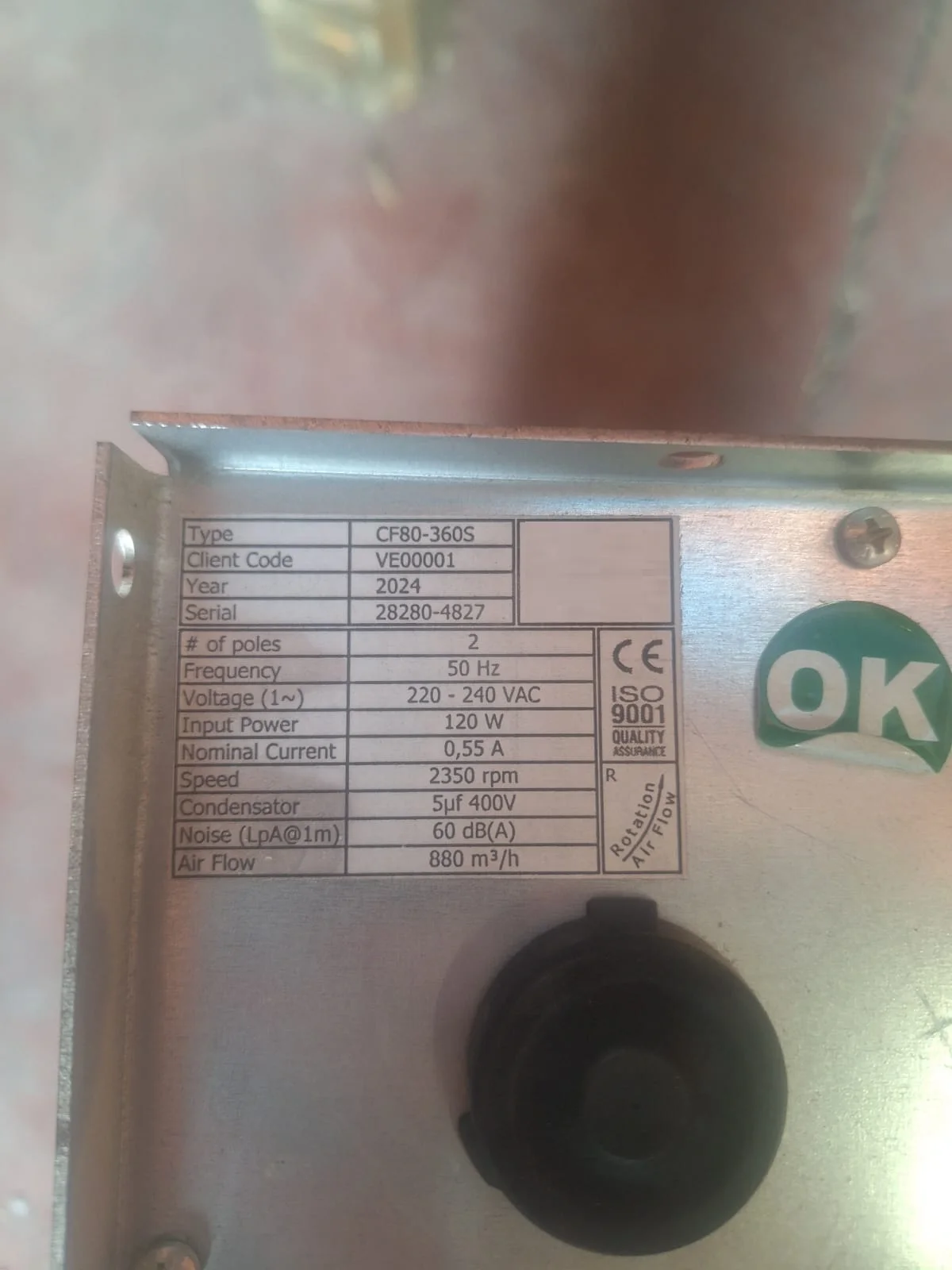
The nameplate from the customer’s original fan, which served as the baseline for performance analysis and the subsequent 68% energy efficiency improvement.
How to spot an oversized fan replacement
Beyond a simple quotation, four things carried this.
- Assembly as well as parts. Doing final assembly with customer-supplied brackets made us a production partner, rather than a component vendor. Consequently labor came off their line, and their logistics simplified.
- A decision in a day. The customer wanted an answer within a day and drawings within two. That pace suits how we work, and it contrasts with the long NPI cycles imported European brands quote.
- An oversized fan replacement that lowers running cost. Instead of quoting like for like, we cut transformer cooling fan power by 68%. For an OEM shipping thousands of transformers, that lowers running cost for their own customers. In turn, that is an argument they can sell with.
- Certification already covered. Picking a transformer cooling fan from our established cross-flow platform meant it sat under a valid CE mark already. That removed the regulatory delay and cost a new certification would have added.
Browse our cross-flow fan range, or the AC cross-flow fan series for other lengths. Dry-type transformer classes are defined by the IEC in IEC 60076-11.
Questions about the substitution
How do I tell whether my existing fan is oversized?
Compare the air power your system needs against the fan input power. Multiply airflow in m3/s by pressure in Pa for useful watts, then divide by a realistic efficiency. Where the installed fan draws far more than that, an oversized fan replacement is worth costing. On kit that runs all day, the saving repays fast.
What does it cost at 5,760 units a year?
A volume like that falls into our top pricing tier. However, we quote it directly rather than publishing a figure. Assembly services are quoted separately, since they depend on labor content and process complexity rather than on fan quantity.
Could you source the brackets as well?
Yes. This customer chose to consign their existing bracket supply. Our NPI process handles full turn-key work though, covering sourcing, tooling and manufacture of custom sheet metal, enclosures and wiring harnesses, typically inside a 90-day cycle.
The new fan gives 600 m3/h against 880 before. How is that justified?
Our review found the original 120W transformer cooling fan was far larger than the actual heat load needs. Thermal calculations showed 600 m3/h from a 38W fan keeps the operating temperature safely inside design limits. The customer approved that on the data, and gained a 68% energy saving and a quieter fan at 1400 RPM.
Why does a slower fan sound so much quieter?
Because noise climbs steeply with blade tip speed, rather than in step with it. Dropping from 2350 to 1400 RPM is a big cut in tip speed. Consequently the audible difference is far greater than the 40% speed change suggests. In short, slowing a fan is usually the most effective noise control available.
Technical Documentation & Resources
Sizing something comparable?
Share the airflow, pressure, voltage and control interface, and we come back with a tested curve and a drawing. Meanwhile custom work runs to 90 days for spec sheets and samples. Since 1990 Longwell has supplied fans to HVAC and industrial OEMs.
Browse Related Products:
🏆 ISO 9001 / ISO 14001 / ISO 45001 | CE (TÜV) | UL/ETL | ATEX Zone 21/22 | AMCA 210/211 / ISO 5801 tested