What the BESS integrator needed
A North American battery energy storage integrator needed a BESS cooling fan for a new generation of compact, high-density battery cabinets.
Their number was 1442 Pa of static pressure. That is a great deal. Notably it comes from the cabinet rather than any preference.
Where the pressure comes from
The design packs a dense heat exchanger and multiple filters into a small volume. Consequently the air path is highly restrictive, and the fan has to push against all of it while still delivering enough flow to keep every cell within its temperature band.
- A 230 VAC supply at 50 or 60Hz.
- Next, an envelope no larger than 290mm across and 210mm deep.
- Meanwhile IP55, since these cabinets are deployed across varied climates.
- Speed control over a 0-10VDC signal from their battery management system.
- Finally, CE marking so the finished system sells in Europe.
They had already picked a model from our catalog. So they wanted the formal factory specification sheet to close out their design.
Validating the BESS cooling fan
Their selection was correct. Even so, we validate rather than confirm. Two alternatives were worth ruling out on the record.
An axial fan was never possible
No axial fan of comparable size produces 1442 Pa. Axial designs move volume rather than build pressure, whereas this application is almost entirely pressure.
That is not a marginal call. It is a difference of roughly an order of magnitude, so the fan type was settled before anything else.
The 250mm option, and why it failed
We considered a smaller 250mm impeller, since it would free space in an already tight cabinet.
However, it could not reach the pressure. Fan pressure scales with the square of tip speed, and tip speed depends on diameter, so dropping 30mm costs more pressure than it sounds like. The 280mm aluminum impeller was the smallest that met the requirement with margin.
Why backward-curved blades
Backward-curved geometry is what makes high pressure efficient. By contrast a forward-curved wheel needs more power and makes more noise for the same duty. That matters when a BESS cooling fan runs continuously inside a sealed cabinet.
The control interface
We verified the drive accepts the analog range their battery management system outputs. Consequently proportional speed control works with no conversion stage. Meanwhile RS485 is available if they later want digital control and status instead of a voltage.
What it cost
Power and noise. This BESS cooling fan draws 500W and measures 75 dB(A) at full speed, both of which are substantial.
That is what 1442 Pa costs. In short, there is no quiet, low-power way to push air through a restrictive path at that rate. However, the speed control softens it. The fan needs full output only at high ambient or with loaded filters, and otherwise runs well below.
Technical Specifications
Note the storage row below runs wider than the operating range. On a BESS cooling fan that distinction matters.
| Parameter | Value |
|---|---|
| Model | LWBE3G280-102NS-16 |
| Nominal Voltage | 230 VAC |
| Voltage Range | 176-264 VAC |
| Frequency | 50/60 Hz |
| Max Airflow | 3193 m³/h / 1878 CFM |
| Max Static Pressure | 1442 Pa |
| Max Speed | 3000 RPM |
| Input Power | 500 W |
| Rated Current | 2.3 A |
| Noise Level (LpA) | 75 dB(A) |
| Operating Temperature | -25°C to +60°C |
| Storage Temperature | -40°C to +80°C |
| Protection Class | IP55 |
| Insulation Class | Class B |
| Duty Cycle | S1 (Continuous) |
| L10 Bearing Life | 40,000 hours (@40°C, 15-65% RH) |
| Impeller Material | Aluminum Alloy |
| Bearing Type | Maintenance-free ball bearings |
| Weight | 5.4 kg |
| Dimensions | Ø280 mm x 205 mm |
| Control Interface | 0-10VDC / PWM / RS485 (SmartEC™) |
| Certifications | CE, RoHS, Reach |
Technical Documentation
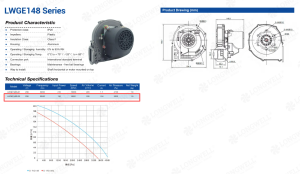
Here the final approved Chinese-language specification sheet was the primary deliverable, required by the customer’s engineering team in Asia for design validation. Download the full document.
A summary data sheet contains the key performance curve and technical specifications for quick reference by procurement and system integration teams. Download the summary sheet.
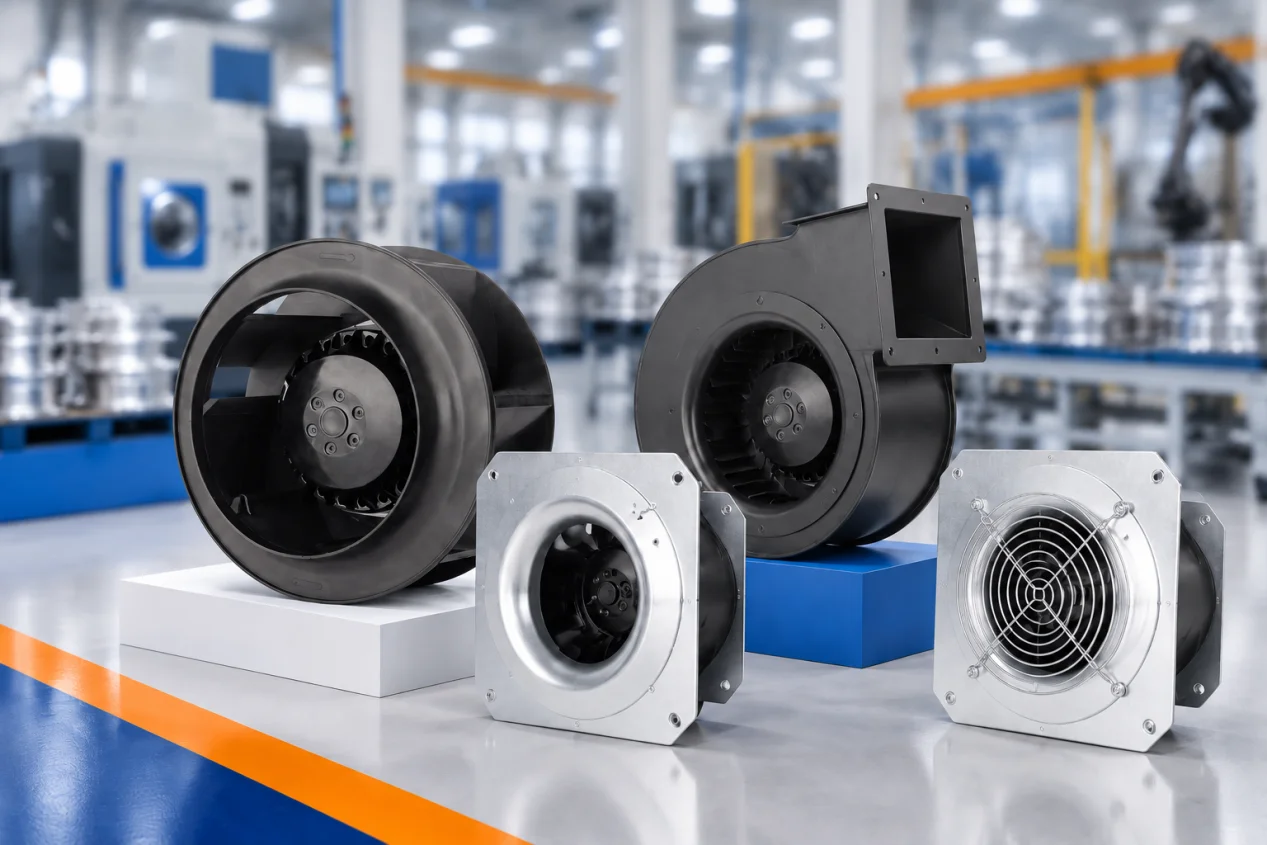
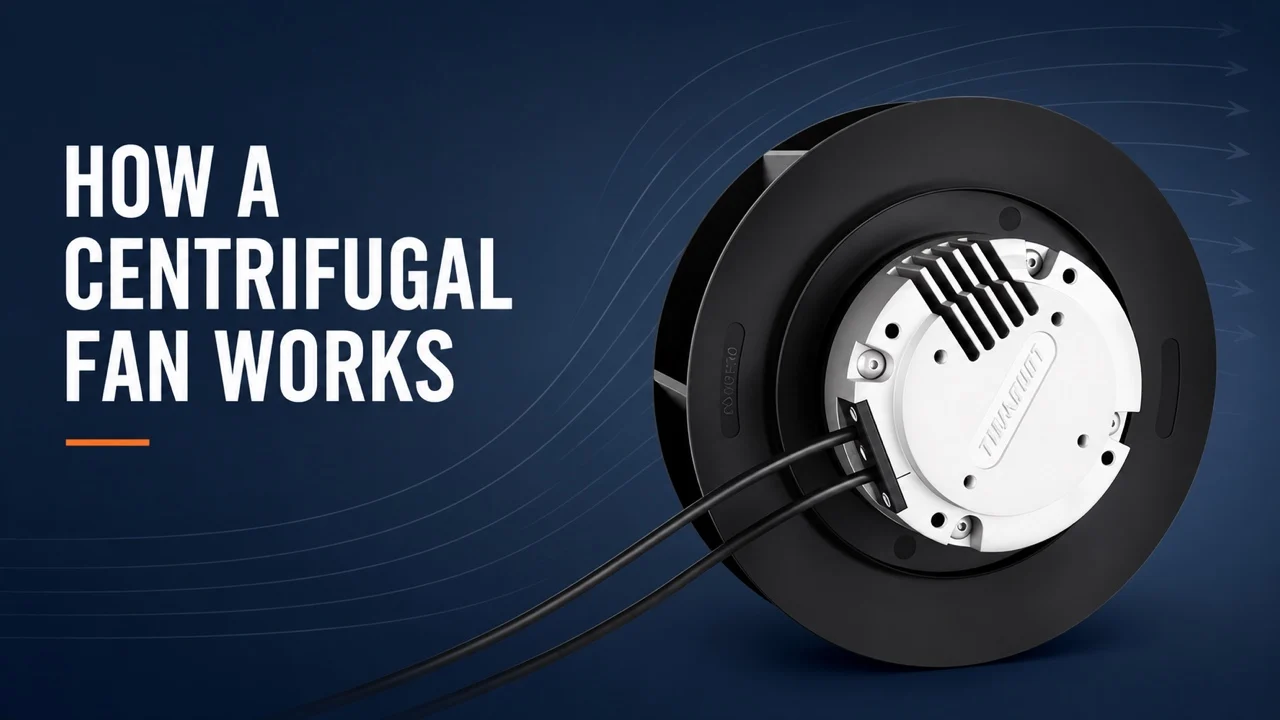
The product image shows the EC backward-curved centrifugal fan with its integrated motor and mounting flange. 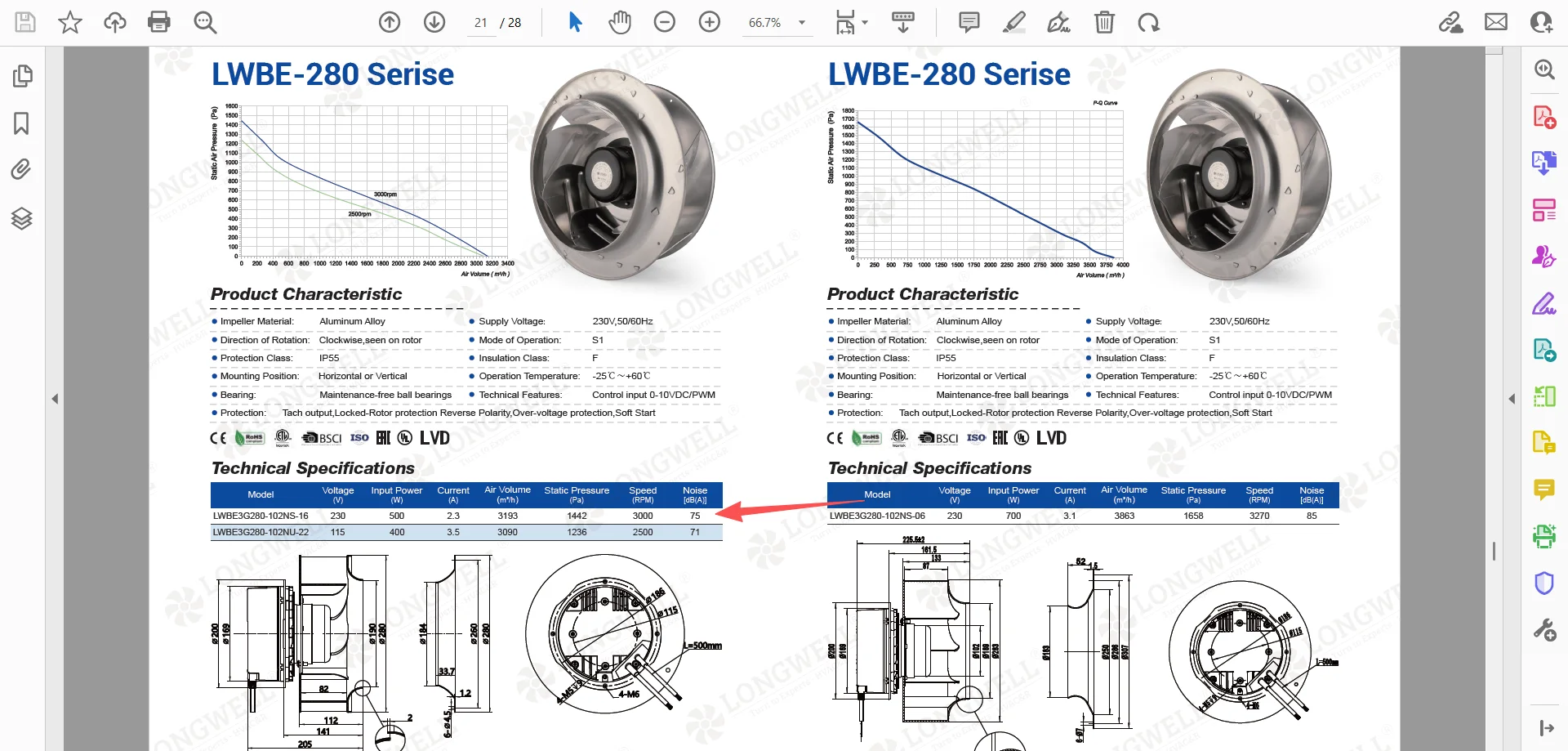
If you are cooling a battery cabinet
A BESS cooling fan is unforgiving to specify, since a thermal problem becomes a safety problem. So get these right early.
- Measure the pressure drop of the full air path, filters included. Heat exchanger, filters, grilles and internal ducting all add. Sizing against the exchanger alone is the commonest way to end up with a fan that cannot deliver its rated flow.
- Leave pressure margin for filter loading. Filters in a field-deployed cabinet load with dust over months. A fan chosen with no headroom will silently deliver less air as time passes, which is exactly the failure mode you do not want on a battery.
- Do not shrink the impeller to save space. Pressure falls with the square of diameter, so a modest reduction costs a lot of capability. Find the space elsewhere before compromising the fan.
- Take the tachometer or status feedback. In a sealed cabinet a failing fan is invisible until temperatures rise. Feeding fan status back to the battery management system turns a hidden fault into an alarm.
See our centrifugal fan range, the backward curved fan section, or EC plug fans. Ingress ratings follow IEC 60529.
Questions about this fan
Why does a 30mm smaller impeller lose so much pressure?
Because pressure rises with the square of blade tip speed, and tip speed is proportional to diameter at a given RPM. Going from 280mm to 250mm removes roughly 20% of the pressure capability at the same speed. Recovering it by spinning faster costs disproportionately more power and noise.
Is 75 dB(A) acceptable for a battery cabinet?
For an outdoor or plant-room installation, generally yes. That figure is at full speed, which the BESS cooling fan reaches only at high ambient or with loaded filters. However, where cabinets sit near occupied space, use the speed control and tell us your acoustic limit so we can show where on the curve it lands.
Why is the storage range wider than the operating range?
Because a stationary fan tolerates conditions that a running one does not. Lubricant that is too stiff to start at -40C is fine once the unit has warmed. The storage figure matters for shipping and for cabinets commissioned after a winter in transit, which is a real scenario in this industry.
Can the fan speed follow the battery management system directly?
Yes. The drive accepts a proportional analog signal, so the management system varies airflow with cell temperature rather than switching the fan on and off. That keeps temperature more stable, uses less energy, and reduces the thermal cycling that shortens cell life.
Technical Documentation & Resources
Have a fan requirement like this one?
Send the datasheet you are working against, or simply the duty point. Then our engineers tell you what fits and what does not. Meanwhile custom spec sheets and samples take up to 90 days. Since 1990 we have been building fans for OEMs worldwide.
Browse Related Products:
🏆 ISO 9001 / ISO 14001 / ISO 45001 | CE (TÜV) | UL/ETL | ATEX Zone 21/22 | AMCA 210/211 / ISO 5801 tested
Choose the right centrifugal fan
Longwell manufactures 1,130 centrifugal fans in-house. Send airflow, static pressure and voltage — an engineer replies with a matching model, performance curve and price within one working day.