What the air curtain OEM needed
A European OEM needed specification sheets for three cross-flow fan sizes: 420mm, 1100mm and 1300mm impeller lengths. The fan speed ceiling on the longest is what took the thinking.
Chiefly the products are air curtains and trench heaters. Both need a wide, even sheet of air. However, the fan speed ceiling on the longest size is where this got interesting.
The request itself was terse. Essentially, issue 48V spec sheets. That brevity tells you something. An existing product line is being changed, so the customer wants a qualified supplier for one part variation rather than a development partner.
- A 48 VDC rail, since supply can wander from 40 to 56V.
- 0-10V analogue or PWM control, since a smart building system drives it.
- An ambient range from -25C to +60C, covering cold store entrances and sunlit lobbies alike.
- No more than 55 dB(A) on the larger models, without exception.
- Lastly, CE and ETL compliance, for Europe and North America.
Here the 48V bus is what turns this into a project rather than a catalog lookup. It is common in modern low-voltage building systems, yet uncommon in fan catalogs.
Configuring the DC cross-flow fan family
Initially, our LWCD series was clearly the right platform. Consequently the work was configuration rather than design.
Brushless DC, not AC with a converter
We briefly considered an AC motor. However, running one from a 48V DC bus needs an inverter, which adds cost, volume and a failure point.
Volume is the killer here. Air curtains are deliberately slim, so finding room for an inverter inside one is not a happy exercise. A brushless DC cross-flow fan, by contrast, takes the 48V supply directly.
Windings and control
Basically the task was setting motor windings and the built-in controller for 48V nominal. Our SmartEC driver board already reads 0-10V and PWM directly. Consequently the customer gets plug-and-play integration, with no custom firmware and no signal converter in between.
Likewise the -25C to +60C range comes from our standard component selection under the ThermoFlex approach, so it needed no modification.
Where the fan speed ceiling had to sit
Meanwhile the real trade-off appeared on the 1300mm model. Reaching the target airflow meant picking a speed, and speed drives noise.
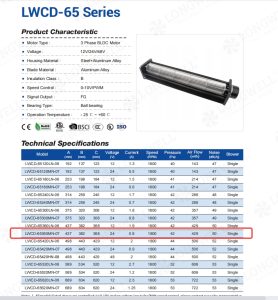
At 1800 RPM it gives 1392 m3/h and sits exactly on the 55 dB(A) limit. Going faster would produce more air, yet it would fail the noise test. On an air curtain in a hotel lobby, that is the test that actually matters.
Materials
An aluminum impeller keeps spinning mass low, while a cold-rolled steel frame holds a 1300mm span rigid. That pairing is standard and cheap for this class of fan.
Finally we approved spec sheets for the LWCD-60420HN-08, LWCD-651100HN-08 and LWCD-651300HN-08. Together they cover the customer whole product range.
Technical Specifications
Three DC cross-flow fan lengths are listed below. Read the speed and noise rows together on the longest one, since those two decided the whole selection.
| Parameter | LWCD-60420HN-07 | LWCD-651100HN-08 | LWCD-651300HN-08 | Unit |
|---|---|---|---|---|
| Nominal Voltage | 48 | 48 | 48 | VDC |
| Voltage Range | 40~56 | 40~56 | 40~56 | VDC |
| Speed | 2000 | 1800 | 1800 | RPM |
| Max Airflow (m³/h) | 355 | 1178 | 1392 | m³/h |
| Max Airflow (CFM) | 209 | 693 | 819 | CFM |
| Max Static Pressure | 35 | – | – | Pa |
| Noise Level | 43 | 55 | 55 | dB(A) |
| Max Ambient Temp | +60 | +60 | +60 | °C |
| Min Ambient Temp | -25 | -25 | -25 | °C |
| Impeller Diameter | 60 | 65 | 65 | mm |
| Impeller Length | 420 | 1100 | 1300 | mm |
| Bearing | Ball Bearing | – | ||
| Certifications | CE, ETL | – | ||
| Life Expectancy (L10) | 40,000 | Hours | ||
Technical Documentation

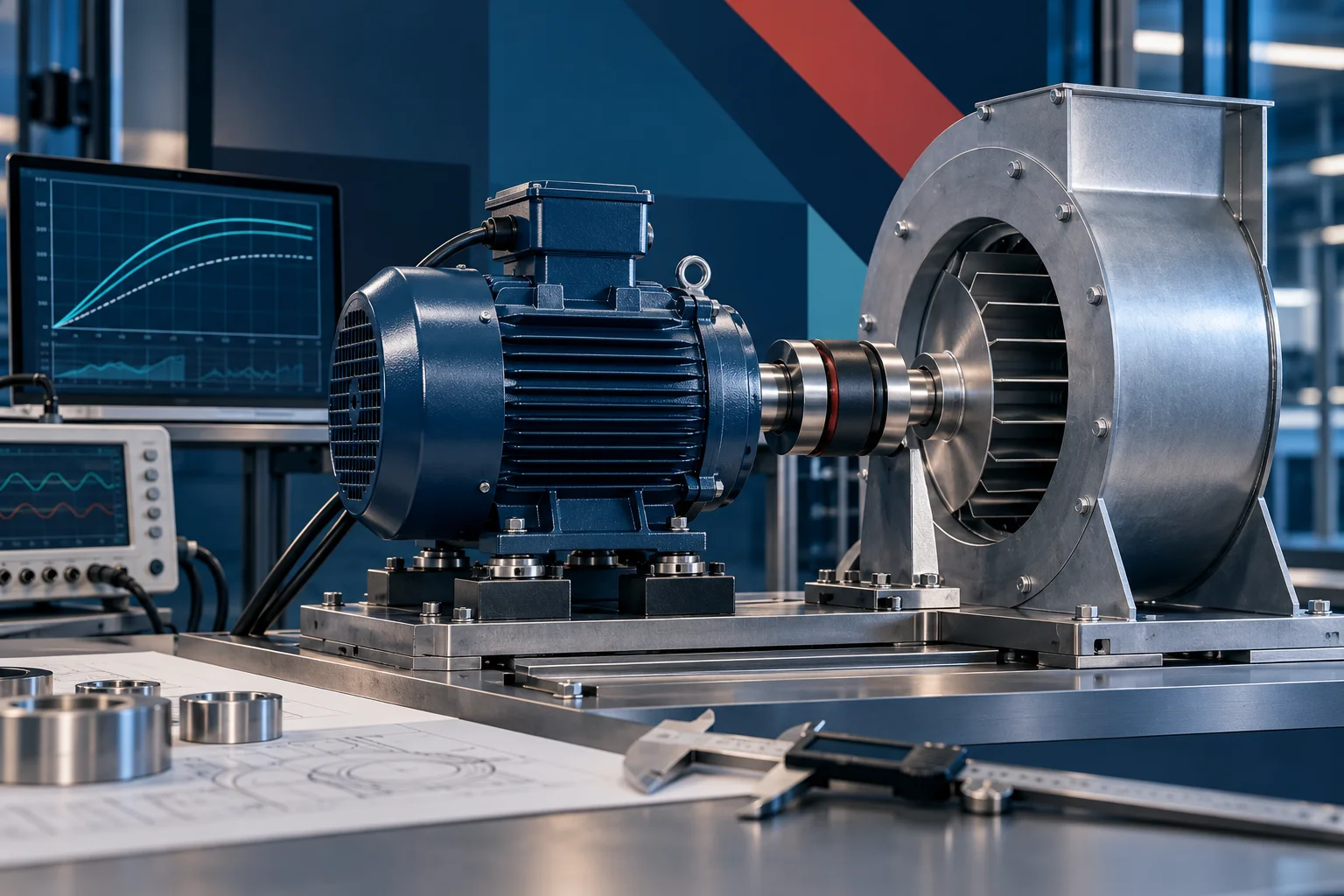
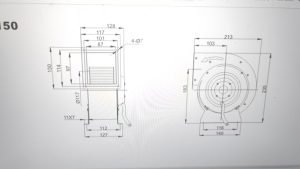
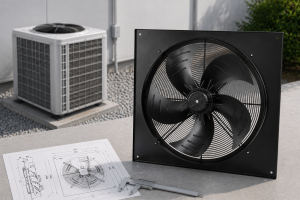
The image shows the physical construction of the cross-flow fan assembly, including the aluminum impeller and cold-rolled steel frame.
Specification Sheet (PDF)
For design engineers, this PDF specification sheet contains all key performance data, mechanical drawings, and wiring diagrams for the 48V cross-flow fan series.Technical Data & Features (PDF)
Procurement managers and compliance officers can use this document to verify certifications (CE, ETL), material specifications, and technical features like locked-rotor protection.Customer Approval Form (PDF)
Here the document is the final output of the engineering review, formally presenting the approved specifications for customer sign-off before archiving.
Setting a fan speed ceiling across a family
On a request like this, four things mattered.
- Three approved files in three days. This was a documentation request, not a 90-day NPI project, and it was treated accordingly. Final technical files for all three models went out three days after the enquiry.
- No tooling charge at all. Using an existing, proven DC cross-flow fan platform meant zero NRE. Combined with our manufacturing base, the price lands materially below imported European brands for a technically equivalent smart fan.
- Certification carried over. The base models already hold CE and ETL. Moving to a 48V brushless motor counts as a minor change, so no full recertification followed. That saved the customer months of lab time and a substantial testing bill.
- One fan speed ceiling across three sizes. All three share the same SmartEC motor family, bearings and materials. That simplifies procurement, inventory and incoming inspection, and it keeps batch-to-batch behavior consistent across the range.
Browse our cross-flow fan range, the DC cross-flow fan series, or the air curtain section. Test methods are set out in ISO 5801.
Questions about 48V operation
How do you set a fan speed ceiling across different lengths?
By the longest rotor, not the shortest. A longer impeller has lower bending stiffness, so its resonance sits at a lower frequency. The fan speed ceiling for the family is whatever keeps the biggest size clear of that, even where the smaller ones could safely run faster.
What L10 life applies at higher temperatures?
Meanwhile the documented figure is 40,000 hours at 25C ambient. At the 60C maximum, bearing life derates considerably, and as a rule of thumb it roughly halves for every 10 to 15C increase. Send us your duty cycle and we will calculate the actual number rather than the rule of thumb.
Can I control speed with a potentiometer?
Not directly, no. The SmartEC controller expects a 0-10V analogue signal or a PWM signal on the dedicated yellow wire in the harness. A plain variable resistor in the supply will not do it, and attempting it usually produces a fan that runs hot rather than slow.
What is the lead time on 500 units?
A standard make-to-order run of 500 units takes 15 to 25 days from purchase order confirmation to ex-works shipment. This project produced the specification documents that precede such an order. Under a frame agreement we can also hold buffer stock for faster delivery.
Why is 48V becoming common in HVAC equipment?
Because it sits below the level where most electrical safety rules turn onerous, while still carrying useful power without heavy cable. Modern buildings increasingly distribute at 48V. Consequently a DC cross-flow fan that accepts it directly removes a conversion stage from the product.
Technical Documentation & Resources
- Download the LWCD-651100MN-06-48V specification sheet (PDF)
- Open the LWCD-651100MN-06-48V technical drawing (PDF)
- View the LWCD-651100MN-06-48V technical drawing 2 (PDF)
- Get the LWCD-651100MN-06-48V project photograph (DOCX)
- Open the LWCD-651100MN-06-48V specification sheet (DOCX)
- Open the LWCD-651100MN-06-48V technical drawing 3 (PDF)
- View the LWCD-651100MN-06-48V project photograph 2 (DOCX)
- Get the LWCD-651100MN-06-48V technical drawing 4 (PDF)
Got a duty point you need matched?
Tell us the airflow, the pressure and the space you have. Then we mark your duty point on a tested curve and send the drawing back. Meanwhile samples and custom spec sheets take up to 90 days. Since 1990 we have supplied OEMs across HVAC, refrigeration and industry.
Browse Related Products:
🏆 ISO 9001 / ISO 14001 / ISO 45001 | CE (TÜV) | UL/ETL | ATEX Zone 21/22 | AMCA 210/211 / ISO 5801 tested
Choose the right cross flow fan
Longwell manufactures 495 cross flow fans in-house. Send airflow, static pressure and voltage — an engineer replies with a matching model, performance curve and price within one working day.