A request for paperwork, not a product
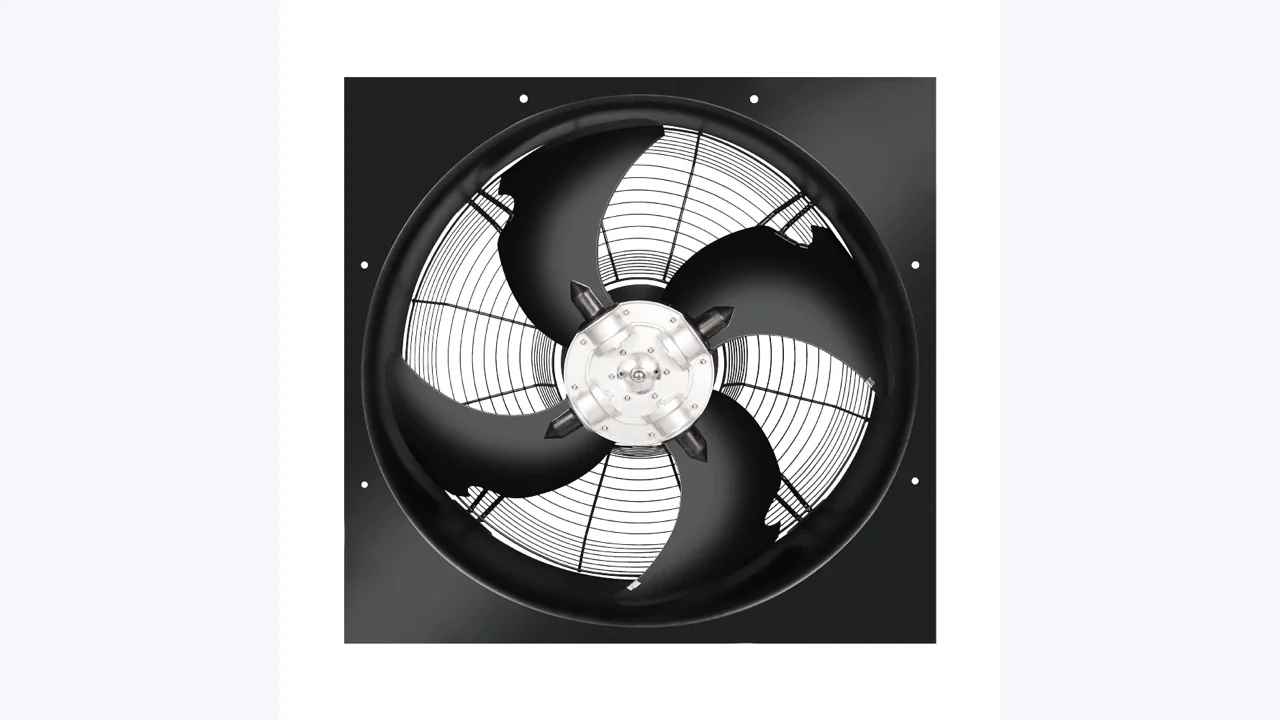
A commercial HVAC OEM already using our 350mm EC axial fan asked for a fan spec sheet. Not a new design, not a quotation. A document.
They needed it for the blowing version of a fan they had been buying in the sucking configuration. Same platform, air pushed over the motor instead of drawn toward it.
Why the fan spec sheet mattered now
In short, they were designing a new air-cooled condenser and had to close out the paperwork for it.
CE marking was mandatory for their European market, and their file had to reference documentation consistent with EN 60335-1. A variant nobody had issued a fan spec sheet for is a hole in that file.
The fixed points around it
- First, 230 VAC with a usable window of 176 to 264 V.
- Next, a 0-10 VDC control input, because the unit talks to a building management system.
- Meanwhile a 435 by 435mm mounting pattern, no deeper than 127mm.
- Finally, 65 dB(A) maximum, and an ambient range of -25C to +60C.
None of those were negotiable, and none of them were new. That is exactly what made the request awkward: everything was known except the document.
Verifying a fan spec sheet before issuing it
A fan spec sheet is a statement, so issuing one for a configuration that had never been formally characterised meant verifying it first rather than copying the sucking-version sheet and changing a word.
Blowing is not the sucking curve relabelled
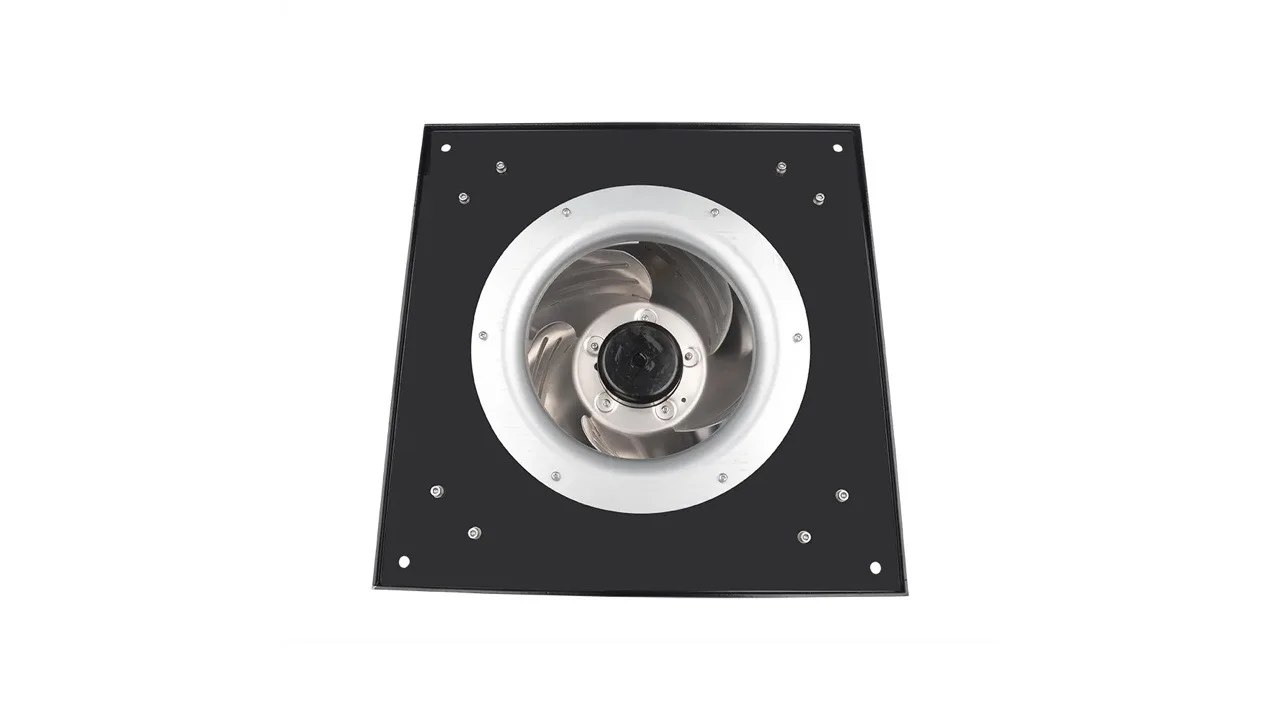
In the blowing orientation, air passes over the motor before it reaches the coil. Consequently the motor cooling changes, the velocity profile leaving the fan changes, and the pressure the fan can develop is not identical.
For a condenser, blowing is usually the better choice, because it produces a more even high-velocity plenum across the coil face. Sucking can leave uneven low-pressure zones on the intake side.
But better does not mean the same. So the P-Q curve had to be confirmed in the orientation the customer was actually going to use.
What the verification showed
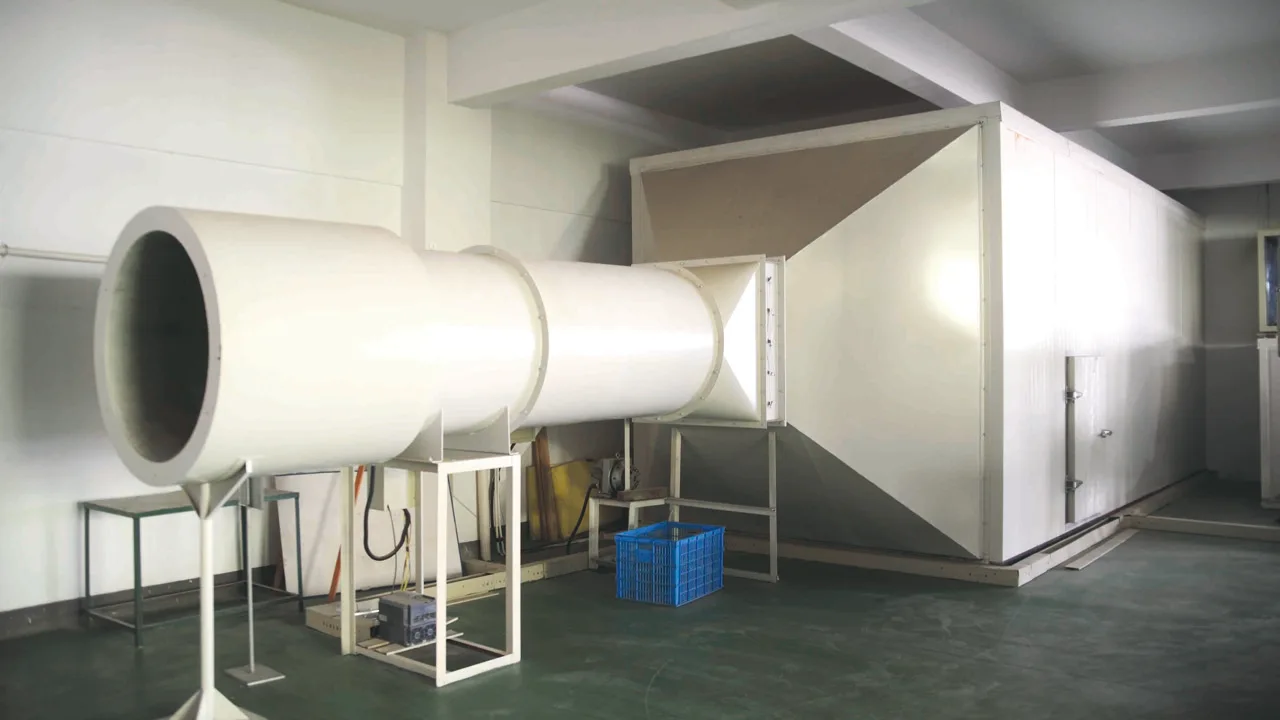
Consequently the five-blade PA66 impeller was measured in that orientation. It held 3,451 m3/h and developed up to 128 Pa in the blowing configuration. That covered the coil impedance plus the protective grilles, with margin.
Had it not covered it, the honest outcome would have been a different fan rather than a generous sheet.
Why EC was never in question
Meanwhile the 0-10 VDC requirement settled the motor choice on its own. An integrated EC controller accepts that signal directly.
An AC motor would need an external drive to do the same job, which adds a component, a cabinet position and another thing to commission. Here the customer already had the control signal and nowhere convenient to put a drive.
What the request actually cost us
Time, and no revenue. After all, verifying and issuing a fan spec sheet for an existing variant bills nothing.
It was still the right call, because an OEM blocked on documentation is blocked whether or not the fan is fine.
Technical Specifications
Every number below existed before the request. What did not exist was a sheet with all of them on it, signed off for this configuration.
| Parameter | Value |
|---|---|
| Model Number | LWAE3G350ST-5PGW-06 |
| Nominal Voltage | 230 VAC |
| Voltage Range | 176-264 VAC |
| Frequency | 50/60 Hz |
| Speed | 1800 RPM |
| Current | 1.2 A |
| Power Input | 175 W |
| Airflow (Max) | 3451 m³/h / 2054 CFM |
| Static Pressure (Max) | 128 Pa |
| Noise Level | 65 dB(A) |
| Ambient Temperature | -25°C to +60°C |
| Protection Type | IP54 |
| Insulation Class | Class B |
| Life Expectancy (L10) | 40,000 Hours (at 40°C) |
| Weight | Approx. 2.5 kg |
| Certifications | CE, RoHS, Reach |
Technical Documentation

The product drawing shows key mechanical dimensions, including the 435mm mounting pattern and 126.6mm depth, for precise integration into the condenser unit chassis.
View Specification Sheet (PDF)
The final, approved specification sheet for the LWAE3G350ST-5PGW-06 is essential for system integrators, compliance engineers, and procurement teams for final validation.
Get Specification Sheet (DOCX)
The editable source file of the specification sheet allows OEM partners to easily integrate product data into their internal technical documentation and bill of materials (BOM) systems.
If you are the one waiting on a document
A missing fan spec sheet is a common gap, and it usually surfaces late. These checks find them earlier.
- Ask which configuration the sheet covers. A fan spec sheet for the sucking version does not automatically describe the blowing version of the same model. Check that the orientation on the document matches the one in your assembly.
- Request the curve, not just the duty point. A single airflow figure tells you nothing about behavior as your coil fouls or your filter loads. The P-Q curve shows where you sit and how much margin you have left.
- Confirm the document names the exact part number. Suffixes carry real differences: orientation, lead length, connector, guard. A sheet for the base model is not evidence for the variant you ordered.
- Raise documentation needs at design freeze, not at certification. Test houses ask for supplier documentation at the worst possible moment. Listing what you will need while the design is still open costs an email; finding out later costs weeks.
See our axial fans range, the EC axial fans section, or condenser fans. Safety requirements for this class are published by the IEC as IEC 60335-1.
Questions about variant documentation
Does reversing a fan just reverse the airflow?
No. Running an axial fan backwards moves far less air, because the blade profile is designed for one direction. A blowing variant is a different build with the impeller and hub arranged for that orientation, not the same fan wired in reverse.
Why does orientation change motor temperature?
Because in the blowing configuration the air reaches the motor before it has picked up heat from the coil, while in the sucking configuration it arrives warmed. On an outdoor condenser in summer, that difference is worth checking against the motor ambient rating.
Can I use a spec sheet for the base model in my certification file?
Only if the part number on it matches what you are fitting. Test houses check that, and a mismatch between the sheet and the bill of materials is a common reason files come back. Ask your supplier to issue documentation against the exact variant.
What if the variant turns out not to meet the numbers?
Then the specification changes, which is uncomfortable but far cheaper before certification than after. That is the argument for verifying a configuration rather than assuming it inherits the base model performance.
Technical Documentation & Resources
Have a fan requirement like this one?
Send the datasheet you are working against, or simply the duty point. Then our engineers tell you what fits and what does not. Meanwhile custom spec sheets and samples take up to 90 days. Since 1990 we have been building fans for OEMs worldwide.
Browse Related Products:
🏆 ISO 9001 / ISO 14001 / ISO 45001 | CE (TÜV) | UL/ETL | ATEX Zone 21/22 | AMCA 210/211 / ISO 5801 tested