What the fan coil OEM specified
An OEM was developing a range of high-end, low-profile fan coil units. Each one needed a quiet DC cross-flow fan sitting inside it. The brief asked for two performance points rather than one. Usually that means the customer wants room to choose.
The target was 87 m3/h against 23 Pa. Above all, it had to arrive as a wide, even sheet of air rather than a jet.
Here the constraints were tight in every direction.
- A 12 VDC rail that can wander between 8 and 16 VDC, so battery or shared-supply systems are in play.
- Noise no higher than 35 dB(A) at one meter.
- Total length under 355mm, with a slim cross-section for trench heaters and thin radiators.
- PWM speed control, so the DC cross-flow fan takes orders from a smart thermostat or a BMS.
- CE and ETL already in place, since the launch could not wait for component certification.
That acoustic figure tells you where these units go. Namely modern offices, hotel rooms and expensive houses, where anything audible becomes a complaint.
Choosing the DC cross-flow fan
The airflow shape decided the fan type before anything else. A wide, slow, uniform sheet of air is what a cross-flow impeller does. Equally, it is what nothing else does well.
Why not axial or centrifugal
We looked at both and set both aside. An axial fan throws a fast, turbulent column, which is wrong for a long, thin outlet. A centrifugal blower, meanwhile, would be oversized and would make far more pressure than a trench heater ever needs. Neither would have hit 35 dB(A) in any case.
Two models, one real decision
Our LWCD series of DC cross-flow fans already covered the requirement. Consequently we proposed two variants and let the customer pick. The whole difference is the impeller diameter.
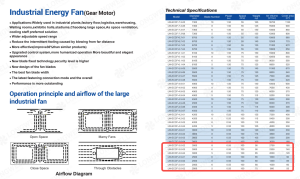
- LWCD-30290LN-06, with a 30mm impeller. It meets the baseline airflow at just 33 dB(A) against 15 Pa. This is the choice for a low-resistance unit.
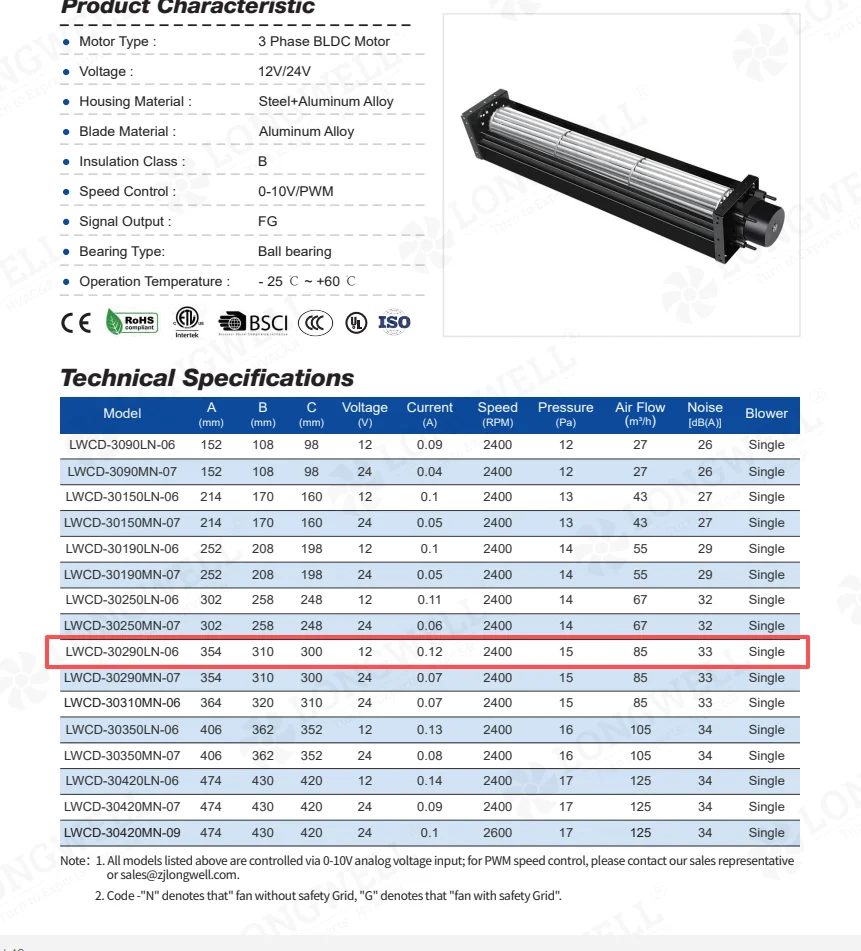
- LWCD-40290LN-06, with a 40mm impeller. It makes 23 Pa, enough for a denser heat exchanger or a filter, and the noise only rises to 35 dB(A).
Two decibels is, on balance, a small price for eight extra pascals. Even so, it is the customer’s call, because only they know how restrictive their heat exchanger is.
The motor and its driver
Both fans use a three-phase brushless DC motor on long-life ball bearings. That combination delivers the 40,000-hour L10 service life this application needs.
Meanwhile the driver board matters just as much. It carries our SmartEC control, so the PWM input and the FG tachometer output are already there for BMS integration. As a result no external controller is needed. That removes a component, a wiring harness and a failure point from the finished unit.
Technical Specifications
The two models below differ in one dimension only, the impeller diameter. Everything that follows from that difference is visible in the pressure and noise rows.
| Parameter | LWCD-30290LN-06 | LWCD-40290LN-06 |
|---|---|---|
| Airflow (Max) | 85 m³/h / 50 CFM | 87 m³/h / 51 CFM |
| Static Pressure (Max) | 15 Pa | 23 Pa |
| Nominal Voltage | 12 VDC | 12 VDC |
| Voltage Range | 8 – 16 VDC | 8 – 16 VDC |
| Speed | 2400 RPM | 2400 RPM |
| Current (Nominal) | 0.14 A | 0.2 A |
| Noise Level | 33 dB(A) | 35 dB(A) |
| Operating Temperature | -20°C to +50°C | -20°C to +50°C |
| Impeller Diameter | 30 mm | 40 mm |
| Impeller Length | 290 mm | 290 mm |
| Overall Dimensions | 354 x 50 x 50 mm | 352 x 60 x 60 mm |
| Bearing Type | Ball Bearing | Ball Bearing |
| Life Expectancy (L10) | 40,000 hours | 40,000 hours |
| Certifications | CE, ETL | CE, ETL |
| Control Signal | PWM | PWM |
Technical Documentation
Download LWCD-40290LN-06-00 Specification Sheet
The document provides the full technical specifications, performance data, and mechanical drawings for the 40mm impeller diameter model.
Download LWCD-30290LN-06-00 Specification Sheet
Here the document contains the complete engineering data for the 30mm impeller diameter variant, intended for the lowest-noise applications.
This product image shows the complete assembly of the LWCD series fan, including the motor housing, cold-rolled steel frame, and aluminum impeller.
Above, the mechanical drawing provides the critical mounting dimensions and overall envelope required by system integrators and design engineers.
Why the OEM specified our parts
This was a specification request rather than a development project. In the end, four things made it easy to say yes to us.
- An answer the same week. The customer wanted standard product documentation. We sent approved files straight from the library, rather than opening the 12 to 18 month NPI cycle a European supplier often quotes even for small changes.
- A mature part, with volume behind it. Choosing a standard DC cross-flow fan means the tooling is long since paid for and the line runs it regularly. That is where the cost advantage of a catalog part over a custom one actually comes from.
- CE and ETL already held. The LWCD series carried both. Therefore the customer launch date never depended on a component-level certification queue.
- Data measured, not modeled. Airflow, pressure and acoustics are verified in our own lab, which works to AMCA 210/211 and ISO 5801 methods.
Browse the full cross-flow fan range, or the DC cross-flow fan series specifically. ETL marks can be verified in the Intertek directory.
Questions this specification raised
What really separates the 30mm and 40mm models?
Only the impeller diameter, plus everything that follows from it. The 40mm wheel makes 23 Pa instead of 15 Pa, so it copes with filters and tighter grilles. In exchange, the noise rises from 33 to 35 dB(A). Otherwise both share the same 290mm impeller length and the same 12VDC PWM motor.
Can this go into a residential heating appliance sold in the USA?
Yes. This DC cross-flow fan holds an ETL mark, issued by a nationally recognized testing laboratory and accepted in both the US and Canada. It confirms compliance with safety standards including UL 507. Furthermore, at 33 to 35 dB(A) it is quiet enough for a living room.
How is the speed controlled?
Through a PWM signal on a dedicated wire in the harness, which gives properly variable speed rather than fixed steps. Because the input is standard PWM and the supply window runs from 8 to 16 VDC, it integrates with most BMS and home automation controllers that can output a logic-level PWM signal.
Why is a cross-flow fan quieter than an axial fan here?
It moves the same air far more slowly over a much wider outlet. Noise rises steeply with air velocity, so spreading the flow across 290mm rather than forcing it through a small round hole is the single biggest reason a DC cross-flow fan can hold 35 dB(A).
Technical Documentation & Resources
Sizing something comparable?
Share the airflow, pressure, voltage and control interface, and we come back with a tested curve and a drawing. Meanwhile custom work runs to 90 days for spec sheets and samples. Since 1990 Longwell has supplied fans to HVAC and industrial OEMs.
Browse Related Products:
🏆 ISO 9001 / ISO 14001 / ISO 45001 | CE (TÜV) | UL/ETL | ATEX Zone 21/22 | AMCA 210/211 / ISO 5801 tested
Choose the right dc cross flow fan
Longwell manufactures 50 dc cross flow fans in-house. Send airflow, static pressure and voltage — an engineer replies with a matching model, performance curve and price within one working day.