What the OEM was replacing
Initially an OEM wanted to modernise the cooling in an industrial product line, at roughly 1,500 units a year. In the end a universal voltage fan is what they got.
Usefully they sent the datasheet for the fan being replaced. Consequently this was a form, fit and function job with a fixed baseline.
What was fixed
- First, a 172 by 152 by 51 mm frame, a common enclosure cooling size.
- Next, IP55, which points at factory floors, control cabinets or outdoor telecom housings.
- Meanwhile the incumbent ran at 4000 RPM delivering roughly 289 CFM.
- Finally, a wide-ranging AC input, since the equipment sells into several markets.
Notably one detail in their attachment gave away the real intent. The file was named for an EC fan, even though the datasheet enclosed was for an AC one. They wanted to move off legacy AC motor technology, not simply find another AC fan.
Why a universal voltage fan changed the maths
Certainly a like-for-like AC replacement was the obvious move. Even so, we rejected it.
It would have matched the datasheet and missed the point. Their objective was modernisation, whereas an AC fan delivers none of the efficiency, life or control benefits behind that.
Matching the baseline
The chosen EC model fits the same 172 by 152 by 51 mm frame, delivering 305 CFM against the incumbent 289. Meanwhile it runs at the same 4000 RPM on 31W.
Here the frame is die-cast aluminum with a UL94V-0 PBT impeller. Furthermore dual ball bearings support a 70,000-hour L10 life, which is where the reliability argument lives.
The benefit they had not asked for
Notably this universal voltage fan accepts 100 to 240 VAC.
Previously they used a dual-voltage AC fan. So two variants had to be specified, stocked, picked and shipped depending on destination market.
A universal voltage fan collapses that to one part number. Consequently the saving is not in the fan price at all. It is in carrying one SKU instead of two across purchasing, inventory, documentation and service parts.
Notably that benefit rarely appears in a quotation comparison. On 1,500 units a year across several markets it is worth more than the unit price difference.
What it cost
Purchase price. An EC motor with integrated electronics costs more than the shaded-pole or PSC motor it replaces.
However, it is repaid through part-load energy, longer bearing life and the SKU consolidation. On a line running continuously that arithmetic is comfortable. By contrast, on equipment used occasionally it is much closer, and worth calculating rather than assuming.
Technical Specifications
Note the operating voltage row below. That range is what removes a second part number.
| Parameter | Value |
|---|---|
| Model Number | LWAE17251SH-03-11 |
| Dimensions | 172 x 152 x 51 mm |
| Rated Voltage | 220 VAC |
| Operating Voltage | 100.0-240.0 VAC |
| Input Power | 31 W |
| Input Current | 0.3 A |
| Speed | 4000 RPM (±10%) |
| Maximum Air Flow | 305.29 CFM / 518.7 m³/h |
| Maximum Air Pressure | 28.92 mm H₂O / 283.6 Pa |
| Acoustical Noise | 67 dBA |
| Protection Type | IP55 |
| Insulation Type | UL:CLASS A |
| Bearing Type | Two Ball Bearings |
| Life Expectancy | 70,000 Hours (at 25°C, 15~65%RH) |
| Operating Temperature | -10°C to +60°C |
| Weight | 740 g |
| Frame Material | Aluminum PLASTIC UL:94V-0 |
| Impeller Material | PBT Plastic UL:94V-0 |
Technical Documentation
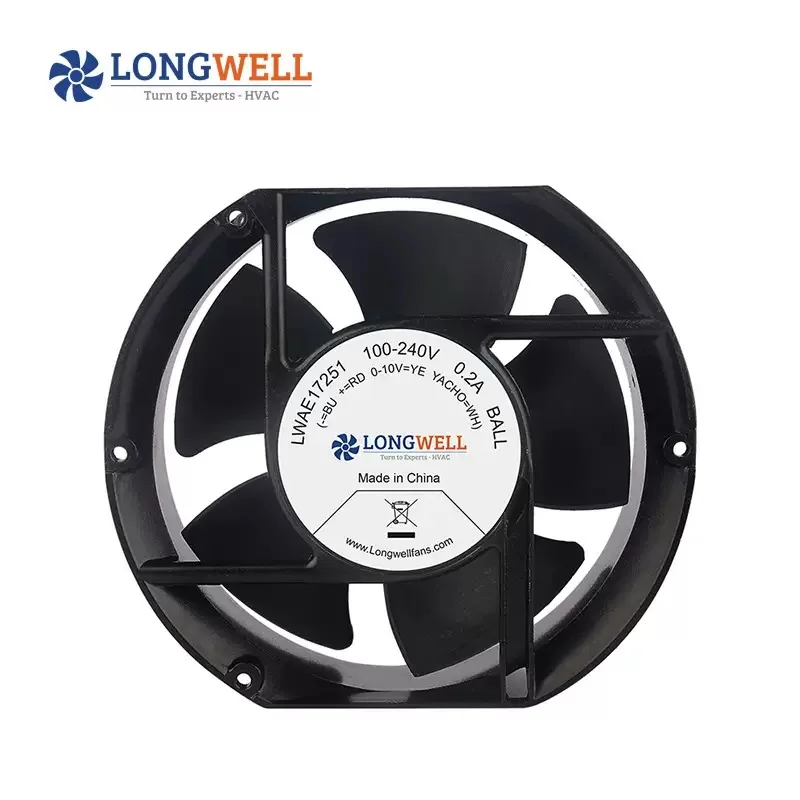
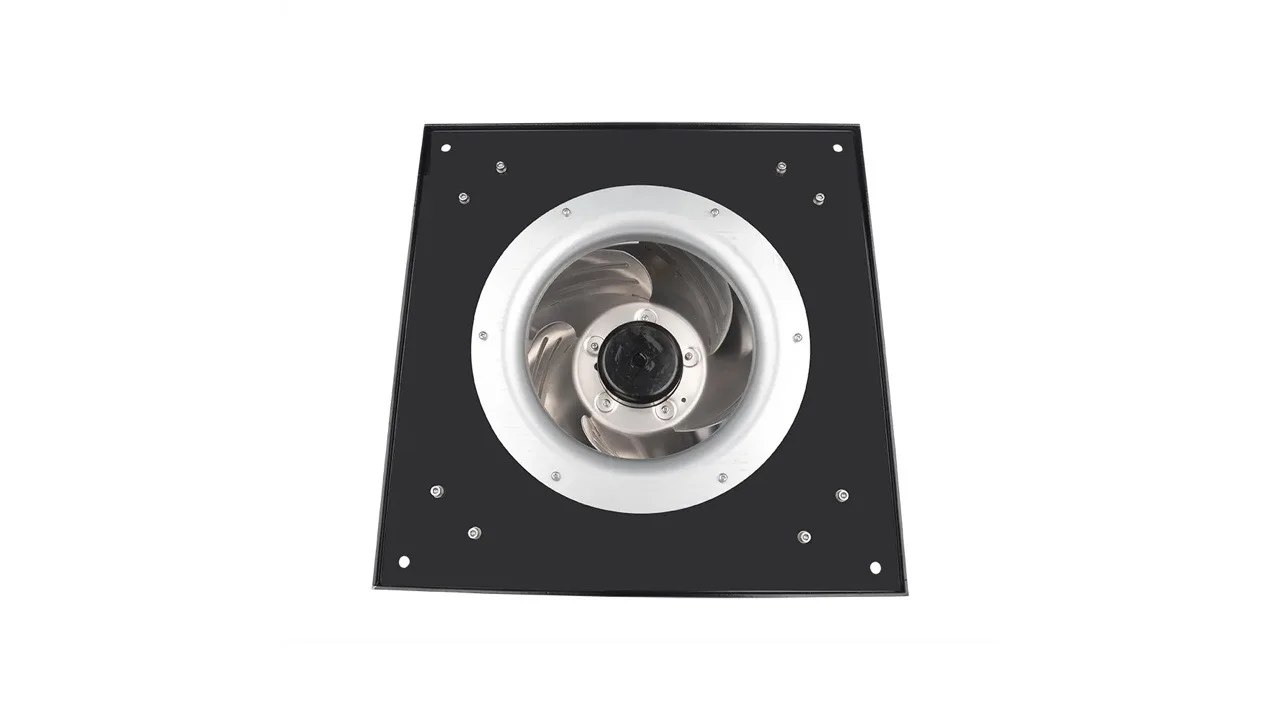
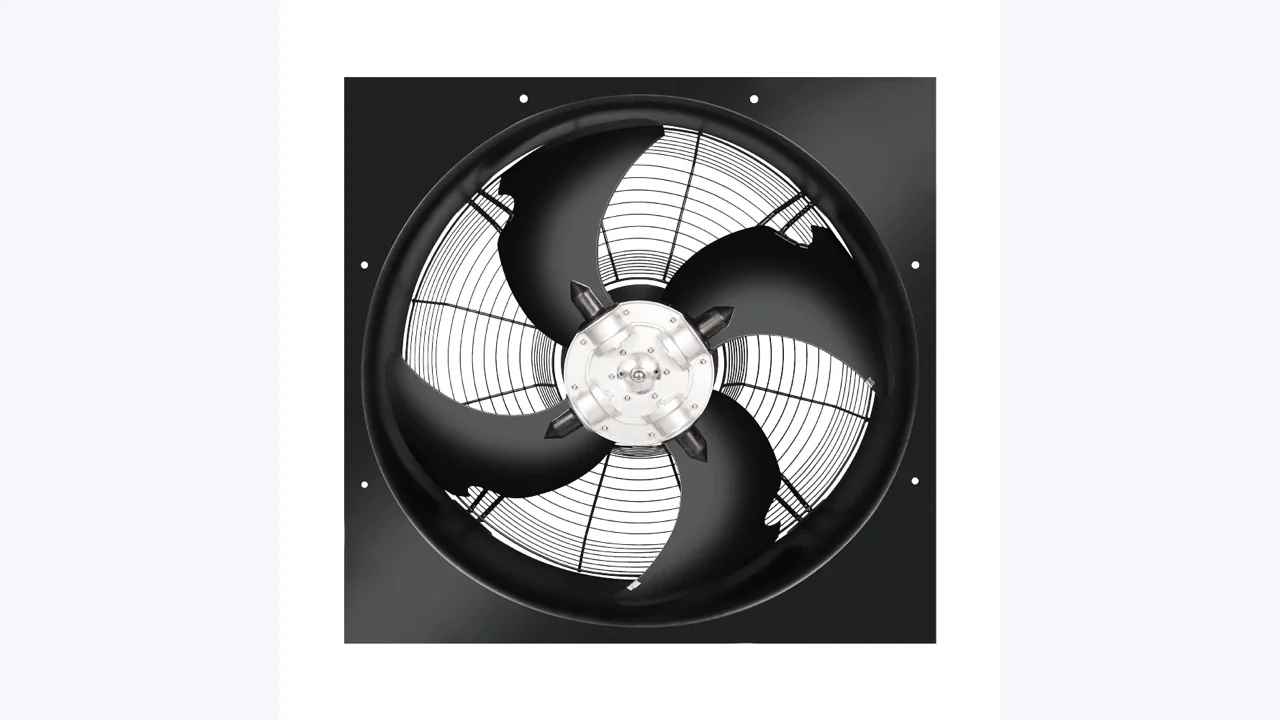
The product image shows the final LWAE17251SH-03-11 fan, which an OEM procurement manager would use for visual verification.
LWAE17251SH-03-11 Specification Sheet (PDF)
Here the final, approved specification sheet contains all electrical and mechanical performance data an HVAC engineer needs for system integration.
Customer Requirement Document (Reference)
This reference document shows the original competitor fan data used to define the project scope, useful for quality engineers comparing the old and new solutions.
If you sell into several markets
A universal voltage fan is an underrated specification when a product sells into more than one market.
- Count your SKUs, not just your fan price. A universal voltage fan removes a variant from purchasing, stores, documentation and spares. That cost is spread across departments, which is exactly why it gets left out of a price comparison.
- Say which markets the product ships to. A supplier who knows you sell into both 115V and 230V regions can propose a single part. One who only sees a 230V requirement will quote a 230V fan.
- Check the IP rating covers where the fan sits. IP55 resists dust and low-pressure jets, which suits a factory floor or an outdoor housing. Inside a clean sealed cabinet it is more than needed, and it costs more.
- Send the incumbent datasheet when replacing. It fixes the baseline precisely: frame size, speed, airflow and mounting. A replacement judged against a real datasheet is far more likely to drop in without surprises.
See our axial fan range, the EC axial fan section, or compact cooling fans. Ingress ratings follow IEC 60529.
Questions about this replacement
What does a universal voltage input actually save?
A part number. Instead of stocking a 115V and a 230V variant, purchasing orders one, stores holds one, and service ships one. On a product sold into several regions that removes duplicated effort across departments, which usually exceeds the price difference on the fan itself.
Does the fan perform the same at 115V and 230V?
Yes, within its rated range. The EC controller regulates to the commanded speed rather than following the supply, so airflow is the same at either end. That is the difference from an AC motor, whose speed depends directly on supply frequency and voltage.
Is 70,000 hours realistic?
It is an L10 rating at 25C and controlled humidity, meaning 90% of a large batch are expected to still run at that point. Real life depends on your ambient temperature and duty cycle. Treat it as a comparison basis against the fan you are replacing rather than as a promise.
When would an AC replacement have been the right answer?
Where the equipment runs briefly and rarely, where there is no interest in speed control, and where purchase price dominates. In that case the EC premium is not repaid. This customer ran continuously and wanted modernisation, which reverses the calculation.
Technical Documentation & Resources
Need the same thing for your own unit?
Give us the numbers and the envelope, and you get a shortlist rather than a catalog. Meanwhile custom spec sheets and samples run to 90 days. Since 1990 Longwell has supplied EC fans and blowers to OEMs in HVAC, cold chain, data center and industrial markets.
Browse Related Products:
🏆 ISO 9001 / ISO 14001 / ISO 45001 | CE (TÜV) | UL/ETL | ATEX Zone 21/22 | AMCA 210/211 / ISO 5801 tested