What the HVAC OEM asked for
An HVAC OEM sent a short request for quotation. They wanted a 158 by 38 axial impeller with a 6mm bore, plus drawings and pricing, for 5,000 units a year.
Short briefs tell you plenty. This one describes a supply agreement for an established line, probably compact fan coil units or condensers. There, the OEM pairs our axial impeller with its own motor and housing.
Two constraints carried real weight.
- A 6mm bore, since the motor and its shaft were already chosen.
- A unit cost that still works at 5,000 pieces a year.
- Low vibration, though nobody wrote it down.
That last point deserves saying out loud. The impeller is the main spinning mass in the product. Consequently its balance largely sets the noise the end user hears. A poorly balanced axial impeller will miss the OEM noise target, however good the motor is.
Getting a 6mm bore into a standard axial impeller
Our catalog already held a close match. Specifically, the LWA-φ158×37-07 measures 158.70mm across and 37.00mm tall, which lines up with the requested 158 by 38.
One thing did not line up. Our standard drawing calls for a 15.00mm bore with a keyway. However, the customer needs 6mm.
Two ways to solve a bore mismatch
The first option is a new mold with the 6mm bore built in. It gives the lowest cost per piece. Even so, it carries a heavy NRE charge plus 90 to 120 days of tooling lead time.
Here the second option uses a machined hub insert inside the existing part. Therefore no tooling cost, and it arrives almost at once.
At 5,000 units a year the sums favor the insert clearly. A new mold only pays for itself at much higher volume. Besides, the customer needed samples on a production schedule, not in four months.
How the insert works
So we designed a CNC-machined aluminum hub insert to press-fit into the standard 15mm bore. It carries its own 6mm bore, plus a set screw to lock onto the motor shaft.
Crucially, nothing about the blade shape or the molded structure changes. The proven blade profile stays exactly as it was, so nobody has to retest the aerodynamics.
Material and balance
Meanwhile the axial impeller itself is molded in glass-fiber reinforced polypropylene, PP-GF30. It is stiff enough to keep blades steady, light enough to balance easily, and quite happy in HVAC air.
Finally we proposed the LWA-φ158×37-07 with the 6mm insert already fitted, balanced to a residual unbalance of 0.25g or better at 1100 RPM.
Technical Specifications
The bore line below is the interesting one, since it is delivered rather than molded. The balance figure is the other number worth reading closely.
| Parameter | Value |
|---|---|
| Longwell Part Number | LWA-φ158*37-07 |
| Overall Diameter | 158.70 mm |
| Overall Height | 37.00 mm |
| Bore Diameter (as delivered) | 6.00 mm (via custom hub insert) |
| Material | Glass-Fiber Reinforced Polypropylene (PP-GF30) |
| Color | Gray |
| Dynamic Balance Specification | Residual unbalance ≤ 0.25 g @ 1100 ± 50 RPM |
| Max. Radial Runout | ≤ 0.8 mm |
| Max. Axial Runout | ≤ 0.8 mm |
| Impact Resistance | No cracking from 0.6 m drop test onto concrete |
| General Tolerance Standard | GB/T 1804-92, Grade J |
Technical Documentation
Meanwhile the following documents were provided to the customer’s engineering and procurement teams to validate the solution and facilitate integration.
LWA-φ158×37-07 Engineering Drawing (PDF)
The drawing provides all critical dimensions, balancing requirements, runout tolerances, and material callouts needed by an OEM design engineer to confirm fit and function.
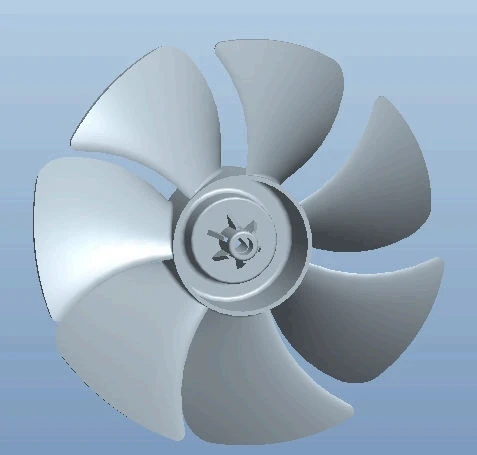
This 3D rendering shows the 7-blade axial impeller’s front profile, illustrating the blade geometry designed for efficient air movement in axial flow applications.
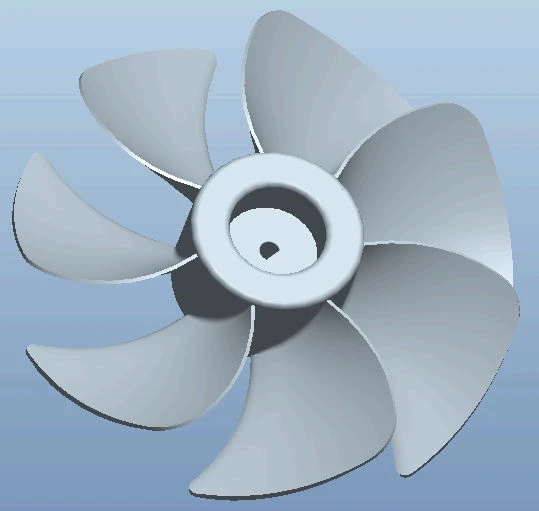
Here the rear view details the impeller’s central hub, where the custom 6 mm bore insert is fitted for mounting to the specific motor shaft used in the OEM’s product.
Why the OEM placed the volume here
Sourcing a spinning part for a 5,000-unit line is a supplier choice as much as a part choice. In the end, three things settled it.
- Engineering that adapts quickly. A hub insert is not glamorous, yet it gave the exact fit with no tooling cost and no four-month wait. Meanwhile the cheaper long-term option would have missed the customer launch entirely.
- Volume that is routine for us. Five thousand units a year sits well inside our output, which includes over 120,000 data center fan units and 30,000 cold chain units annually. Consequently a supply-driven line stoppage is not a realistic risk at this scale.
- A balance figure written on the drawing. The 0.25g commitment sits near a G2.5 balance quality grade, checked against methods traceable to AMCA 210 and ISO 5801. That is what stops the axial impeller becoming the OEM noise problem.
Browse our impeller and fan blade range, or the axial fan section for complete assemblies. Balance quality grades are defined in ISO 21940.
Questions about component supply
What material is it, and what temperature range does it cover?
It is molded in glass-fiber reinforced polypropylene, PP-GF30, a normal HVAC choice for its stiffness and durability. Furthermore the part is qualified for continuous running from -20C to +60C, which covers most commercial and residential ventilation duty.
Can we have a different bore or color at volume?
Yes. At volumes like 5,000 a year, a custom bore through a hub insert is a standard offering with a short lead time. Above roughly 20,000 units a year, cutting a new injection mold with a molded bore and a color matched to your RAL code becomes economic under our 90-day NPI process.
What lead times apply to the first order and to releases?
A first order of 300 to 500 units ships within 25 to 35 days of order confirmation, even with the hub change. Releases against a blanket order and a rolling forecast then run 15 to 25 days, which keeps your line supplied predictably.
Does the insert affect balance?
It has to be accounted for, so balancing happens after the insert is fitted rather than before. An aluminum hub adds mass close to the axis, so its effect is small. Small is not zero, though. Balancing the finished assembly is the only way the 0.25g figure means anything.
Technical Documentation & Resources
Have a fan requirement like this one?
Send the datasheet you are working against, or simply the duty point. Then our engineers tell you what fits and what does not. Meanwhile custom spec sheets and samples take up to 90 days. Since 1990 we have been building fans for OEMs worldwide.
Browse Related Products:
🏆 ISO 9001 / ISO 14001 / ISO 45001 | CE (TÜV) | UL/ETL | ATEX Zone 21/22 | AMCA 210/211 / ISO 5801 tested
Choose the right fan impeller
Longwell manufactures 10 fan impellers in-house. Send airflow, static pressure and voltage — an engineer replies with a matching model, performance curve and price within one working day.